Posts Tagged 'DMA'


Open Office: Public Relations

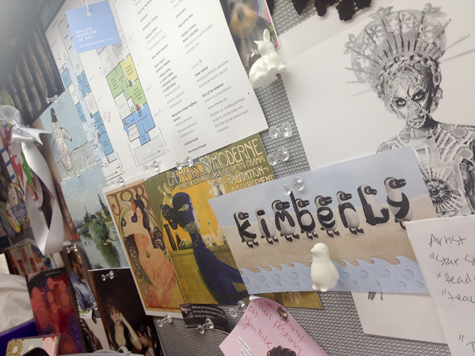
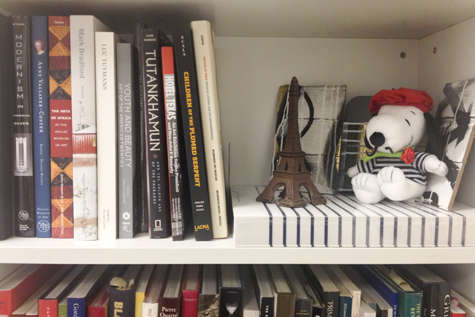
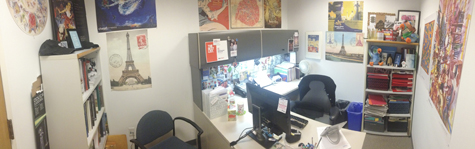
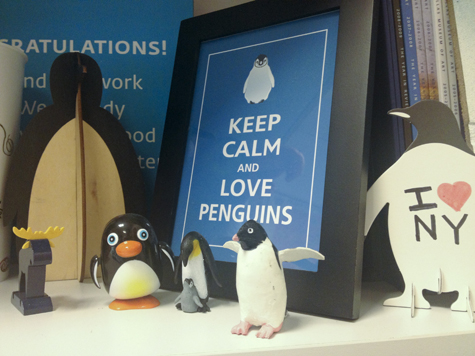
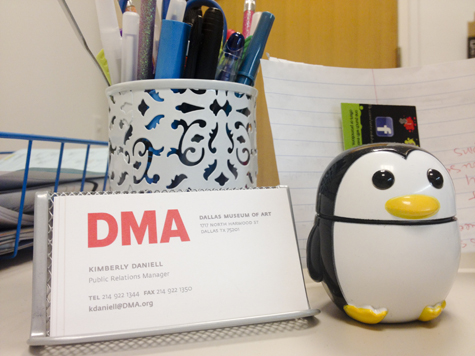
I’m the Public Relations Manager at the Dallas Museum of Art, and in my job I get to share information on all the fun and wonderful exhibitions, events, and art at the DMA with the public and press. You may have guessed from my office décor that I love penguins, Paris, and art. In the past few years, we have had three exhibitions that combine two of my favorite things, Paris and art: The Fashion World of Jean Paul Gaultier: From the Sidewalk to the Catwalk, Posters of Paris: Toulouse-Lautrec and His Contemporaries, and Chagall: Beyond Color. All we need now is an exhibition – and requisite poster – involving penguins, maybe themed around the DMA’s “Penguin” cocktail shaker (seen here).

2

1

4

5

3

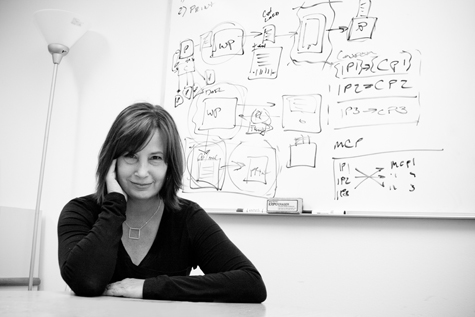
Kimberly Daniell is the Public Relations Manager at the DMA.

Creating an Available Space

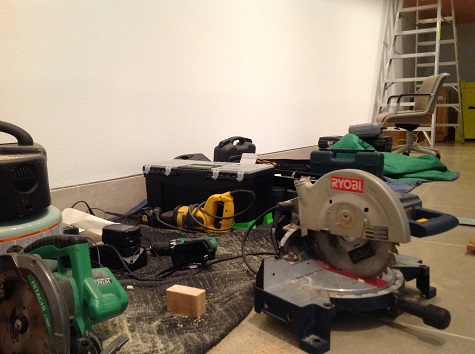
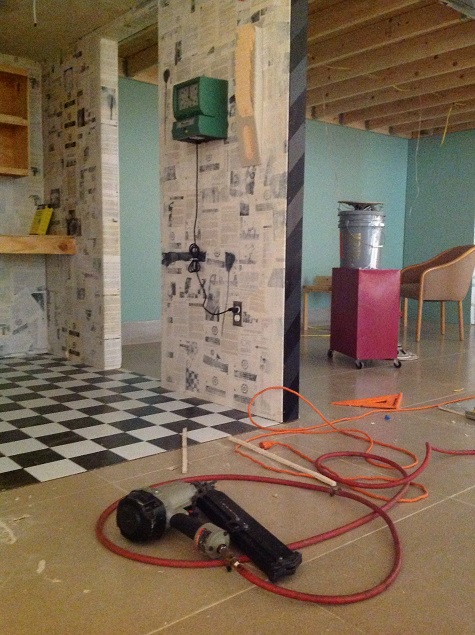
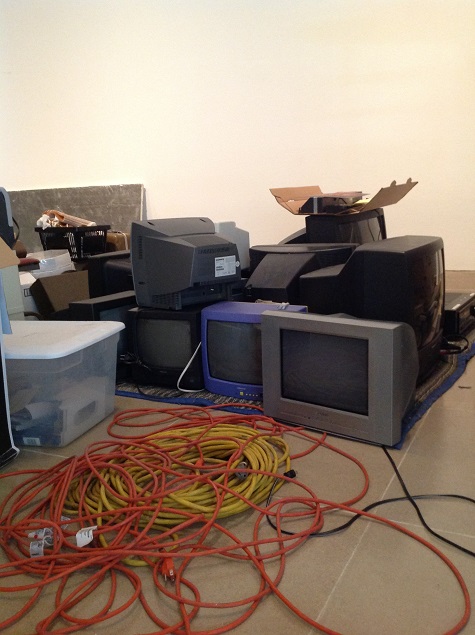
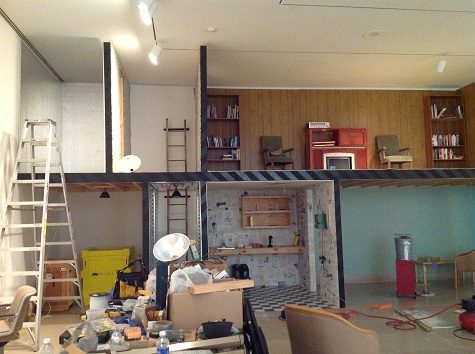
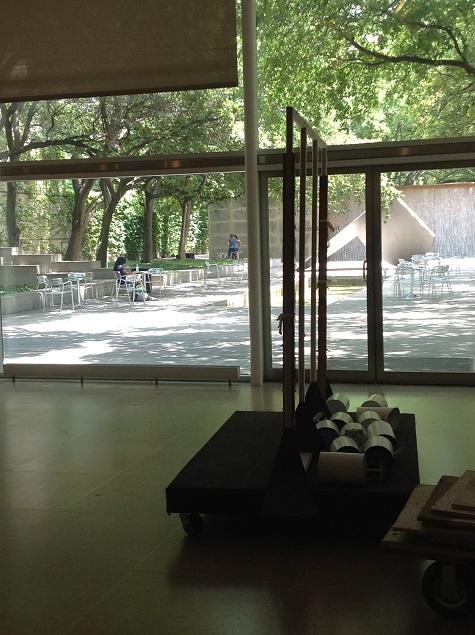
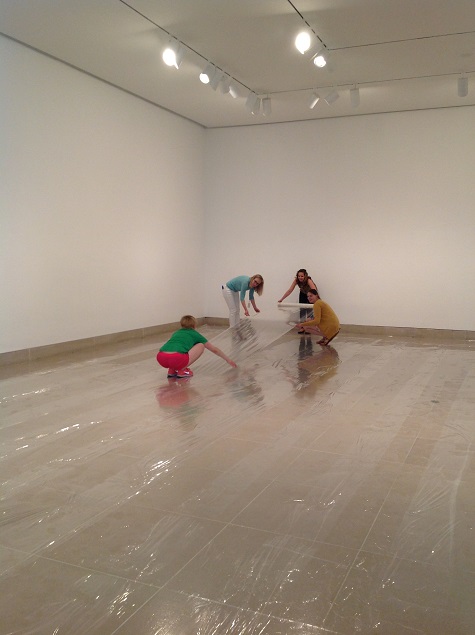
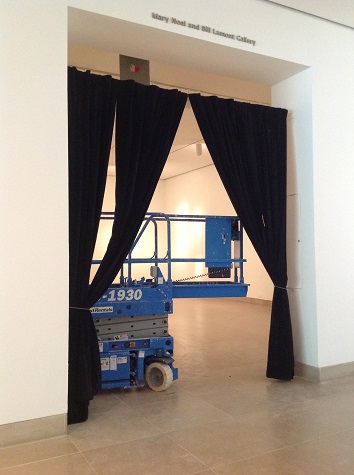
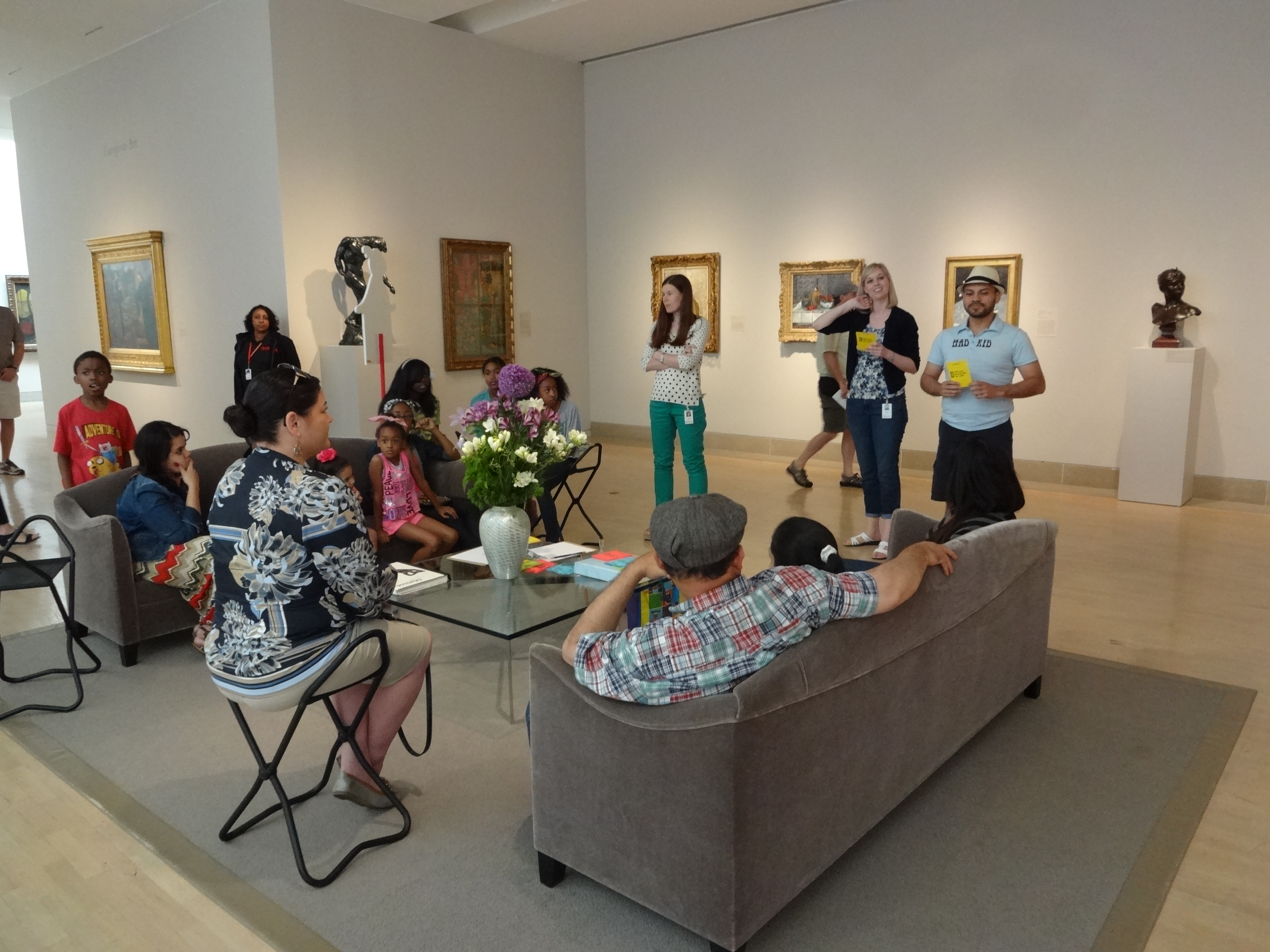
The Barrel Vault and Quadrant Galleries have a very different look. We’re preparing them for the DMA’s first experimental project space featuring Dallas-area artists, collectives, and art educators. Want to find out more about what’s to come? Join us next Friday, July 19, for a Late Night celebrating the opening of DallasSITES: Available Space and read a bit more about the creative space here.

DMA Summer Free-for-All

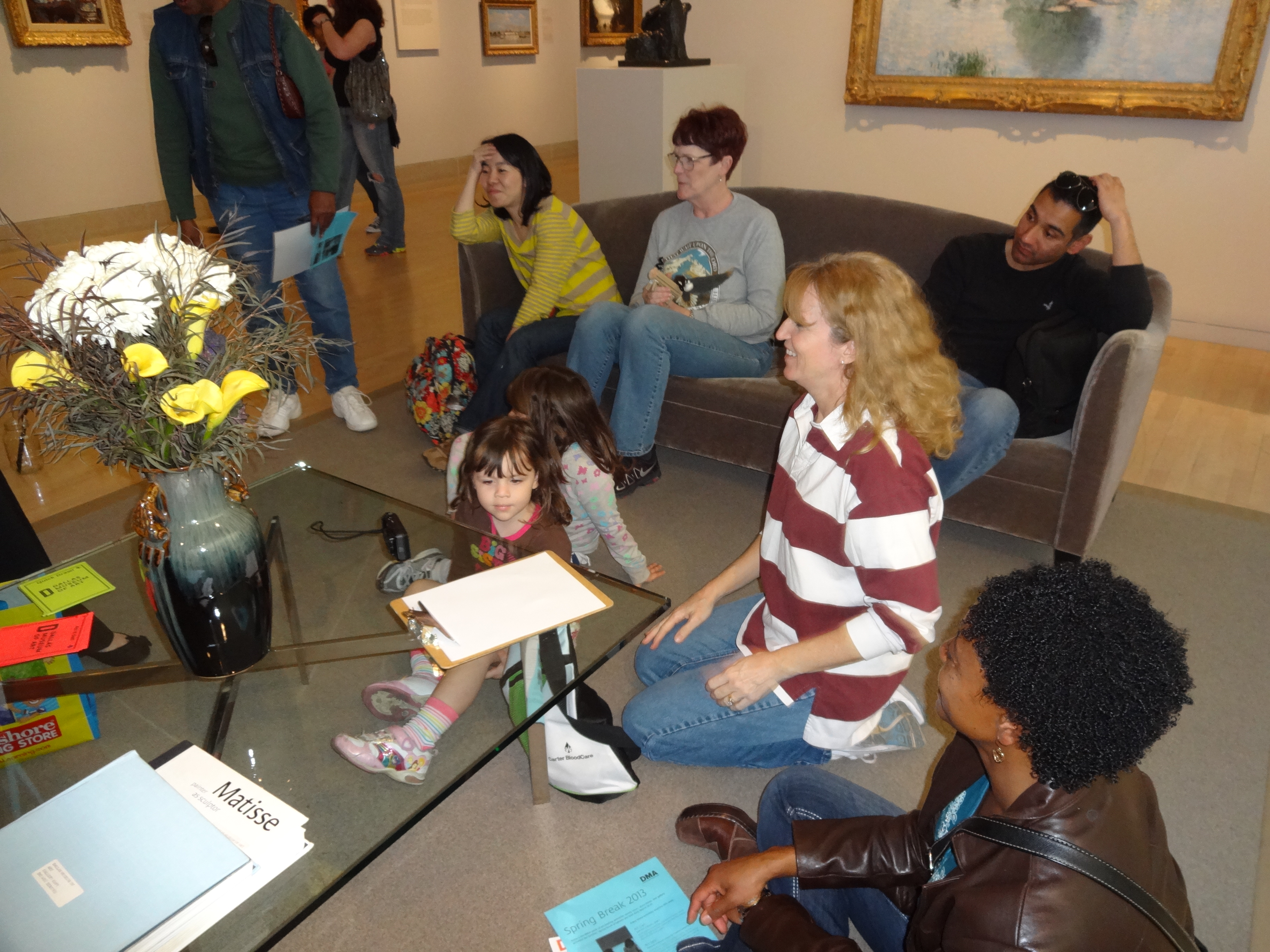
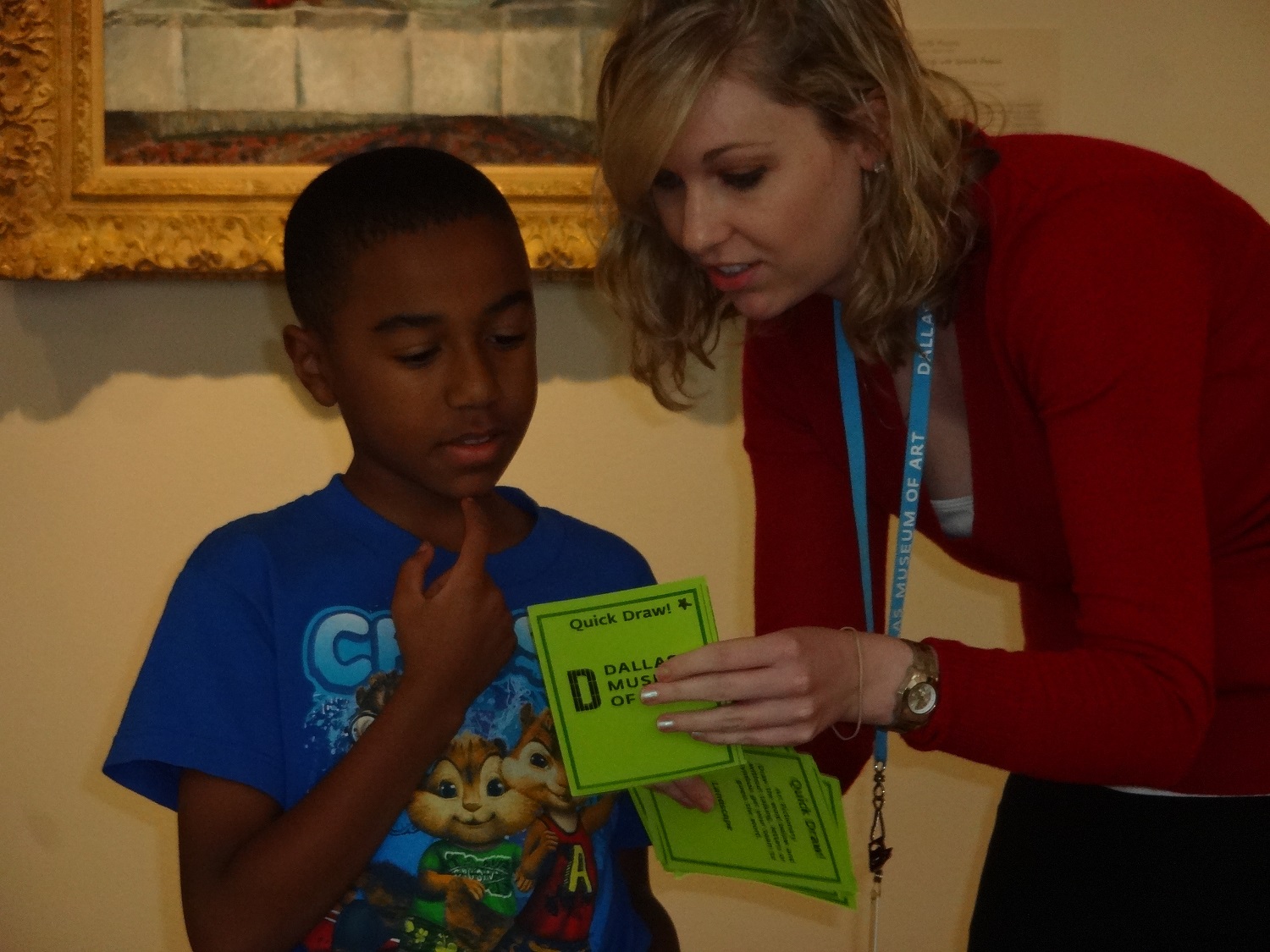
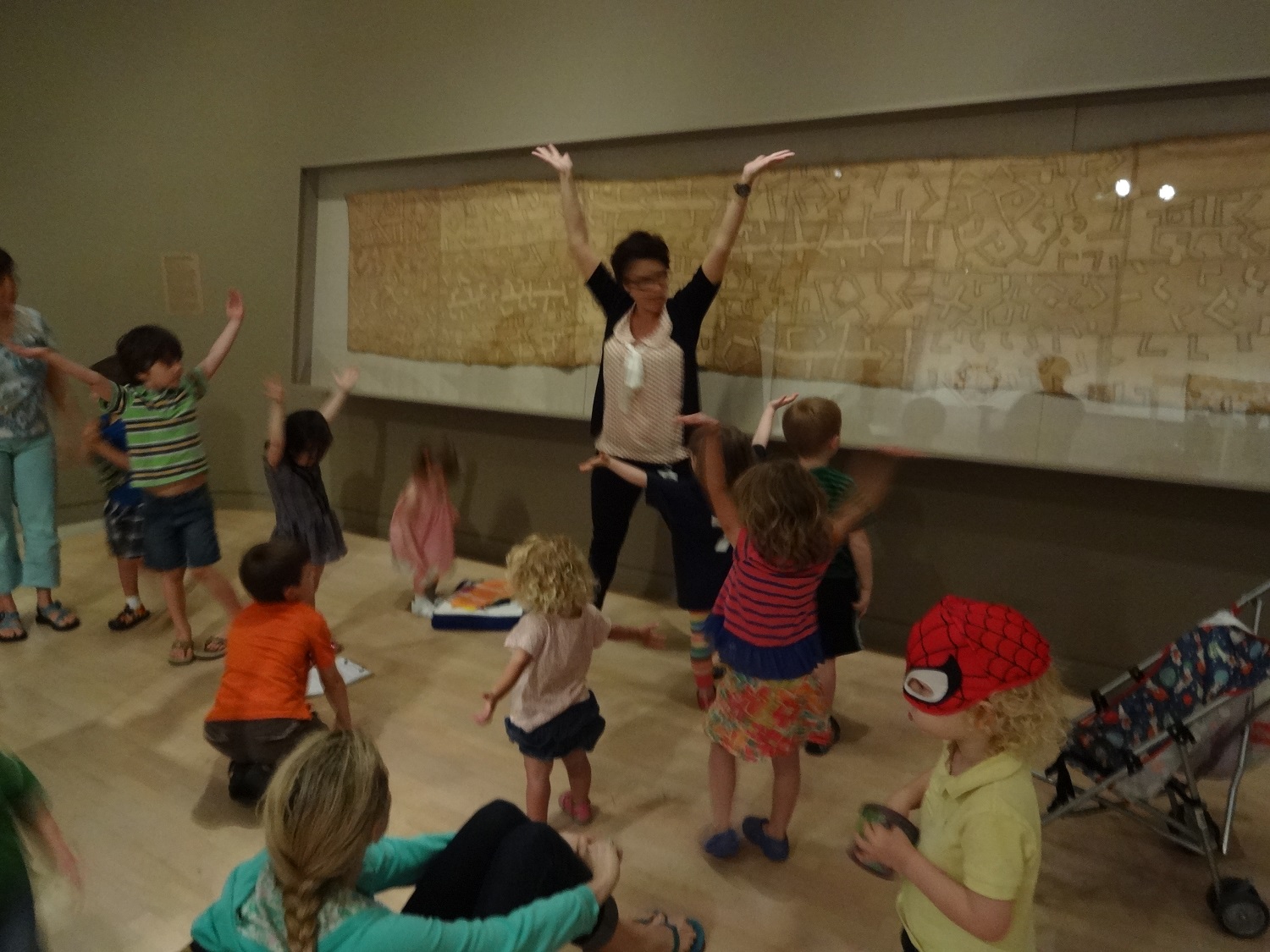
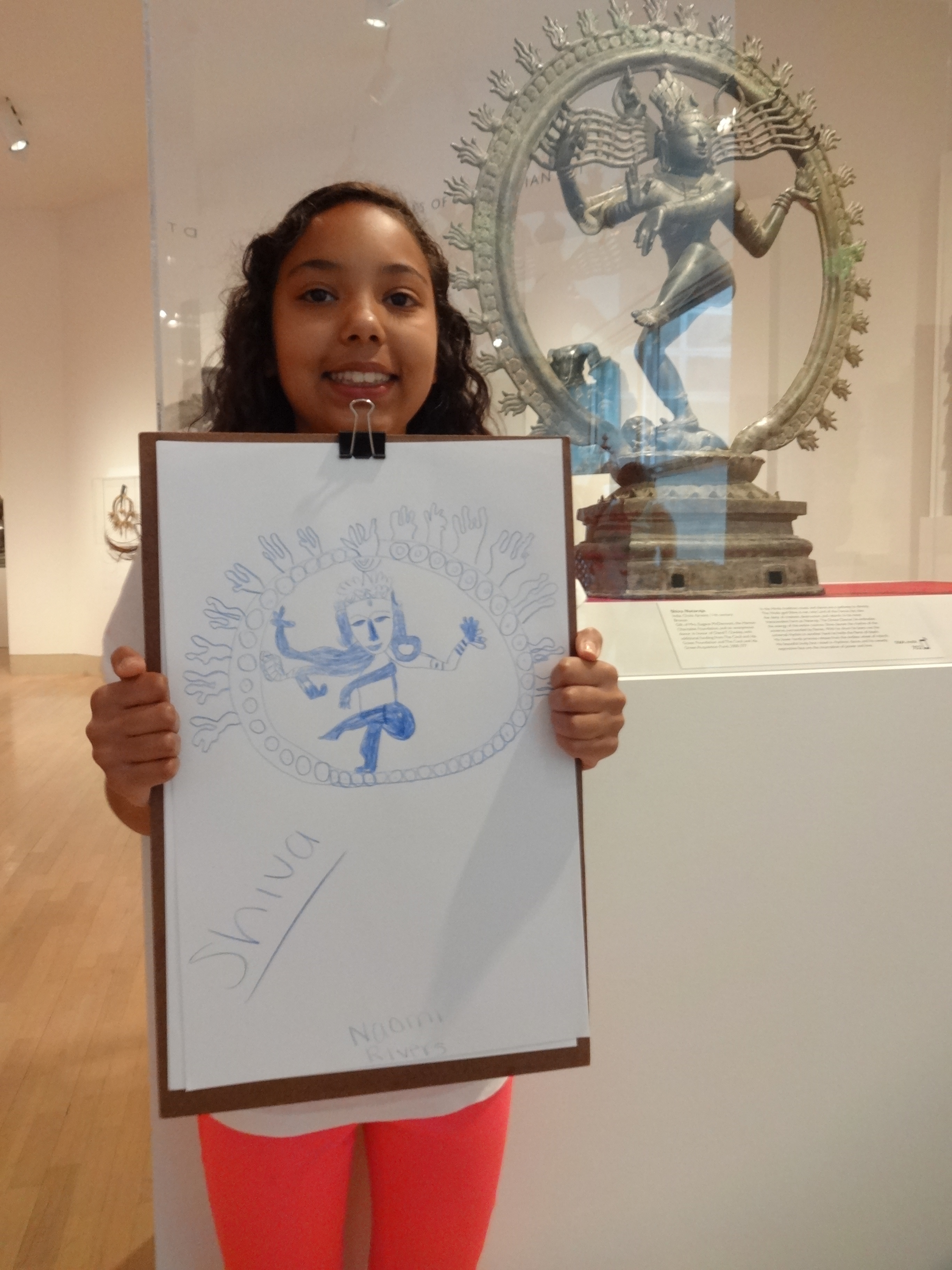
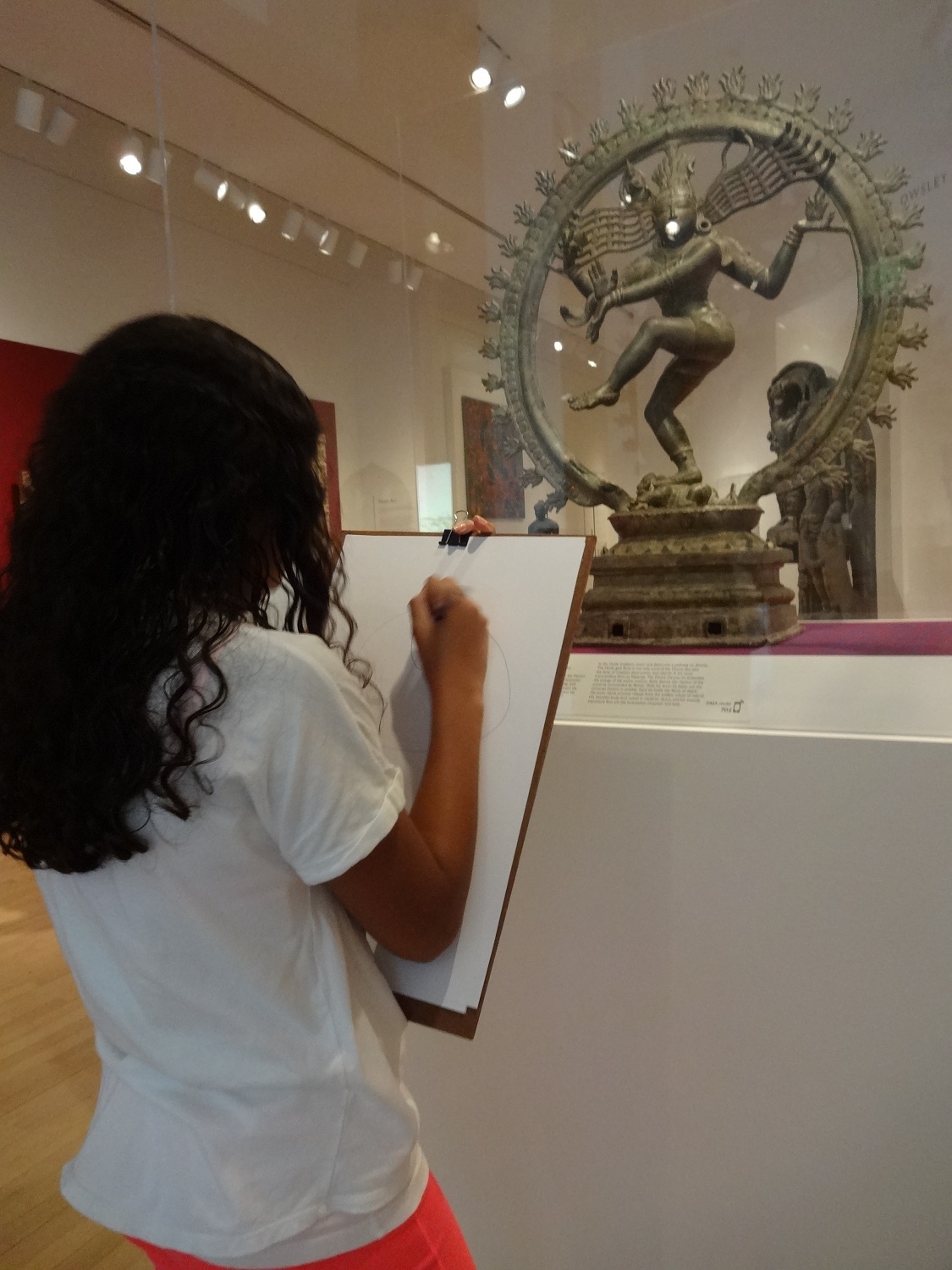
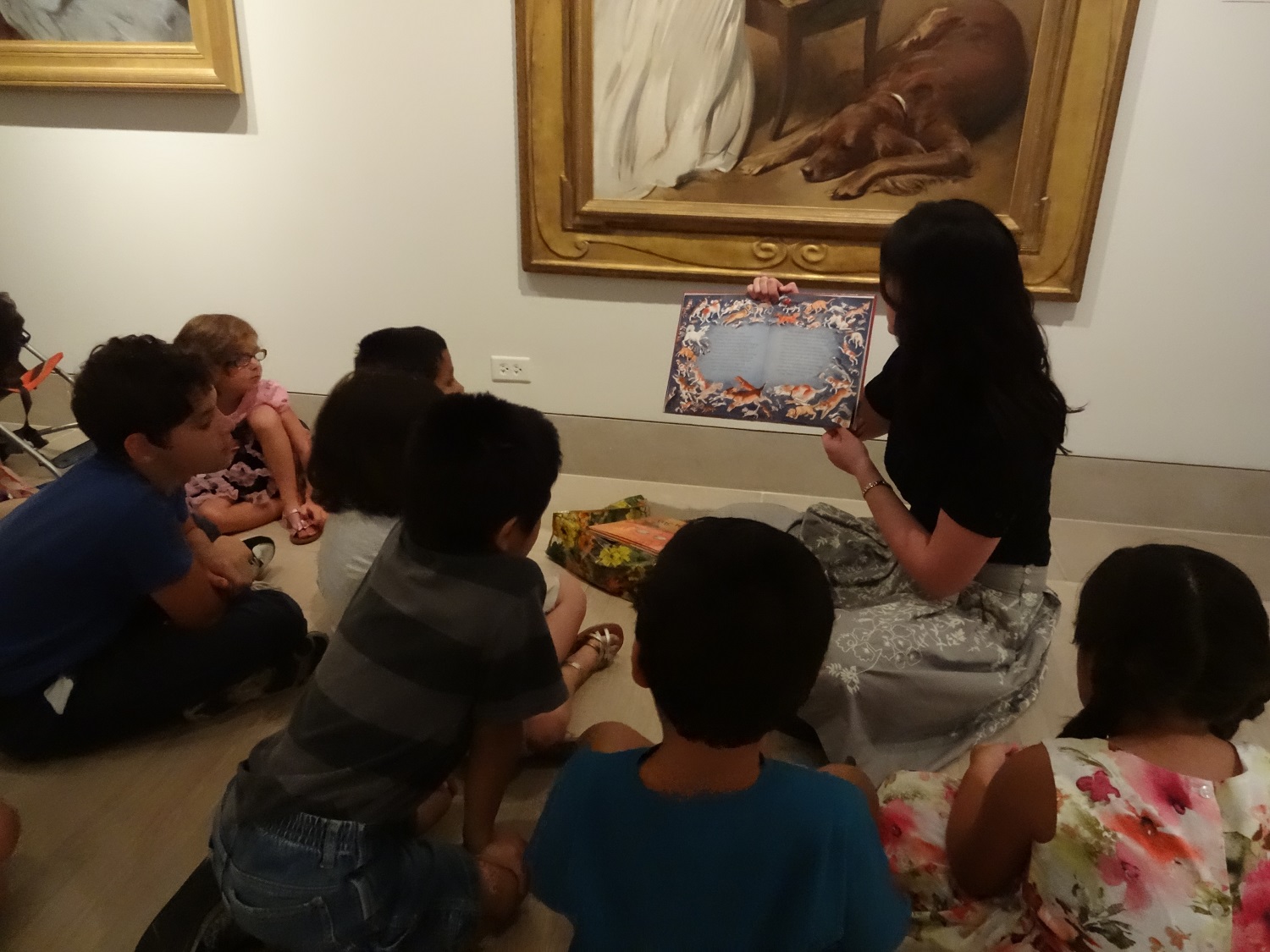
Join in the free fun this summer at the DMA. Throughout the week, we’re offering free family programs–story time, sketching in the galleries, art making, family game day, and more. How many ways can your family have fun at the DMA? Visit our Summer Family Programs page to start planning. Enjoy free general admission every day the DMA is open (Tuesday-Sunday 11:00 a.m.-5:00 p.m.; Thursday 11:00 a.m.-9:00 p.m.).

Friday Photos: From Sea to Shining Sea

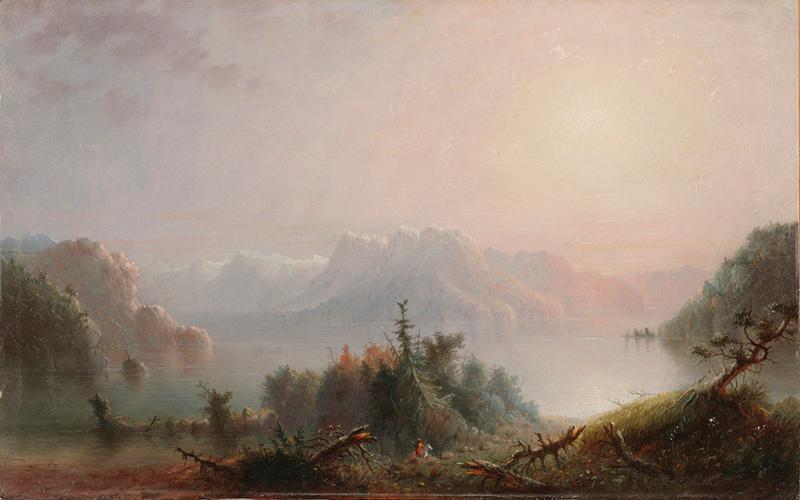
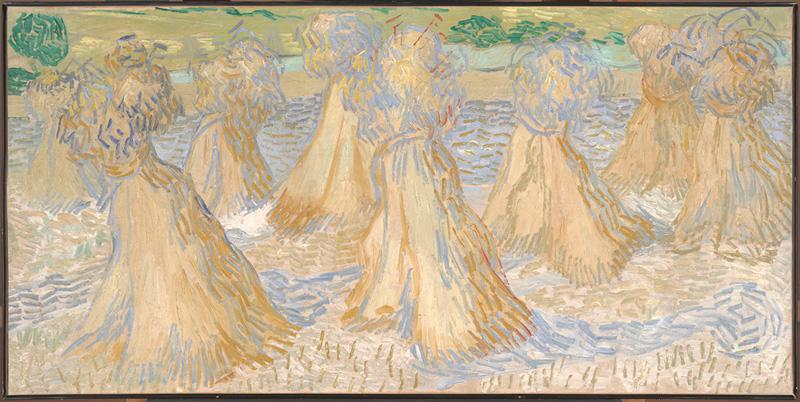
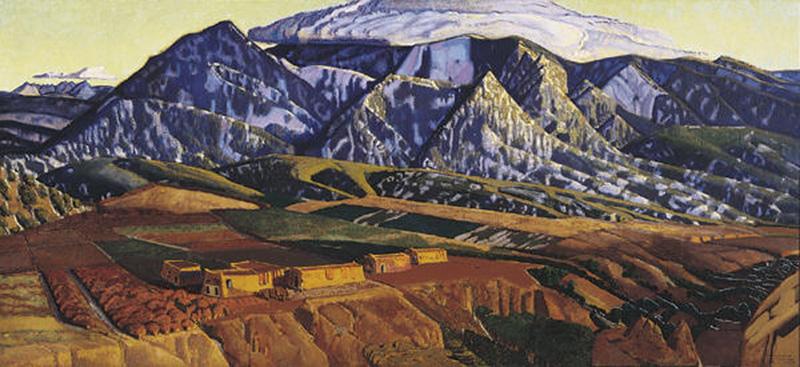
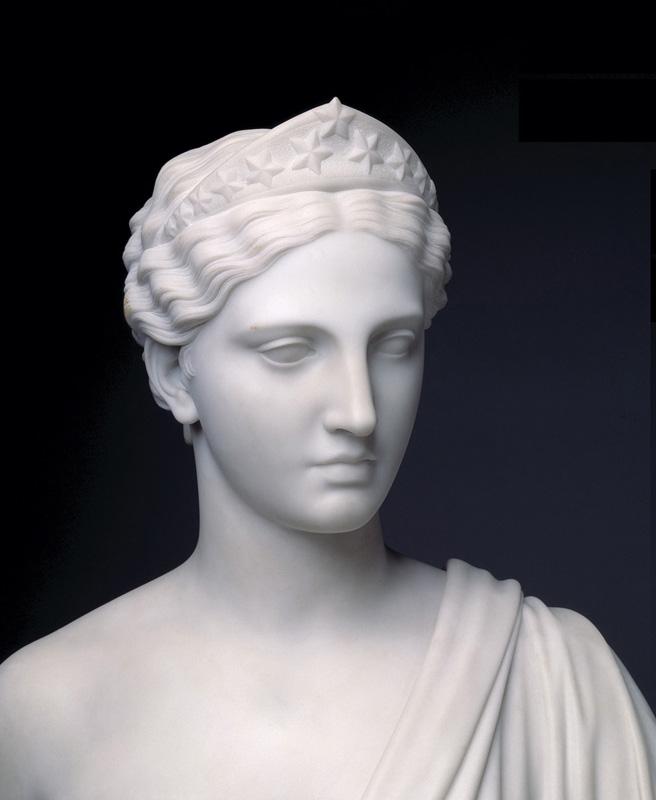
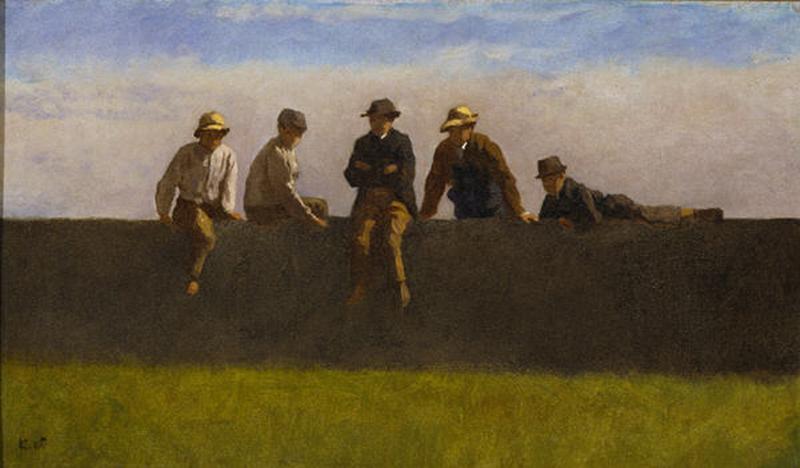
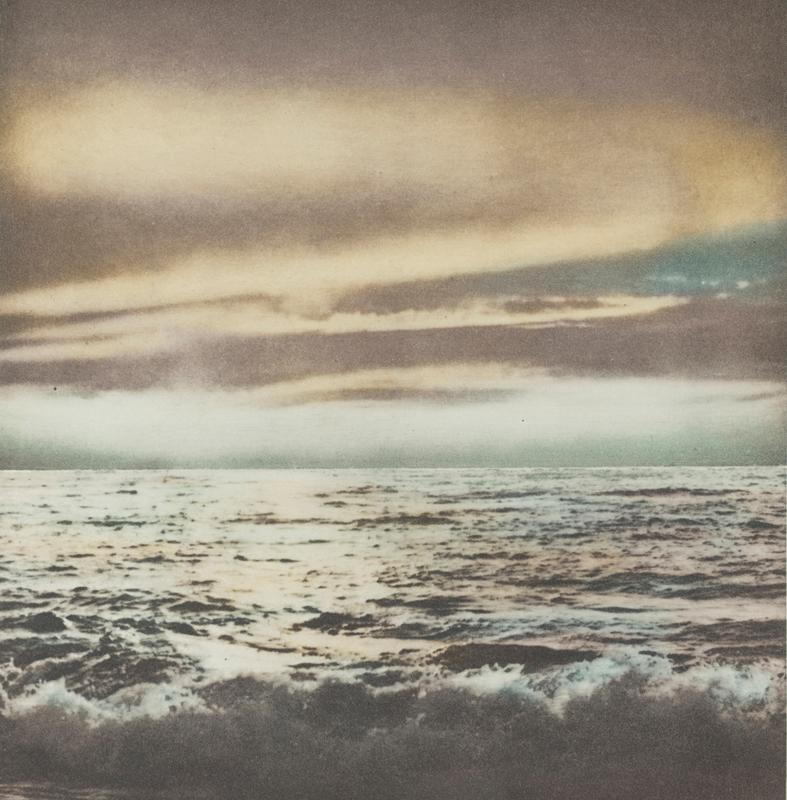
In the spirit of the 4th of July holiday, this Friday photo post is highlighting pieces from the DMA’s collection that have some patriotic flare! The works of art included below contain elements that call to mind the iconic poem “America the Beautiful” by Katharine Lee Bates. Can you think of any other works of art that could align with the poem?

Artworks Shown (left to right):

Row 1

  • Alfred Jacob Miller, The Lake Her Lone Bosom Expands to the Sky, 1850, Dallas Museum of Art, gift of C.R. Smith
  • Vincent van Gogh, Sheaves of Wheat, 1890, Dallas Museum of Art, The Wendy and Emery Reves Collection

Row 2

  • Ernest Blumenschein, Mountains Near Taos, 1926-1934, Dallas Museum of Art, gift of Helen Blumenschein
  • Hiram Powers, America, 1860, Dallas Museum of Art, gift of Eleanor and C.Thomas May, Jr.

Row 3

  • Eastman Johnson, Five Boys on a Wall, 1875-1880, Dallas Museum of Art, Foundation for the Arts Collection, gift of Roland S. Bond, Mrs. Alfred L. Bromberg, and Margaret J. and George V. Charlton
  • Gerhard Richter, Ocean (Seelandschaft)1971, Dallas Museum of Art, Dallas Museum of Art League Fund, Roberta Coke Camp Fund, General Acquisitions Fund, DMA/amfAR Benefit Auction Fund, and the Contemporary Art Fund: Gift of Mr. and Mrs. Vernon E. Faulconer, Mr. and Mrs. Bryant M. Hanley, Jr., Marguerite and Robert K. Hoffman, Howard E. Rachofsky, Deedie and Rusty Rose, Gayle and Paul Stoffel, and two anonymous donors

Danielle Schulz
Teaching Specialist

From Sea to Shining Sea

In celebration of the Fourth of July, we thought it might be fun to spotlight some of the great American artworks in our collection that have been created in the 237 years since our nation’s founding.

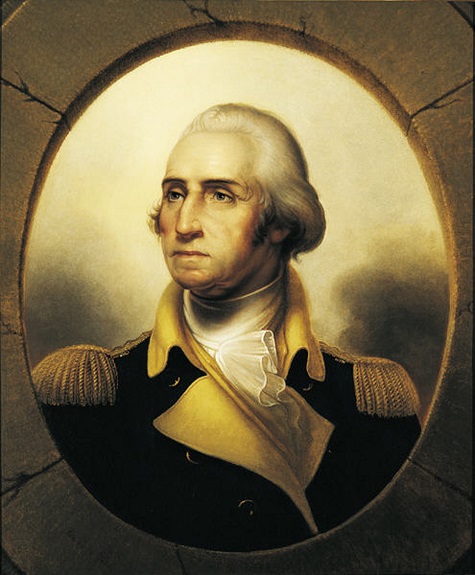
Rembrandt Peale, George Washington, c. 1850, oil on canvas, Dallas Museum of Art, The Karl and Esther Hoblitzelle Collection, gift of the Hoblitzelle Foundation

Rembrandt Peale, George Washington, c. 1850, oil on canvas, Dallas Museum of Art, The Karl and Esther Hoblitzelle Collection, gift of the Hoblitzelle Foundation

What better way to start than with the Father of Our Country? This portrait, completed fifty-one years after Washington’s death, was created by an artist who had met George Washington on several occasions. His first encounter with the president occurred when Rembrandt Peale was just seventeen years old. He painted a portrait of the president that would serve as the inspiration for countless additional portraits over the years. Peale shows Washington in his later years, perhaps reflecting back on his time as a surveyor, general, and president. When you visit the galleries, you might compare this painting with Jean-Antoine Houdon’s bust of George Washington, which is located right around the corner. Which one do you think is a more accurate likeness?

Crawford Riddell, Bed, c. 1844, Brazilian rosewood, tulip poplar, and yellow pine, Dallas Museum of Art, gift of three anonymous donors, Friends of the Decorative Arts Fund, General Acquisitions Fund, Discretionary Decorative Arts Fund, and the Boshell Family Foundation

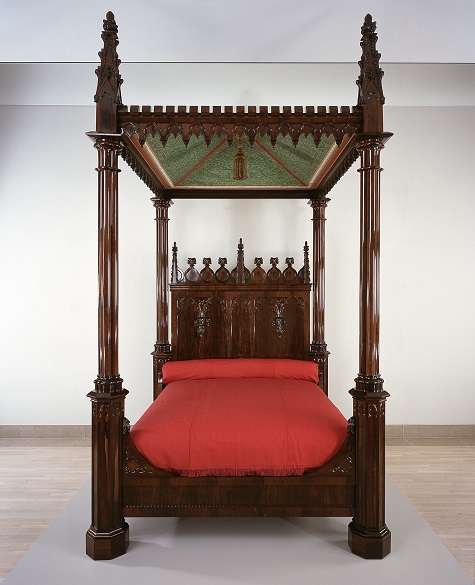
Crawford Riddell, Bedstead, c. 1844, Brazilian rosewood, tulip poplar, yellow pine, and polychromed textile, Dallas Museum of Art, gift of three anonymous donors, Friends of the Decorative Arts Fund, General Acquisitions Fund, Discretionary Decorative Arts Fund, and the Boshell Family Foundation

It’s impossible to lead a tour through our galleries without stopping at the Gothic bedstead. As beautiful as this work of art is, I think its history is even more fascinating. This bed was commissioned by a group of Whig party supporters who were convinced that Henry Clay was finally going to win an election and become President of the United States. Unfortunately for those eager supporters, Clay lost the 1844 election to James K. Polk, and the bed never made its way into the White House. It’s always fun to hear from our visitors who they think might have slept in a bed this grand.

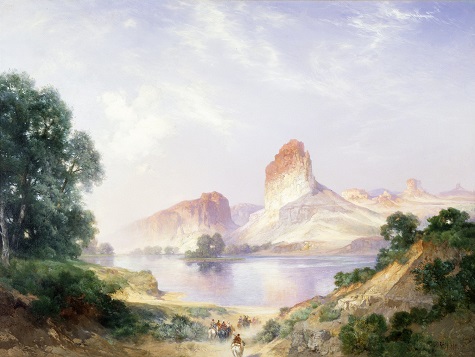
Thomas Moran, An Indian Paradise (Green River, Wyoming), 1911, oil on canvas, Dallas Museum of Art, Munger Fund

Thomas Moran, An Indian Paradise (Green River, Wyoming), 1911, oil on canvas, Dallas Museum of Art, Munger Fund

In the late 19th and early 20th centuries, American artists headed West to explore new territories in the United States. Many of them were captivated by the natural beauty of the landscape—especially areas like the Grand Canyon, Yellowstone and Yosemite Parks. These artists began to think of such awe-inspiring locations as our cathedrals and monuments. By capturing their beauty and grandeur on canvas, they celebrated the landscapes that make our country unique. What natural wonders are your favorite American landscapes?

Our collection provides many wonderful primary sources that relate to key events in American history. We hope that you’ll come visit them in person on July 4—the DMA will be open (with FREE general admission) from 11:00 a.m. until 5:00 p.m.

Shannon Karol is the Manager of Docent and Teacher Programs at the DMA.

Indiana Jones in the Digital Age

Uncrated stopped by the IT Department and caught up with Jessica Heimberg, Senior Developer, to learn more about her role here at the DMA. She can typically be found hiding behind two large monitors on her desk.

Jessica Heimberg

Describe your job in fifty words or less.
I work in the Information Technology Department. My official title is Senior Developer, but I am more like the MacGyver of tech projects and all things IT. (For those of you who missed this TV series, MacGyver was a non-gun-toting secret agent who improvised gadgets to solve crimes.)

What might an average day entail?
It could start with an update meeting and nice espresso, courtesy of DMA Deputy Director Rob Stein, or it could start with a flooded closet and fried switches. Depending on the day, I may be writing code, managing a project, creating documentation, trouble-shooting software, (politely) arguing with a vendor, walking with the cable dudes through a dusty construction site, or trying to figure out why someone’s e-mail worked on their iPhone yesterday but not today. Actually, I think I just described my Tuesday a few weeks ago.

How would you describe the best part of your job and its biggest challenges?
The best part of my job is that by helping create new programs, and supporting the DMA and its staff, I get to play a public service role in my city, and that makes me proud. I feel more than ever that people need art, music, playgrounds, and parks.

One of the more challenging and equally exciting effects of working in a small department is that we have to manage a lot of IT without a lot of staff. This definitely forces efficiencies, and we get to apply real creativity to problem solving. By nature and training, I tend to create schedules and plans. I like to maintain order and do my best to make working on projects as low stress as possible, but as anyone who’s ever worked on ANYTHING knows, even best-laid plans can get monkey-wrenched, and I have learned that some of the best ideas come out of the rubble of an initial plan.

Growing up, what type of career did you envision yourself in? Did you think you’d work in an art museum?
I was going to be Indiana Jones—am I dating myself here? In a past life (yes, I am older), I worked in the fashion industry, and then in corporate settings, but always gravitated toward the arts, science, and nature to find balance and inspiration.

What is your favorite work in the DMA’s collection?
Just one? Not possible to pick just one.

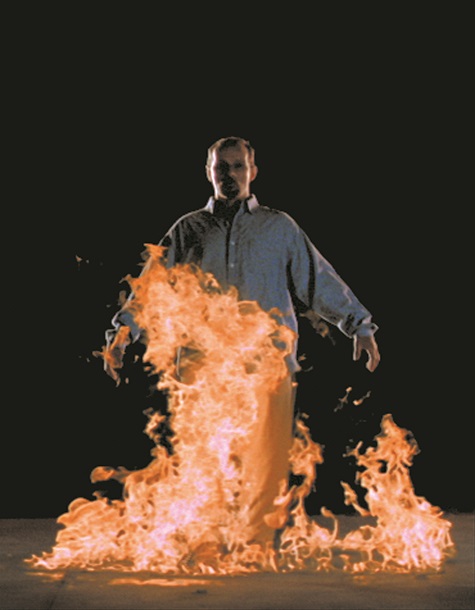
Bill Viola, The Crossing, Chanel 1 - "Fire," 1996, two-channel video/sound installation, Dallas Museum of Art, Lay Family Acquisition Fund, General Acquisitions Fund, and gifts from an anonymous donor, Howard E. Rachofsky, Gayle Stoffel, Mr. and Mrs. William T. Solomon, Catherine and Will Rose, and Emily and Steve Summers, in honor of Deedie Rose

Bill Viola, The Crossing, Channel 1 – “Fire,” 1996, two-channel video/sound installation, Dallas Museum of Art, Lay Family Acquisition Fund, General Acquisitions Fund, and gifts from an anonymous donor, Howard E. Rachofsky, Gayle Stoffel, Mr. and Mrs. William T. Solomon, Catherine and Will Rose, and Emily and Steve Summers, in honor of Deedie Rose, (c) Bill Viola, Long Beach, California

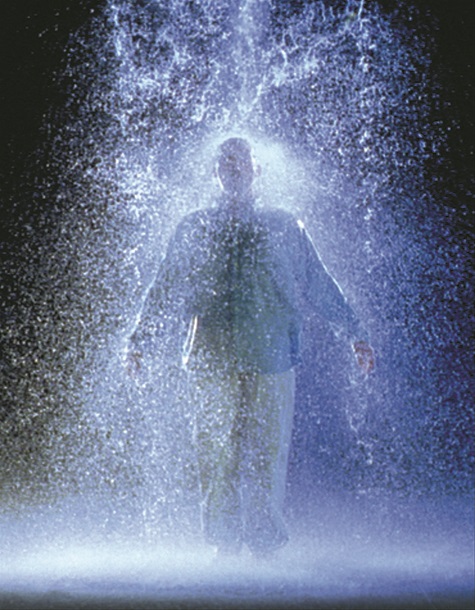
I have always loved The Crossing, by Bill Viola. At my last job, at least once a week I would take lunch at the DMA and wander the galleries for an hour just to clear my head. I remember when the Viola was installed and how exciting it was to walk into this big, dark space and stand in front of the projection, watching. I visited the thing three or four times before realizing it had a whole other side! I fell in love with it a second time. I know it is a digital piece, but something about the scale and pace of it strikes me as very human, and it is comforting to me.

Bill Viola, The Crossing, Chanel 2 - "Water," 1996, two-channel video/sound installation, Dallas Museum of Art, Lay Family Acquisition Fund, General Acquisitions Fund, and gifts from an anonymous donor, Howard E. Rachofsky, Gayle Stoffel, Mr. and Mrs. William T. Solomon, Catherine and Will Rose, and Emily and Steve Summers, in honor of Deedie Rose

Bill Viola, The Crossing, Channel 2 – “Water,” 1996, two-channel video/sound installation, Dallas Museum of Art, Lay Family Acquisition Fund, General Acquisitions Fund, and gifts from an anonymous donor, Howard E. Rachofsky, Gayle Stoffel, Mr. and Mrs. William T. Solomon, Catherine and Will Rose, and Emily and Steve Summers, in honor of Deedie Rose, (c) Bill Viola, Long Beach, California

Is there a past exhibition that stands out in your mind as a favorite, or is there a particular upcoming show you’re looking forward to seeing?
Oh, gosh – so many! I thoroughly enjoyed the “blockbuster” exhibitions like Tutankhamun and the Golden Age of the Pharaohs and especially The Fashion World of Jean Paul Gaultier: From the Sidewalk to the Catwalk, but most of my favorites have been mounted by our own curatorial staff. I loved Coastlines: Images of Land and Sea, The Mourners: Medieval Tomb Sculptures from the Court of Burgundy, African Masks: The Art of Disguise, Omer Fast: 5000 Feet Is the Best, and the telling of a chunk of American history through Modernism in American Silver: 20th-Century Design. I think Nur: Light in Art and Science from the Islamic World, the Islamic art and culture exhibition opening in 2014, will be a stunner.

Jessica Heimberg is Senior Developer, Information Technology at the DMA.

Reclining Nymph Gets a New Name

You may have heard that we recently reattributed a Baroque sculpture in the Wendy and Emery Reves Collection to the artist Giovanni Bonazza. Here’s an interview with Olivier Meslay, associate director of curatorial affairs at the DMA, explaining how he discovered the true artist of Reclining Nymph:

[youtube http://www.youtube.com/watch?v=YNc_m3gkjK8]

For additional information on the sculpture and its reattribution, you can read the full press release here or see the work up close, and for free, on view in The Wendy and Emery Reves Collection on Level 3.

Marfa State of Mind

marfa

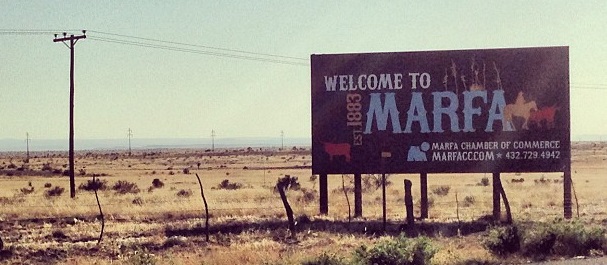
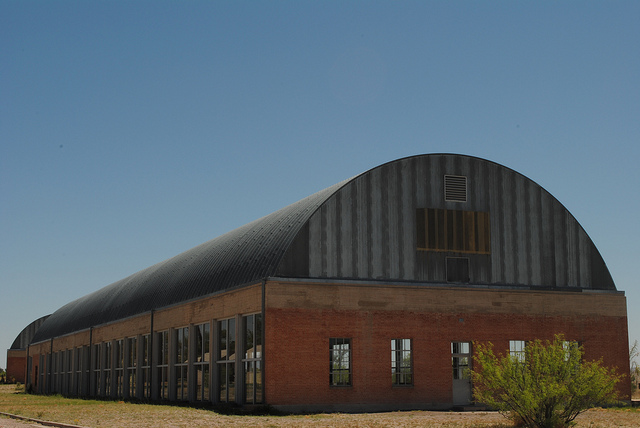
Marfa, Texas is more than just those mysterious lights (though they are pretty magical). I was lucky enough to visit the artistic oasis recently, and though I never left the state of Texas, I truly felt like I was transported to another place and time. Marfa is a small city located in the high desert of far west Texas, near Big Bend National Park. Founded in the early 1880s as a railroad stop, the town was transformed into a cultural destination thanks to artist Donald Judd. Upon relocating to Marfa from New York City in 1971, Judd acquired the decommissioned Fort D.A. Russell and began transforming the site’s buildings into exhibition spaces. His intention was to create a location in which he could permanently install his artwork and present it to the public.

It takes a great deal of time and thought to install work carefully. This should not always be thrown away. Most art is fragile and some should be placed and never moved again.” –Donald Judd

Judd’s ideas took shape as The Chinati Foundation formally opened to the public in 1986. When I first visited the museum I was struck by the absolute vastness of the space.

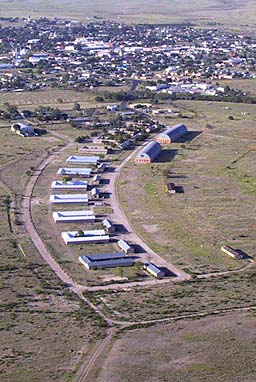
The Chinati Foundation

The Chinati Foundation

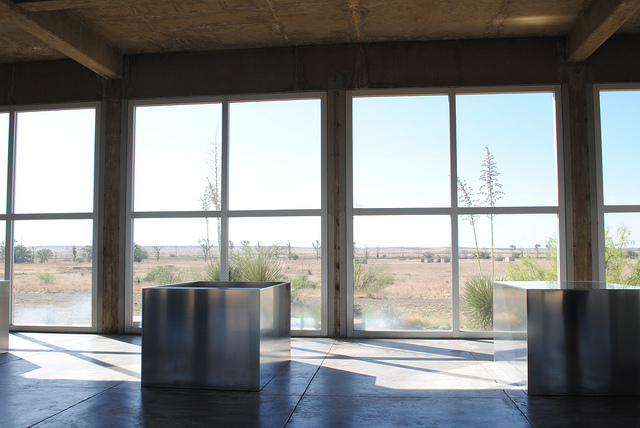
The Chinati Foundation is located on 340 acres of land. The art collection includes 15 outdoor concrete works by Donald Judd, 100 aluminum works by Judd housed in two converted artillery sheds, 25 sculptures by John Chamberlain, an installation by Dan Flavin occupying six former army barracks, and works by Carl Andre, Ingólfur Arnarsson, Roni Horn, Ilya Kabakov, Richard Long, Claes Oldenburg and Coosje van Bruggen, David Rabinowitch, and John Wesley. Each artist’s work is installed in a separate building on the museum’s grounds. When Judd renovated the buildings, he attempted to retain the integrity of the original structures as much as possible, only adding components that he deemed necessary. One of these was windows: the walls of the converted artillery sheds feature floor to ceiling windows. This alteration maximizes natural light and space and allows the surrounding landscape to meet and converse with the aluminum boxes that reside inside the sheds.

The location of The Chinati Foundation site–named after the surrounding Chinati Mountains–was extremely important to Judd, who, as a minimalist artist, believed strongly in creating works which are inextricably linked with the surrounding landscape. Judd fell in love with the desert landscape surrounding Marfa, and saw it as the perfect space for his art. “Too often,” Judd said, “the meaning of a work of art is lost as a result of a thoughtless or unsuitable placement of the work for display. The installation of my own work, for example, as well as that of others, is contemporary with its creation, and the space surrounding the work is crucial to it. Frequently as much thought has gone into the placement of a piece as into the piece itself.” (Quote from the Judd Foundation)

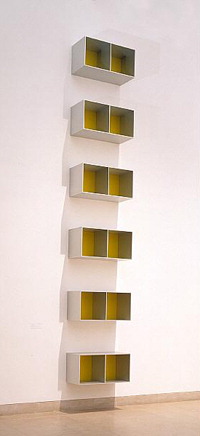
Donald Judd, Untitled, 1988 Dallas Museum of Art, Museum League Purchase Fund, General Acquisitions Fund, H. Harold Wineburgh Fund and gift of an anonymous donor

My trip to magical Marfa opened my eyes to the artistic passion and work of Donald Judd, but on a larger scale, it also invited me to reflect upon the decisions behind how works of art are displayed. I think of Judd’s Untitled piece that the DMA owns: six symmetrically divided rectangular boxes forming a column over eighteen feet high, made from cool industrial surfaces. My only experience with this work of art is seeing it displayed inside the white walls of the DMA, alongside work from other artists.

The time I spent in Marfa not only made me wonder how this particular Judd work would look exhibited alone against a desert backdrop, but furthermore, it made me question whether more works of art should be exhibited in the Judd manner–surrounded only by works from that artist and in a structure that complements its artistic intent.

I now turn this question to the public: is there a work of art in the DMA’s collection that you would like to see exhibited differently? And if so, how would you like to see it displayed?

Artwork Shown:

  • Donald Judd, Untitled, 1988, Dallas Museum of Art, Museum League Purchase Fund, General Acquisitions Fund, H. Harold Wineburgh Fund and gift of an anonymous donor

Danielle Schulz
Teaching Specialist

End of the Trail

mozley sign

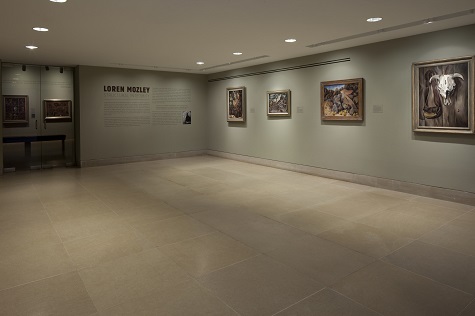
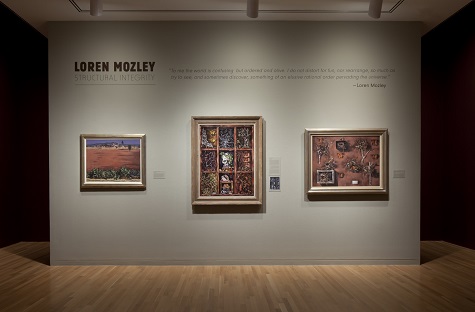
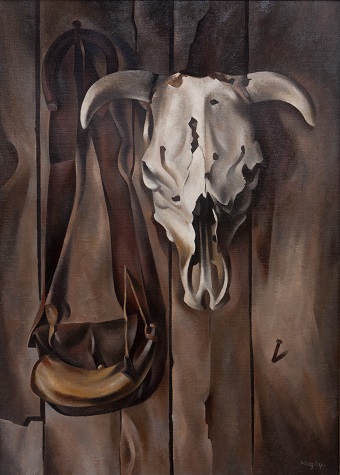
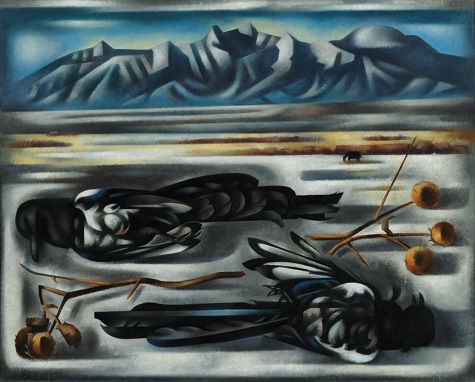
We are in the final days of the Loren Mozley: Structural Integrity exhibition. It is rare to see these works by the Texas modernist on view together, so don’t miss your opportunity to visit this free exhibition, on view through Sunday, June 30.

DMA’s Cinderella Inspires New Show

In honor of Thomas Sully’s birthday on June 19, we sat down with William Keyse Rudolph, the DMA’s former Associate Curator of American Art. Now the Milwaukee Art Museum’s Dudley J. Godfrey, Jr. Curator of American Art and Decorative Arts, William is currently organizing a retrospective exhibition of the artist. Sully (1783–1872) was born into a theatrical family in England but made a career in America, capturing in paint many of the leading actors and actresses of the time. The exhibition will feature many of these portraits as well as his “fancy pictures”–paintings made for mass appeal, with literary, artistic, and/or imaginary subjects. While at the DMA, William acquired Cinderella at the Kitchen Fire for the collection; the painting will be featured in the traveling exhibition and accompanying catalogue.
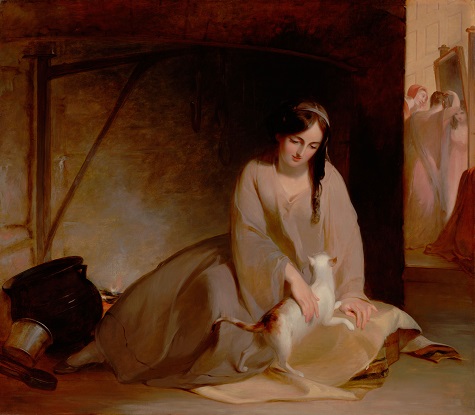
Thomas Sully, Cinderella at the Kitchen Fire, 1843, oil on canvas, Dallas Museum of Art, gift of the Pauline Allen Gill Foundation

Thomas Sully, Cinderella at the Kitchen Fire, 1843, oil on canvas, Dallas Museum of Art, gift of the Pauline Allen Gill Foundation

1. You were quoted in Art and Antiques magazine as saying that the DMA’s Cinderella at the Kitchen Fire took your breath away the first time you saw it. Why is this? Why do you consider this work Sully’s “finest fancy picture”?

For one thing, the picture is bigger than you expect. It’s nearly four feet by five feet. It was hanging on the wall of an art dealer’s office, surrounded by books, clutter, papers–and it just jumped out at me, even with all that distraction. It’s a beautifully painted, delicate picture, full of all sorts of grays and pinks that never reproduce well, but that are knock-out in person. And to be honest, it has this great big wonderful orange and white cat frolicking with Cinderella almost right at front and center. At that time, I had an orange and white cat, so the die was cast. I had to love it! And to be fair, former DMA director Jack Lane’s first words upon seeing an image of the painting were “Look at that cat!” He’s a cat person, too. We were also very fortunate that Mrs. Pauline Gill Sullivan, who had been a great benefactor of the DMA, saw the painting when we brought it to the Museum on approval and very graciously agreed to fund its acquisition. Besides having her own fine collection of European and American art, Mrs. Sullivan had a wonderful track record of making acquisitions available to the Museum, such as the commanding 18th-century portrait by Ralph Earl and a really dreamy late 19th-century Frank Duveneck painting of a woman in a red hat, so I was grateful that she responded so well to a big fairytale scene, which was out of her comfort zone in terms of the artist, size, and subject matter.

2. Did you have an interest in Sully and his paintings prior to this acquisition?

Yes. I had lived, worked, and gone to graduate school in Philadelphia for ten years before coming to the DMA, so I was well aware of Sully. He is so closely linked with the city of Philadelphia, where he worked for about sixty years, that it is almost impossible to spend time in Philly and not run into his work in virtually every cultural institution, from museums to libraries and hospitals.

3. How does it make you feel knowing that a key acquisition you made while working at the DMA will now be featured in Milwaukee’s exhibition and catalogue? Was it difficult to leave Cinderella behind?

I am, of course, thrilled! Cinderella at the Kitchen Fire actually gave birth to the show. After I acquired the work, my colleague Carol Eaton Soltis (a curator at the Philadelphia Museum of Art) and I began to talk about why this work was so interesting, which led to us proposing a show at the DMA that examined Sully’s total career: portraits as well as fancy pictures like this one. That show, which we began working on in 2005, was originally scheduled for 2009-2010 but ultimately didn’t happen due to timing and other issues. So we are really happy that years later the idea for the show was able to travel with me to Milwaukee and can now finally be seen here and then at the San Antonio Museum of Art. And yes, it was very difficult to leave Cinderella behind. You never, ever forget your first acquisition, and she was mine. I have missed her every day since I left the DMA, and I’m ridiculously excited to have her back with me for a brief time. If you ask gallery attendants at the DMA who remember me, they will tell you I used to go talk to her in the galleries. So my team here has been warned about that! I will probably burst into tears when she comes out of her crate and I see her again.

4. Since Sully also specialized in portraiture, is there any evidence that the figure of Cinderella was based on a real person?

Carol Soltis and I are convinced that the model for Sully was his daughter Rosalie, who posed for many of his works, several of which will also be in the show. She was a very talented painter herself, who died young.

5. Cinderella was painted when Sully was 60 years old. In your opinion, did it bring him the success and attention he hoped for in his later years? Did it help him attract new clients?

Yes and no. Sully hoped to sell the painting much faster than he did. He exhibited it several times in the Northeast and it was made into an engraving, but it took a few years to actually sell to a collector. One of the fascinating stories of this exhibition is how the fancy pictures like Cinderella functioned for Sully as a way to try to counteract the effects of economic crises on the portraiture market. Works like Cinderella were attempts to keep himself in front of the public, which he hoped would both result in sales of the subject pictures and remind clients that he could still turn it on when he wanted to.

6. A later version of Cinderella was (at least at one time) in the collection of Thomas Sully, Jr., of Naples, Florida. Is he a descendant of the painter? Did you ever track down this painting and will it be part of the exhibition and/or catalogue?

He is a descendant. I’ve seen an old reproduction of this picture, and I actually suspect it was the work of one of Sully’s grown children, whom he trained as artists. For that reason, I’ve never really worried about tracing it, as the DMA has the best one. What I’d be curious to see someday is another version of Cinderella done later that apparently shows her with the fairy godmother, but that one is completely obscure and only listed in Sully’s register. If anyone knows where it is, I would love to see it!

7. Do you know yet which works in the exhibition will be installed near the DMA’s Cinderella?

I don’t know exactly where the painting will go in the gallery, but it will be part of a section devoted to Sully’s fancy pictures. So she will live near an amazing picture of Little Nell Asleep in the Curiosity Shop from the Free Library of Philadelphia, which is based on Charles Dickens; and a gigantic, dramatic painting based on a scene from the early American novel The Pilot by James Fenimore Cooper that we’re borrowing from the Birmingham Museum of Art in Alabama. All three of them will be stunning together, and all were painted around the same time.

Thomas Sully: Painted Performance will be on view at the Milwaukee Art Museum October 11, 2013-January 5, 2014, and then at the San Antonio Museum of Art February 7-May 11, 2014. I hope some of the DMA’s visitors who love this painting will come see the show in one of these places to help celebrate this important painter and this really beautiful picture that the DMA family has been so quick to adopt as a favorite. And thank you to Sue Canterbury, Maxwell L.  Anderson, and all the DMA family for making her available for loan.

Reagan Duplisea is the Associate Registrar, Exhibitions at the DMA.

Archives

Categories