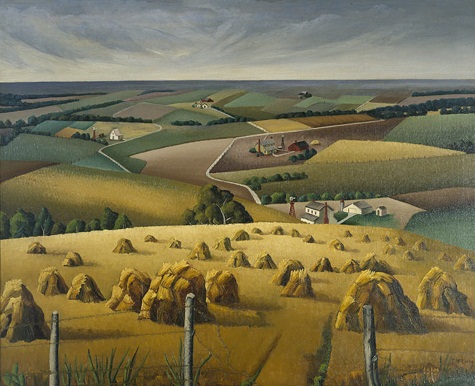
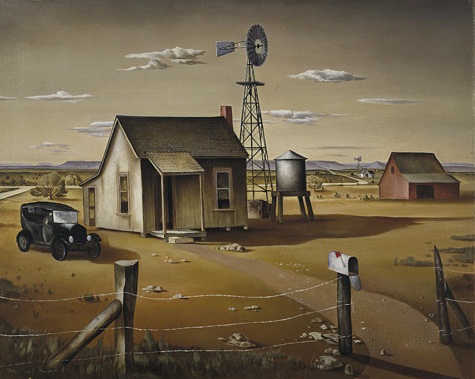
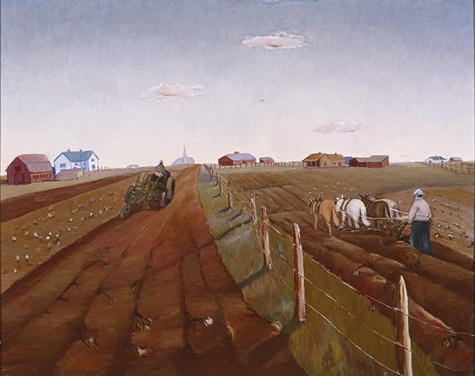
Posts Tagged 'Dallas Museum of Art'


DMA Friends: A Daily Dose of Art

“I travel a lot and always go to an art museum. But it’s expensive. Here—it’s free. I come all the time and stay like fifteen minutes…I get my daily dose of art.”

27

This month, Robert “Bobby” Kaufman became the first DMA Friend to claim a high-point-level reward offered through DMA Friends, the free membership program that launched in January 2013. “The quality of rewards is so high and a positive incentive for coming [to the DMA].” For 35,000 points, Bobby claimed the “Dinner and a Movie” reward. Come this May, he’ll dine on the DMA’s dime and watch a movie of his choosing with his invited guests in the Horchow Auditorium. Way to go, Bobby!

I sat down with Bobby for a chat last Thursday and discovered that he is without a doubt one of our most loyal DMA Friends. He stands out among our growing crowd of 5,500+ Friends who participate in DMA activities ranging from viewing art in the galleries to making something in the Center for Creative Connections to attending our weekly Gallery Talks. Bobby earns points by visiting and participating often, in short spurts. He spends most of his time in the American and European galleries, where he returns to favorite works and leaves feeling inspired. “I can’t paint. . . . But looking at the masters is a reminder to me to try to create something important.” An aspiring poet, he hopes to make his mark in the field of writing one day. He eloquently related to me how details in two of his favorite European paintings—in particular the gestures of figures in each painting—inspire him to be evocative and thoughtful when describing characters through his words.

Born and raised in Dallas, Bobby told me that he came to the Museum maybe once when he was growing up. Two years ago, his parents gave him a DMA membership when he took a teaching position in the English Department of a Dallas-area high school. Then, he started visiting the DMA every few months. Since the DMA returned to FREE general admission and launched the DMA Friends program in January, he’s visited nearly every day–often after school on weekdays. He opted not to renew his DMA membership because the DMA Friends program gives him exactly what he needs for an art museum experience.

Want to learn more about how to become a DMA Friend and earn points and rewards like Bobby? Visit DMA.org/friends and then come by the Museum to see us!

Nicole Stutzman Forbes is the Chair of Learning Initiatives and Dallas Museum of Art League Director of Education at the DMA.

Creative Comics

Dallas students had a great time learning about comics on Sunday, March 10, at the DMA’s Urban Armor workshop. Urban Armor is a program that allows teens and tweens to take a closer look at the Museum’s collection and create unique art in the DMA’s computer-equipped Tech Lab.

UA5

Workshops are generally scheduled twice a month for two hours and are free; for more information, and to register, visit the DMA’s Urban Armor page.

Local comic book artist and illustrator Kristian Donaldson led our recent workshop, which covered the basics of drawing comics and their history and progression. Donaldson completed his training at the Savannah College of Art and Design and has worked for Marvel, DC, Dark Horse Comics, and Dallas Observer/Village Voice Media. He has also taught several classes for young adults and college-age students across the U.S.

UA3

The workshop was inspired by the recent Arts & Letters Live program featuring Art Spiegelman on February 27. One of the perks of being the McDermott Intern for Adult Programming and Arts & Letters Live is getting the chance to create a program based on my passions and interests. I grew up in small-town Texas, far from any art institutions, so as a relatively new museum-goer I have become keenly aware of a certain gap in museum activities. While programs for children, families, and adults abound, similar activities for teens and young adults often do not. One of the things I love about the DMA is that we do have programs like Urban Armor, teen-friendly author events, and student discounts. When I saw that Spiegelman was coming to Dallas, I thought that the formula of comics + teens + local art programs at schools like Booker T. Washington + Urban Armor at the DMA + FREE = awesome.

UA1

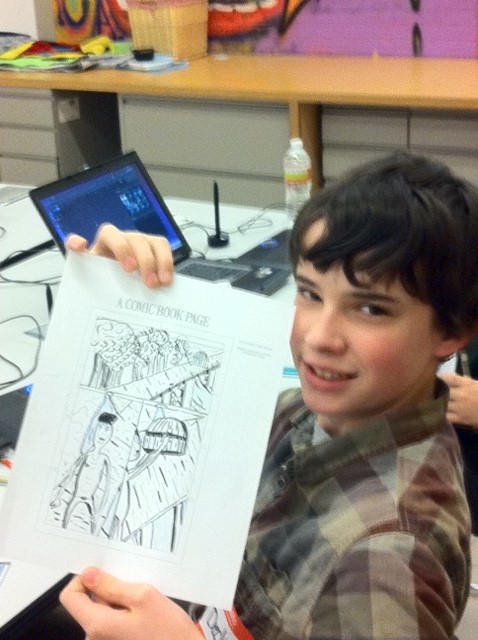
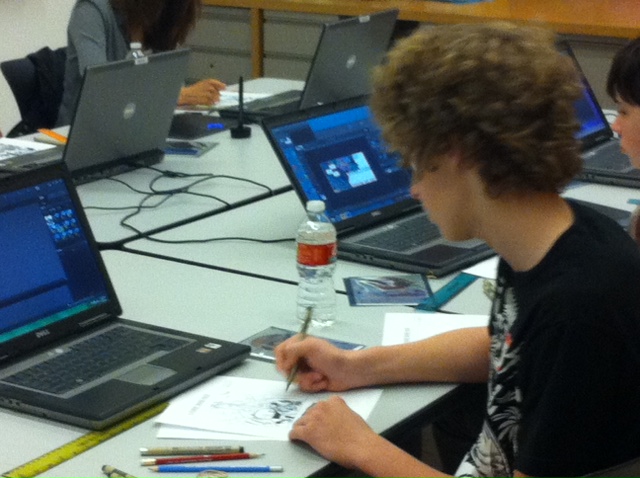
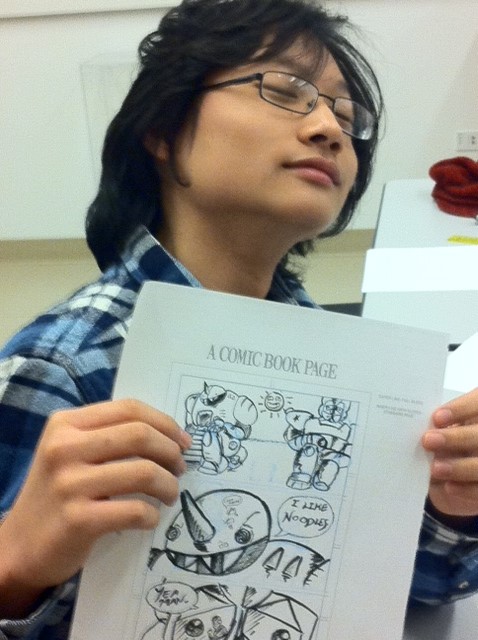
And so it began. Students age 14-17 gathered in the Center for Creative Connections to be schooled in the awesomeness that is comic book art. Kristian was very open-minded and supportive in his approach, encouraging the students to run with whatever style comes naturally, because there is no “right” or “wrong” way to draw a comic. While working with his self-professed current obsession with outer space, Kristian showed us step-by-step how to divide a basic template into three parts, set the scene with a general landscape, bring in human anatomy and emotion using shapes and positive and negative space, and lead into a story that is completely up to the artist. WOW. It was mesmerizing to watch the students create their own unique interpretations of what a comic should be. One student focused on what can only be described as a well-drawn noodle monster. I was amazed at the skill level and creativity flowing in the room.

UA2
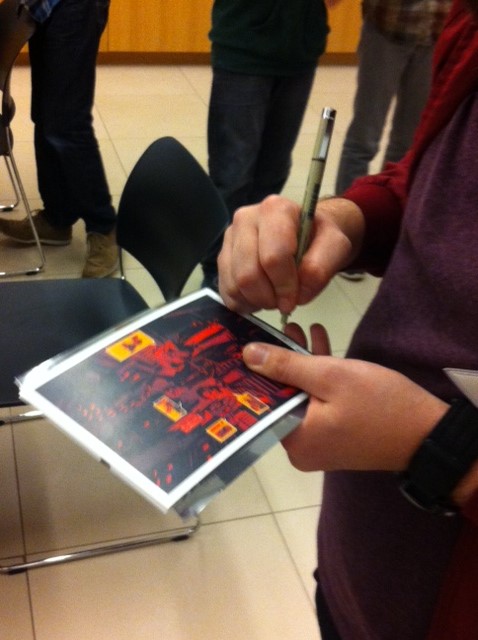
After the workshop was over, Kristian kindly signed some of his work for the students as they begged for another program with him later in the season. Comics: Part II, anyone?

Emily Brown is the McDermott Intern for Adult Programming and Arts & Letters Live at the DMA.

Open Office: Foundation and Government Relations Director

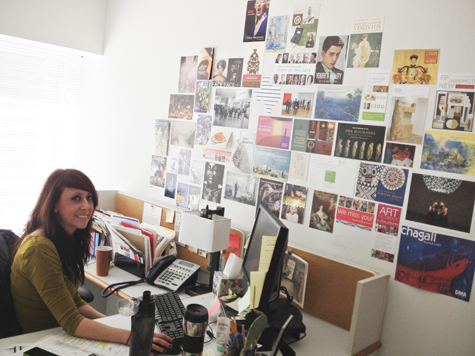
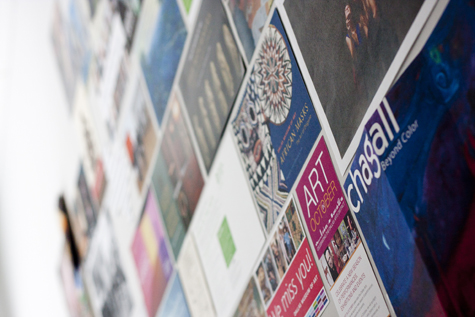
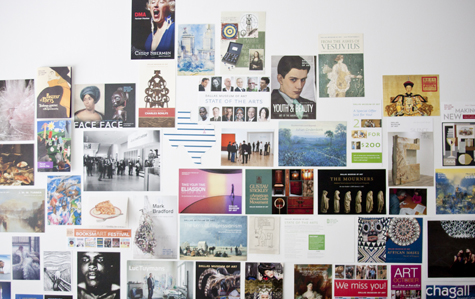
I inherited my office–and the majority of this wall collage–from its former resident. I had always admired her creative office décor, so I immediately added to it when I moved in. The timespan of exhibitions reflected on the wall ranges from 2004 (Splendors of China’s Forbidden City: The Glorious Reign of Emperor Qianlong) to present day (the newly opened Cindy Sherman). It’s fun to see a visual history of the shows we’ve presented over the last decade. Too bad it’s the only organized area of my office.

29 27 28

Anne Palamara Smith is the Director of Foundation and Government Relations at the DMA.

A Dot That Went for a Walk

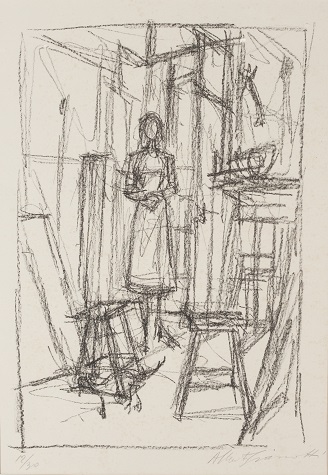
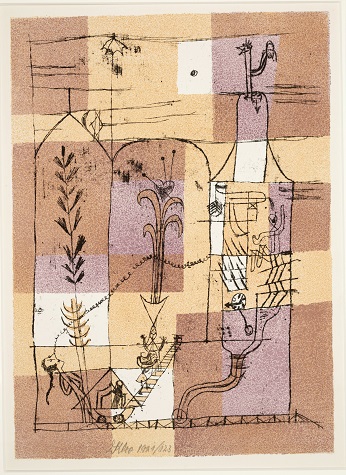
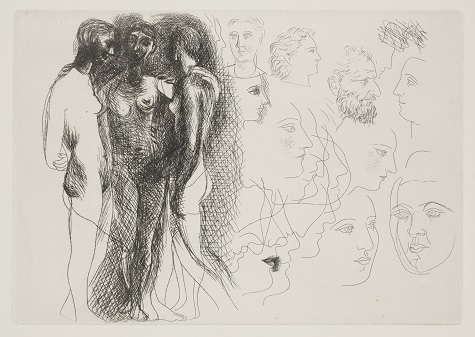
Once again, the Works on Paper Gallery on the Museum’s second level is being reinstalled. Fourteen drawings, lithographs, etchings, and engravings by some of the 20th century’s greatest artists—Henri Matisse, Alberto Giacometti, Pablo Picasso, and many more—will adorn the gray walls.

The new installation, titled Linear Possibilities in Modern European Prints, didn’t come together overnight. I’ve been working on it for the last six months, and I am now very excited (even a bit nervous) to present it to the Museum’s public. The idea came to me after looking many times through the Museum’s collection of European works on paper, which includes over 2,000 prints, drawings, and photographs dating from the late 1400s to the 1980s.

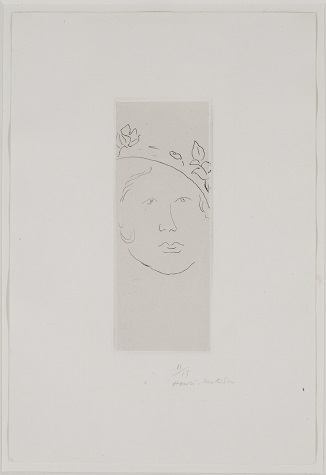
Henri Matisse, Loulou, 1914, etching, Dallas Museum of Art, Foundation for the Arts Collection, gift of the Wendover Fund

Henri Matisse, Loulou, 1914, etching, Dallas Museum of Art, Foundation for the Arts Collection, gift of the Wendover Fund, © 2013 Succession H. Matisse / Artists Rights Society (ARS), New York

I had to work with a few limiting factors before finding my final concept. The three walls of the gallery can only accommodate a certain number of works comfortably, so I had to keep the number within a range of eight to fourteen works. Also, works on paper are very sensitive to natural light. The longer a work is on view, the more damage that occurs, causing the paper to darken and certain media to fade. Therefore, I couldn’t use any work that had recently been on view. I found a few possibilities based on particular themes or artistic movements before choosing to investigate lines, one of art’s most basic elements.

Alberto Giacometti, Annette in the Studio, 1954, lithograph, Dallas Museum of Art, gift of Mr. and Mrs. Alfred L. Bromberg

Alberto Giacometti, Annette in the Studio, 1954, lithograph, Dallas Museum of Art, gift of Mr. and Mrs. Alfred L. Bromberg, © 2013 Artists Rights Society (ARS), New York / ADAGP, Paris

The idea was influenced by a great quote from the Swiss artist Paul Klee: “A line is a dot that went for a walk.” Lines appear in many types and sizes: vertical, horizontal, zigzagged, curvy, squiggly, thick, thin, long, short. When combined, lines reveal spaces or forms and allude to volume or mass. They can possess emotive qualities as well as imply movement.

Paul Klee, Hoffmanesque Scene (Hoffmaneske Szene), 1921, color lithograph, Dallas Museum of Art, gift of Stuart Gordon Johnson by exchange; General Acquisitions Fund; and The Patsy Lacy Griffith Collection, gift of Patsy Lacy Griffith by exchange

Paul Klee, Hoffmanesque Scene, 1921, color lithograph, Dallas Museum of Art, gift of Stuart Gordon Johnson by exchange; General Acquisitions Fund; and The Patsy Lacy Griffith Collection, gift of Patsy Lacy Griffith by exchange, (c) Artists Rights Society (ARS), New York / VG Bild-Kunst, Bonn

Pablo Picasso, Three Standing Nudes, at Right, Sketches of Heads (Trois nus debout, à droite esquisses de têtes), 1927, etching, Dallas Museum of Art, Dallas Art Association Purchase

Pablo Picasso, Three Standing Nudes (left) and Sketches of Heads (right), 1927, etching, Dallas Museum of Art, Dallas Art Association Purchase, © 2013 Estate of Pablo Picasso / Artists Rights Society (ARS), New York

The works in the installation demonstrate how painters and sculptors of the European avant-garde turned to drawing and printmaking in a new manner, creating with nothing but lines. They explored the possibilities of rhythmic or abstracted sequences of delicate, robust, and expressive lines in their compositions of a nude, an artist’s studio, or more abstracted scenes. There is an astonishing beauty to be found in these prints and drawings by Matisse, Giacometti, Picasso, and others. I encourage you to visit the Dallas Museum of Art (general admission is free!) to see these amazing and innovative works.

Linear Possibilities in Modern European Prints goes on view in the European Art Galleries on Level 2 Sunday, March 17.

Hannah Fullgraf is the McDermott Graduate Curatorial Intern in European Art at the DMA.

There’s No Place Like Home…Or a Museum That’s Open Until Midnight

Next week is Spring Break and we are offering a lot for families and visitors of all ages to do at the DMA.

We will kick-off the week with our WFAA Family First Day on Saturday, March 9. Then, throughout the week you can explore our galleries with self-guided tours, stop by the Art Cart, compete in games with your family, and more!

Stop by our new Art Cart in the Museum galleries.

Stop by our new Art Cart in the Museum galleries.

And to end the weeklong celebration, we invite you to join us for our annual Spring Break Block Party on Friday, March 15. We will be open until midnight for our Late Night event, as will our neighbors in the Arts District: the Crow Collection of Asian Art, the Klyde Warren Park, and the Nasher Sculpture Center.

Each year we program the March Late Night around a fun family theme, from Where the Wild Things Are to Alice in Wonderland and the world of Dr. Seuss. This year, staff debated between Mary Poppins and The Wizard of Oz, and after some nostalgic discussions and fun brainstorming meetings, we decided to go over the rainbow and follow the yellow brick road to the wonderful world of Oz.

Don’t miss the “Prince of Pop-Ups,” Robert Sabuda, who will discuss his major feats of paper engineering, including his pop-up book The Wonderful Wizard of Oz.

Sabuda_Wizard of OZ

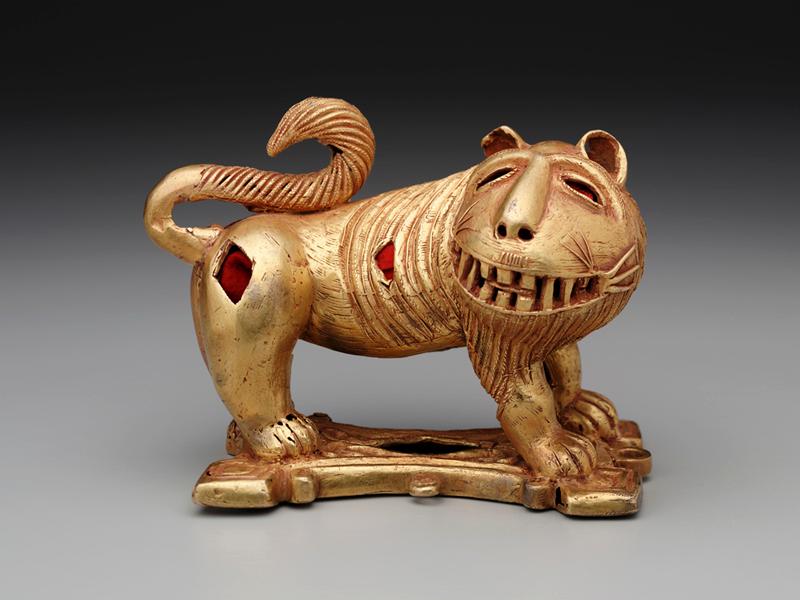
Families can explore the galleries with our Journey Through Oz Family Adventure to find courage, a heart, a brain, and a home. And if you stay late, you can take a tour that looks at the lions, tigers, and bears (oh my!) in our collection.

Sword ornament in the form of a lion, c. mid-20th century, Cast gold and felt, Dallas Museum of Art, The Eugene and Margaret McDermott Art Fund, Inc.

Sword ornament in the form of a lion, Ghana, Nsuta State, Asante peoples, c. mid-20th century, cast gold and felt, Dallas Museum of Art, The Eugene and Margaret McDermott Art Fund, Inc.

As for films, we decided we didn’t want to show the original Wizard of Oz but instead screen some interesting takes on the classic. So throughout the night you can watch Tom and Jerry’s take on the film as well as The Muppet’s version. And for adults we will screen the cult classic Return to Oz.

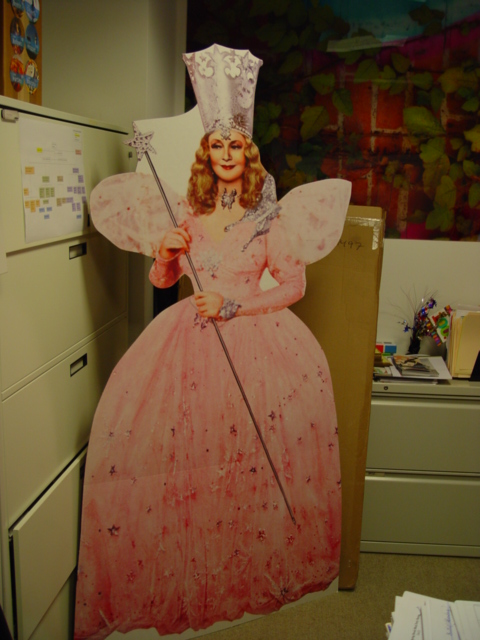
Don’t forget to bring your camera so you can take a photo with your friends and family in front of our Emerald City backdrop, accompanied by cardboard cut-out characters from The Wizard of Oz. Glinda the Good Witch is living in my office until the big day!

Glinda

And if you are a DMA Friend, come to Late Night dressed as your favorite Wizard of Oz character to earn the Midnight Masquerade Badge and 450 points! Not a DMA Friend? Be sure to sign up at the kiosks near the Visitor Services Desks when you arrive.

Stacey Lizotte is the Head of Adult Programming and Multimedia Services at the DMA.

21 Years of Silver Supper

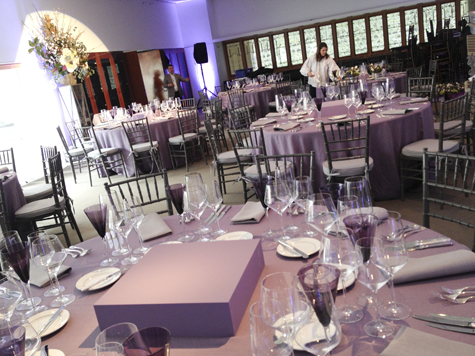
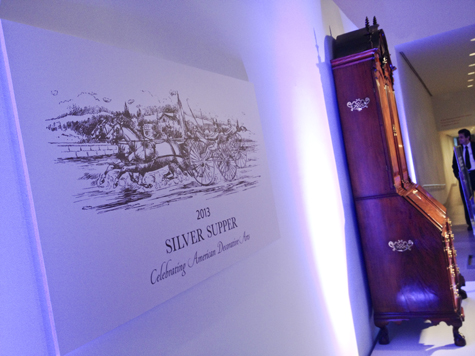
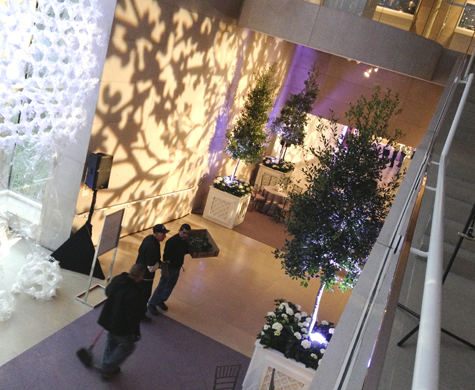
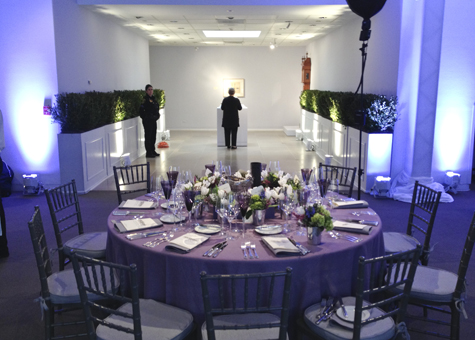
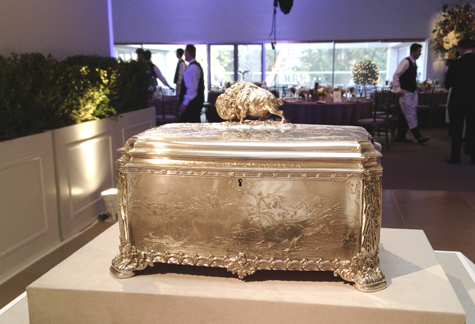
This past Friday was the 21st anniversary of Silver Supper, an annual event that celebrates the DMA’s outstanding holdings of American decorative arts and silver. This year’s Silver Supper highlighted thirty-two works from the DMA’s decorative arts and design collection. For more information on the annual event, visit the DMA’s website.

20

21

22

23

24

25

26

Soup’s On

In a museum the size of the DMA, it’s hard to keep track of isolated changes over 370,000 square feet. So we are letting you know about three recent additions to the permanent collection that are now on view. I encourage you to visit the Museum and go on a “scavenger hunt” to see how these works add an extra spark to the galleries—remember, general admission is free!

All three of the works fall within the purview of decorative arts and were originally marketed to elite consumers. One is by a well-known figure—the 19th-century design magnate Louis Comfort Tiffany (American, 1848-1933). Fans of contemporary art or those familiar with the DMA’s upcoming exhibitions will recognize the name of photographer Cindy Sherman (American, born 1954). The third designer may be unknown outside of specialist circles, but during his lifetime Archibald Knox (British, 1864-1933) was credited with developing a uniquely British approach to the Art Nouveau movement.

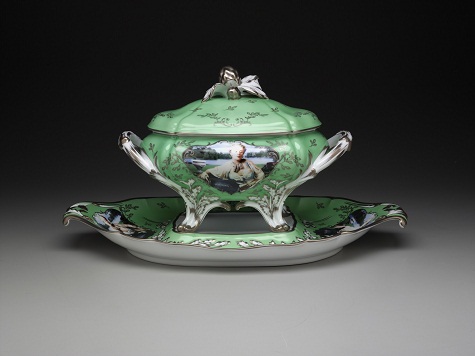
Cindy Sherman, "Madame de Pompadour (née Poisson)" soup tureen with platter, 1990, Ancienne Manufacture Royale de Francem, porcelain with silkscreen transfer and platinum decoration, Dallas Museum of Art, DMA-amfAR Benefit Auction Fund

Cindy Sherman, “Madame de Pompadour (née Poisson)” soup tureen with platter, 1990, Ancienne Manufacture Royale de Francem, porcelain with silkscreen transfer and platinum decoration, Dallas Museum of Art, DMA-amfAR Benefit Auction Fund

From March 17 to June 9, the Cindy Sherman exhibition will adorn the walls of the Barrel Vault and Quadrant Galleries, but visitors to the European Galleries can also encounter the contemporary American’s work. Her Madame de Pompadour (née Poisson) soup tureen with platter sits camouflaged with rococo curves and floral embellishments. It creates a provocative disjuncture amid a wall of paintings by Canaletto (Italian, 1697-1768), Jean-Baptiste Oudry (French, 1686-1755), and Jacques-Louis David (French, 1748-1825).

Madame de Pompadour (French, 1721-1764) was the most famous of King Louis XV’s mistresses. She played a critical role in elevating rococo style to the pinnacle of aesthetic taste in mid-18th-century France. In 1756 she commissioned a tureen and platter from the renowned porcelain manufacturer in Limoges. Over two hundred years later, Sherman used the same factory to produce a limited-edition interpretation based on Pompadour’s original design.

Sherman takes on the guise of a historical tastemaker but allows viewers to be in on her joke. Close inspection of the photo-silkscreened portrait (reproduced twice on both the tureen and platter) reveals a pastiche—the theatrical make-up, somewhat ratty shawl, ill-fitting gray wig, and conspicuously faux breasts.

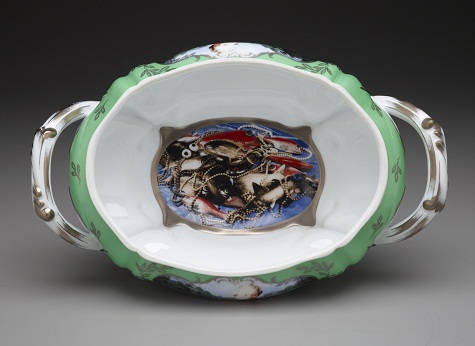
Cindy Sherman, "Madame de Pompadour (née Poisson)" soup tureen with platter, interior, 1990, Ancienne Manufacture Royale de Francem, porcelain with silkscreen transfer and platinum decoration, Dallas Museum of Art, DMA-amfAR Benefit Auction Fund

Cindy Sherman, “Madame de Pompadour (née Poisson)” soup tureen with platter, interior, 1990, Ancienne Manufacture Royale de Francem, porcelain with silkscreen transfer and platinum decoration, Dallas Museum of Art, DMA-amfAR Benefit Auction Fund

Museum guests won’t glimpse the tureen’s additional humorous detail because it is hidden on the base of the interior. As a visual pun on Pompadour’s maiden name and extreme wealth, Sherman created a still life of fish (French, poisson) and beaded necklaces.

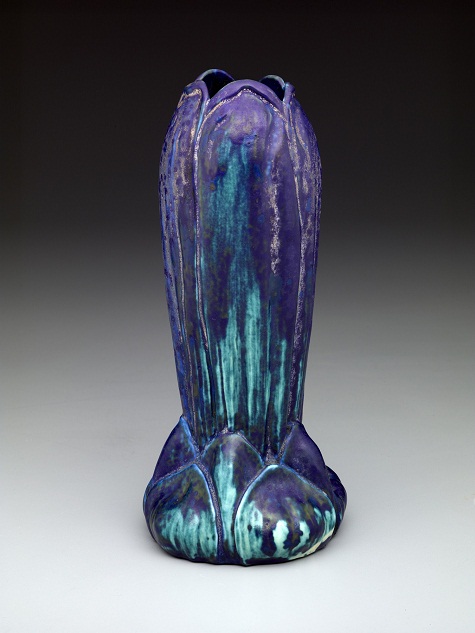
Creative Director: Louis Comfort Tiffany, Vase, c. 1905-1919, earthenware, Dallas Museum of Art, Discretionary Decorative Arts Fund

Tiffany Studios, Vase, c. 1905-1919, earthenware, Dallas Museum of Art, Discretionary Decorative Arts Fund

Several new installations spice up the displays in the North Decorative Arts Gallery. Here you can find the latest addition to the DMA’s collection of works by Tiffany. Placed in a corner case surrounded by other examples of leading art pottery manufacturers, the brilliant hues of this small vase seem to reiterate the impact Tiffany Studios had on American decorative arts.

The iridescent surface shimmers with deep indigos, purples, and teals. The shape conjures images of flower petals or buds. Both traits demonstrate Tiffany’s dual focus on nature and mastering a material’s technical possibilities.

He coined the term “Favrile” in 1893 as an adaptation of the Old English word for “handmade.” The same moniker distinguished the wares of the ceramic workshop when it opened at Tiffany Furnaces (Corona, New York). As seen here, the glazing process allowed for creative expression and experimentation on the surface of an object formed from an existing mold.

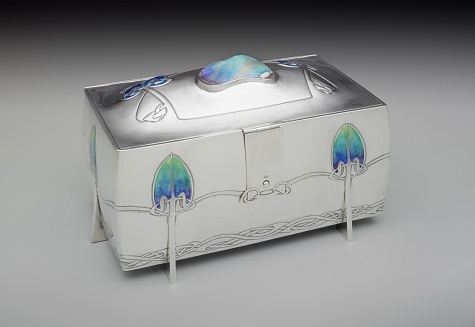
Archibald Knox, Liberty and Co., W. H. Haseler & Co., Box (model 652 variant), 1905, Dallas Museum of Art, anonymous gift.

Archibald Knox, Liberty and Co., W. H. Haseler & Co., Box (model 652 variant), 1905, Dallas Museum of Art, anonymous gift.

The third object making its DMA debut appears in a case on the east wall of this gallery. It’s hard to miss a lavish box decorated with incised linear patterns and blue-green enamel, and topped by a sizeable opal. On the adjacent platform, a charger with ship motif (1881) and a bench (1900) echo the Celtic stylings seen on Knox’s construction. Taken as a whole, the arrangement illustrates the late 19th-century interest in national identity. Many artists in Europe used the contemporary archeological discoveries of Scandinavian sites as source material for a “Viking Revival” style.

This piece is one of four variants known to exist. Unlike the other, simpler iterations, the model 652 variant features a bulging lid beset with a substantial gem. Within Liberty & Co.’s Cymric line, this would have been one of the costliest items for sale. Thankfully, this and the other works described above can be seen free of charge at the Dallas Museum of Art.

Emily Schiller is the McDermott Graduate Curatorial Intern at the Dallas Museum of Art.

Make This: Poured Paint Sculptures

20130217_151126

Studio Creations participants share their thoughts about Lynda Benglis’ work.

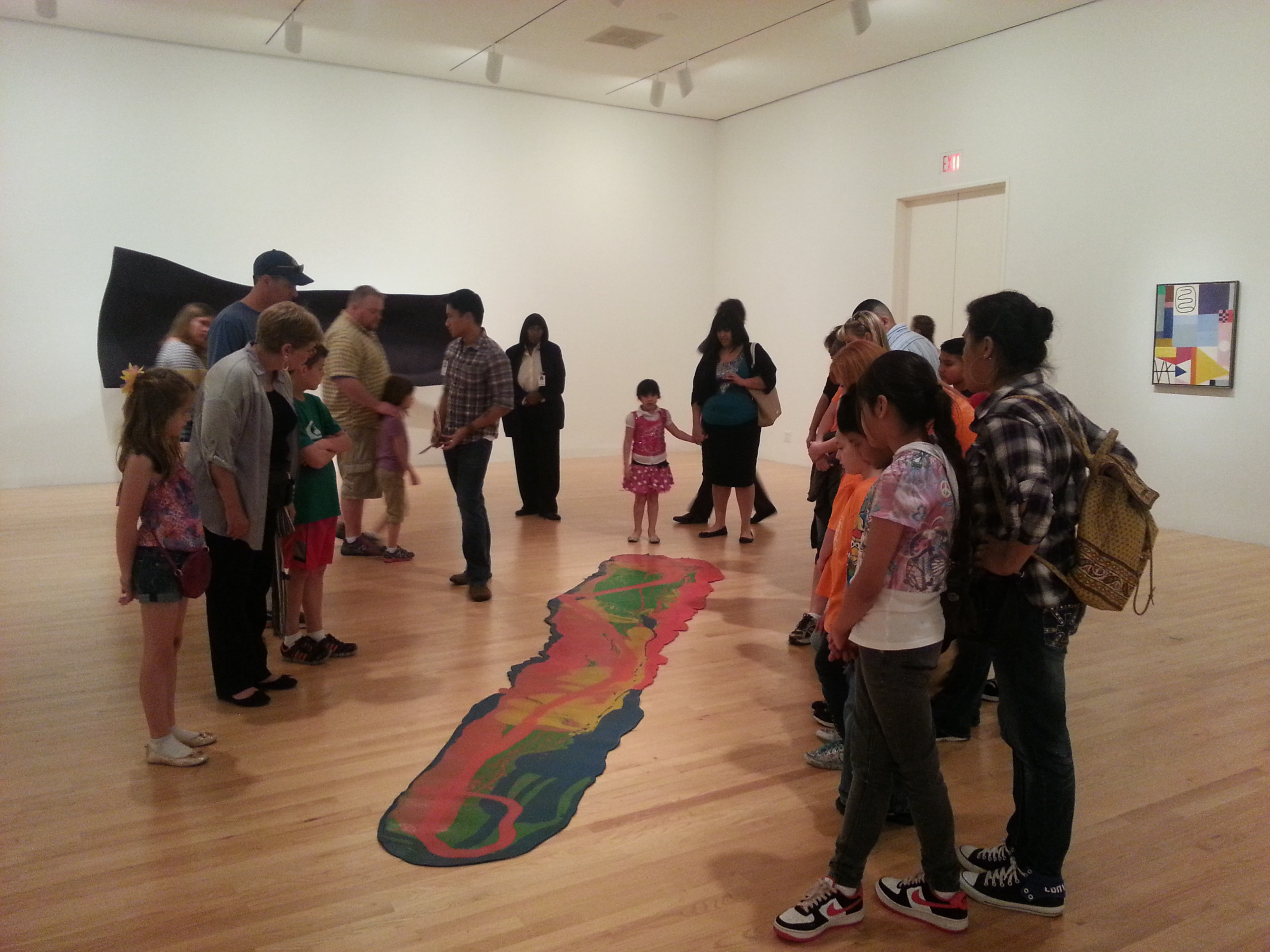
During Studio Creations this month, we looked at Lynda Benglis’ Odalisque (Hey, Hey Frankenthaler), part of the special exhibition Difference?. There are many aspects of this work of art that make it fun to talk about with people, but what I find the most interesting is the way it challenges how we define painting and sculpture. To me, it really lives between the two! This idea provided the catalyst for our Studio Creations art making activity. During each workshop, visitors created poured paintings based on chance, which, when dry, could be peeled from the painting surface and made into something sculptural. Here’s a quick tutorial for creating the project at home with your family:

Supplies

  • Gloss medium or Liquitex pouring medium (available at most art supply stores)
  • Acrylic paint (I prefer gloss acrylics, but any type will work well)
  • Painting surface: A sheet of cardboard covered with heavy plastic (or something similar)
  • Squeeze bottles or cups for dispensing paint
  • Toothpicks for adding designs (optional)

IMG_0449[1]

Plastic-covered painting surface, gloss medium, and acrylic paint in squeeze bottles

Steps

IMG_0450[1]

Squeeze a small amount of gloss medium onto the painting surface. Using your squeeze bottles or cups, drop a little bit of paint into the medium. There’s no right or wrong way to do this so feel free to experiment! Try planning it out or putting the paint in randomly.

IMG_0451[1]

Now try tilting your painting surface in different directions. The paint will start to run depending on the direction and angle that you tilt it. This is where the part about chance comes in–you only have a certain amount of control over the paint as it moves. Chance played a big role in the way that Lynda Benglis created Odalisque–she didn’t have any control over the paint after pouring it.

IMG_0453[1]

Whenever you feel like it, add more paint. But be sure to drop it into the medium–otherwise, it could break off from the rest of the painting when dry. Continue adding paint and tilting the surface until your painting almost reaches the edge.

IMG_0455[1]

When you are finished, let your painting dry for at least one day. If you added a lot of paint, it may need an extra day or two to fully dry. Afterwards, carefully peel the painting away from the painting surface–it should be plastic-like in consistency.

Now try making it into something sculptural! Your painting can easily be cut and molded. Some ideas that came up during Studio Creations were: a mask, a bowl, a mouse pad, a jacket, and a sun catcher, among others. If you’d like to share your creation with us, feel free to send an image to jbigornia@dma.org and I’ll post it on our Flickr page.

IMG_0458[1]

Finished painting

IMG_0459[1]

Almost sculptural, don’t you think?

IMG_0460[1]

Detail of paint surface

Tips

  • Your painting does not have to look a certain way. Have fun and experiment!
  • For best results, I suggest using pouring medium instead of gloss medium. It’s a little bit more expensive, and it’s only made by Liquitex, but it was designed for projects just like this one and can prevent “crazing” in the paint. For super-duper results, mix a little bit of gloss or pouring medium into your paint before you start your project. One part medium to ten parts paint should be perfect. You can also try string medium!
  • You can get different designs by letting the paint run in one direction for a while and then turning it in another direction. This is really good for making swirls, circles, etc. You can use a toothpick to create fine lines as well.
  • The medium dries clear.
  • Lots of other cool poured paint projects can be found online!
  • Further questions? Feel free to shoot me an email!

JC Bigornia
C3 Program Coordinator

Deep in the Heart of Texas

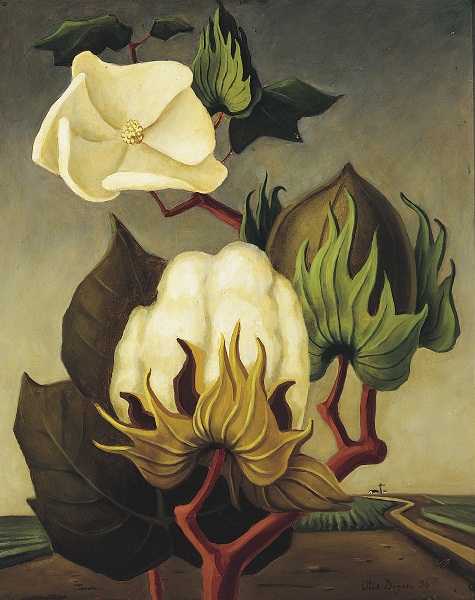
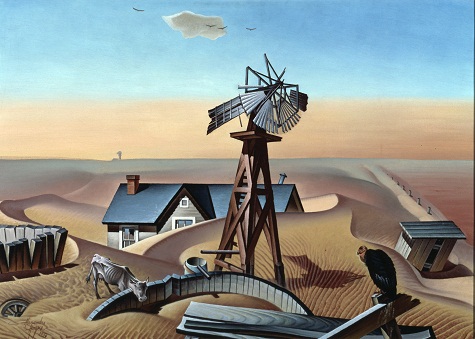
Saturday is the 177th anniversary of the signing of the Texas Declaration of Independence on March 2, 1836. Celebrate Texas Independence Day this year by viewing newly installed works by Texas artists in the American Art Galleries on Level 4 or visiting the new exhibition Loren Mozley: Structural Integrity.

Otis Dozier, Cotton Boll, 1936, oil on Masonite, Dallas Museum of Art, gift of Eleanor and C. Thomas May, Jr.

Otis Dozier, Cotton Boll, 1936, oil on Masonite, Dallas Museum of Art, gift of Eleanor and C. Thomas May, Jr.

Alexandre Hogue, Drouth Stricken Area, 1934, oil on canvas, Dallas Museum of Art, Dallas Art Association Purchase

Alexandre Hogue, Drouth Stricken Area, 1934, oil on canvas, Dallas Museum of Art, Dallas Art Association Purchase

Florence E. McClung, Squaw Creek Valley, 1937, oil on canvas, Dallas Museum of Art, gift of Florence E. McClung

Florence E. McClung, Squaw Creek Valley, 1937, oil on canvas, Dallas Museum of Art, gift of Florence E. McClung

Charles T. Bowling, Mason County Landscape, 1938, egg tempera on composition board, Dallas Museum of Art, gift of Eleanor and C. Thomas May, Jr.

Charles T. Bowling, Mason County Landscape, 1938, egg tempera on composition board, Dallas Museum of Art, gift of Eleanor and C. Thomas May, Jr.

Jerry Bywaters, Share Cropper, 1937, oil on Masonite, Dallas Museum of Art, Allied Arts Civic Prize, Eighth Annual Dallas Allied Arts Exhibition, 1937

Jerry Bywaters, Share Cropper, 1937, oil on Masonite, Dallas Museum of Art, Allied Arts Civic Prize, Eighth Annual Dallas Allied Arts Exhibition, 1937

Merritt Mauzey, Neighbors, 1938, oil on masonite, Dallas Museum of Art, Arthur Kramer and Fred Florence Purchase Prize, Ninth Annual Dallas Allied Arts Exhibition, 1938 1938

Merritt Mauzey, Neighbors, 1938, oil on Masonite, Dallas Museum of Art, Arthur Kramer and Fred Florence Purchase Prize, Ninth Annual Dallas Allied Arts Exhibition, 1938 1938

Kimberly Daniell is the Public Relations Manager at the Dallas Museum of Art and Elizabeth Donnelly is the Exhibitions Assistant at the Dallas Museum of Art.

The Arts of India, Southeast Asia, and the Himalayas

On February 28, the DMA will celebrate the publication of the first catalogue dedicated to exploring the Museum’s collection of South and Southeast Asian art. The Arts of India, Southeast Asia, and the Himalayas at the Dallas Museum of Art was written by Dr. Anne R. Bromberg, the DMA’s Cecil and Ida Green Curator of Ancient and Asian Art.
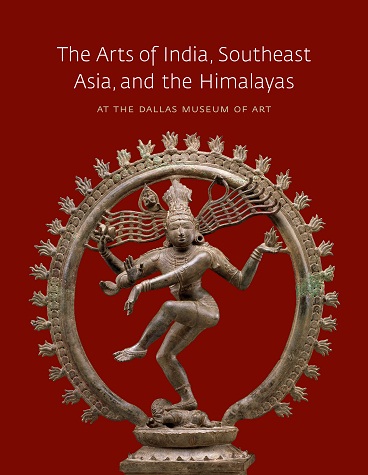
DMA_SAsian_Jacket

The catalogue examines over 140 sculptures, architectural pieces, and other works of art that represent the many cultures and religions of India, Southeast Asia, and the Himalayas. Both visually and intellectually compelling, the catalogue celebrates the beauty and diversity of art from the region, as well as its social and historic significance.

The DMA’s South Asian collection has been growing since the first statue from the region was acquired in 1955. Since then, several exhibitions have led to the expansion of the collection, including the groundbreaking exhibition The Arts of Man in 1962 and the 1993 exhibition East Meets West: Selections from the David T. Owsley Collection. Following that exhibition, Mr. Owsley agreed to donate the exhibited works to the Museum, providing the core of the new Asian galleries that opened in 1996. He is also leaving his personal collection to the Museum in his estate.

We invite you to visit the Asian galleries to see (for free!) works from the catalogue that are currently on view, including the following and many others.
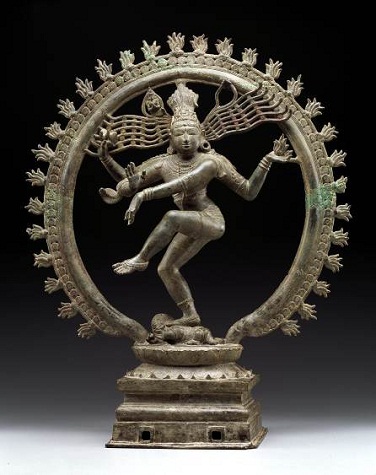
Shiva Nataraja, Chola dynasty, 11th century, bronze, Dallas Museum of Art, gift of Mrs. Eugene McDermott, the Hamon Charitable Foundation, and an anonymous donor in honor of David T. Owsley, with additional funding from The Cecil and Ida Green Foundation and the Cecil and Ida Green Acquisition Fund

Shiva Nataraja, South India, Tamil Nadu, Chola dynasty, 11th century, bronze, Dallas Museum of Art, gift of Mrs. Eugene McDermott, the Hamon Charitable Foundation, and an anonymous donor in honor of David T. Owsley, with additional funding from The Cecil and Ida Green Foundation and the Cecil and Ida Green Acquisition Fund

This bronze sculpture of Shiva, the Hindu god of destruction, shows him in his form as the Lord of the Dance. His dancing obliterates ignorance, signified by the dwarf beneath him. On special occasions, metal images such as this one were taken on procession both within the temple and in the surrounding area.
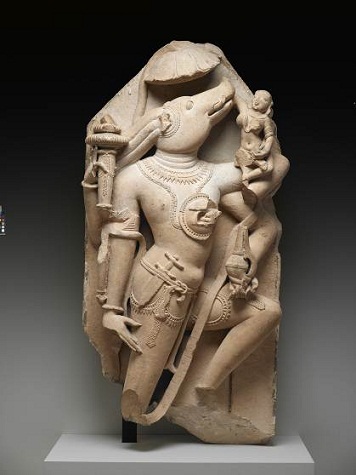
Vishnu as Varaha, 10th century, sandstone, Dallas Museum of Art, gift of David T. Owsley via the Alvin and Lucy Owsley Foundation and the Alconda-Owsley Foundation, E.E. Fogelson and Greer Garson Fogelson Fund, General Acquisitions Fund, Wendover Fund, and gift of Alta Brenner in memory of her daughter Andrea Bernice Brenner-McMullen

Vishnu as Varaha, Central India, Madhya Pradesh, 10th century, sandstone, Dallas Museum of Art, gift of David T. Owsley via the Alvin and Lucy Owsley Foundation and the Alconda-Owsley Foundation, E. E. Fogelson and Greer Garson Fogelson Fund, General Acquisitions Fund, Wendover Fund, and gift of Alta Brenner in memory of her daughter Andrea Bernice Brenner-McMullen

This sculpture portrays Vishnu, the Hindu preservation deity, as his incarnation of Varaha, with the head of a boar and the body of a human. He is shown triumphantly rising up from the ocean with the earth goddess, whom he has just rescued from the sea-demon that tried to drown her. Large figures of Varaha such as this one were often used to commemorate a king’s victory in battle, drawing an analogy between the righteousness of Varaha and the monarch.
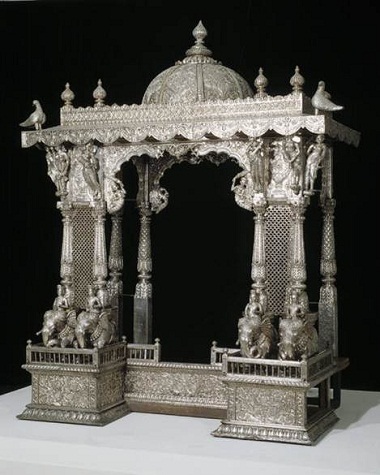
Shrine, late 18th-19th century, silver over wood, Dallas Museum of Art, gift of David T. Owsley via the Alvin and Lucy Owsley Foundation

Shrine, India, Gujarat, late 18th-19th century, silver over wood, Dallas Museum of Art, gift of David T. Owsley via the Alvin and Lucy Owsley Foundation

This magnificent shrine is covered with a silver veneer and represents a miniature version of the universe; imagery evolves from the earthly realm of human activity to the heavenly realm with celestial dancers and birds near the dome. The eclectic imagery makes it difficult to identify as either Jain or Hindu without the holy figure that would have been seated in the middle. Shrines such as this one were used in private homes as well as in devotional chapels in larger temple complexes.
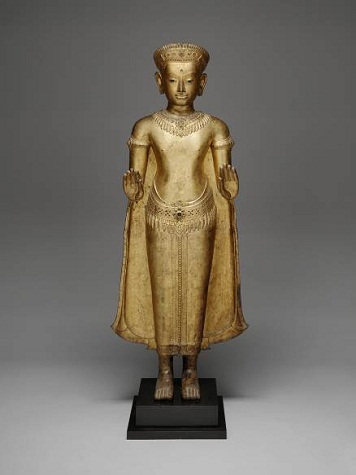
Buddha Sakyamuni, Khmer, c. 13th century, gilded bronze, Dallas Museum of Art, gift of David T. Owsley via the Alvin and Lucy Owsley Foundation, the Cecil and Ida Green Acquisition Fund, and Wendover Fund

Standing Buddha, Thailand, Lopburi style, 13th-14th century, gilt bronze, Dallas Museum of Art, gift of David T. Owsley via the Alvin and Lucy Owsley Foundation, the Cecil and Ida Green Acquisition Fund, and Wendover Fund

This gilt bronze statue of the Buddha stands with his hands out in a gesture meant to drive back floodwaters. The Buddha’s spiritual wealth is reflected in the lavish material of his clothing and intricate decoration of his crown and jewelry. The artistic style is named after the central Thai city of Lopburi, which was both the political and artistic center of the region.
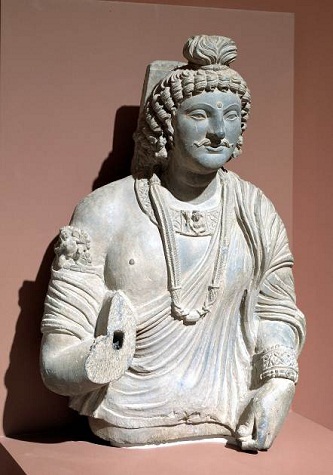
Bust of a bodhisattva, Kushan, 2nd-3rd century, gray schist, Dallas Museum of Art, gift of Margaret J. and George V. Charlton

Bust of a bodhisattva, India, Gandhara, Kushan period, 2nd-early 4th century, gray schist, Dallas Museum of Art, gift of Margaret J. and George V. Charlton

This terracotta sculpture represents the last of the bodhisattvas that preceded the historical Buddha. This bodhisattva will be reborn as Siddhartha Gautama, the Buddha. Here, he is meditating on that reincarnation.

Please join us on Thursday, February 28, for a discussion led by Dr. Bromberg with fellow contributing authors to the book: Frederick M. Asher, Chair of the Department of Art History at the University of Minnesota; Robert Warren Clark, Coordinator of the Tibetan Language Program at Stanford University; and Nancy Tingley, an independent curator of Southeast Asian art. During this insightful program, they will discuss the history of the South and Southeast Asian collection at the DMA, as well as the process of creating the catalogue and what they found most interesting from the experience.

Andrea Lesovsky is the McDermott Graduate Curatorial Intern in Ancient and Asian Art at the DMA.

Archives

Categories