Archive for the 'People' Category


An Extraordinary Ten Years

After a decade of working with school programs at the Dallas Museum of Art, I have recently resigned as Head of Teaching Programs in order to continue to develop my two passions – works of art and teaching.

The last ten years have been extraordinary in many ways as I have learned about and taught with the DMA’s encyclopedic collections and special exhibitions.  I’ve met several teachers who share my passion for art and teaching and have spent many meaningful hours in the galleries with them as we explored works of art together.  I’ve directed our docent program and have worked closely with over a hundred dedicated volunteers who give several hours of their time each week to make Museum visits possible for tens of thousands of Dallas-area students each year.

Although I’m looking forward to new adventures, I’m sad to leave behind the wonderful friendships I’ve made – with works of art and with people.  I appreciate all of the time and energy that teachers devote to sharing their love of works of art with their students and the time they commit to scheduling and preparing for art museum visits.  I believe that experiences with works of art can be transformative, and I wish all of you art teachers and my staff and docent colleagues all of the best as you continue to make these experiences possible.

Fondly,

Molly Kysar
Head of Teaching Programs

[slideshow]

TAEA 2010

This past weekend, my colleague Shannon Karol and I took a trip down I-35 to Austin for the annual Texas Art Education Association (TAEA) conference.   TAEA brings together art educators in K-12 classrooms, universities, and museums.

My favorite part of TAEA has been getting to hear what other museums in the state are doing.  This year, I learned how ArtPace works with community partners in a program called ¿Como Vives?, how the Meadows Museum structures a multiple-visit program with area 6th graders, and how the Museum of Fine Arts, Houston engages audiences with contemporary art.  There was a lot to take in! 

Shannon and I also got a chance to talk about the DMA in presentations we gave.  Shannon shared her expertise in African art with conference-goers in her session, Themes for Teaching with African Art.  The session included themes (including family, proverbs, and royalty) that can be used to engage students of all ages with African art.  If you are interested in integrating African artworks into your classroom, I hope you’ll check out Shannon’s African Art Resources

In my session, Close-Looking, Collaboration, and Creative Response: Interactive Experience with Works of Art, I shared three activities that allow for my favorite kinds of gallery experiences: ones that are open-ended, involve groupwork, and art-making or writing in response to a work of art.  My favorite of the three is Post-It poetry.  I like poetry exercises; I think they’re a great way to get students to distill their ideas about an artwork into brief, meaty responses.  With Post-It poetry, students write words that describe an artwork on individual Post-Its and stick them to a board that serves as a group word bank.  After all group members have contributed responses, the group works together to rearrange Post-Its to create phrases or sentences.  Click here for more detailed Post-It poetry instructions.

What I like most about this activity are the unexpected resonances that happen when students read poems.  Hearing different, fresh combinations of words always enriches the experience of looking at an artwork for me.  Below are some Post-It poetry pictures, and a Post-It poem participants made during my TAEA session.

[slideshow]

The two of us also took in the sights in Austin.  We checked out the Blanton Museum of Art, stopped by the capitol, shopped funky stores on South Congress, and had a blast eating out of trucks!  (Not the F-150 kind, but the street-food-vending kind).   All in all, it was quite the weekend.

Amy Copeland
Coordinator of Go van Gogh Outreach

Community Connection: Eye-opening, Enlightening, and Fabulous

Some of our devoted Go van Gogh volunteers have participated for many years, so we design special workshops for them with the goal of making connections – with works of art, with fellow volunteers, and with personal teaching experiences – in fun and fresh ways.  These themed workshops often feature guest speakers, such as local artists or our colleagues in the education department.   

Our last workshop focused on the theme “PLAY”; you can view pictures from the workshop in our intern Karen’s photo post.  We invited Leticia Salinas, the 2009-2010 McDermott Intern for Family Experiences, to lead conversations and activities with volunteers in front of works of art entirely in Spanish.  Volunteers commented after the workshop that their experience with Leticia was “eye-opening”, “very valuable”, “helpful”, “enlightening”, and “fabulous”.

Leticia leads the Paint the Town DMA Summer Art Camp.

Tell us about your connection with the DMA.

I’ve been in Dallas for about ten years, and during college I visited the DMA every now and then and attended Late Nights.  Last year, I was the McDermott Intern in the Family Experiences department.  I continue to help during Late Nights and other special Family Experiences programs. 

What are you doing now?

I am a Special Education Bilingual Teaching Assistant at Thomas Elementary in Plano ISD.  I help teachers in classrooms with special education and/or bilingual students, primarily kindergarten through second grade. 

Describe your session with Go van Gogh volunteers.

I gave two tours in Spanish focusing on Jackson Pollock’s Cathedral and three hats in the African collection.  This helped volunteers put themselves in the position of ESL students and also showed them effective ways of teaching these learners.  Hopefully, the volunteers were able to gauge how these students feel and will be able to use that knowledge as a tool when they teach.  It was a really great experience, and I enjoyed it.  The volunteers were all very willing to participate even though it was a different language and they may have felt uncomfortable.

What do you consider important when working with ESL students, and how does this apply to teaching with works of art?

When working with ESL students, there has to be something more than language.  You have to be really creative and think of different ways to teach a subject.  This applies to all subjects.  I think art is a great way to teach ESL learners because they have a visual picture of what you’re talking about.  You can get creative and lead activities that are more hands-on and fun, playing with color and lines and movement.  All of those concepts are easy to teach to students who don’t speak English fluently.

Finish this sentence: In ten years, I’d like to be…

I hope to be at a place where I’m happy with my job and I love what I do, whether it be working in a museum or with kids or doing something totally different that I never thought I would do.  Hopefully, in ten years I’ll have it all figured out.

A Day in the Life of an Intern

I have been an intern at the Museum for almost two months and have had some exhilarating moments.  I have enjoyed walking through the galleries with the curators as they speak about the works of art. They are walking encyclopedias. I have also had the opportunity to be a part of some great training sessions. The docent trainings, which occur every Monday, have been wonderful. The docents, along with the education staff, learn about works of arts in the collection and exhibitions. Sometimes these trainings are led by the curators, and other times, by an education staff member. The docents and staff  also go into the galleries and work on activities to better familiarize ourselves with the artworks in order to create great teaching moments.

Another area of the Education Department I worked with is Go van Gogh. I have also attended a few of the volunteer trainings. Sometimes during training we go into the galleries and look at the works of art and other times we get to make artwork for the different programs we teach. Go van Gogh allows me to travel to different elementary schools in Dallas and discuss with children works of art from the Museum’s collection. How cool is that! I get an opportunity to spend one hour with students and have these amazing and in-depth conversations about artists and their artworks.  By the way, another great aspect of this program is driving the Go van Gogh van.

I have recently started giving tours at the Museum. I have given two so far and each time the students have left giving me great big hugs and saying how much they have enjoyed their visit. Leading the tours allows me to continue to work with children. I will also be giving several “A Looking Journey” Tours for 4th graders  throughout the remainder of my internship.

Other moments at the Museum consists of meetings. Meeting over here, meeting over there, meeting everywhere! I want to say there is not a week that goes by in which I haven’t attended a meeting. I enjoy the meetings because it allows me to bond with the Education staff and learn how to plan for future programs. One of my favorite meeting moments was a  meeting, in which the staff brainstormed fifty Ideas based on a pair of 3-D glasses. What an incredible experience.

So there you have it. There is always something exciting going on in “A Day in the Life of an Intern.”

Karen A. Colbert
Teaching Programs Intern

Interview with Visitors Services Staff

Ginan Kalenik, Visitor Services Manager

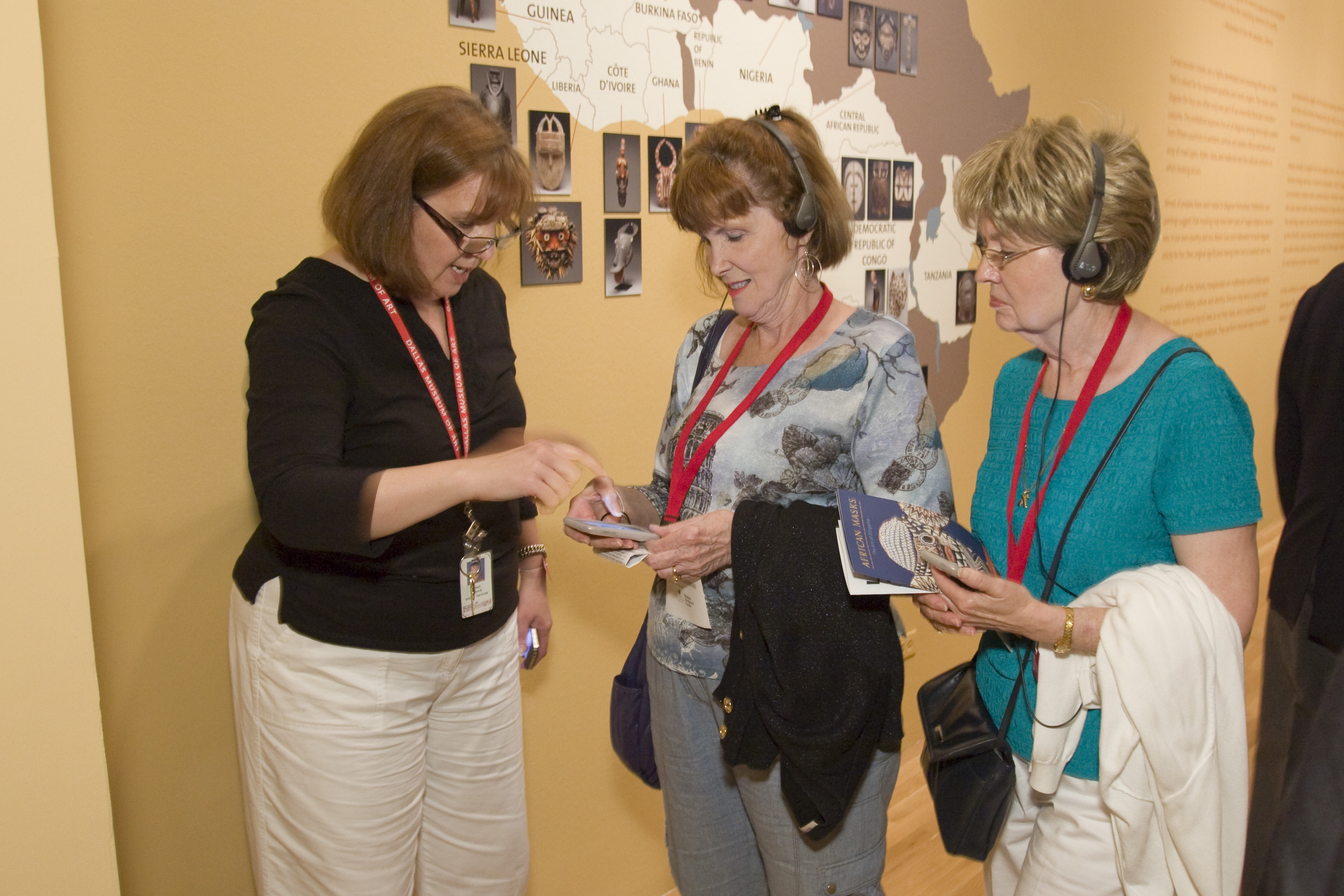
One of the first individuals a DMA visitor encounters is a member of the Visitor Services staff. This team works hard to ensure that all visitors have enjoyable experiences during their museum visit. Ginan Kalenik, Visitors Services Manager, recently answered questions related to her position at the Museum.

Name and Title: Ginan Kalenik, Visitor Services Manager

Years Employed at the Dallas Museum of Art: Six years employed; twenty years as a Visitor Services  volunteer prior to that.

Describe your job here at the Museum: Visitor Services sells tickets to our visitors and answers visitors’ questions.

What is your favorite part of your job? Helping an excited visitor plan their experience at the DMA.

What is a challenge you face in your job? Helping visitors understand that there are rules of conduct in the museum that are intended to preserve the art, not to prevent them or their children from having a good time.

How did you decide you wanted to work in a Museum? I’ve always loved museums, especially art museums.  I decided to volunteer to be a part of the new museum when it opened at its current location.  At an opportune time there was an opening to join the staff part-time, and that morphed into a full-time position.

If you weren’t working at the Museum, what is something else you would be doing?  I would be back on my former career path in a corporate environment as a Project Manager dealing with technology.

Amy Wolf
Coordinator of Gallery Teaching

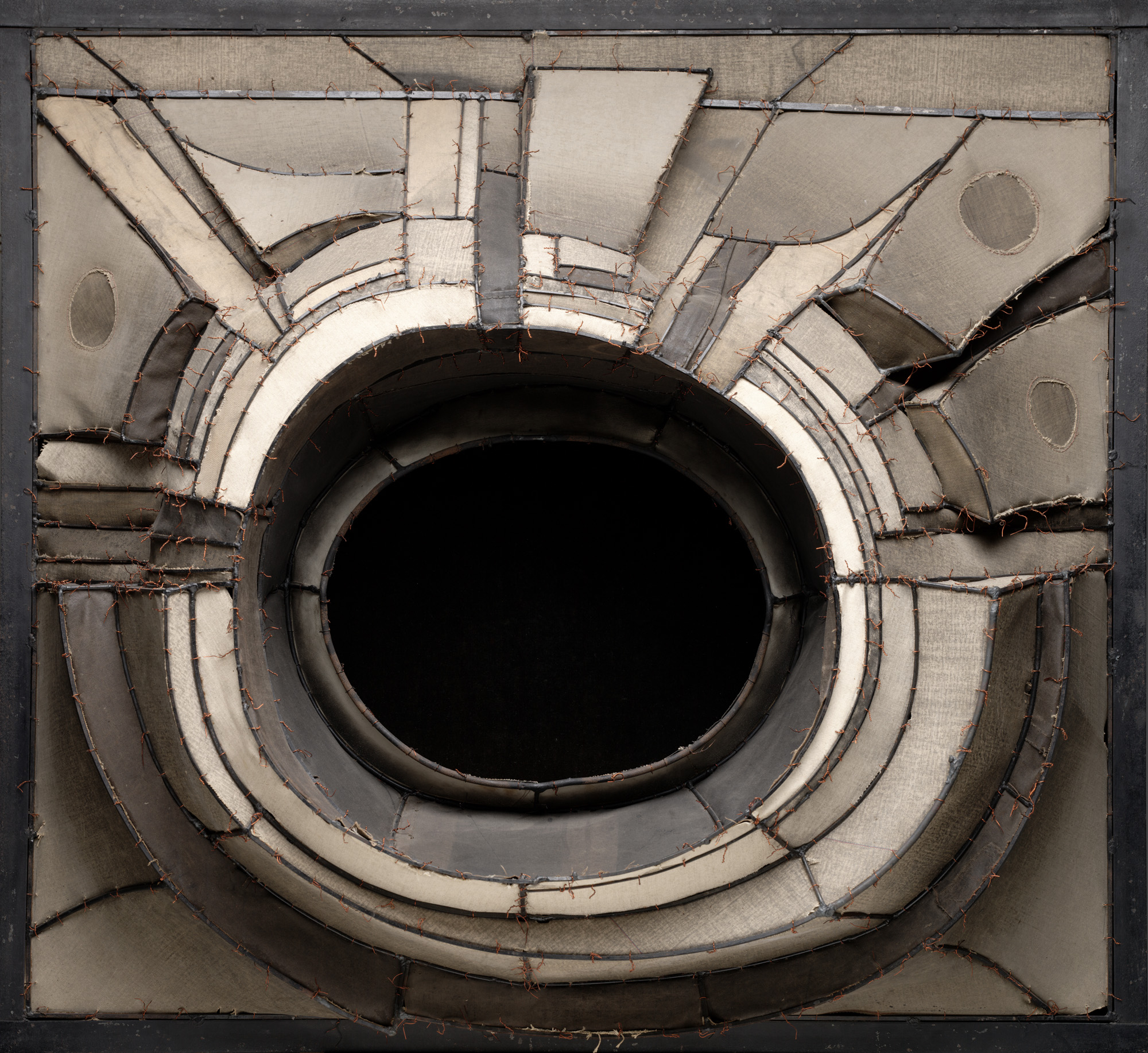
The hole goes all the way down to space…

Lee Bontecou, Untitled (35), 1961, welded metal and canvas, Dallas Museum of Art, gift of the Meadows Foundation, Incorporated, 1963.92.FA.

We spend a lot of time here in the Education Department thinking about works of art in our collection and how we can engage visitors with them in provocative, meaningful ways.  The fun part comes when we go out into the galleries to talk to visitors about what they see and what artworks mean to them. 

This past Tuesday afternoon, I spent some time in the Center for Creative Connections talking to a few visitors and one staffer about Lee Bontecou’s Untitled (35), an artwork in the new Encountering Space installation.  Next to Untitled (35), we have a metaphor response wall where visitors can leave their thoughts about the artwork, in response to a few prompts.  I asked visitors a variation of one of the prompts:  What words or pictures come to mind when you look at the work of art?  Below are their responses (look for visitors in the slideshow!). 

It looks like a well, an endless well.  It goes down deep in the ground, so deep you can’t see it.  Not even a flashlight would help.  If you keep imagining, the hole goes all the way down to space, you can see stars.
    
-Corinthia, 9 years-old

It looks like something’s in it.
     
-Kody, 4 years-old

It’s mysterious, and very intriguing.
     
-Brittany, Kody’s mom

Upon walking up, it looks like a carpet design coming out at you.  Like it used to be flat, but it’s coming out at you.  I thought it looked like a volcano, too.
     
-Victoria

From far away it looks like a stadium, but then I got closer, and it looks like a building.  It reminds me of the movie Inception–how the buildings come apart.
      -Ivan

It looks like it should be in the Nightmare Before Christmas.
     -Jennifer
[slideshow]

Readers, what words or pictures come to mind when you see this artwork?

Amy Copeland
Coordinator of Go van Gogh Outreach

Community Connection: Nasher Sculpture Center

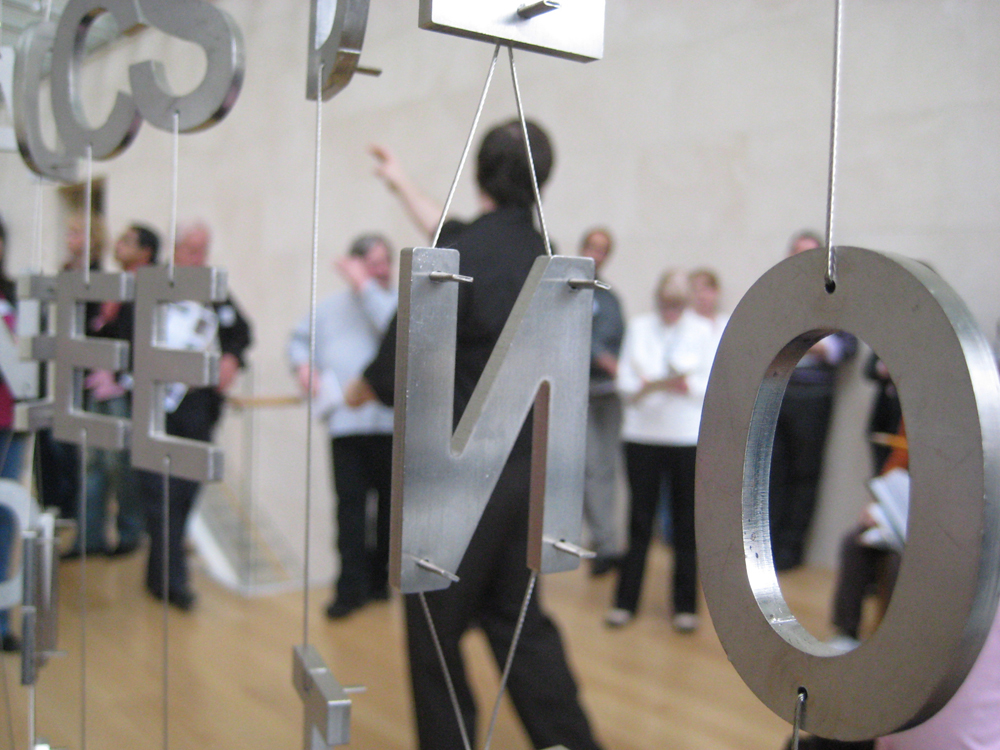
This past weekend marked the kick-off of Art in October, a celebration of the Dallas Arts District that features a variety of performances, exhibitions, programs, and events throughout the month.  In honor of this celebration, I walked across the street to the Nasher Sculpture Center for a coffee break with Stephen Ross.  Stephen began working in Admissions at the Nasher months after it opened in 2003.  Since then, he has held the title of Education Coordinator, Assistant Curator of Education, and for the last two years, Curator of Education.  See if you can find Stephen in this picture (hint: you can often identify a museum educator by his/her all-black outfit).

Stephen Ross seen through Jaume Plensa’s Twenty-nine Palms, 2007

What sparked your interest in museum education?
I think you have two choices coming out of graduate school – stay in school and become a curator (even though you don’t know what that is) or get a job at a museum.  I like museum education because I get to work with the public.

What has been the most enjoyable, challenging, or surprising aspect of your work with the Nasher?

I really like our Education Department.  It is limited because of our small staff, which is a total of three people.  I work with two really good people, and together we reach a wide spectrum from young children to adults.  We do a lot – we reach different audiences with different types of learning – so we all get to do a variety of things.

If you could take home any work of art from the Nasher, what would you choose?

I would take home Alberto Giacometti’s Two Figurines (Deux figurines sur socles) because they’re wonderful and tiny.  I love their size and portability – each figurine is less than two inches tall.  Giacometti would carry them around in matchboxes and put up small “exhibitions” on café tables.  They are the smallest pieces in the Nasher collection.

Tell us about your relationship with the DMA.

I work with the Museum Forum for Teachers, a five-day summer program for teachers that occurs at the Nasher, the DMA, The Rachofsky House, the Kimbell Art Museum and the Modern Art Museum of Fort Worth.  We also collaborate on the docent program, which is a big help.  A small museum like ours could never have its own docent program, and we are thankful that DMA docents also lead tours at the Nasher. 

I love the sense of collaboration, in general.  I feel I can pick up the phone and call anyone in the DMA Education department to talk about program ideas, ask questions, etc.

Describe your idea of a perfect day.

Reading Beckett.  Listening to the Rudy Van Gelder sound.

Check out the Nasher and other Arts District venues during Art in October.

Melissa Nelson
Manager of Teaching in the Community

Community Connection: We Heart Volunteers

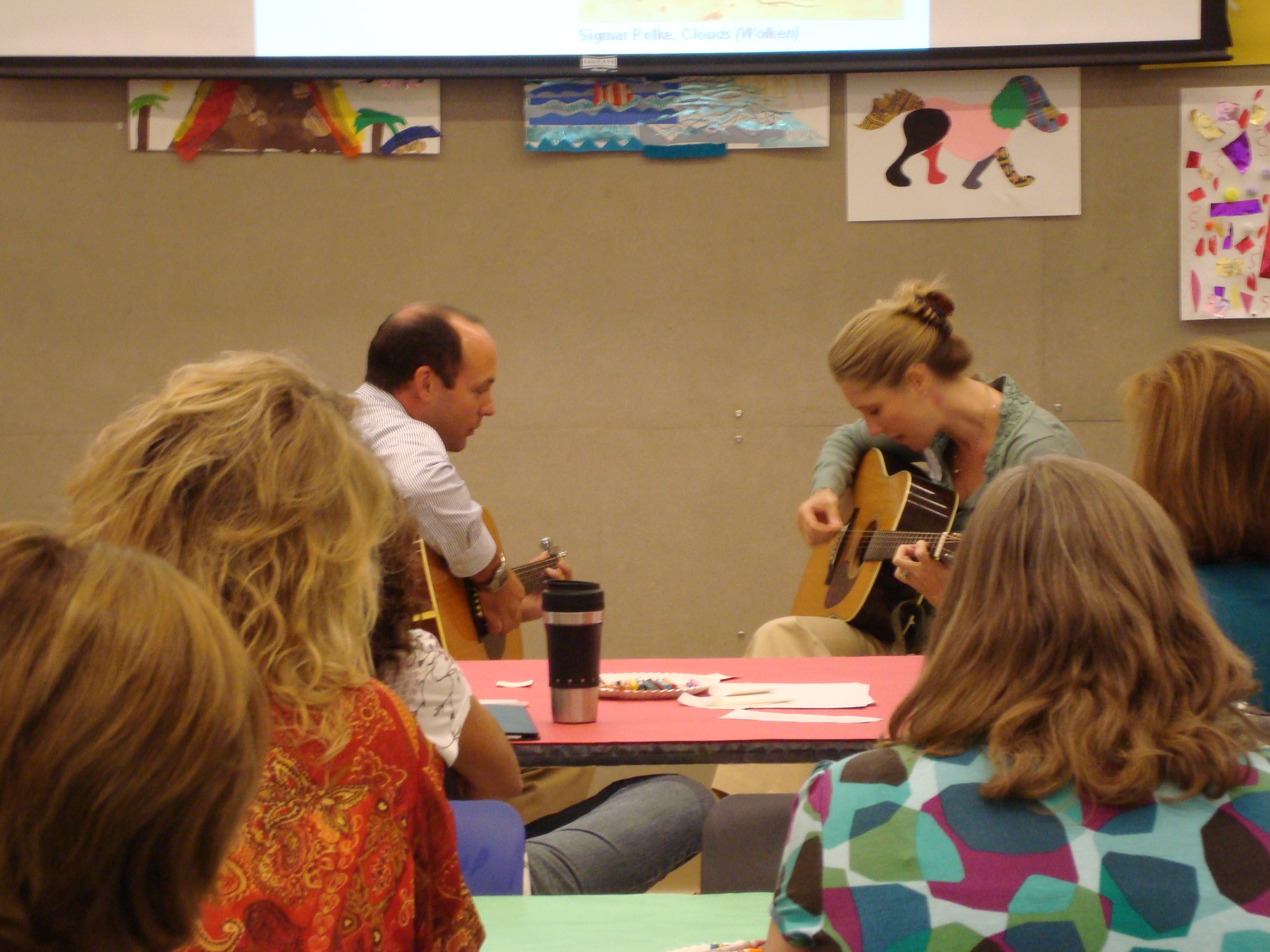
Meet Deborah Harvey, who is starting her fourth year as a Go van Gogh volunteer.  We can always count on Deborah for her positive and fun attitude and for her willingness to try new things.  For example,  Deborah bravely volunteered for an unknown task during a volunteer training focused on the different ways that people learn.  Little did she know that our guest speaker was a musician, and as part of his demonstration, he taught Deborah to play a song on the guitar in a mere thirty minutes.  You can see a picture of Deborah performing below.

Deborah plays a newly-learned song at volunteer training.

Tell us a little about yourself. 

I’m a former teacher.  Most of my teaching experience is with younger elementary students.  I’m also married and have a sixteen year-old son and a twelve year-old daughter.

What motivated you to join the Go van Gogh volunteer program?

I wanted to stay in the realm of teaching once I retired.  I like the opportunity to have a whole classroom experience as opposed to one-on-one interactions with students. The subject matter among all the Go van Gogh programs is varied, which keeps things interesting for me.

Share a memorable experience from your time as a volunteer.

Just today, I visited a fourth grade classroom at J. Erik Jonsson Community School with a program about Texas art.  The children shared a lot about their vacation experiences and things that felt like Texas to them.  I really enjoyed the wide variety of responses.  One student talked about going to the beach, and another student’s family owns a ranch with longhorn cattle.

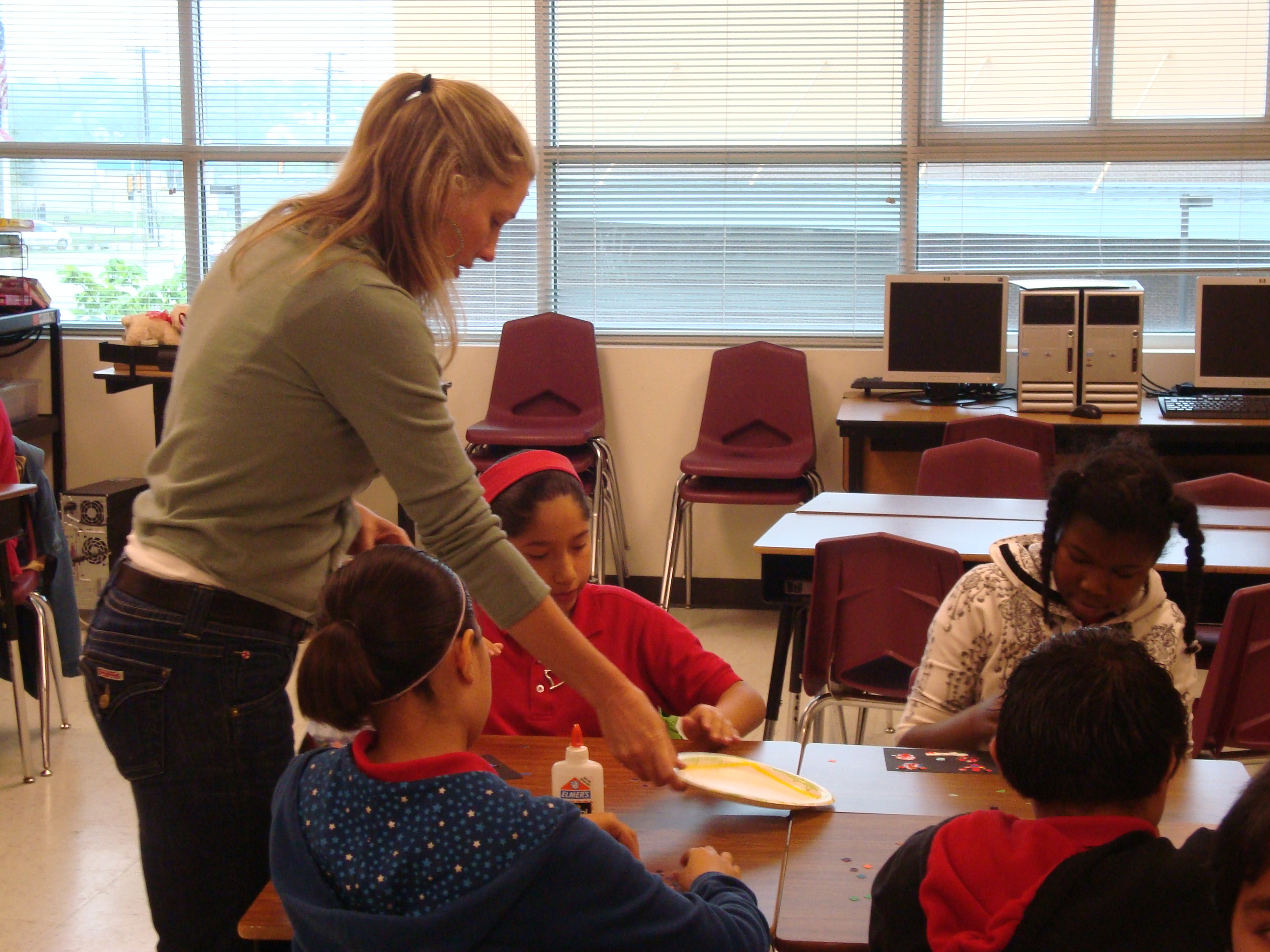
Deborah visits a fifth grade classroom at Felix Botello Elementary.

Has anything surprised you about teaching with works of art, visiting classrooms, or student responses to the programs?

At times, I’m surprised that the older children are still very engaged.  Sometimes it can be hard to find a common ground or things that interest them.  The programs are so age-appropriate that the kids get really engaged.

Outside of volunteering with Go van Gogh, how do you spend your time?

I volunteer as a board member at both of my kids’ schools, and I volunteer with Meals on Wheels.  I also like to travel; I’m going to San Francisco tomorrow for my husband’s birthday, and our family is taking a trip to Vail for Christmas.

Thanks to volunteers like Deborah, 430 classrooms throughout Dallas – approximately 8,800 students – experienced Go van Gogh programs during the 2009-2010 school year.  Request a program now for the 2010-2011 school year!

Melissa Nelson
Manager of Teaching in the Community

Spotlight on Denise Ford, DMA Docent

Today is our first day of tours for the 2010-2011 school year, and we are excited to share our collections and our new exhibitions–Arts of Mexico and African Masks: The Art of Disguise–with teachers and students from across the Metroplex.  Our tour calendar is filling up quickly, so if you want to schedule a DMA visit for your students, fill out our Online Visit Request Form soon.

With the start of tours comes the return of our fabulous docents.  This year, we have 108 docents who will give tours to K-12 and Higher Education students, as well as to adults.  I thought I would give you a chance to get to know one of our brand new docents, Denise Ford.*  Denise joined the DMA docent program last year, and this is her first year as a full-time touring docent.  If you bring your students for a tour on a Tuesday afternoon, you just might have Denise as your guide!
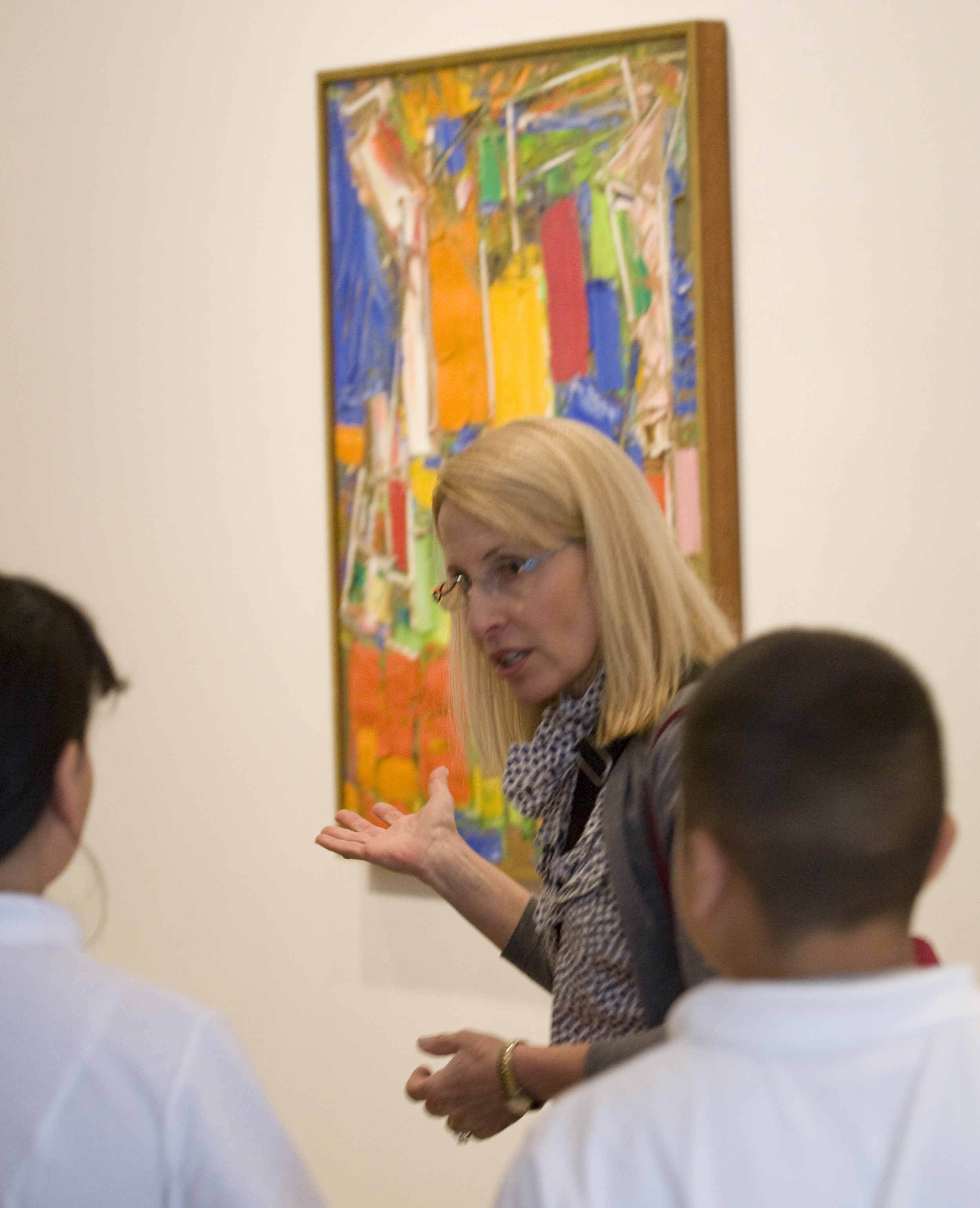
Docent Denise Ford in front of Hans Hofmann's Red and Blue Harmony

How long have you been a DMA docent?
I have been a docent for one year.

Why did you become a docent?
I became a docent because of my interest in art, my desire to interact with other people (especially students), and my desire to give back to the Dallas community.

Tell me about your experience in the docent program.
In the short time that I have been a docent, I have learned so much about art and how history and culture are such vital parts of art and artists.  I have met all kinds of people from all walks of life.  I have enjoyed spending time in the Museum with students, many of whom are new to the Museum.  I particularly like to encourage the students to develop ideas about the objects they are looking at.

What is your favorite work of art in the DMA collection?
My favorite work of art in the DMA collection is The Eye by David Altmejd.  The Eye was an object all students loved to see and interpret.  I also enjoy the Reves Collection , especially touring students because it helps them understand art outside of the museum and in someone’s home!

Share your best tour experience.
I had many memorable experiences and am trying to keep a tour journal.  Two experiences stand out from this past year.  The first was a male student who was somewhat quiet and stayed a little distant from the rest of the class.  After fifteen minutes or so, he warmed up and said, ‘You have a nice smile.’  The second was a group who was interested, informed, and welcomed challenging ideas.  One girl in this group latched onto my arm about halfway through the tour and never left my side until it was time to board the bus.  When she left, she said, “Before I came today, I did not think I liked art and museums.  I thought it was boring.  But I loved this, and want to bring my mom back with me.”

Docent Denise Ford with a group of 4th graders

Denise also understands how important teachers are in the lives of their students.  She says: “Although I have never taught school, I really appreciate the teachers who bring their students to the Museum.  Teaching requires a gift of patience and a kind spirit.  It is apparent when there is positive interaction between teachers and their students.”  I couldn’t agree with her more!  We hope to see you and your students at the DMA this year.

Shannon Karol
Coordinator of Museum Visits

*If you would like to learn more about our docents, visit the DMA’s new blog Uncrated, which features an interview with docent Tom Matthews.

Intern Update

postcard from Justin Greelee's travels in Italy

 A few short months ago, we said farewell to our interns Logan Acton and Justin Greenlee, and last week we welcomed our new interns for 2010-2011, Karen Colbert and Ashley Bruckbauer.   

Logan Acton, Assistant to the Director of Education

Since wrapping up their internships, Justin and Logan have both been very busy. Justin left the States for Italy to work for a study abroad program run by his alma mater, Kenyon College.  He’s had the chance to do a lot of traveling — mostly art-related — including an amazing trip to Assisi.  

Logan completed his M.A. in Aesthetic Studies from The University of Texas at Dallas and was hired in August as a full-time DMA staffer. He is now the Assistant to the Director of Education, and we are thrilled to get to continue working with him.  

Ashley Bruckbauer, McDermott Intern

 Ashley Bruckbauer is the new McDermott Intern for Programs and Resources for Teachers. She received her B.A. from Southern Methodist University in Art History and Advertising Management. Her experiences prior to joining the DMA are graduate-level research in France, an internship at the Crow Collection of Asian Art, and teaching abroad in Shanghai, China.  

Karen Colbert, McDermott Intern

 Karen Colbert is the new McDermott Intern for Teaching Programs. She is currently completing her Master’s degree in Art Education, with a focus on museum education and arts leadership, at the University of North Texas. Before joining the DMA staff, Karen was an educator at the Women’s Museum in Dallas and an art teacher with the Dallas Independent School District. 

 We are excited to have Ashley and Karen on our team for the 2010-2011 school year! Keep an eye on this blog for upcoming posts about their experiences as DMA interns. 

Molly Kysar
Head of Teaching Programs


Archives

Categories