Archive Page 72

Make This: Sound Prints

Have you ever wondered what a painting might sound like if you could listen to it? With conductive ink, a Makey Makey, and some basic software, you can add a new level of interactivity to your artwork through the use of sound! In this guide, I’ll show you how to make a print that will make sounds when you touch it. These sounds are completely reprogrammable and can be changed on the fly, giving you lots of possibilities for what you can create.

A Makey Makey is an interface that connects to your computer which allows you to create your own tactile inputs that will take the place of certain keys on your keyboard.
IMG_2684

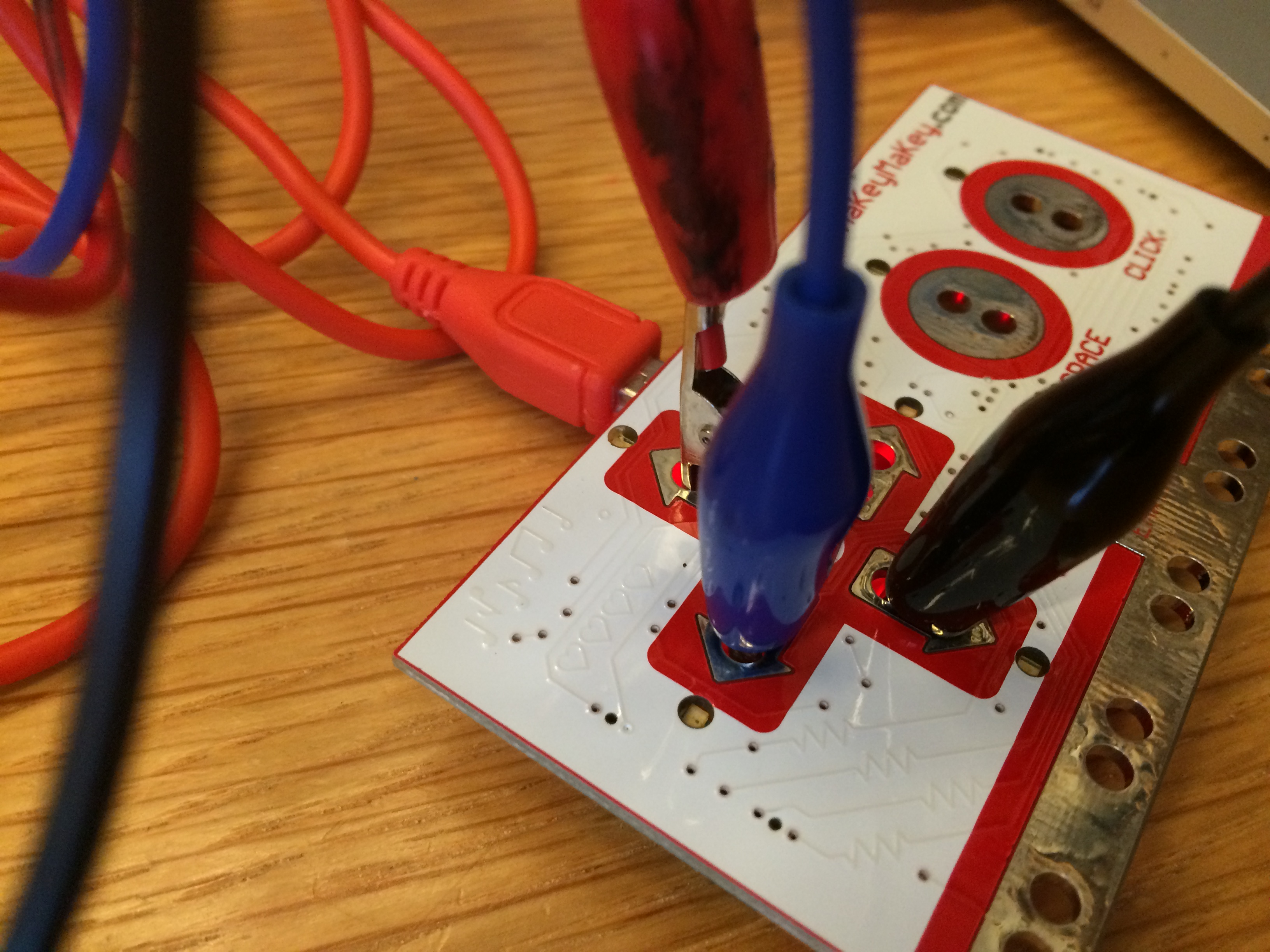
The Makey Makey can be connected to different conductive materials to replace your keyboard’s arrow keys, space bar, mouse button, and more

For the purpose of this project, you’ll be using conductive ink to create three interactive areas on your work of art that will be hooked up to the Makey Makey and act in place of the arrow keys on your computer. We’ll then use Soundplant to map different sounds to those keys, which will allow those areas to play a sound when touched.

Supplies:

  • Copy paper for making a stencil
  • Exacto knife
  • Cutting mat
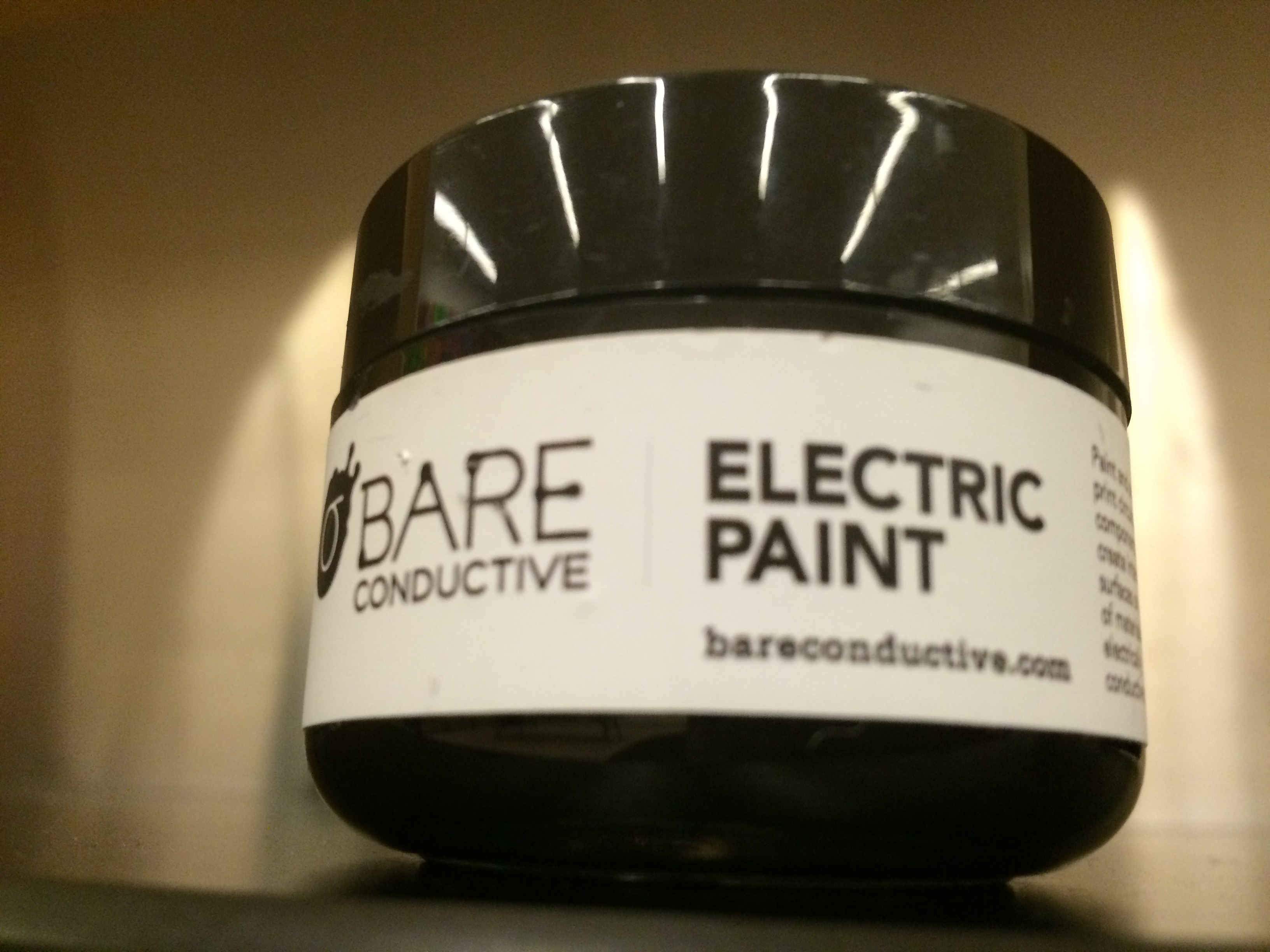
  • Conductive ink
  • Screen printing screen
  • Squeegee
  • Heavy printing paper
  • Copper tape (optional)
  • Makey Makey kit ($45; MakeyMakey.com)
  • Soundplant software
  • Computer

Step 1: Screen print your image with the conductive ink. 

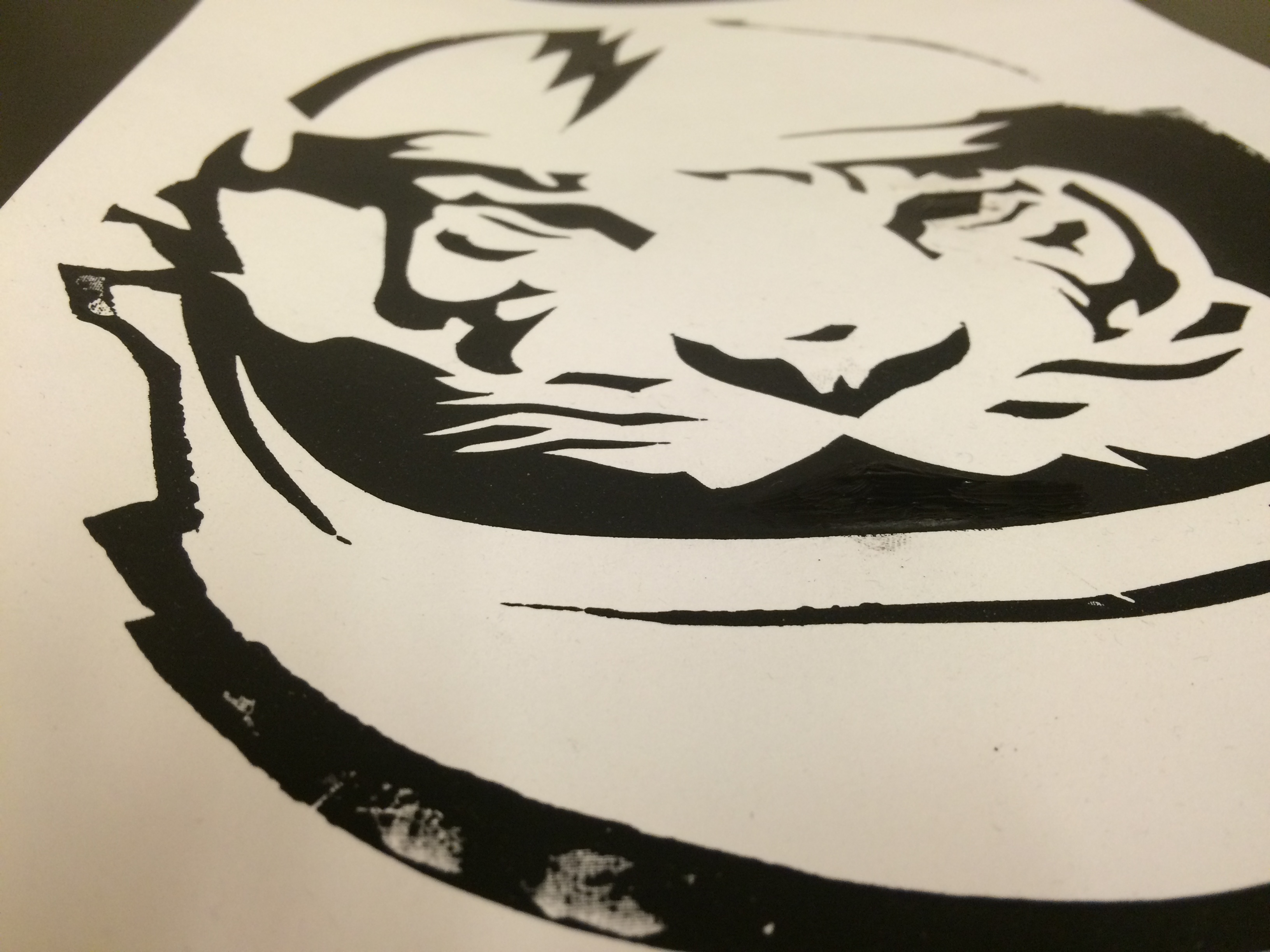
I like the paper stencil method, but use whatever technique you like best. For help on printmaking with stencils, check out my past post on screen printing. Let your print dry fully before proceeding. IMG_2673 IMG_2674 IMG_2676
Step 2: Connect your print to the Makey Makey. 

Again, for the purpose of this post, I’m choosing three areas on my print that will activate the Makey Makey when they are touched. You can connect them directly to the device using alligator clips (included in the kit). Remember to connect the clips to the proper inputs on the Makey Makey–in this case, the left, right, and up arrows.

IMG_2686

Step 3: Upload some sounds. 

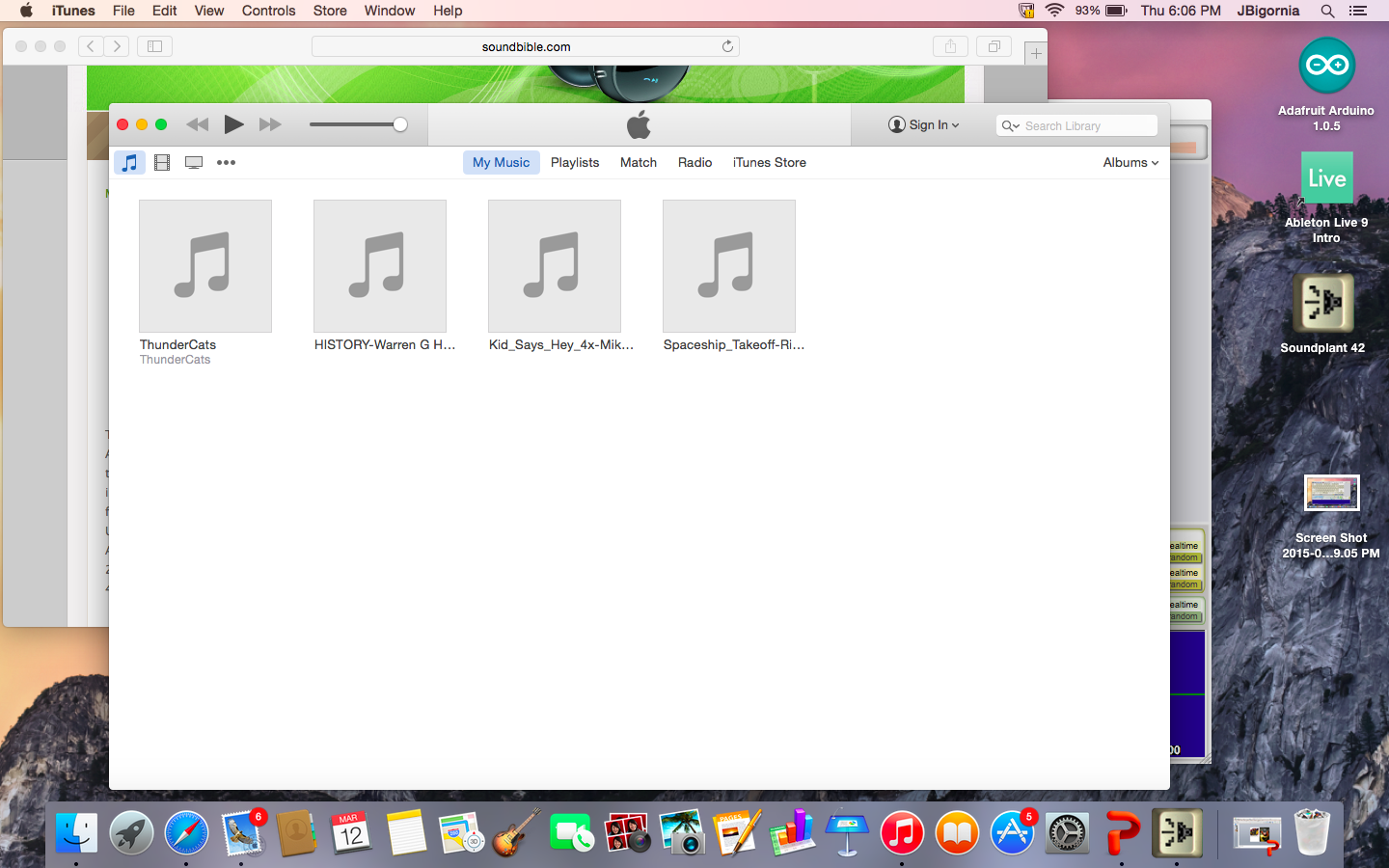
I found a bunch of sounds for this project using free online sound libraries and saved them as mp3 flies on my computer. The Soundplant site has some good suggestions for libraries to use. I tried to look for sounds that would complement my print in a weird or unexpected way.
Screen Shot 2015-03-12 at 6.06.10 PM

Step 4: Map your sounds to the keyboard using Soundplant.

Open up Soundplant and assign one sound file to each of the left, right, and up arrow keys by dragging the file onto the software’s virtual keyboard. Soundplant even offers some basic editing tools, allowing you to adjust the length of your sound clip, add various effects, and more!
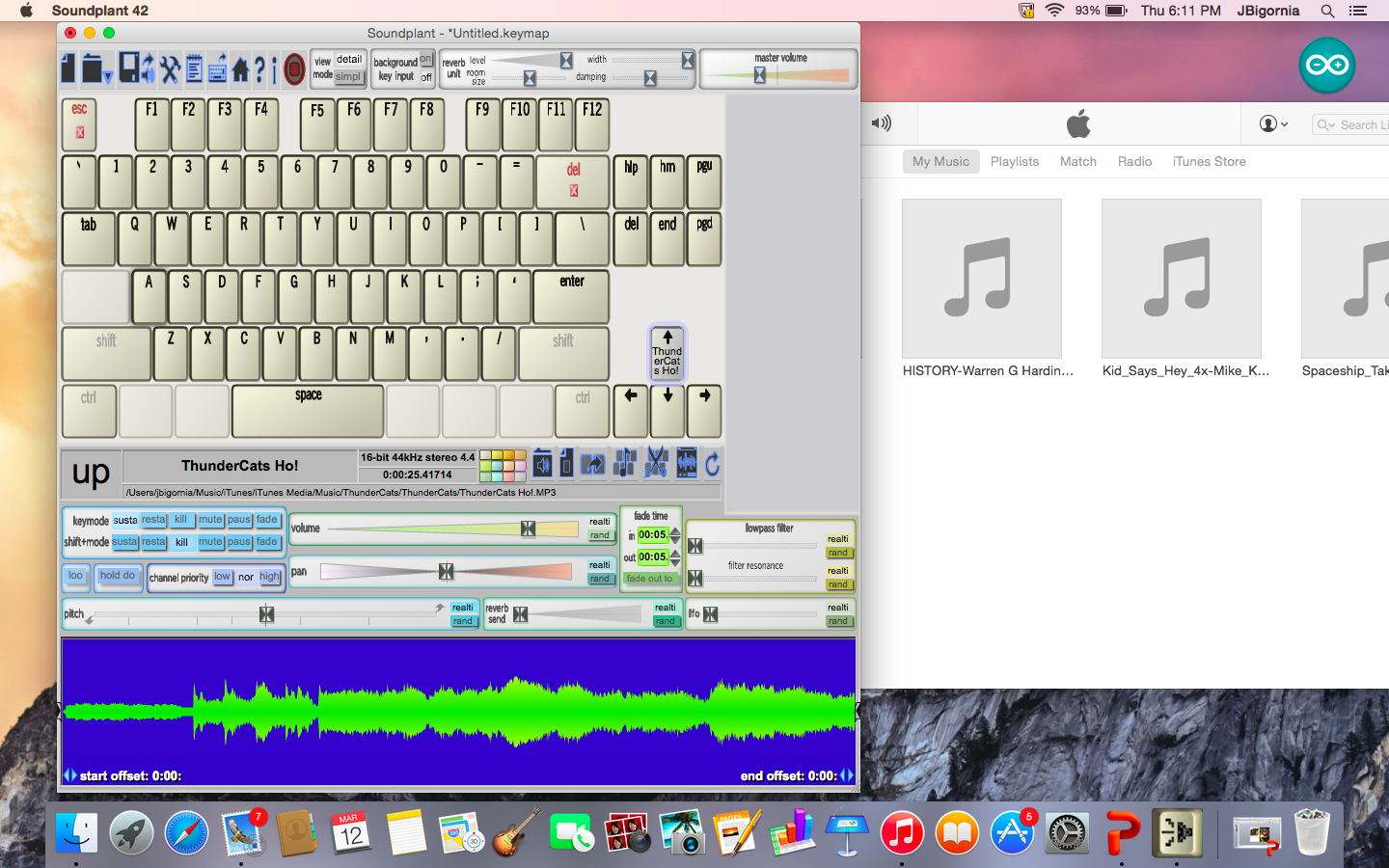
Screen Shot 2015-03-12 at 6.11.02 PM

Step 5: Connect the Makey Makey to the computer and play!

Plug the Makey Makey into your computer’s USB port. Be sure to also connect an extra alligator clip and wire to the space marked “Earth” at the bottom of the board. Hold the metal part of the alligator clip at the other end of the wire between your fingers and touch the interactive areas of your print with your other hand. Your computer should play the sounds you mapped to the different areas! You should also see the playback of your clip on the computer. If you’re having trouble getting it to work, make sure the volume is up on your computer, that all your connections are correct, and most importantly, that you are connected to the Makey Makey as well.
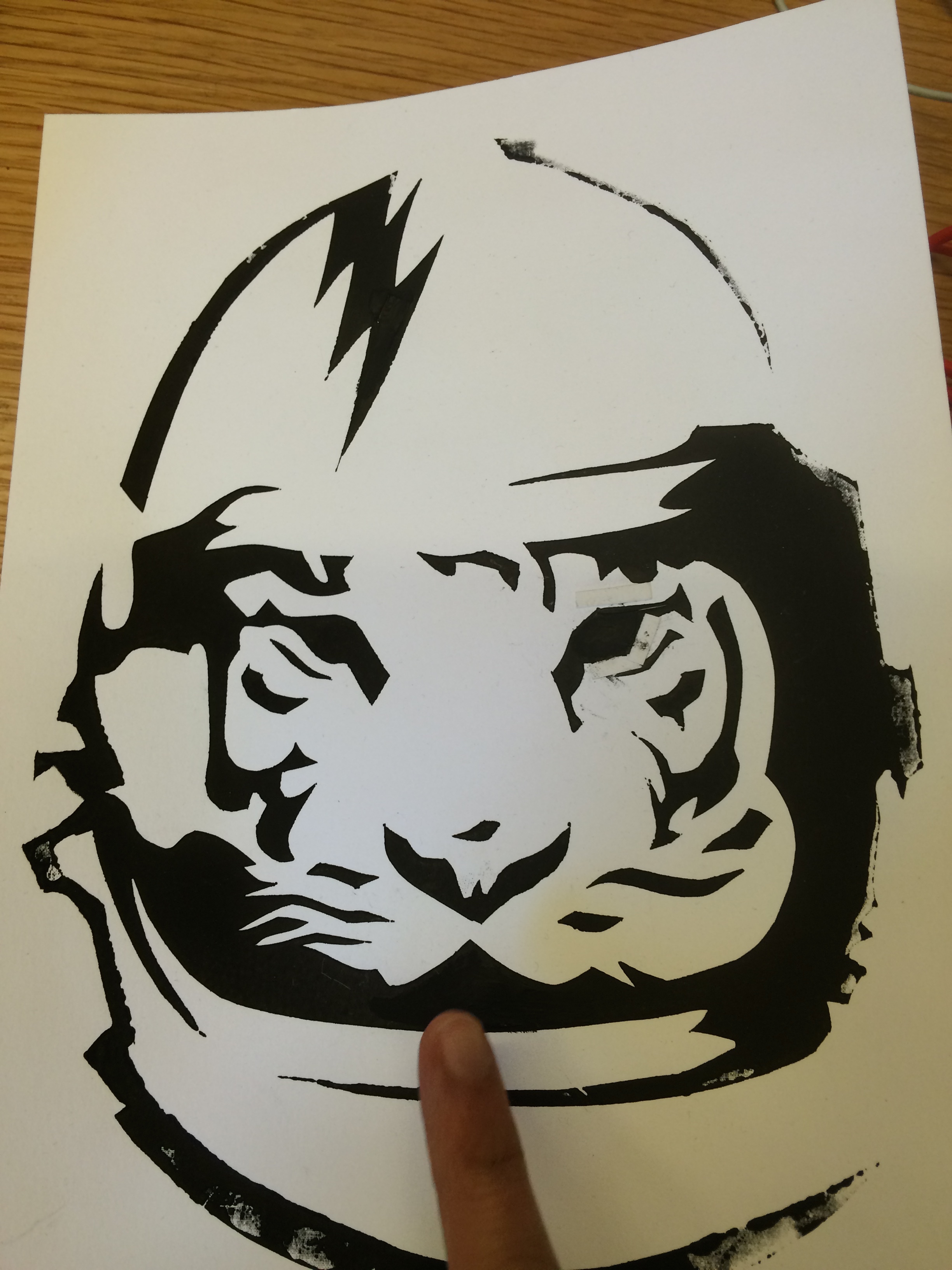
IMG_2687

The fun part of this project is that the sounds you choose can totally change the way people experience your artwork. A set of funny, quirky sounds will provoke a very different response from the viewer versus ones that are dark and foreboding. And because the Makey Makey will work with most conductive materials, you can create interactive sculptures, installations, and more! Additional project ideas can be found on the Makey Makey website.

JC Bigornia
C3 Program Coordinator
Turning the Tables: Student Gallery Talks

1
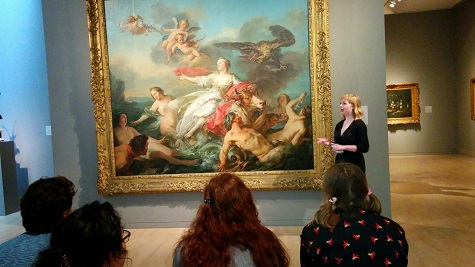
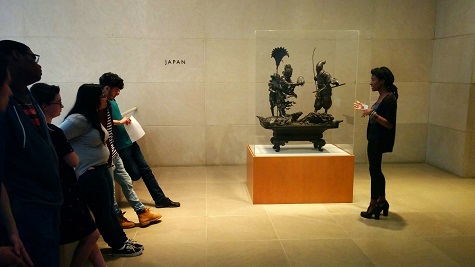
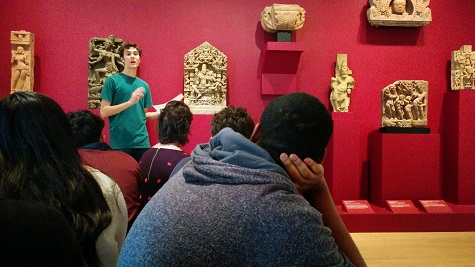
It has often been said that the best way to learn something is to teach it to someone else. With this in mind, a group of students from Booker T. Washington High School for the Performing and Visual Arts recently gave gallery talks on a work of art in the DMA’s collection that they selected and researched themselves.

2
For several years, DMA Education staff have partnered with teachers at Booker T. Washington to work with two classes of Senior Visual Arts students throughout the school year. Among the many activities and concepts we explored over several months was to incorporate the students’ speech credit requirement by culminating the year with each of them giving a brief talk in the galleries.

3
All of the students presented interesting and fun introductions to their selected works of art! The range of works they selected was expansive—from grandiose neoclassical history paintings to intimate cloisonné Japanese vessels. Many of them brought their own experiences and expertise to their presentations as well, such as their studio practices and the places they have traveled.

4
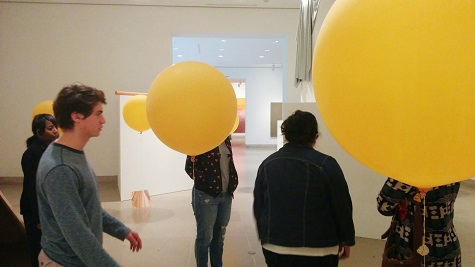
It took four one-hour visits with three presentations running simultaneously for us to allow all forty students to present their ten-minute talks. On one of the days, we had some time left over, so a group of students explored the Concentrations 58: Chosil Kil exhibition. They had a great time walking between the balloons, letting their movements disrupt the balloons and push the copper sheets against the ground.

We wrapped up our year with these two classes on April 1 with a party and casual walkthrough of the Michaël Borremans: As sweet as it gets exhibition. Time to start planning for next year’s classes!

Josh Rose is the Manager of Docent and Teacher Programs at the DMA.

Experiments on Public Space

As part of my time as a McDermott Intern in Education at the DMA, I was given the opportunity to carry out an independent project. Experiments on Public Space (EPS)started with the aim of evaluating and measuring “publicness” through a research approach that is grounded in artistic practice. From the beginning, the project hoped to contribute to the Museum by initiating an active reclaiming of publicness of the institution through the creation of opportunities for thought, transformatory participation, and active discussion. By doing this, the project’s ambition for the DMA was, and is, to exemplify and animate what it means to be a public museum in the 21st century.

16298451814_d330c066d1_z

The decision to focus on the issue of publicness is responsive not only to the field of art and culture but also to a globalized context in which our notion of democracy and democratic space is constantly being tainted and distorted. The project is a result of my past research, and my belief that performance art and participatory projects have the ability to provide social, political, and/or personal experiences.

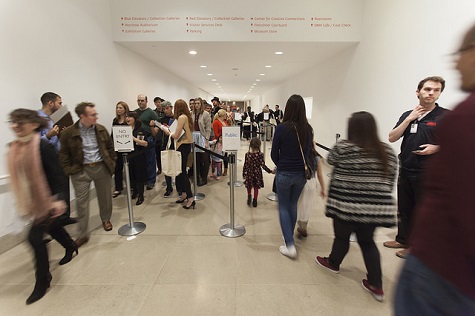
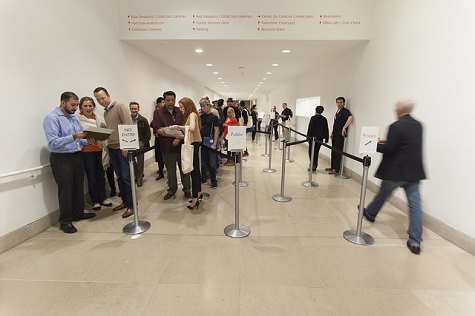
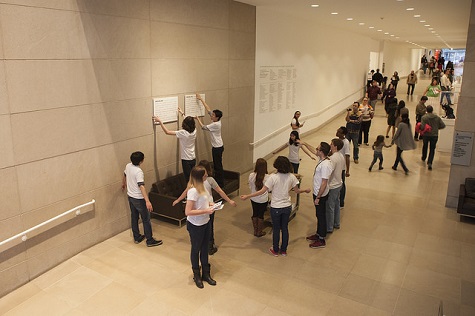
The project launched during the February Late Night with Gesture—Tribute to Tania Bruguera, an unannounced performance that placed Museum visitors in crowd control situations. The piece was the first attempt at creating a space in which to ask participants to explicitly consider the differences between public and private, control and freedom, access and limitations.

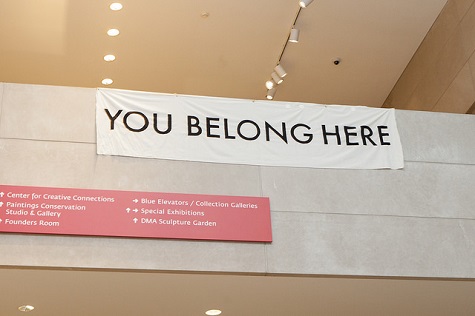
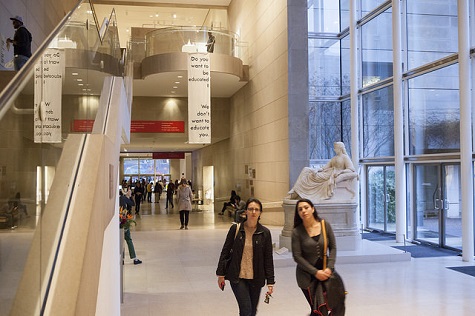
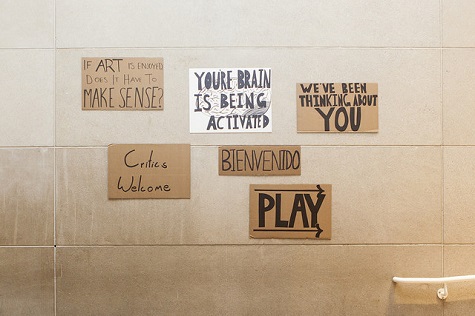
The second experiment, Alternative Signage, took place during the March Late Night. This program, which was the result of a collaboration with the DMA/Perot Museum of History and Science Teen Advisory Council (T.A.C.), was also a performance piece where I and a group from the T.A.C. intervened in Museum spaces by installing alternative signs that were conceptualized and designed over a period of three months. The signs reworked and reimagined the ways text, symbols, and signage can influence participation and experiences, and therefore overall publicness.

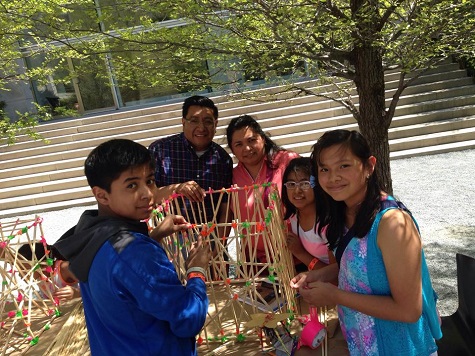
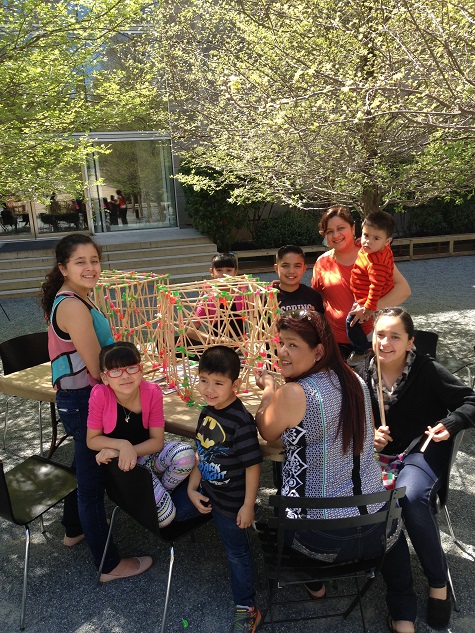
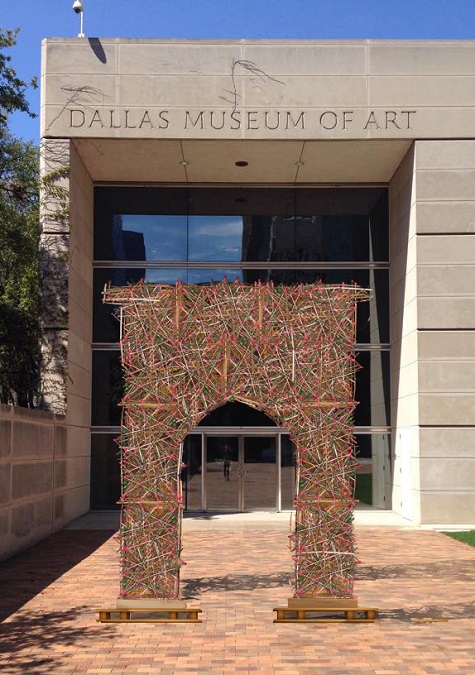
I Am a Monument… is the third of four experiments that constitute EPS. The program involves a series of workshops that were held during the Museum’s Studio Creations program with guest artist Giovanni Valderas; visitors worked collaboratively to build a temporary monument recognizing and celebrating the Latino community of Dallas. The workshop itself becomes a gesture of coming together to celebrate and participate in this building of relationships between communities. The unveiling of the monument, in the shape of an arch, will create a passageway that represents the desire for mutual understanding and the welcoming of the Latin American community. See it revealed on the Ross Avenue Plaza during this month’s Late Night on Friday, April 17!

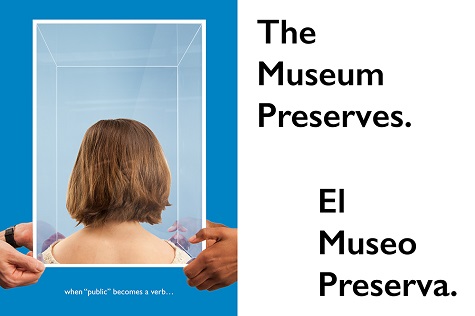
Experiments on Public Space will come to a close with a fourth and final program, a panel discussion titled when “public” becomes a verb…, which will bring together four speakers to present a series of visual statements produced in collaboration with the DMA and the Perot Museum of Nature and Science Teen Advisory Council (T.A.C.). The panel discussion will take place during the May Late Night on Friday, May 15, starting at 6:30 p.m. in the Center for Creative Connections Theater.

Poster 1 of 4 - Example

For EPS, each program was conceived as a way of collecting “data on publicness” of the Museum. The results of these “experiments” will be on display at the Center for Creative Connections beginning on April 17. Visitors will become evaluators of this data, providing their thoughts and comments and an overall measurement of the individual issues of publicness explored in this project through a series of interactive activities in the space.

Eliel Jones, McDermott Education Intern for Visitor and Community Engagement at the DMA.

Mastering the Arts

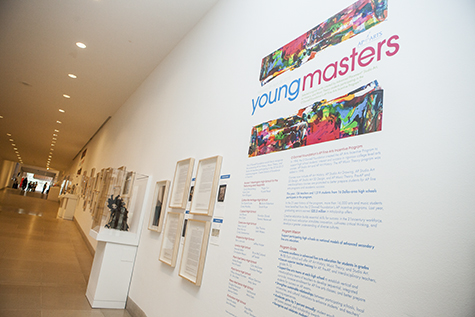
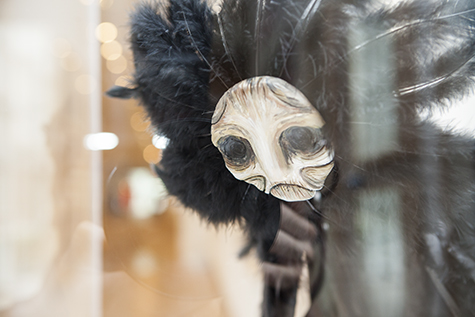
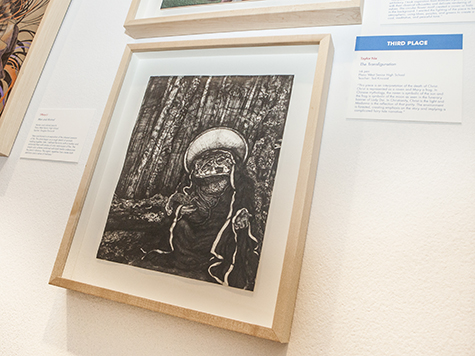
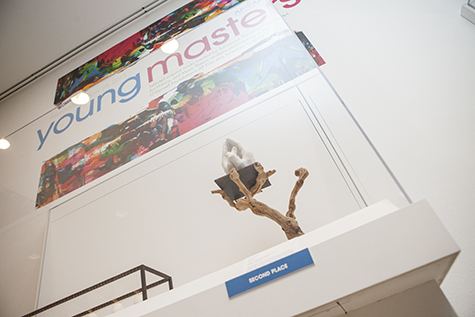
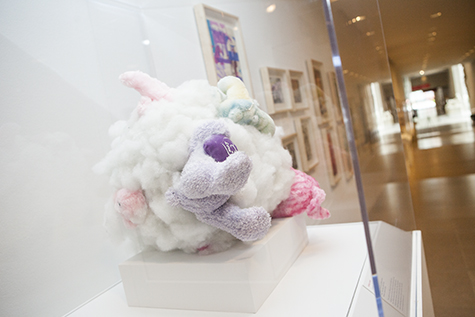
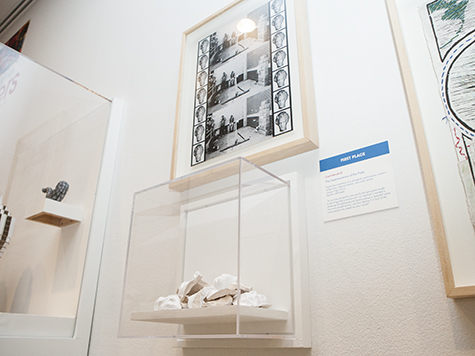
For seventeen years Young Masters has showcased the amazing talent of area AP High School students. Come share our awe over the creative work produced by Advanced Placement® Studio Art, Art History, and Music Theory students from 10 North Texas High Schools through April 28.


young_masters_blog_post_2015_001


young_masters_blog_post_2015_002


young_masters_blog_post_2015_004


young_masters_blog_post_2015_005


young_masters_blog_post_2015_003


young_masters_blog_post_2015_006


Friday Photos: NAEA in NOLA

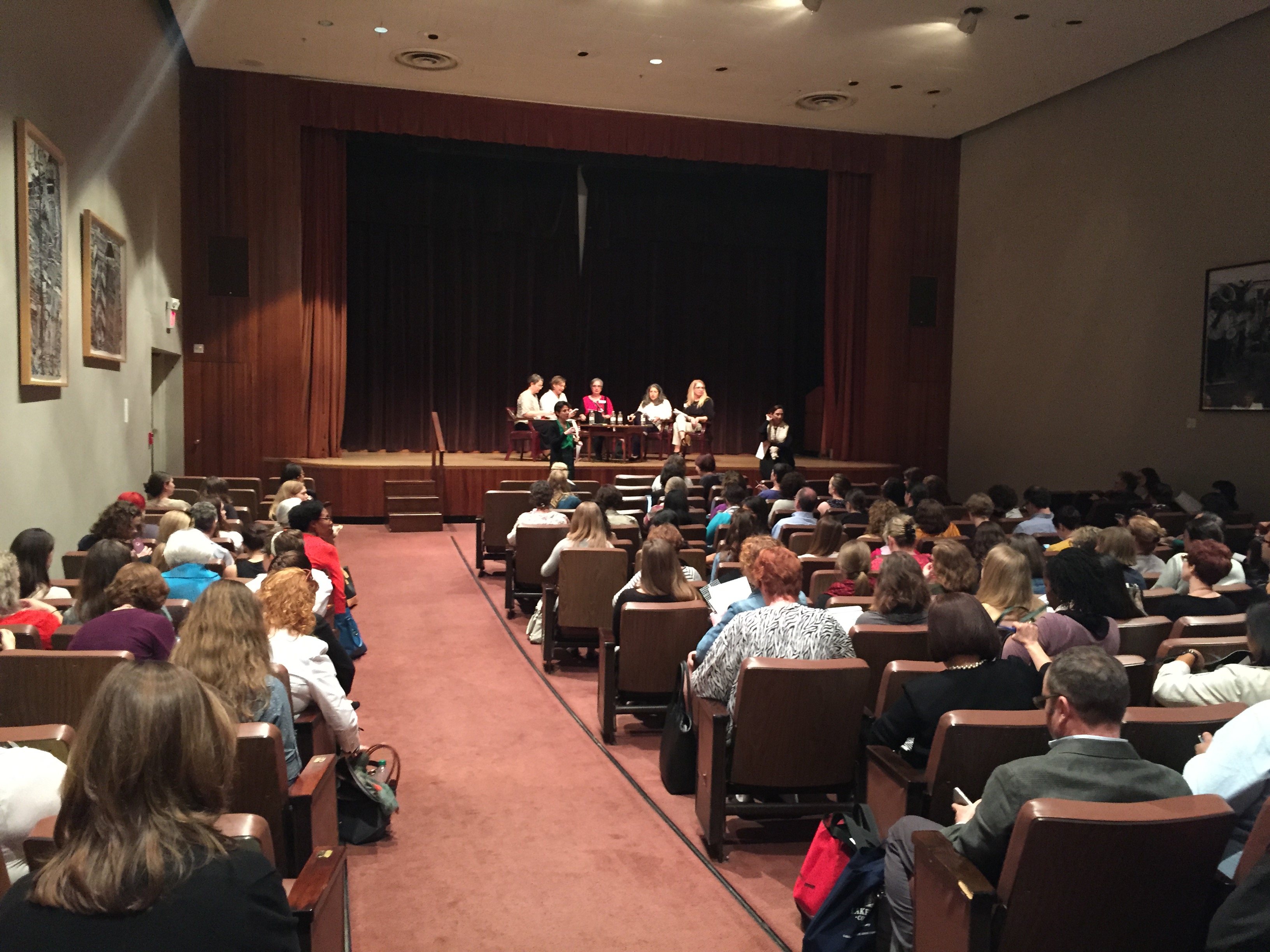
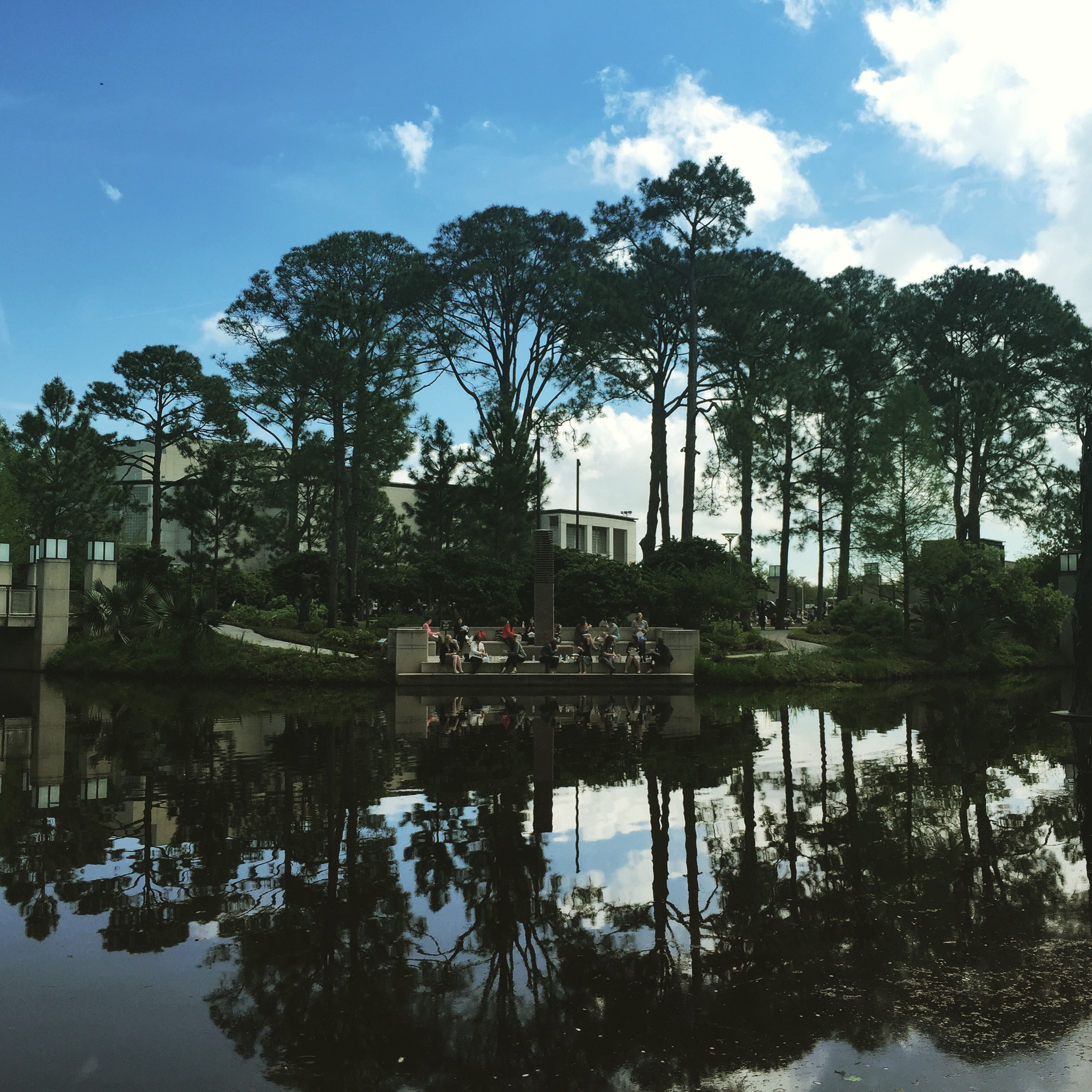
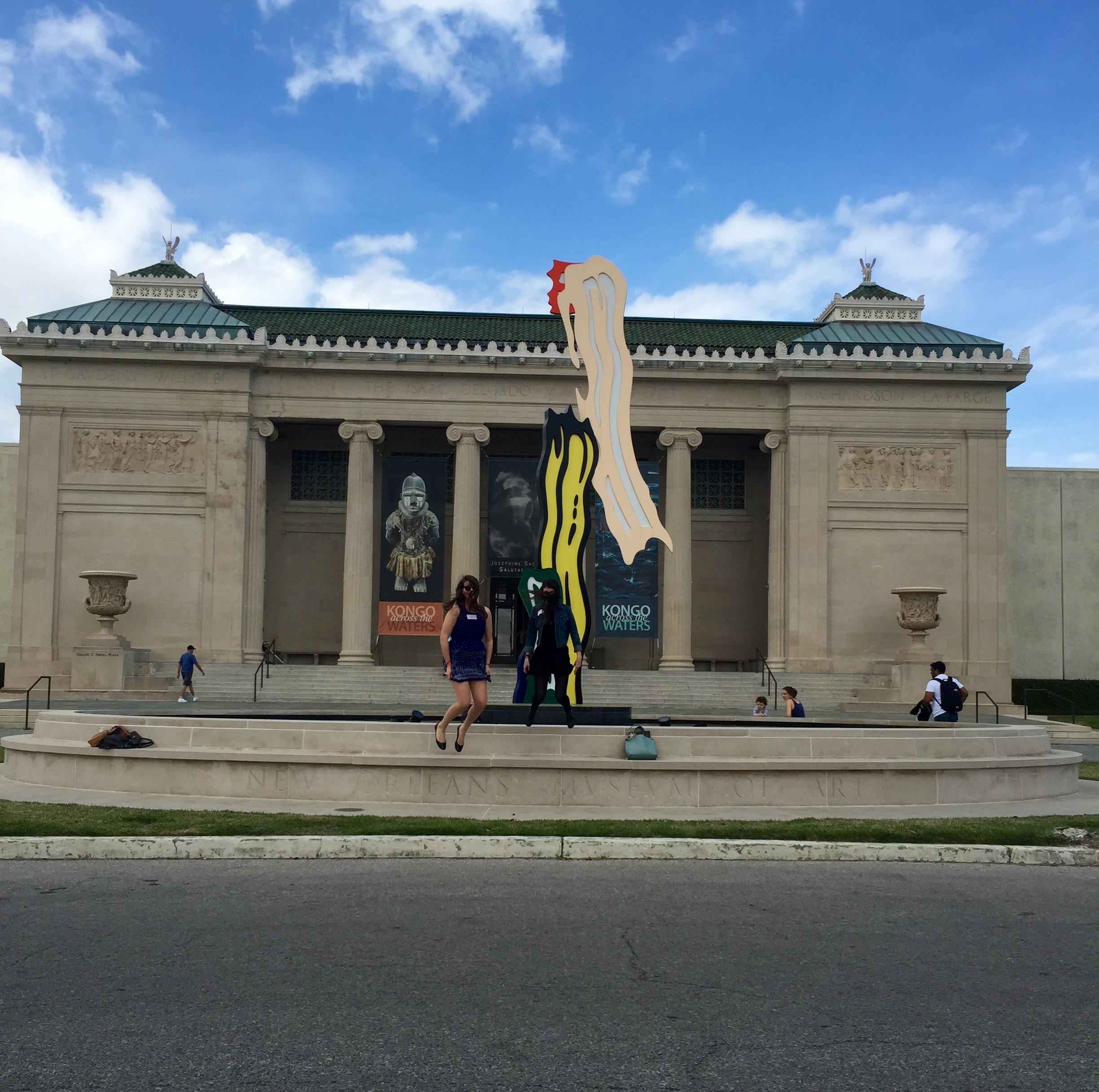
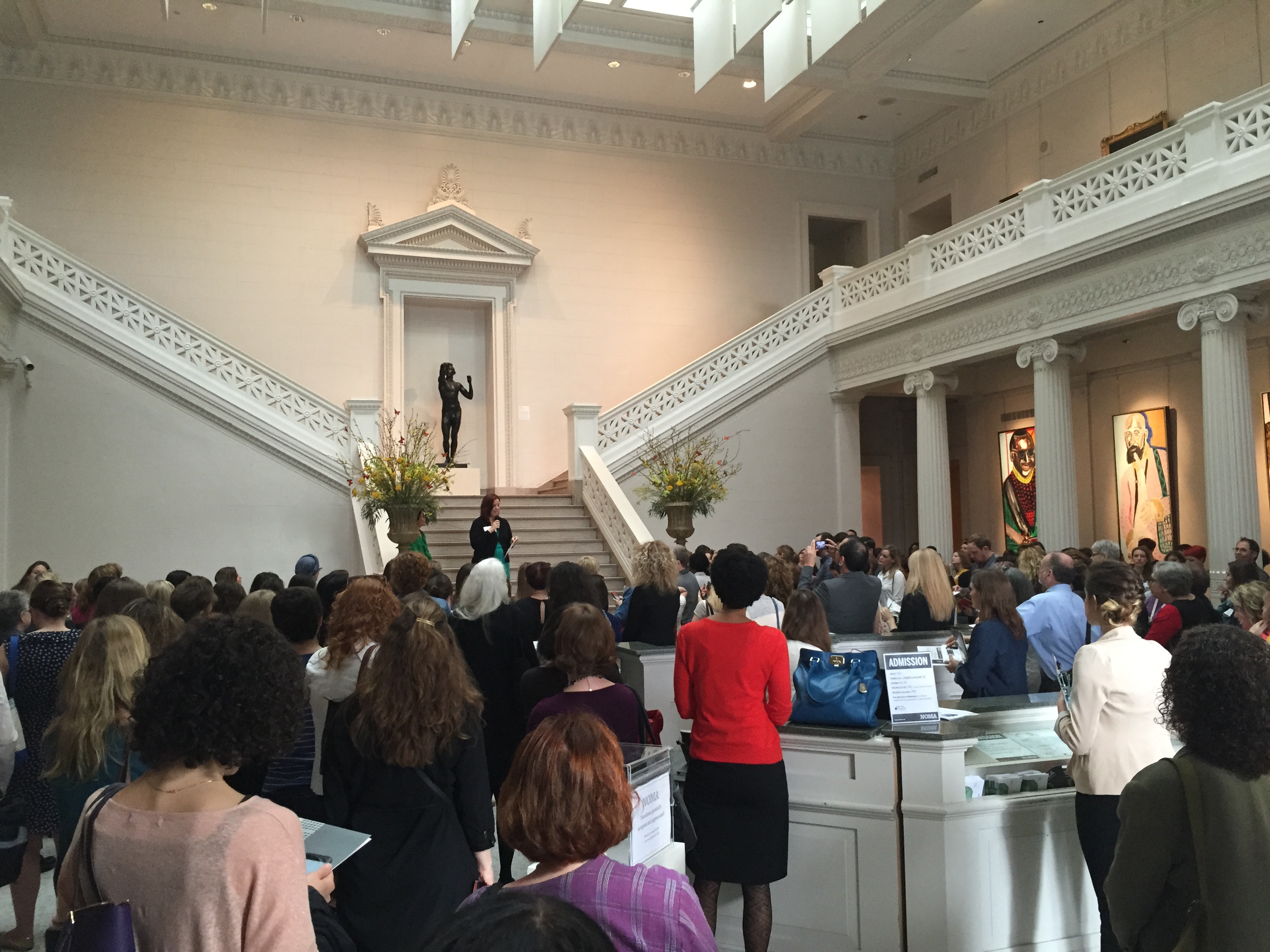
As part of our McDermott Internship, each intern is able to request funds to use for professional development–this can go towards a language class, visiting other museums to learn more about their practices, or events like conferences. This year, some of us decided to attend the National Art Education Association Conference in New Orleans.

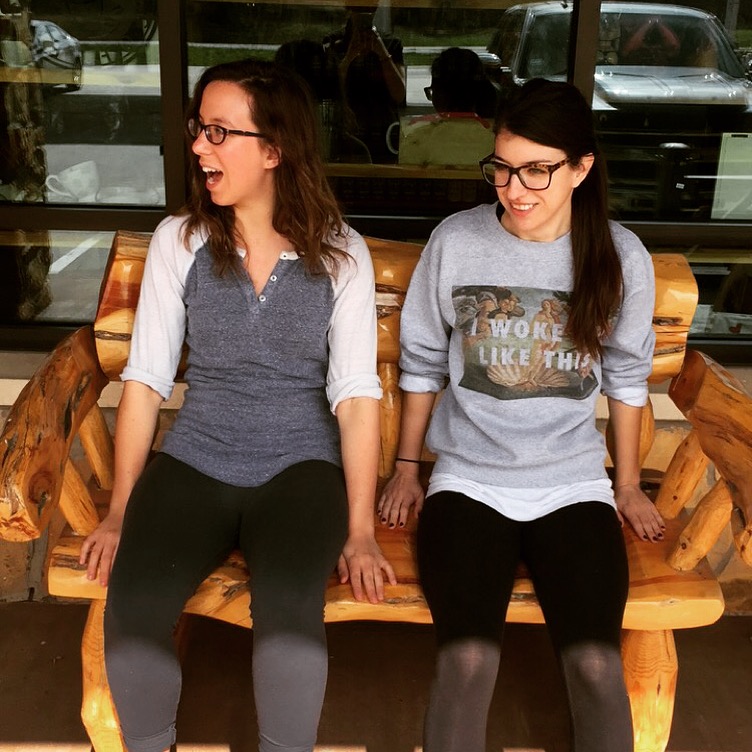
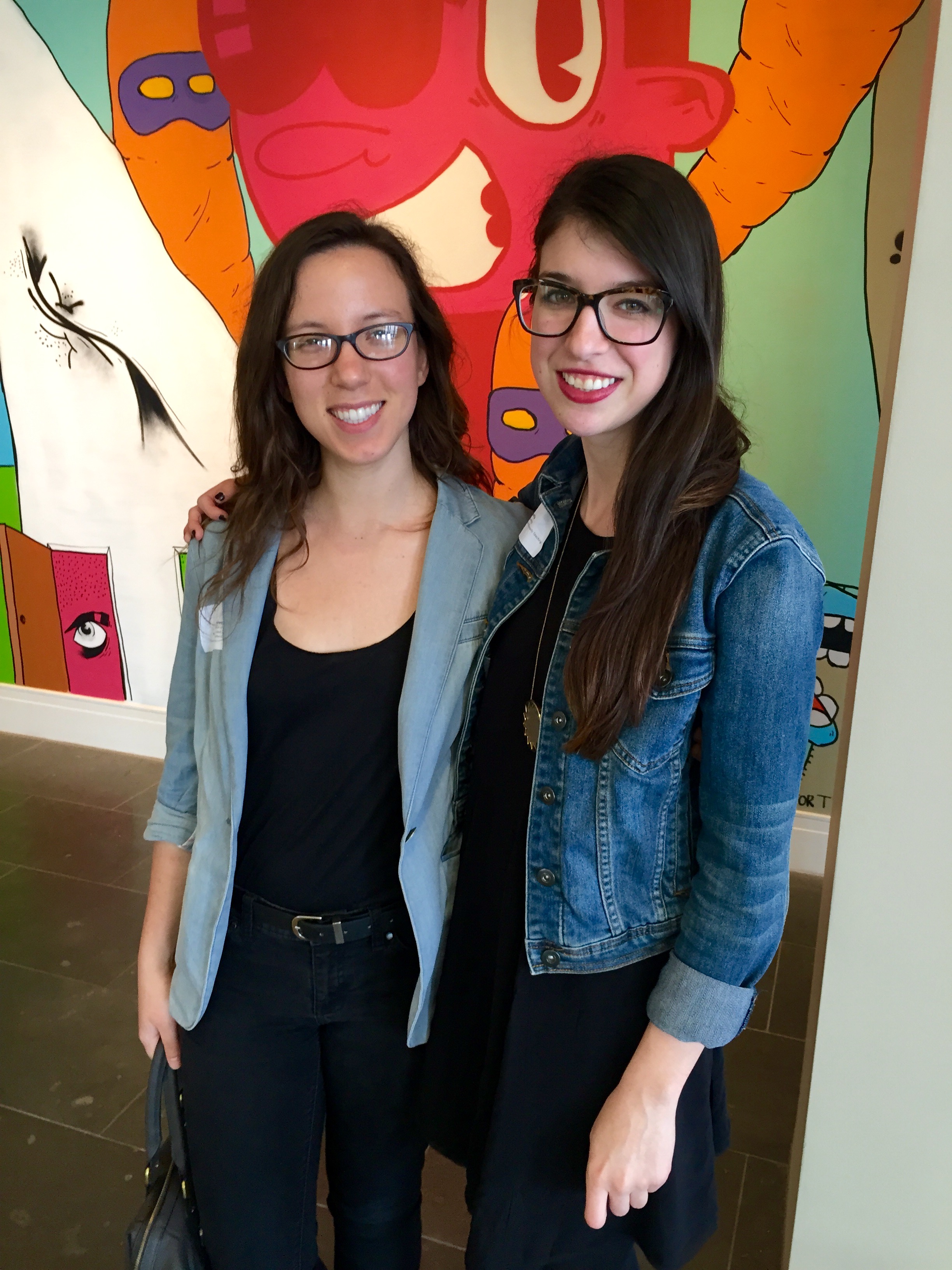
Always on board for some intern bonding, we decided to drive the 8 hours from Dallas to New Orleans. This was a great start to our trip, which has only gotten better since our arrival in the Big Easy! We’ve had a great time attending sessions, visiting local museums (New Orleans Museum of Art, Ogden Museum of Southern Art, and the Contemporary Arts Center) and learning more about the field of museum education. Here are just a few pictures of our trip so far!

We’re looking forward to bringing the knowledge and new ideas we’ve heard at the conference back to the DMA!

Liz Bola
McDermott Graduate Intern for Gallery and Community Teaching

Discovering Eliza

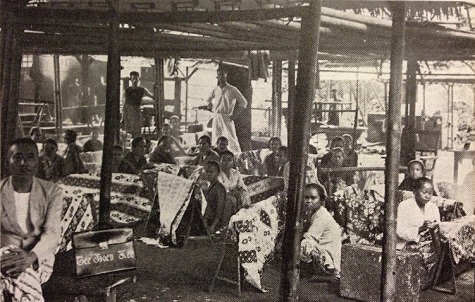
It was a truly exciting moment for me when I discovered that the DMA held a batik produced by “THE” Eliza van Zuylen. Owning one of van Zuylen’s exquisite hand-drawn cloths was a privilege that only very wealthy women in 19th-century colonial Indonesia enjoyed. With the average wage of a government employee being twenty guilders a month, and a van Zuylen sarong costing around thirteen guilders, these batiks were comparable to a Chanel bag or Louboutin shoes today. Adorned with European-style flower bouquets, hence buketan-style batik, the cloths were wrapped around the waist and combined with fashionable lace-trimmed blouses called kebayas.

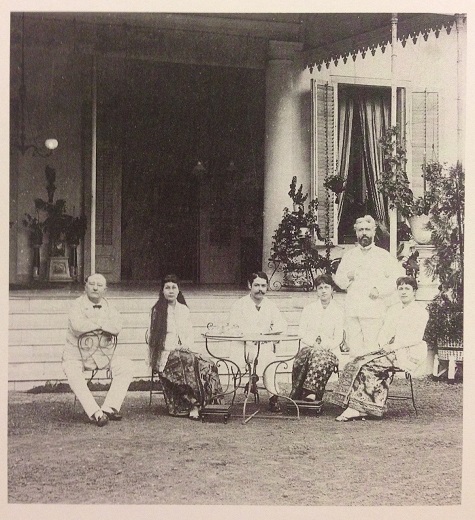
Three Indo-European women wearing kebaya blouses with batik sarongs, Batavia (Jakarta), around 1880. Heringa, R./ Veldhuisen, H.C: Fabric of Enchantment. Batik from the North Coast of Java. Los Angeles County Museum of Art. Los Angeles, 1996. pg. 48

Three Indo-European women wearing kebaya blouses with batik sarongs, Batavia (Jakarta), around 1880, from Heringa, R./Veldhuisen, H.C., Fabric of Enchantment: Batik from the North Coast of Java (Los Angeles: Los Angeles County Museum of Art, 1996), p. 48.

Mainly produced by women in their home and for their private use, Javanese batik underwent a process of commercialization in the late 19th century. In addition to Peranakan Chinese, several Indo-European women on the north coast of the island established batik workshops, often to supplement their husband’s income. Mostly middle class, these women, who were of European and Asian, Chinese, or Arab origin, were situated in between the local Javanese population and the Dutch colonial society. Their intermediary position allowed them to create batik for several societal groups, including the Indo-European, Peranakan Chinese, and upper-class Javanese.

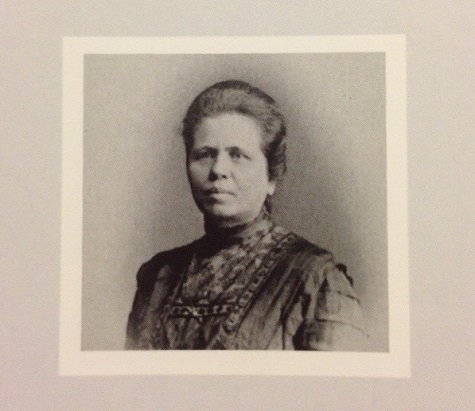
Eliza van Zuylen. Heringa, R./ Veldhuisen, H.C: Fabric of Enchantment. Batik from the North Coast of Java. Los Angeles County Museum of Art. Los Angeles, 1996. pg. 76

Eliza van Zuylen, from Heringa, R./Veldhuisen, H.C., Fabric of Enchantment: Batik from the North Coast of Java (Los Angeles: Los Angeles County Museum of Art, 1996), p. 76.

Eliza van Zuylen was one of these women; she was born in 1863 in Batavia (Jakarta) as the daughter of a Dutch soldier and an Indo-European woman. After her husband, Alphons van Zuylen, was appointed as government inspector in Pekalongan, she moved to this north coast city, which, since the 1850s, was an important batik production center. After helping in her sister Christina’s batik workshop, van Zuylen opened her own business in 1890. Starting off with just three Javanese batik makers, her workshop was very prosperous and expanded quickly, by 1918 becoming the largest Indo-European batik business in the whole of Java. Her workshop ended up being the only Indo-European batik business to survive the economic depression of the 1930s.

Peranakan Chinese batik entrepreneur Tee Boen Kee and his workshop in Batavia (Jakarta), around 1930. Heringa, R./ Veldhuisen, H.C: Fabric of Enchantment. Batik from the North Coast of Java. Los Angeles County Museum of Art. Los Angeles, 1996. pg. 41

Peranakan Chinese batik entrepreneur Tee Boen Kee and his workshop in Batavia (Jakarta), around 1930, from Heringa, R./ Veldhuisen, H.C., Fabric of Enchantment: Batik from the North Coast of Java (Los Angeles: Los Angeles County Museum of Art, 1996), p. 41.

The batik designs, inspired by Dutch horticultural books, imported European flowers, and European fairytales, were created by Eliza van Zuylen herself and then drawn on the cloth with hot wax by her batik makers. Provided the wax drawing met van Zuylen’s expectations, she added her signature to the cloth and allowed it to be dyed. Together with a stamp from her workshop, this signature guaranteed the authenticity of the batik. Not only was the habit of signing batiks, which had been introduced by Indo-European batik entrepreneurs such as van Zuylen, meant to help protect patterns, but it also functioned as an advertisement.

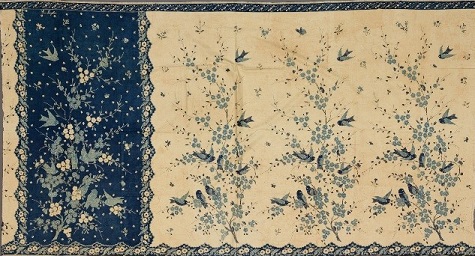
Woman's Sarong, 1910, Java, Pekalongan, Indonesia, batik on commercial cotton, Dallas Museum of Art, gift of Mr. and Mrs. Jerry Bywaters in memory of Paul and Viola van Katwijk

Woman’s sarong, 1910, Java, Pekalongan, Indonesia, batik on commercial cotton, Dallas Museum of Art, gift of Mr. and Mrs. Jerry Bywaters in memory of Paul and Viola van Katwijk

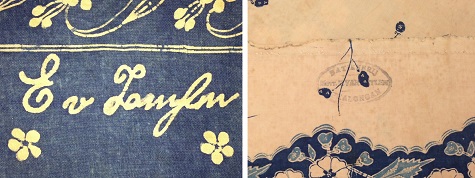
The signature and stamp on the DMA batik by Eliza van Zuylen. Woman's Sarong (details), 1910, Java, Pekalongan, Indonesia, batik on commercial cotton, Dallas Museum of Art, gift of Mr. and Mrs. Jerry Bywaters in memory of Paul and Viola van Katwijk

The signature and stamp on the DMA batik by Eliza van Zuylen

A gift from former Museum director Jerry Bywaters, this beautiful sarong entered the DMA’s collection in 1982. The signature “E v Zuylen” and the stamp stating “Batikkerij Mevr. E. van Zuylen, Pekalongan” prove that this batik was made in van Zuylen’s workshop. The beige and blue color combination, in this case probably achieved with indigo, is referred to as kelengan and was popular among both Indo-European and Peranakan Chinese women on the north coast. The body, or badan, of the cloth is decorated with three flowering twigs along with birds and butterflies. This motif is repeated on the head, or kepala, but on a contrasting dark background. The pattern fields and the edges of the cloth are decorated with floral lace borders. Such a batik would have been suitable for a young Indo-European bride on her wedding night, with the beige symbolizing her purity and the lovebirds referring to marriage.

Elisabeth Seyerl is the McDermott Graduate Curatorial Intern for African and Asian Art at the DMA.

Culinary Canvas: Mango Blueberry Puree

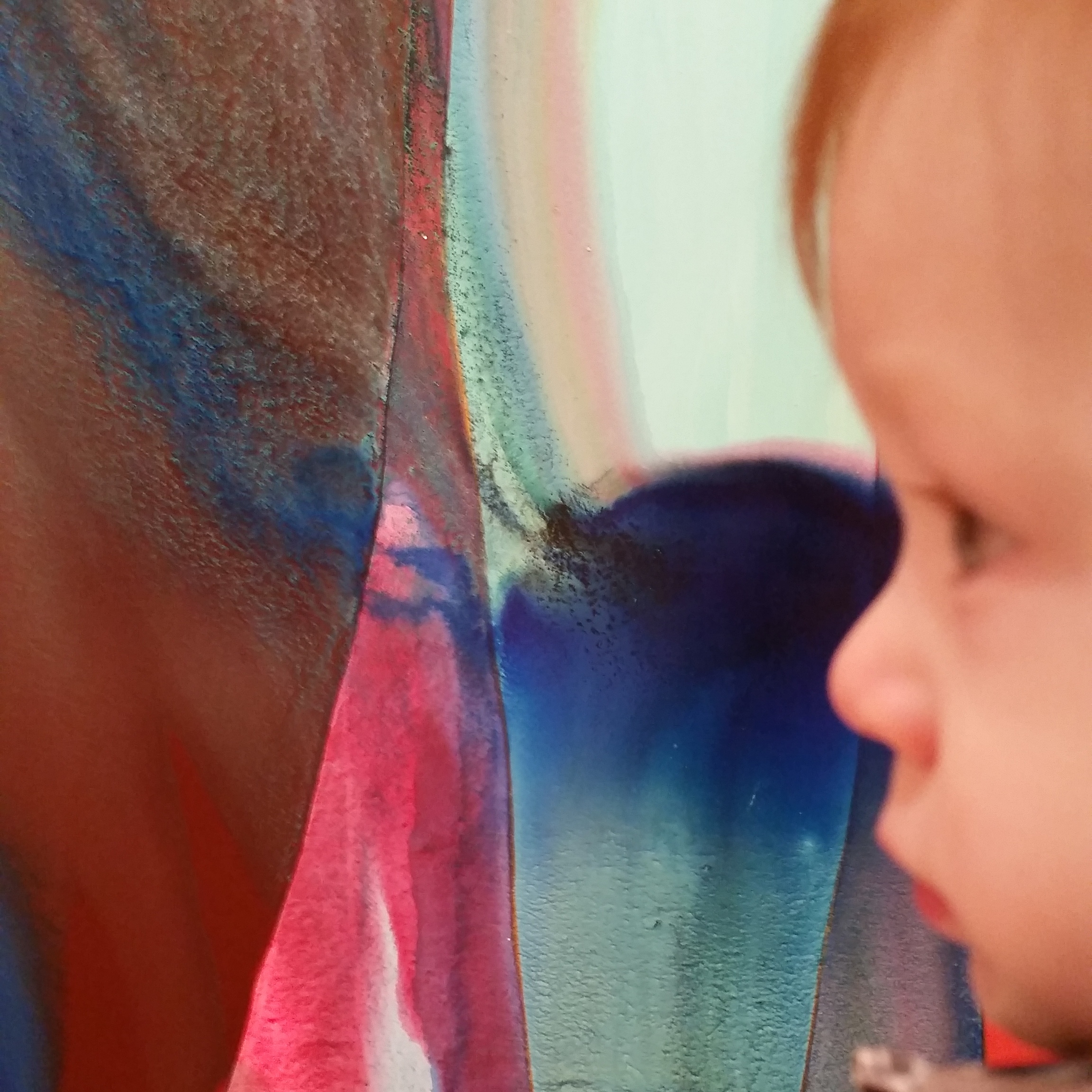
Last week, my little guy and I attended Art Babies. We started the class in our exhibition, Between Action and the Unknown: The Art of Kazuo Shiraga and Sadamasa Motonaga, exploring the large, abstract works of art. He smiled and kicked his little feet, so I could tell he really enjoyed the bright and engaging colors!

Rhys_SM

Color is something that I’ve been thinking about a lot when it comes to his diet–the more colorful the better! As you might have expected, I enjoy making food for him at home, so I wanted to share a simple recipe that you could try, inspired by the deep and vibrant colors in the exhibition. Be sure to bring your little one on your next visit, then make some colorful food for him or her to enjoy at home–you’ll be feeding his body and his mind! If you’re brave, you might even let him paint his high chair tray–at least you’ll know the paint is safe to eat!

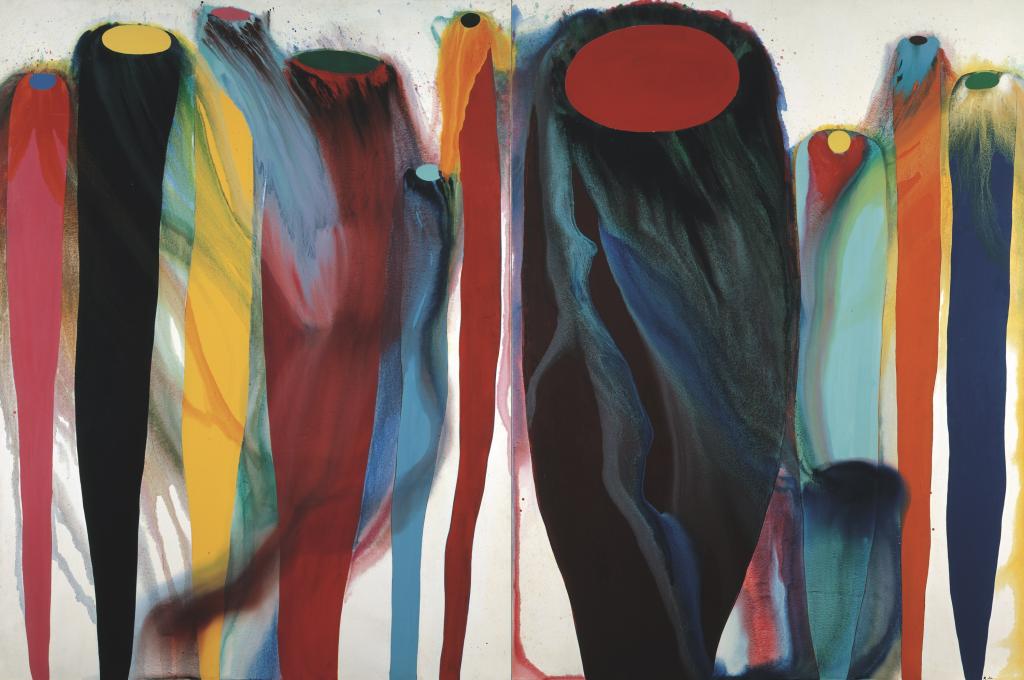
Sadamasa Motonaga, Work 66-1, 1966, oil and synthetic resin on canvas, The National Museum of Modern Art, Tokyo © 2015 Estate of Motonaga Sadamasa

Sadamasa Motonaga, Work 66-1, 1966, oil and synthetic resin on canvas, The National Museum of Modern Art, Tokyo © 2015 Estate of Motonaga Sadamasa

Mango Blueberry Puree

Yields about 16 ounces
Appropriate for 8+ months
Level: Very Easy

1 ripe mango
1 cup fresh or frozen organic blueberries

Prepare the mango by cutting it around the skin, similar to how you would cut an avocado. Note that the pit can be a bit tricky, so do your best to remove it, separating the fruit into two halves. Using a knife, score the fruit up to the skin, being careful not to cut through it. Scoop out fruit pieces and juice, and add to saucepan set on medium-low heat. Add fresh or frozen berries to pan and lightly simmer for about 5 minutes, allowing the fruits to break down slightly and meld their flavors.

Transfer fruit to the bowl of a baby food maker, small food processor, or large measuring bowl, if using an immersion blender. Puree into desired consistency for your baby.

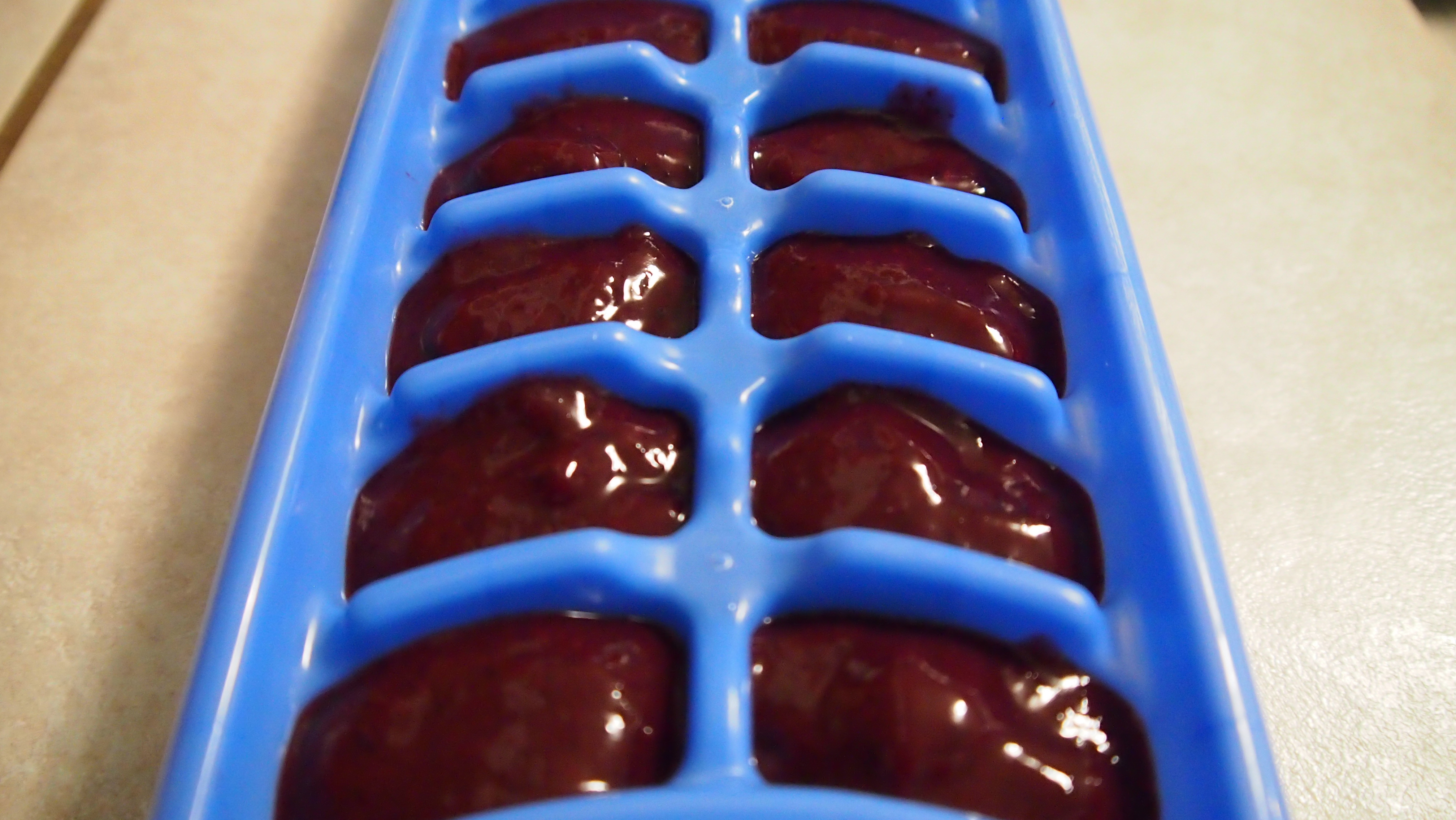
Divide puree into any portion size you’d like and freeze. I find that an ice cube tray works well for small portions that can be pulled out when needed and added to oatmeal, mixed with other fruits, or combined into a larger meal.


baby food maker

Cooked fruit in the baby food maker

blueberry mango puree

Finished puree in ice trays

Original recipe. And of course, be sure to always check with your pediatrician on the appropriate diet for your special little one.

Sarah Coffey
Education Coordinator

ARTifacts: Welcome to the Big Top

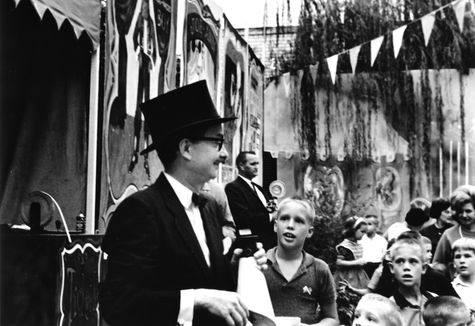
If you put up an exhibition called The Arts of the Circus, as the Dallas Museum for Contemporary Arts did in October 1962, it is a no-brainer that the preview party will be its own three-ring circus.

DMCA Director Douglas MacAgy as Ringmaster for "The Arts of the Circus" preview party. Photo credit: Paul Rogers Harris
DMCA Director Douglas MacAgy as Ringmaster for the Arts of the Circus preview party.
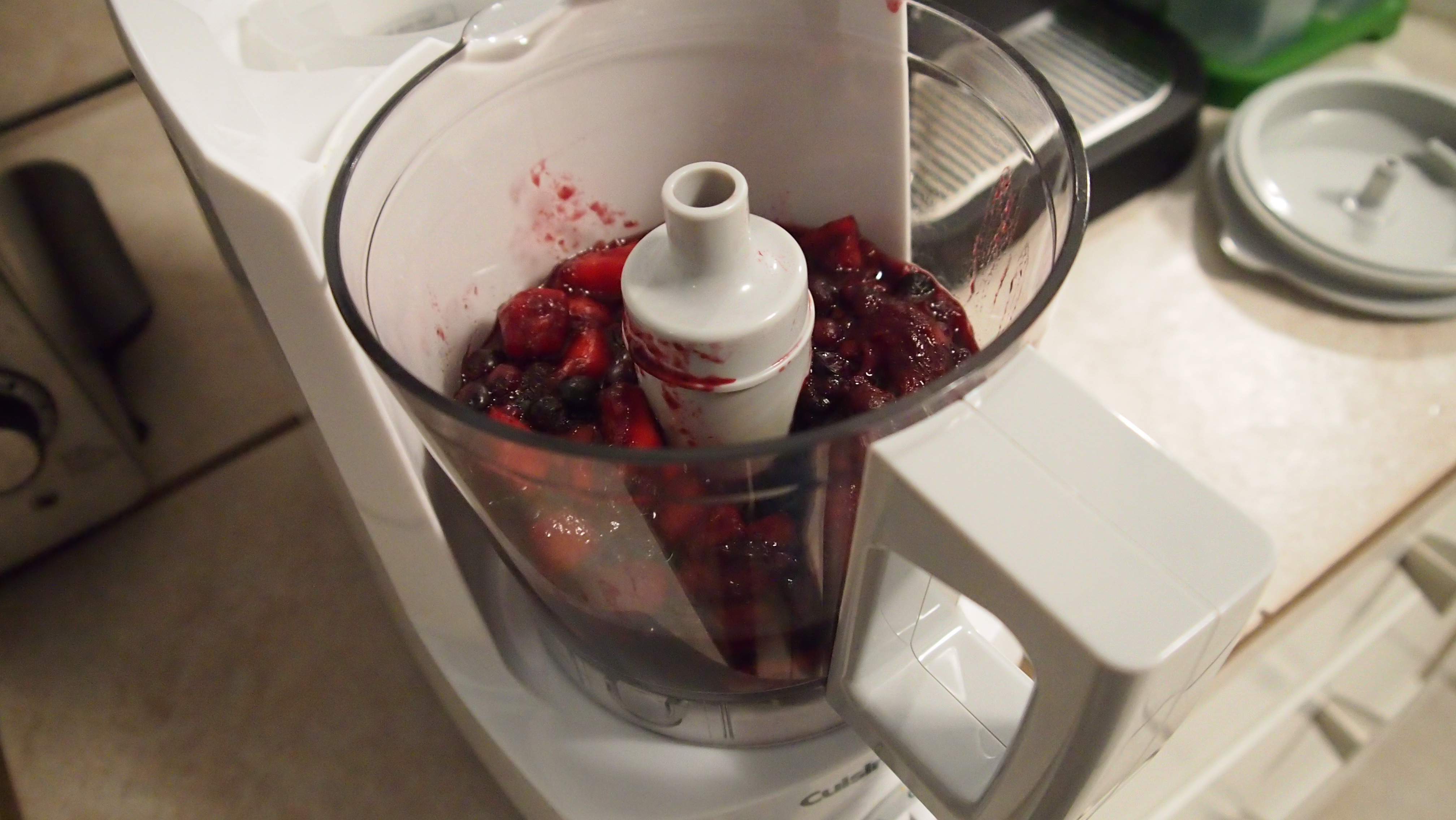
Photo credit: Paul Rogers Harris

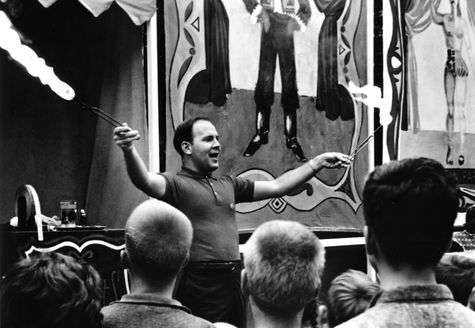
The party featured clowns, balloons, animal crackers and pink lemonade, a sideshow, fire-eaters, and a baby elephant.

Fire-eater at the preview party for the DMCA's "The Arts of the Circus" exhibition. Photo credit: Paul Rogers Harris

Fire-eater at the preview party for the DMCA’s The Arts of the Circus exhibition. Photo credit: Paul Rogers Harris

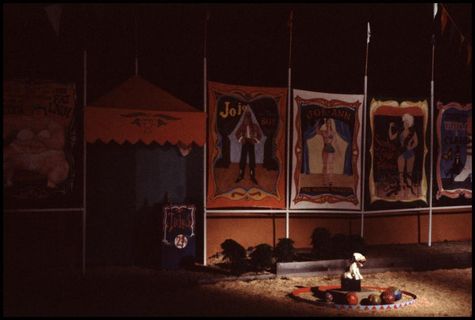
Dallas artists Roy Fridge, Nancy Levinson, David McManaway, Herb Rogalla, Peggy Wilson, and Roger Winter created special sideshow banners to complete the circus atmosphere.

Sideshow banners created for "The Arts of the Circus."

Sideshow banners by local artists created for The Arts of the Circus

The exhibition proper included both circus objects and memorabilia, and artworks with a circus-related subject; it was on view at the Dallas Museum for Contemporary Arts October 9-November 11, 1962.

Hillary Bober is the Archivist at the Dallas Museum of Art.

Friday Photos: All Access Art

This February was a milestone for the DMA education team: we celebrated the fifth anniversary of two of the Museum’s most successful access programs: Autism Awareness Family Celebrations, which currently serve over 900 visitors from North Texas each year, and Meaningful Moments, designed specifically for individuals with early stage dementia.

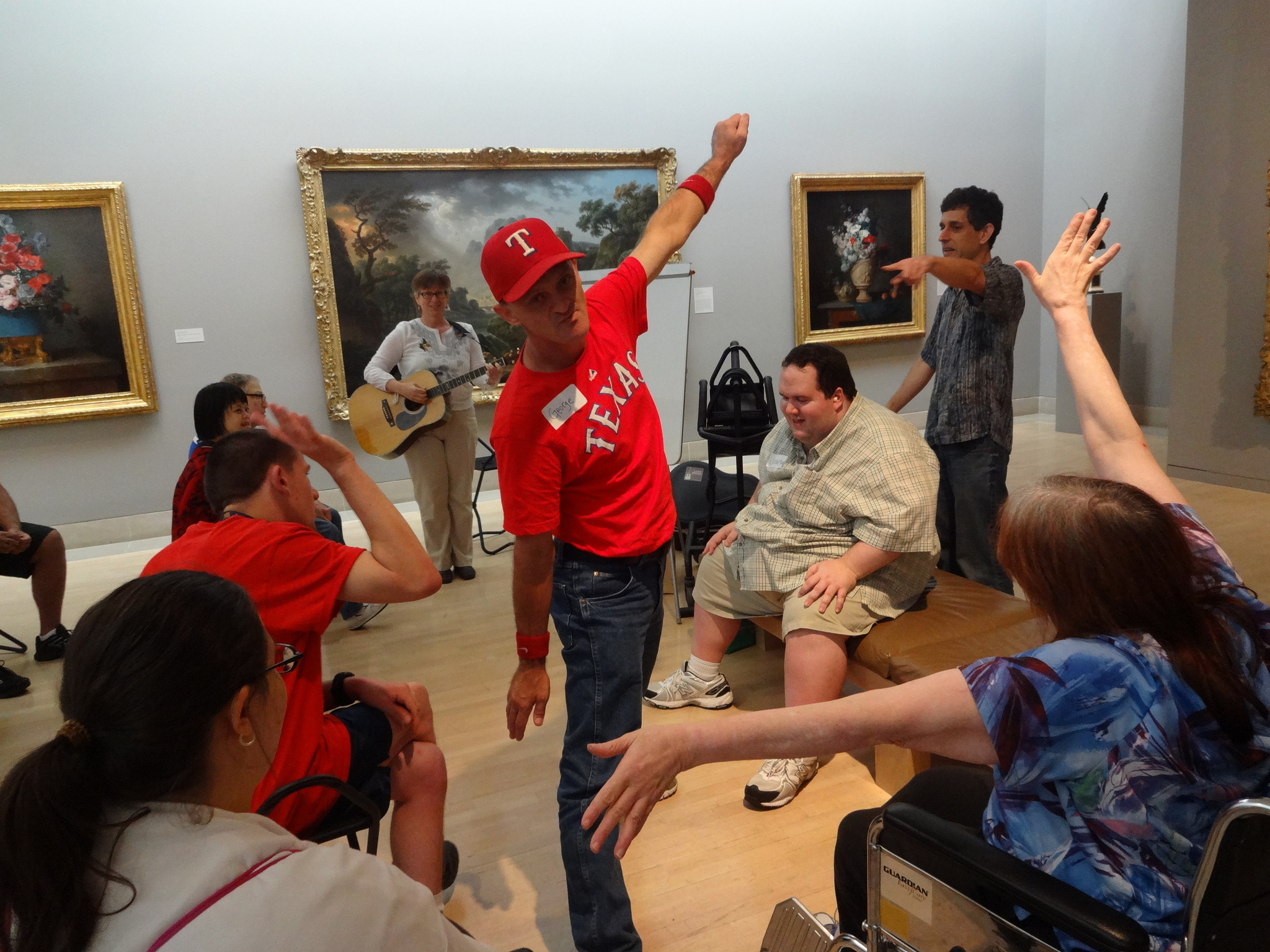
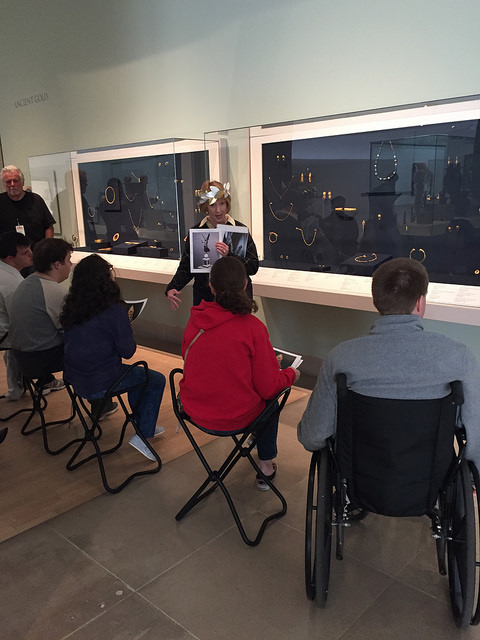
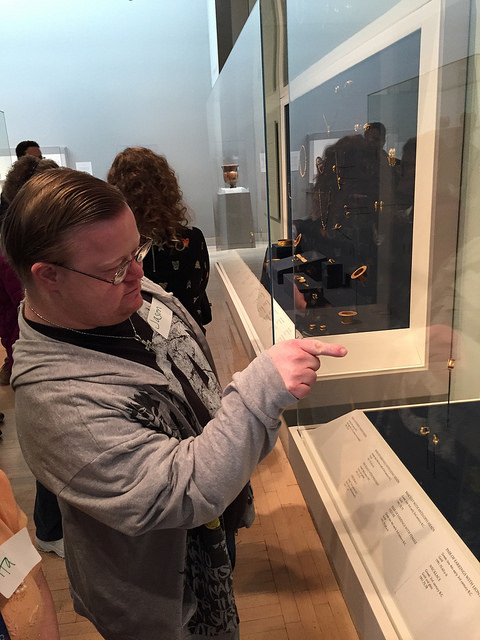
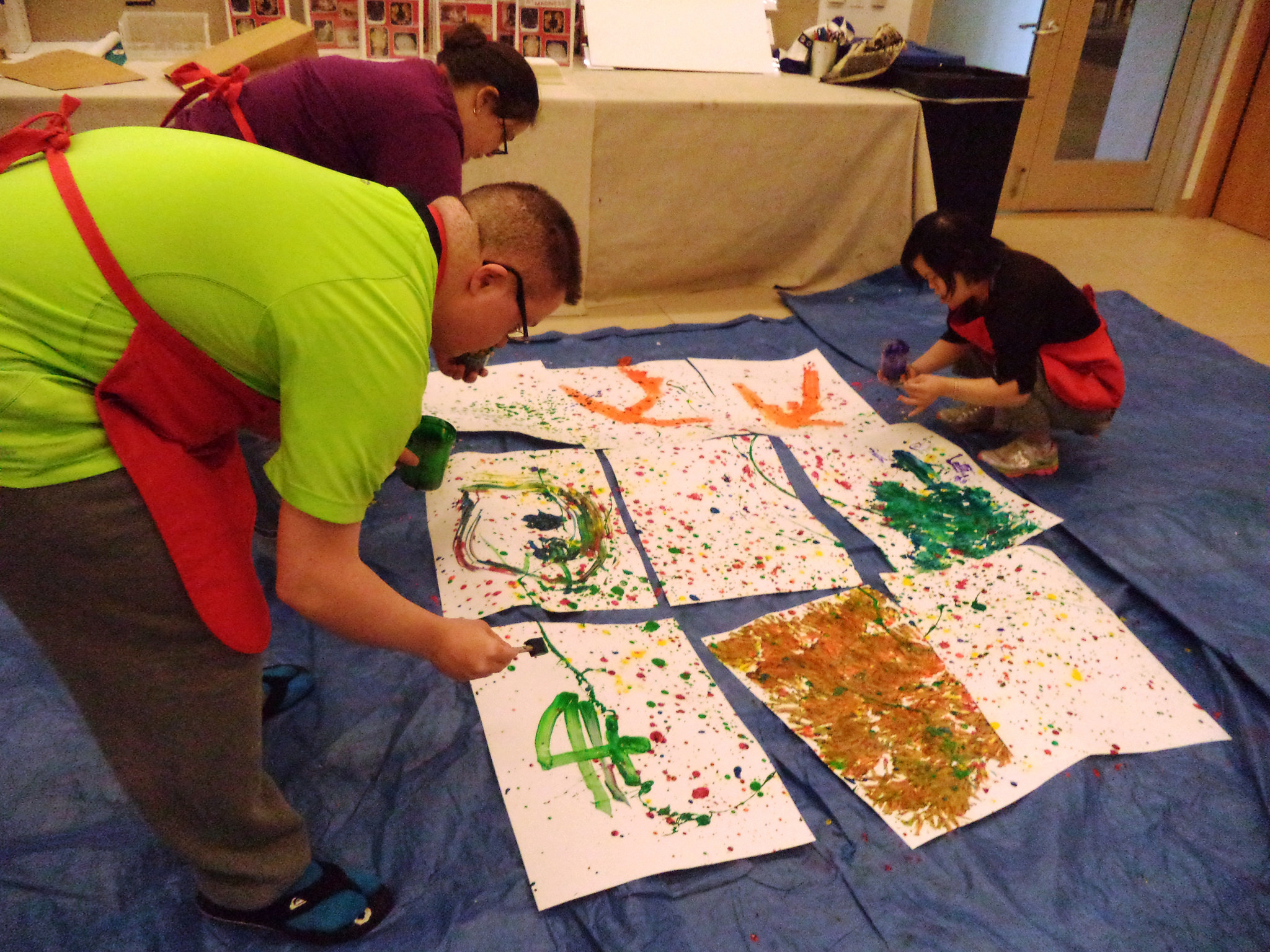
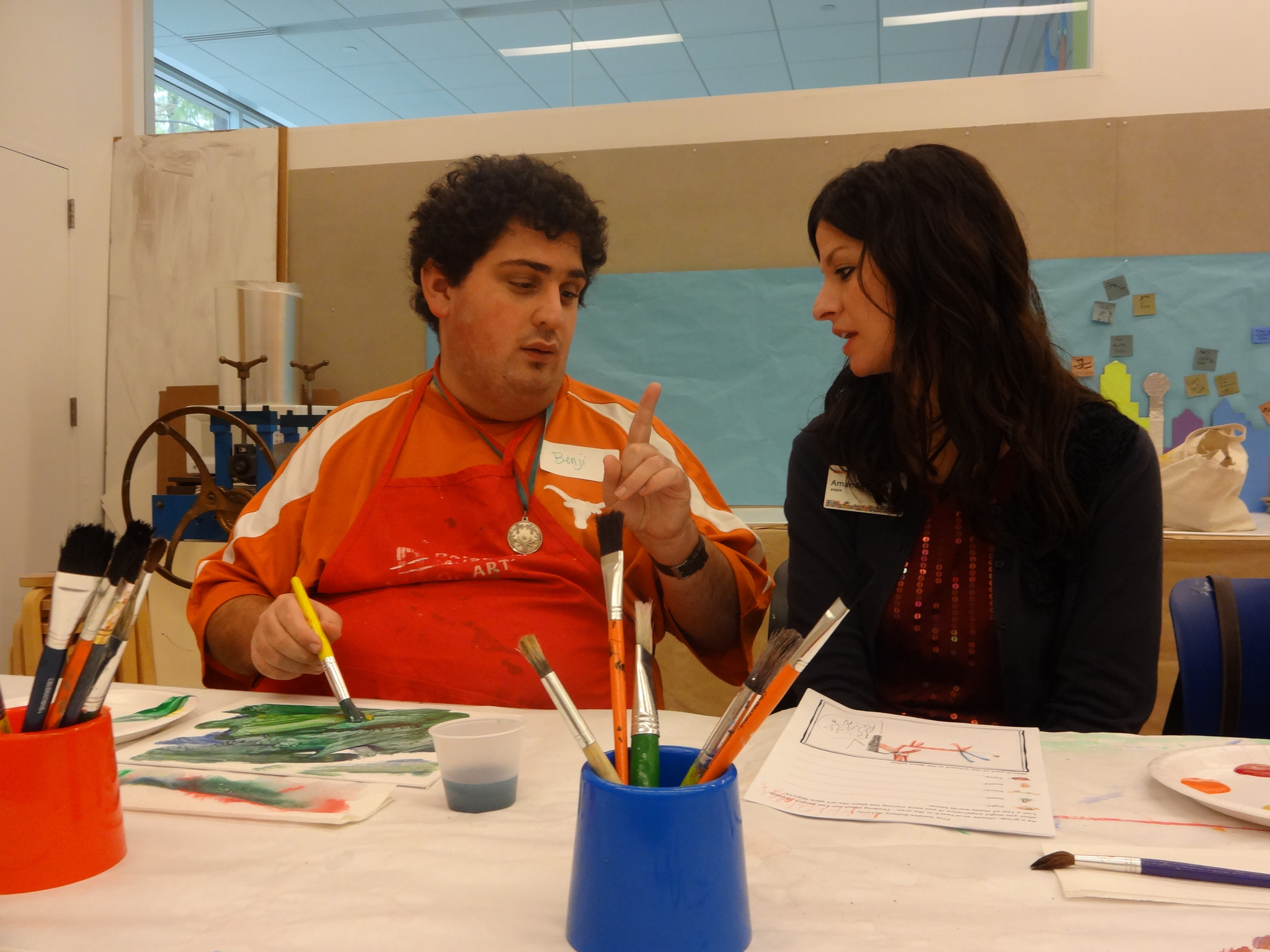
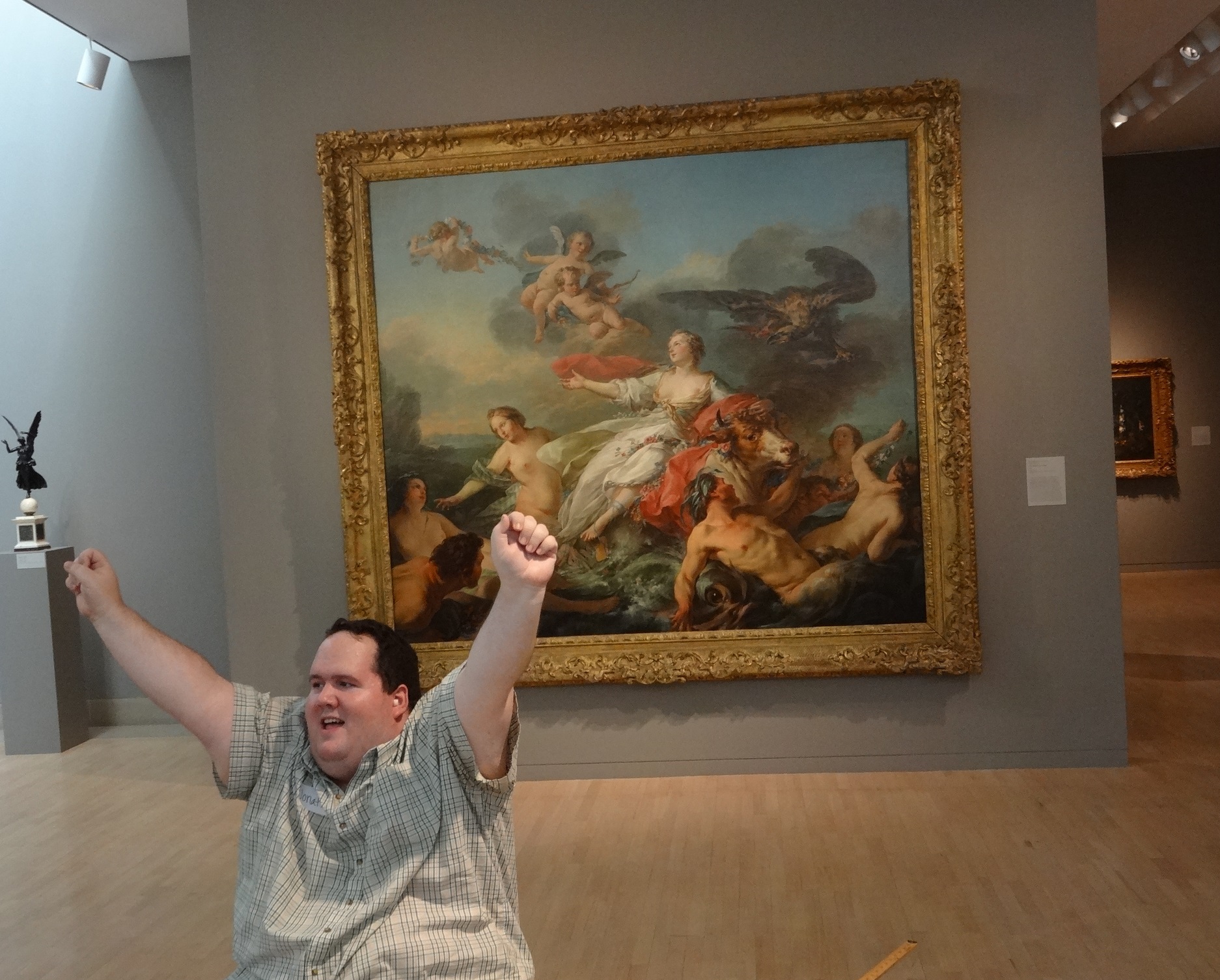
Furthermore, we announced the expansion of our access programs to include All Access Art, a program for adults with intellectual and developmental disabilities. Developed from the DMA’s long-running partnership with the Arc of Dallas advocacy group, All Access Art will now provide art-infused experiences to a wider selection of special needs groups in the DFW area, including Special Abilities of North Texas, Connecting Points of Park Cities, and Community Homes for Adults, Inc. (CHAI). During these visits to the Museum, participants explore the galleries on a theme-based tour and then return to the Center for Creative Connections Art Studio to create their own work of art.xc

We are thrilled at the expansion of this program and look forward to sharing more images and stories of our fantastic experiences with All Access Art!

Danielle Schulz
Teaching Specialist

Austen Abounds

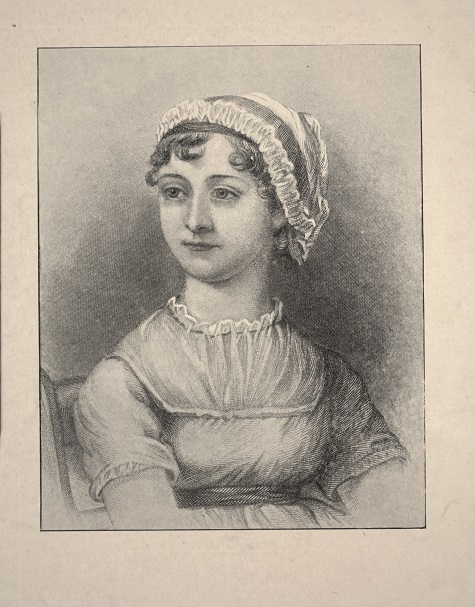
It all started last year when a colleague sent me a link to a portrait we have in our collection of Jane Austen, done by Austen’s sister Cassandra. This colleague knew I was an Austen fan and wanted to see if I was aware that we had this in our collection. I had no idea!

After Cassandra Austen, Jane Austen, n.d., engraving, Dallas Museum of Art, Foundation for the Arts, The Alfred and Juanita Bromberg Collection, bequest of Juanita K. Bromberg

After Cassandra Austen, Jane Austen, n.d., engraving, Dallas Museum of Art, Foundation for the Arts, The Alfred and Juanita Bromberg Collection, bequest of Juanita K. Bromberg

I shared this awesome news with other Austen fans on staff, which led us to think about how great it would be do a Jane Austen-themed Late Night. Around that time, we also heard that the Dallas Theater Center would be doing a spring production of Austen’s Sense and Sensibility. Voilà, an Austen Late Night was born.

DTC FY15 Sense 300w 150t 1

We brainstormed a lot of ideas, researched speakers who had talked at local and national meetings of The Jane Austen Society of North America, and met with staff from the Dallas Theater Center to talk about connections to their production.

After months of planning, we are excited to see the event take shape, and we invite you to join us for our Jane Austen Late Night on Friday, March 20, from 6:00 p.m. to midnight. You can hear music from the Romantic era, learn about the fashion world of Jane Austen, watch a Victorian fencing demonstration, listen to a dramatic reading by Dallas Theater Center actors, take quizzes to test your knowledge of all things Austen, watch films, including the 1940 version of Pride and Prejudice staring Laurence Olivier, and learn how Kate Rorick helped modernize Austen for the digital age.

Secret Diary LB Cover

For those of you who like to bring the world of Austen to life, we invite you to come dressed as your favorite Jane Austen character or in a costume inspired by England’s Regency era for a chance to win great Austen-themed prizes, including a pair of tickets to the Dallas Theater Center’s production of Sense and Sensibility. Baronda Bradley, a specialist in Regency fashion, will judge the contest, starting at 8:30 p.m.

sense-and-sensibility-original (1)

Our March Late Night is also our annual Spring Block Party in the Arts District. There will be a lot to do that evening with the Nasher Sculpture Center and Crow Collection of Asian Art also staying open until midnight.

And, for anyone needing an Austen appetizer, there are still tickets available to see Jo Baker, author of Longbourn, at tomorrow night’s DMA Arts & Letters Live event.

I hope to see all my fellow Austenites on Friday!

Stacey Lizotte is Head of Adult Programming and Multimedia Services at the DMA.


Archives

Categories