Archive Page 65


Friday Videos: Nightlife at the DMA

Did you know that the Dallas Museum of Art is an exciting place to spend your Thursday nights?  Thursday evenings at the Museum are filled with live jazz music in the cafe and artist encounteers in the Center for Creative Connections.  Teachers and students receive free admission from 5:00 to 9:00 p.m. each Thursday with a valid school I.D.  Did you also know that the DMA has its own YouTube channel featuring a brand new video all about Thursday Night Live at the Museum? 

[youtube=http://www.youtube.com/watch?v=2vgBJBWFJA0]

A second video has just been released all about Late Nights at the DMA.  On the third Friday of each month, the Museum stays open until midnight.  In my opinion, this is the best time to be at the Museum–the whole building pulses with energy and excitement!  From live performances to lectures to art-making activities, there are experiences that everyone will enjoy.  In fact, tonight is the April Late Night, so watch the video below and then head down to the DMA for a night of art and fun!

[youtube=http://www.youtube.com/watch?v=XkZK-A0fxFs]

Shannon Karol
Manager of Docent Programs and Gallery Teaching

Revealing Spirits: The Art of Indonesia

My colleague Amy Copeland and I recently led a teaching session focused on a few works of art in the Dallas Museum of Art’s amazing Indonesian collections. Our session in the galleries highlighted an expressive ancestral couple and a beautifully carved door with mythical creatures, emphasizing ways to look closely as well as explore geography and belief systems through objects from Indonesia.

Spirits abound in Indonesia.  A mysterious energy animates the entire universe. Human beings and animals, trees and plants, the ancestral dead, stones, man-made objects, even traditional houses — all share in this vital force.  Man has been inspired to give many of these spirits tangible form, to make the unseen visible.

Dallas Museum of Art wall text

Female ancestor figure, Toba Batak people, Sumatra, Indonesia, 19th century or earlier, wood, Dallas Museum of Art, the Eugene and Margaret McDermott Art Fund, Inc.

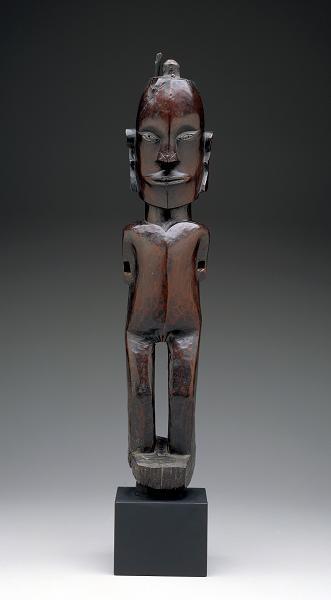
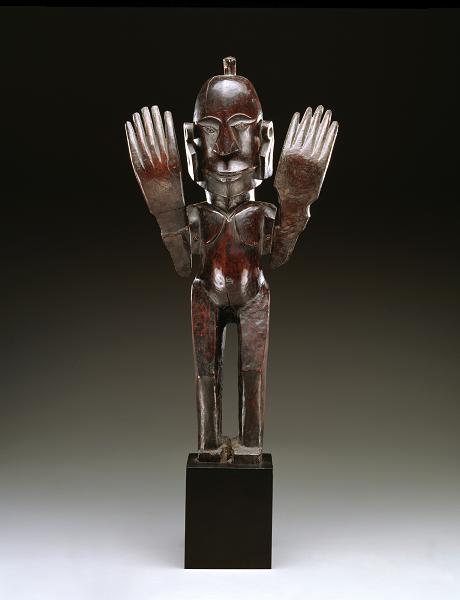
Male ancestor figure, Toba Batak people, Sumatra, Indonesia, 19th century or earlier, wood, Dallas Museum of Art, the Eugene and Margaret McDermott Art Fund, Inc.

This male and female pair represents an ancestral couple from the Toba Batak peoples on the island of Sumatra.  The two objects were originally bound together with a third object and kept out of sight in the uppermost region of the house inhabited by the Batak lineage founder.  This region of the house was a space the Batak associated with the upperworld, where gods and ancestors reside.  Only a privileged few were ever allowed to view or touch these powerful ancestors who both protected as well as carried the potential to inflict harm. What I love about this couple are their expressive qualities.  Look closely at their faces — the eyes, the noses, and the mouths.  Next, notice their posture. Both have knees bent slightly and their backs held in a certain way.  Viewing these in the galleries is best so that you can walk all the way around them. Finally, perhaps what attracts our eye most are the large hands of the female. The male once had separately carved hands as well.  You can see the rectangular slots on either side where his hands were once attached.  The hands on the female are up, with palms turned inward.  This gesture expresses the Batak greeting of “Horas”, or hello.

Door with protective symbols, Kayan people, East Kalimantan, Indonesia, c. 1850-1900, wood, brass, and shell, Dallas Museum of Art, the Roberta Coke Camp Fund

The Kayan people of East Kalimantan in Indonesia live in longhouses, which can be very large structures that rise from the ground on stilts.  The longhouse is a series of contiguous, individual spaces connected by a common verandah.  The organization of the spaces in the longhouse is similar to the American concept of apartment structures.  Each space houses a family, so a longhouse is the residence for many people.  This wooden door was either as the main door to the longhouse or as the door to the individual space of the chief. The animal symbols carved on the door protected inhabitants from evil spirits and intruders.  Look closely for animal forms on the door.  The white, shell circles contrast sharply with the dark wood.    These circles are the eyes of the protective, mythical creature called the aso, a form resembling both a dog and a dragon.

In addition to looking at objects in the galleries, Amy and I shared some general information about Indonesia during the session that help us begin to know and connect with this far away location.

  • Indonesia is the largest archipelago in the world!  It consists of thousands of islands.
  • According to Google Maps, it is 9,200 miles between Dallas, Texas and the East Kalimantan in Indonesia.
  • A plane ride to Indonesia would last sixteen to eighteen hours!
  • Many islands in Indonesia have been known throughout history for the spices, such as nutmeg, and natural medicines, such as camphor, found there.
  • Several delicious coffees originate from Indonesia.  Sumatran coffee from the island of Sumatra is one of my favorites.

Nicole Stutzman
Director of Teaching Programs and Partnerships

Teen Docents: It's a Family Affair

This summer, we celebrate the tenth anniversary of the DMA Teen Docent program!  Over the course of the last ten years, we have noticed that a lot of our new applicants have older siblings who were also teen docents.  There are even a few teen docents whose moms are DMA docents during the school year.  I’m going to turn the spotlight on two teen docents who are sisters, and who also happen to be my cousins.  For us, the teen docent program really is a family affair.

Leah is currently a junior, and this will be her third summer as a teen docent. 

Leah, what was your best tour experience from last summer?
My best teen docent experience from last summer was a tour for a group of girls who were in second, third, and fourth grade.  They really got into the tour, and we had a great time talking, sketching, and playing games inspired by works of art in the galleries.

What are the benefits (in your opinion) of being a teen docent?
Being a teen docent, you get service hours in a fun way.  You get to talk with kids, teach them about art, and meet other teens who have the same interests as you. It is also a great way to build up confidence in leadership and public speaking, as there will never be anyone quite as opinionated as a group of 20 little kids…

Abby will be a freshman in the fall, and this will be her first summer as a teen docent.

Abby, why do you want to join the teen docent program?
I was inspired to become a teen docent after going on a tour of the DMA with Shannon.  I also want to serve the community by educating young children about art.  I want to keep art alive in this community.

What are you most looking forward to when you become a teen docent?
I am looking forward to talking with kids about artworks at the DMA. I also look forward to giving tours with my older sister. I enjoy art, so getting to instill the same love for art into young visitors will be very rewarding for me.

Abby, Shannon, and Leah--three Karols with a connection to the teen docent program

This will be my second year leading the teen docent program.  I’m so excited to reconnect with our great volunteers and to welcome a new class of docents to the program.  Teachers, if you have students (grades 9-12) who you think would make great teen docents, we would love for them to apply.  Please email me (SKarol@DallasMuseumofArt.org) to request an application.

Shannon Karol
Manager of Docent Programs and Gallery Teaching

Printmaking 101

Printmaking has been around since the fifteenth century.  There are many types of printmaking processes, such as woodcuts, etchings, engravings, lithographs, and monotypes. The earliest print technique, the woodcut, was used to illustrate books. To make a woodcut, the artist carved a design from a piece of wood and inked the block. Ink would only stay on the areas of the block that were not carved. Eventually, artists looked for new ways to create images, which resulted in etchings and engravings.  

Etchings and engravings were favored by artists. To make either type of print, an image is drawn onto a metal plate with a v-shaped tool called a burin.  The plate is coated in an acid-resistant surface and ink is beaten into the incised lines with a tool called a dabber. Then, the plate is submerged in an acid bath, which opens up the lines and exposes the metal surface. The acid creates the depth of line by reacting with the areas of exposed metal. Afterwards, the plate go through a printing press. In the engraving process ink rests in the engraved lines and the plate is run through a press. Both prints allowed for greater flexibility with images and a variety of lines and tones in the final product. 

Advances in the print world saw the emergence of  lithographs and monotypes during the nineteenth century. Lithographs are a direct medium; the image is drawn on a flat stone with a greasy oil or crayon and run through a printing press. Monotypes have ink drawn onto a glass or copper plate and transferred to paper. Monotypes produce one image; printing another image results in deteriorated quality.

To help you better understand prints, I included some images of the printmaking process. I hope you enjoy seeing how they are created! If you would like to explore works on paper in the DMA’s galleries, prints by the following artists can be found in the collection: Edgar Degas, Henri de Toulouse-Lautrec, Berthe Morisot, Camille Pissarro, and Pierre Bonnard.

[slideshow]

Amy Wolf
Coordinator of Gallery Teaching

Educator Resources: Funding for Field Trips

One of the best ways to connect your students with art and the cultures they’ve been learning about in the classroom is to bring them to the Museum.  Each year Museum staff and docents tour hundreds of students from the Dallas-Ft. Worth area, and school tours are one of the most enjoyable aspects of our days.  The Museum is entirely FREE for students, teachers, and their chaperones on school tours, and the only cost to you is your bus.  We realize that even the cost of a bus can limit you and your students’ ability to visit the Museum.  So, we’d like to share several opportunities to subsidize the cost of your transportation to and from the Museum.

1. Target Field Trip Grants

Target launched its grant program in 2007 and has awarded almost $10 million in grants, allowing students and teachers from all fifty states to extend the classroom to the world of museums, historical sites, and cultural organizations.  Each Target store awards three grants up to $700 to K-12 schools nationwide.  Applications for the 2011-2012 school year open August 1st!

2. DART Transit Education

DART’s Community/Education Outreach Program provides support for public and private schools, grades 1-12 in thirteen DFW-area cities.  The program offers a twenty-minute on-site presentation about public transportation, safety, and rules of conduct.  Then, classes can be transported FREE to a number of different Dallas sites, including the Arts District and Fair Park.  For more information and to schedule a program, see the DART site.

The Museum offers both docent-guided and self-guided  tours, which can be scheduled online.  Museum visits for the 2011-2012 school year can be reserved beginning in August, and request forms will be available online.  The calendar does fill quickly, so please schedule programs as early as possible.  We look forward to seeing you and your students at the Museum!

Ashley Bruckbauer
McDermott Intern for Teaching Programs and Resources

Friday Photos: April Fool's Day!

We decided to have a little fun on April Fool’s Day, so a few of us took a field trip over to the Nasher Sculpture Center’s new  exhibition, Sightings: Martin Creed.  Getting lost in the balloons was fun and scary at the same time.  Can you find the Museum educators?

[slideshow]

Melissa Nelson
Manager of Teaching in the Community

Form/Unformed: Goldilocks and the Chairs

This past December, the Tower Gallery on the fourth floor of the Museum became home to Form/Unformed: Design from 1960 to the Present.  This exhibition showcases over thirty works drawn largely from the Museum’s collections and reveals the ever-evolving formal aesthetics and ideas that have influenced design of the last fifty years.  Featuring everything from room dividers to candlesticks, the space pays homage to design powerhouses such as Verner Panton, Frank Gehry, Donald Judd, and Louise Campbell.  Though a broad array of objects appear in the exhibition, one cannot help but notice an overwhelming number of chairs

[slideshow]

Like Goldilocks entering the three bears’ home, we are presented with a selection of chairs ranging across all shapes and sizes.  As our exhibitions currently have a heavy empahsis on design, with Gustav Stickley and the American Arts & Crafts Movement and Line and Form: Frank Lloyd Wright and the Wasmuth Portfolio, the Education staff began brainstorming how our society describes furniture and what appeals to us about various pieces.  In an effort to find the chair that is JUST RIGHT for you, here are some of the descriptors that may appear on any one of our wish lists for the perfect chair: organic, innovative, angular, minimal, sturdy, plush, colorful, weird, comfy, casual, simple, unique, futuristic, traditional, embellished, symmetrical, asymmetrical, functional, imaginative, elegant, versatile, compact, playful, practical, nostalgic, modern….As you can see, there are as many different ways to describe a chair as opinions on what qualities make the perfect chair!

What words describe your ideal chair?  Share with us in the comments section!

Form/Unformed: Design from 1960 to the Present will run through January of 2012 and is free with general admission to the Museum.

Ashley Bruckbauer
McDermott Intern for Programs and Resources for Teachers

Educator Resources: Sneak a Peek at New Online Teaching Materials

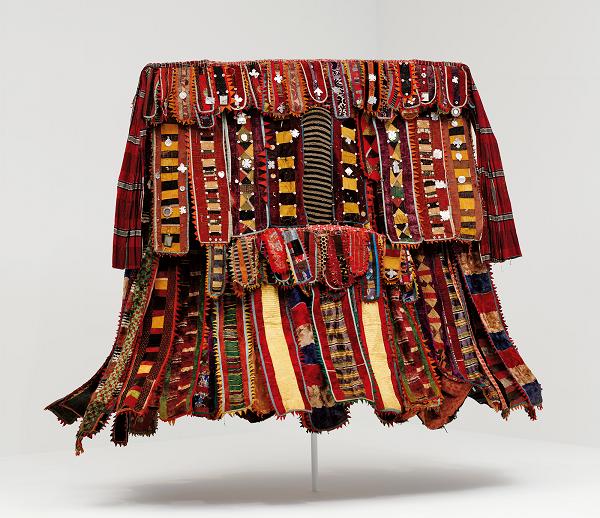
Egungun costume; 1920 - 1950; Yoruba peoples, Nigeria; cotton, silk, and wool fabric, metal, leather, mirrors, cotton, and wood; Dallas Museum of Art, Textile Purchase Fund, 1995.35.

This Egungun costume from Nigeria is one of sixty-five artworks in the Dallas Museum of Art’s collection that will be part of new online teaching materials to be launched in Fall 2011. Education staff, working in close collaboration with curators, designers, and web developers, have been hard at work for over one year designing a new model for creating online resources for teachers that are easy-to-access and provide the following:

  • more and better-organized information
  • video and audio clips related to the artworks and cultures
  • contextual images and multiple views of the artworks
  • teaching ideas that could be customized by classroom educators

The project is officially called Connect: Teachers, Technology, and Art, and it is supported through a grant from the Institute of Museum and Library Services. When we started our project work in November 2009, we went straight to the audience we serve: TEACHERS.  The dialogue and partnership that developed with ten teachers who were selected to represent the minds, wishes, and needs of classroom educators everywhere has been crucial, as it led to a pivotal decision about the presentation of information and ideas about the sixty-five works of art.

These teachers helped us test current teaching materials to identify their strengths and weaknesses, and they showed us how they might use objects like the Egungun costume in a classroom experience with their students. Together, we analyzed and re-imagined what great teaching materials for DMA artworks could be and we are excited to reveal this sneak peek.

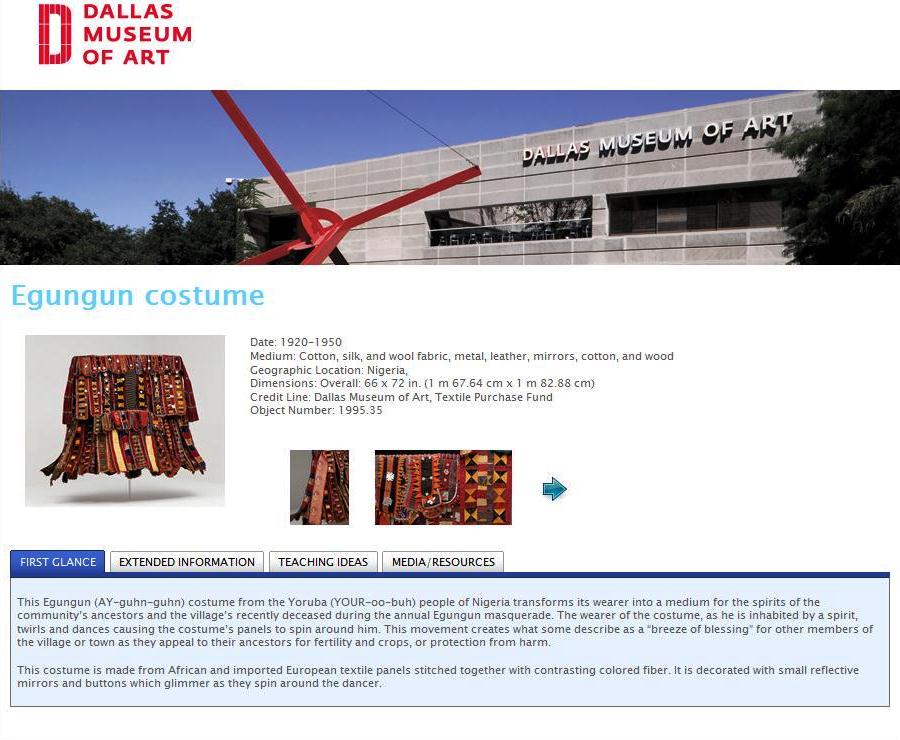
I reveal to you the new template for online teaching materials and the future of online resources for teachers and students at the Dallas Museum of Art.  Each work of art will have its own set of information, clearly organized according to tabs.  The “First Glance” tab provides introductory information about the object, similar to the information found on a label in the galleries.  It may serve as the hook to pull you further into an exploration of the artwork.  The “Extended Information” tab provides paragraphs of topical information that reveal more about the object.  For example, the Egungun costume information includes paragraphs about Death and Religion, Materials, and African Masquerades.  This text has been culled from new curatorial scholarship and existing interpretive resources.  A teacher will also find contextual images in this section.

The third tab, “Teaching Ideas,” is a section presenting questions, comparisons, and activities that any teacher could use to get started teaching a lesson using this artwork.  These ideas are a mix of resources generated by DMA education staff and K-12 teachers.  Finally, the “Media/Resources” tab provides extra resources in the form of books, audio and video clips, and additional web sites.  We are also working to provide as many pronunciations as possible for less familiar words, easy print capabilities, opportunities to view the images in larger sizes, and access to detail images of the art.

In April, we will begin testing this new model with a new group of ten teachers. Will they agree with the first ten in terms of needs and wishes?  That is exactly what we hope to find out. Each of the new teachers will design and implement a lesson using the teaching material template above, and we will ask them to tell us what works and what needs to be changed or added.  We look forward to this second round of crucial work because it will only make the online resources stronger.  What are your initial thoughts about this new look and presentation?

At the completion of the Connect project, we plan to have a wonderful new model, but we will only have converted sixty-five objects to the new teaching materials.  We have hundreds to convert!  A redesigned home page and teacher resources site will help us streamline the presentation of resources as we remain in transition mode and continue converting the existing resources to the new format.  I will be anxious to share the new site with you later this year and welcome your comments.

Nicole Stutzman
Director of Teaching Programs and Partnerships

Friday Photos: NAEA in Seattle

Last week, Nicole, Jenny, Melissa, and I spent Spring Break attending the National Art Education Association convention in Seattle.  This was my first time attending NAEA, and I returned to Dallas energized, excited, and filled with new ideas for the teaching we do in our galleries. 

Although we all attended a lot of sessions at the convention, we also found time to get out and explore Seattle.  I especially enjoyed Pike Place Market and the Seattle Art Museum (their African galleries are amazing).  Below are just a few of the photos from my week at NAEA! 

[slideshow]

Shannon Karol
Manager of Docent Programs and Gallery Teaching

Community Connection: Dallas and Beyond

I look forward to spring for several reasons: warmer weather, hints of green and color coming out on trees and plants, and the National Art Educators Association Convention.  Held in a different city each year, the Convention provides opportunities for us to meet museum and classroom educators from all over the United States, as well as other countries, and to learn what our colleagues are doing and thinking about in their respective cities.  On the flip-side, DMA educators often lead conference sessions and share about the new and exciting programs that consume our daily lives.

The most recent Convention took place in Seattle during Spring Break.  I took part in a session with Elizabeth Gerber and Sofia Gutierrez, educators from the Los Angeles County Museum of Art.  We all work closely with afterschool programs, and evaluation and reflective practice are essential to the development and refinement of our programs.  We led a session that not only described our programs but also encouraged our audience to share their practices.  Meet our most distant Community Connections to date below:

Briefly describe your position at LACMA.

Elizabeth:  In a nutshell, I aim to connect the art at LACMA with the lives of students and teachers throughout Los Angeles County.  This includes working with multi-visit school programs where kindergarteners through high school students visit the museum multiple times; programs that take place in schools, libraries, and community centers; and professional development opportunities for classroom teachers.  These programs occur during school, after school, in the evenings, and on the weekends.  LACMA even creates an exhibition at a local elementary school each year!
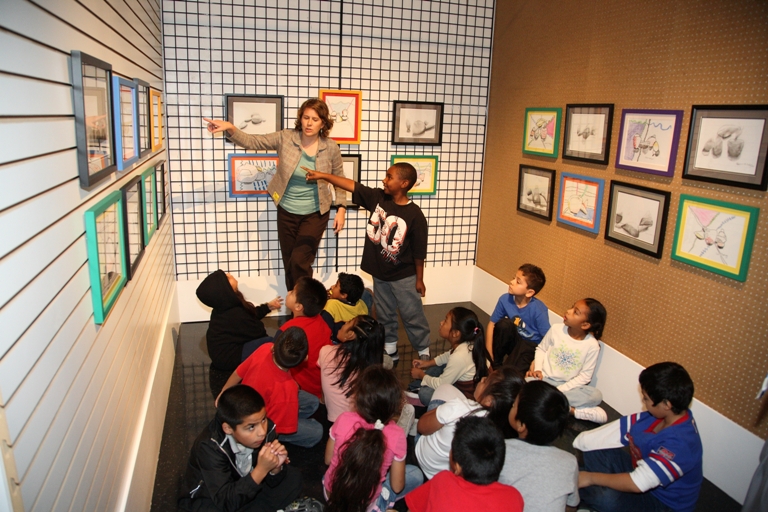
Elizabeth Gerber

Sofia:  I coordinate the out-of-school afterschool component for the Art Programs with the Community: LACMA On-Site program. We have a partnership with the Los Angeles Public Library, the YMCA, and the Los Angeles Unified School District. The majority of the workshops happen at the seventeen partner libraries, where we hold weekly sixty- to ninety-minute hands-on art programs focused on developing critical thinking skills, creativity, and personal connections. I work closely with our teaching artists by mentoring, looking over lesson plans, collaborating on professional development, team teaching, and further developing best strategies for equal voicing opportunities for our participants, many who are English Language Learners. Each workshop has learning and social goals that were developed from our two-year participatory evaluation modeled after the Theory of Change.  I also work closely with the librarians and other community partners and coordinators in our programs to ensure we are meeting the educational and life-long learning needs of their community, and to extend the hospitality of LACMA as part of their community.
Sofia Gutierrez

What was your favorite part of your Seattle NAEA experience?

Elizabeth:  This year I really enjoyed the opportunity to think “big” about museums and the ways they connect with audiences and communities.  This work encompasses everything from collaborating with living artists, to evaluating the work of museums, to articulating the ways museums have an impact on their visitors and program participants.

Sofia:  I especially enjoyed hearing about all the inspiring work that is being done in the field of Museum Education and the nation’s libraries, and the call to action from our profession to ensure that the nation is aware of the crucial role and value of these public institutions, and that museums along with libraries, not just the sciences, are leading the way in developing 21st Century Skills.

If you could take any work of art from the LACMA collection home with you, what would you choose?  (I know I ask this question of all our museum colleagues, but this is a great way to learn about the treasures of their collections!)

Elizabeth:  It is tough to pick just one!  Although my background is in contemporary art, I’d love to live with Copenhagen: Roofs Under the Snow by Peter-Severin Krøyer.

Sofia:  I would choose Veiled Christ, a small 18th century Italian terracotta sculpture of Christ entombed with a shroud covering his body.  And if that wasn’t available, I would take The Magdalen with the Smoking Flame, c. 1638-1640, by Georges de La Tour.

Melissa Nelson
Manager of  Teaching in the Community

Archives

Categories