Archive Page 64


Gerald Murphy and Archibald MacLeish

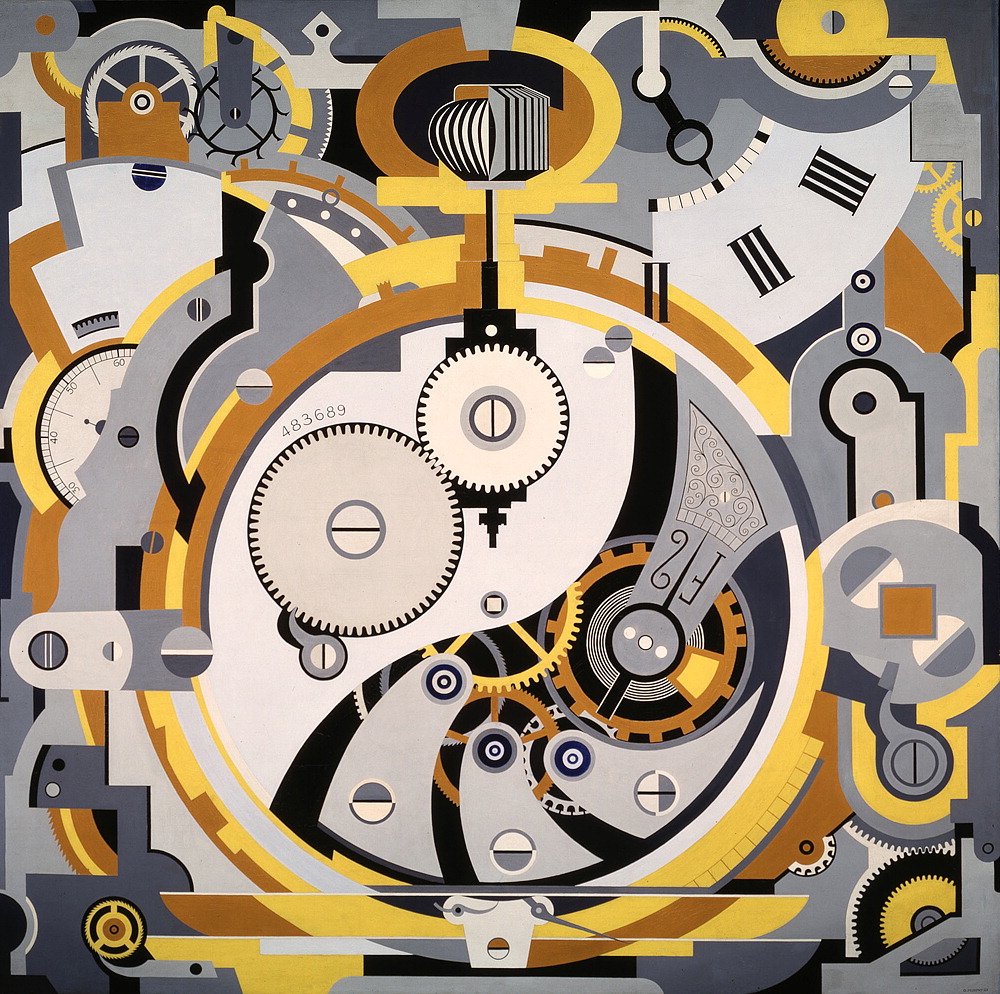
Of all the art in the DMA’s collection, I think I like Gerald Murphy’s Watch most of all. I adore how Murphy makes a complex technological system look bright and vibrant. But moreover, I appreciate how his painting explores the difficult relationship between the people and science of his time. In the 1920’s, the idea of time was changed dramatically by the widespread dissemination of Einstein’s Theory of Relativity in 1919. Suddenly, the Newtonian concept of time as a uniform absolute was invalidated. For many writers and artists of the period, Einstein’s discovery dramatically revised the way they saw the world.


Gerald Murphy, Watch, Dallas Museum of Art, Foundation for the Arts Collection, gift of the artist


Murphy’s Watch explores one man’s view of this sudden change in the perception of time, how it went from an external force outside of the comprehension or control of people to something interior, relative, and subjective. In the painting, Murphy represents his watch internally, by the gears and machinery which make it function and give it power rather than by its most familiar characteristic: its face.

Shannon Karol nicely summarizes the relationships between Murphy and Lost Generation writers. In it, she talks about Murphy’s friendships with Ernest Hemingway and F. Scott Fitzgerald. Murphy was also friends with Archibald MacLeish, a poet who shared Murphy’s fascination with time. In MacLeish’s poem “You, Andrew Marvell,” he describes the shadow of the night as it spreads over the face of Asia and Europe. The title of the poem makes reference to poet Andrew Marvell who, in his own poem “To his Coy Mistress,” speaks about the sway of time over the affairs of lovers. By naming his poem this way, MacLeish reminds readers of time’s slow and steady creep and of its great and terrible power over the lives of people.

By discussing literature and art together, one can explore thematic connections which might not be otherwise apparent. Share some literary or thematic connections you use to talk about DMA art with your students in the comment section below.

Tom Jungerberg

IMLS Grant Coordinator

Call of the Wild: Animals in the Art of the American Indians

The Art of the American Indians: The Thaw Collection is currently on view at the Dallas Museum of Art which features art such as masks, ceramic bowls, jewelry, and clothing. I recently led a gallery talk entitled, Call of the Wild: Animals in the Art of the American Indians that focused on American Indian art that incorporated animals into the design or as the materials to create the work of art.  Animals are essential to many American Indian groups because they provided food, clothing, and oftentimes, shelter.

Mimbres Bowls
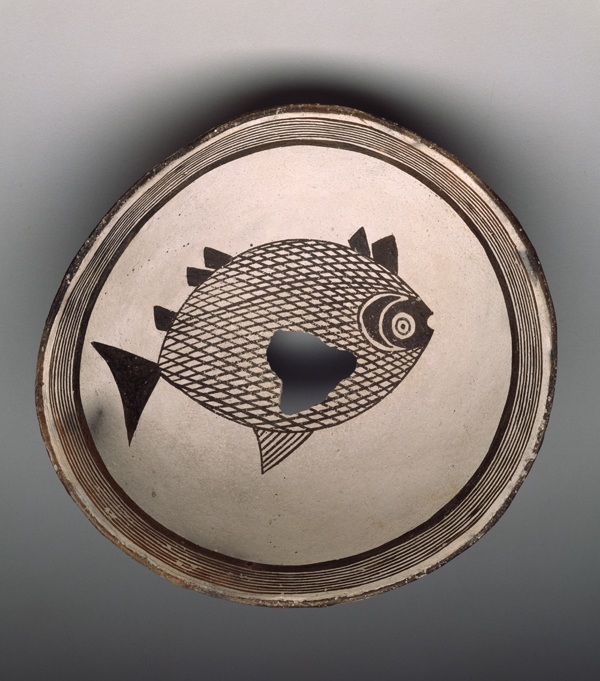
   Bowl With Fish, c. A.D. 1000-1150
United States: New Mexico, Mogollon culture, Mimbres people,
Ceramic; Mimbres Black-on-White type
Foundation for the Arts Collection, anonymous gift

The name Mimbres, which means “willow” in Spanish, was given to a group of people from the Mogollon culture who lived between 150 A.D. to 1450 A.D. The Mimbres people were an egalitarian society and lived in the Northwestern region of New Mexico. The Mimbres people were a very small society with approximately 5,000 members.  Their diet consisted of small game meat such as rabbits, turkeys, sheep, and foxes. They are known for creating clay-fired bowls between 1000 A.D. and 1150 A.D. during the peak of the Mimbres culture, known as the “Classic Mimbres Period”. These bowls were first discovered in the early 1900’s and continue to fascinate archaeologists because of their sophisticated design and level of creativity compared to their contemporaries and other ancient societies.

The Mimbres bowls were painted in the interior surface with geometric designs, human figures and/or animals, with a series of bands painted around the rim of the bowl. The designs may have represented scenes from their daily life or connections to the spiritual world. The leaves from a yucca plant were used as a brush to paint black slip on a white background or to paint white slip on a black background. Archaeologists can only speculate as to what these bowls were used for, such as storing food or used in a funerary offering. Many of these bowls have a hole punched out at the bottom. The process of making these holes is often referred to as “killing the bowl”. These particular bowls would have been placed over a deceased person’s head in order to free their spirit. There are approximately 20,000 Mimbres bowls in private collections and museums around the world.

Horse Mask                                                                                                  
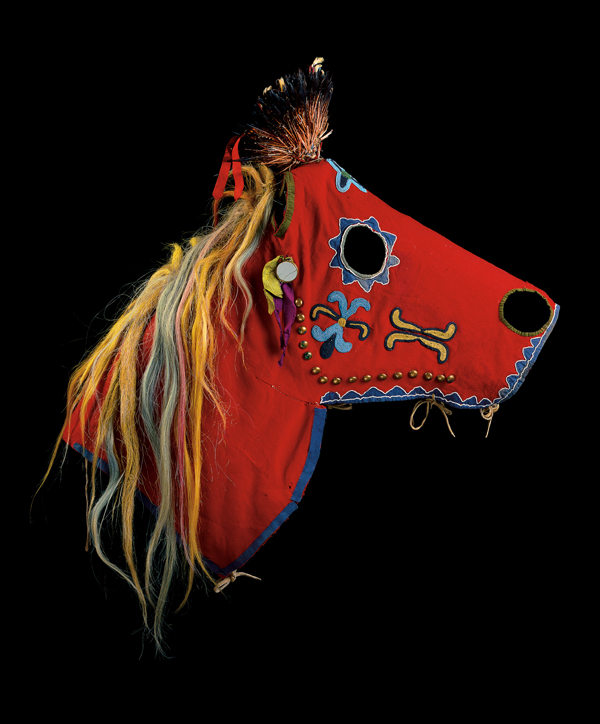
  Horse Mask, ca. 1875-1900
    Nez Perce, (Nimi’ipuu) or Cayuse, Idaho,  Oregon, or eastern Washington
Trade cloth, blue cloth, cotton lining, thread, glass beads, brass buttons, horsehair, mirror, feathers, silk ribbons, hide, ermine
Fenimore Art Museum, Cooperstown, N.Y

During the 13th through 17th century, the Plains Indians were a semi-nomadic society that traveled, traded and farmed by foot. They lived in the Plains region, which covered about one million square miles of land that covered Texas, Colorado, Kansas, Montana, Nebraska, New Mexico, North Dakota, Oklahoma, South Dakota, Wyoming, and the Canadian provinces of Alberta, Manitoba, and Saskatchewan. The buffalo was their primary source of food and was also used for making clothes, shelter, tools, and weapons. In the 1600’s, the Spaniards introduced horses to the Plains Indians, significantly changing their lifestyle. They became equestrian hunters and used horses in battles. This Horse Mask made of horse hair, ermine, feathers, glass beads, trade cloth, brass buttons, and mirrors would have been placed over the horse’s head to be worn during a prewar processional. A zigzag design symbolizing lightening was stitched around the eyes to represent the Thunderbird, a patron of war who protected the horses and warriors during battle. Mirrors were attached to the mask to reflect sunlight in order to distract their enemies.

Shield
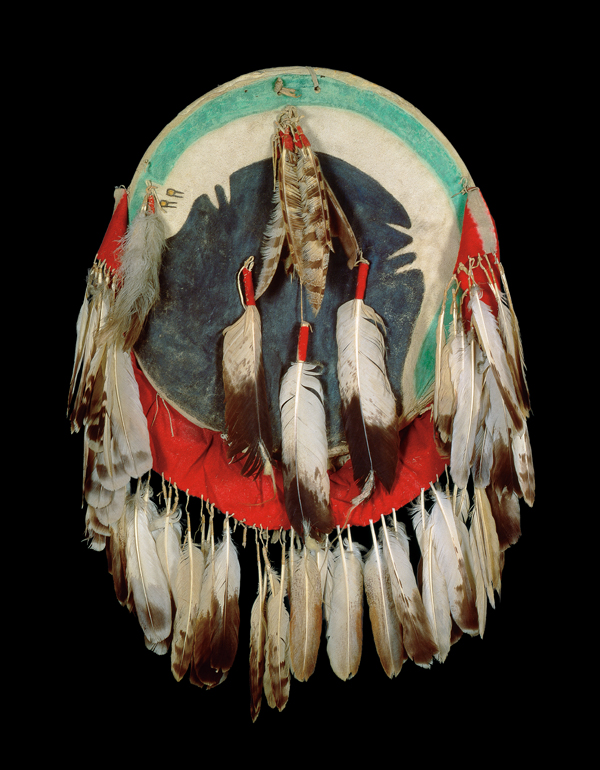
 Shield, ca. 1860
Crow, (Apsaalooke), Montana
Buffalo rawhide, antelope skin, trade cloth, eagle and hawk feathers, porcupine quills
Fenimore Art Museum, Cooperstown, N.Y

The Shield was also an important element of protection for Plains warriors riding into battle. However, it wasn’t just the buffalo hide that protected them from arrows and clubs, but also the spiritual power of the image painted on the shield. This image would have been revealed to the warrior in a vision or dream and was believed to have given him protection while in battle. The image on this shield reveals a White Mountain Lion painted beneath a green curved lined line which signifies a magnificent hunter. The Horse Mask and Shield are no longer used in battle; however, they can be seen in many parades and ceremonies held by Plains Indians today.

These American Indian works of art and others can be found in the Dallas Museum of Art collection and the Art of the American Indians: The Thaw Collection, which is currently on view until September 4th

Thanks,
Karen A. Colbert
Teaching Programs Intern
Friday Photo Post: Mother's Day

Mother’s Day is an annual holiday that recognizes motherhood, mothers,  and their contributions to our lives. In 1868, “Mother’s Friendship Day” was established to bring together families that had been divided during the Civil War. By 1910, Mother’s Day as we now know it was established and continues to be a popular day to celebrate mothers.  Since this Sunday is Mother’s Day, I highlighted works of art with mothers in various roles. If you are a mother, I hope you enjoy this photo post and your special day! 

[slideshow]

Amy Wolf
Coordinator of Gallery Teaching

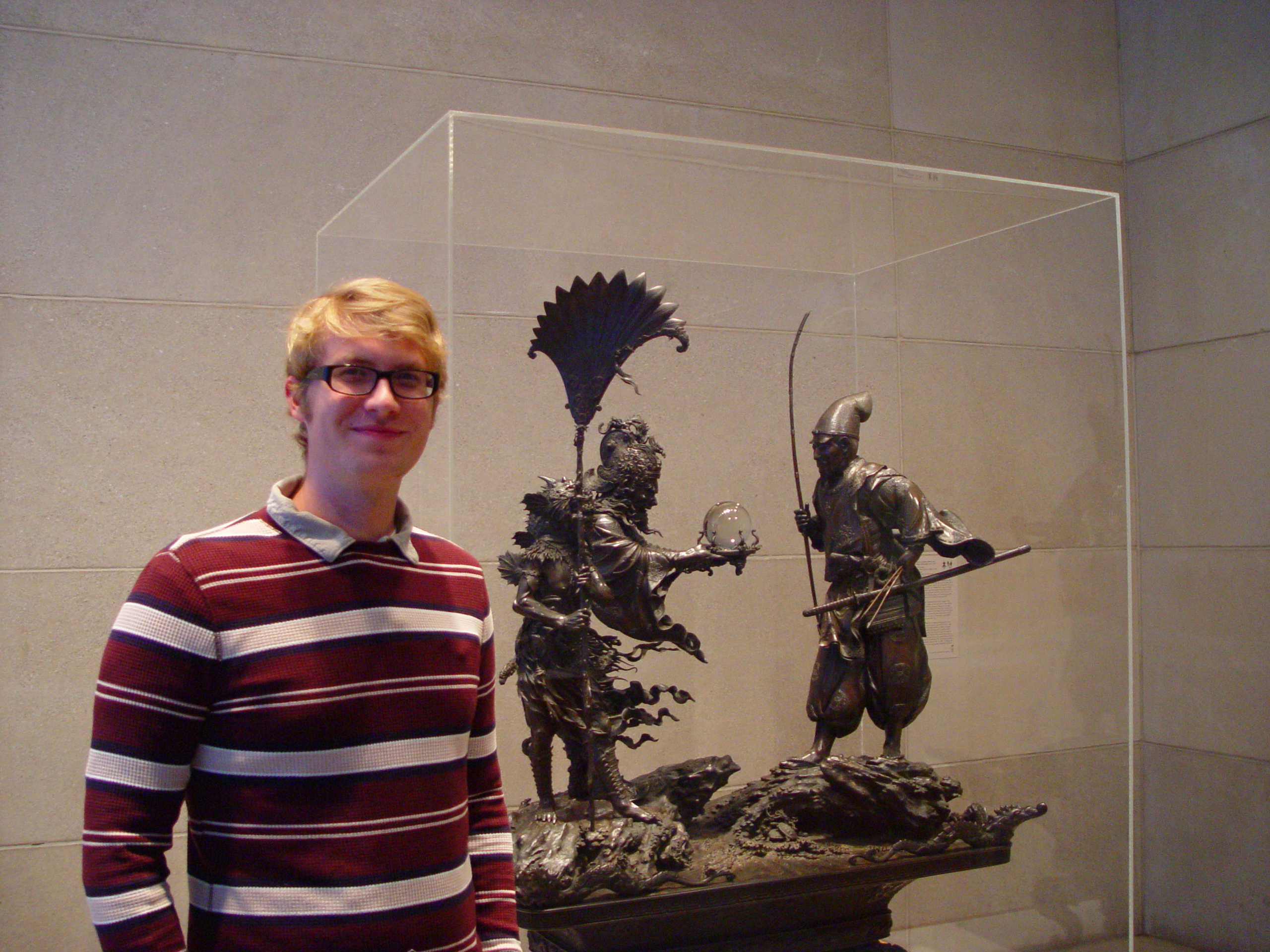
Staff Spotlight: Tom Jungerberg

Over the past two years, we’ve shared with you our exciting work with teachers related to Connect: Teachers, Technology and Art, a project supported by an IMLS grant.  This funding made possible a grant coordinator position that assists with various tasks related to the grant.   Tom Jungerberg quickly fit in with our department, and helped tilt the very uneven ratio of male to female staff ever-so-slightly in the opposite direction.

Could you trace the path that has brought you to the DMA?

I have Bachelor’s degrees from Florida State University in art history and English, and a Master’s degree from Boston University in English.  I’m originally from Florida and I lived there for two years prior to moving to Dallas. I worked at University of South Florida as a visiting assistant professor teaching composition, mostly, and expository writing.

My girlfriend began teaching at UNT Dallas last August, and that’s what brought me here. When I got here, I was excited to see an opening for the IMLS grant coordinator position since it seemed so suitable to my skill set. 

What is your role with the IMLS grant?

I serve as the liaison between Nicole and Jenny and the teachers – I correspond with teachers and coordinate meetings with them.  I write and edit some of the new online teaching resources.  I also participate in meetings, during which we discuss how we’ll approach the artwork as we develop materials and the steps we’ll need to follow to complete the project.

What has been the most interesting aspect of your work here?

I’ve really enjoyed everything, but it’s been especially interesting to observe teachers in the classroom. It’s great to see how people take the materials we’re preparing and apply them to their own curricula and lesson plans.  I appreciate being able to see the final outcome of these things that we’re making, and to see the different ways they’ll be used when they go public.

How do you spend your free time?

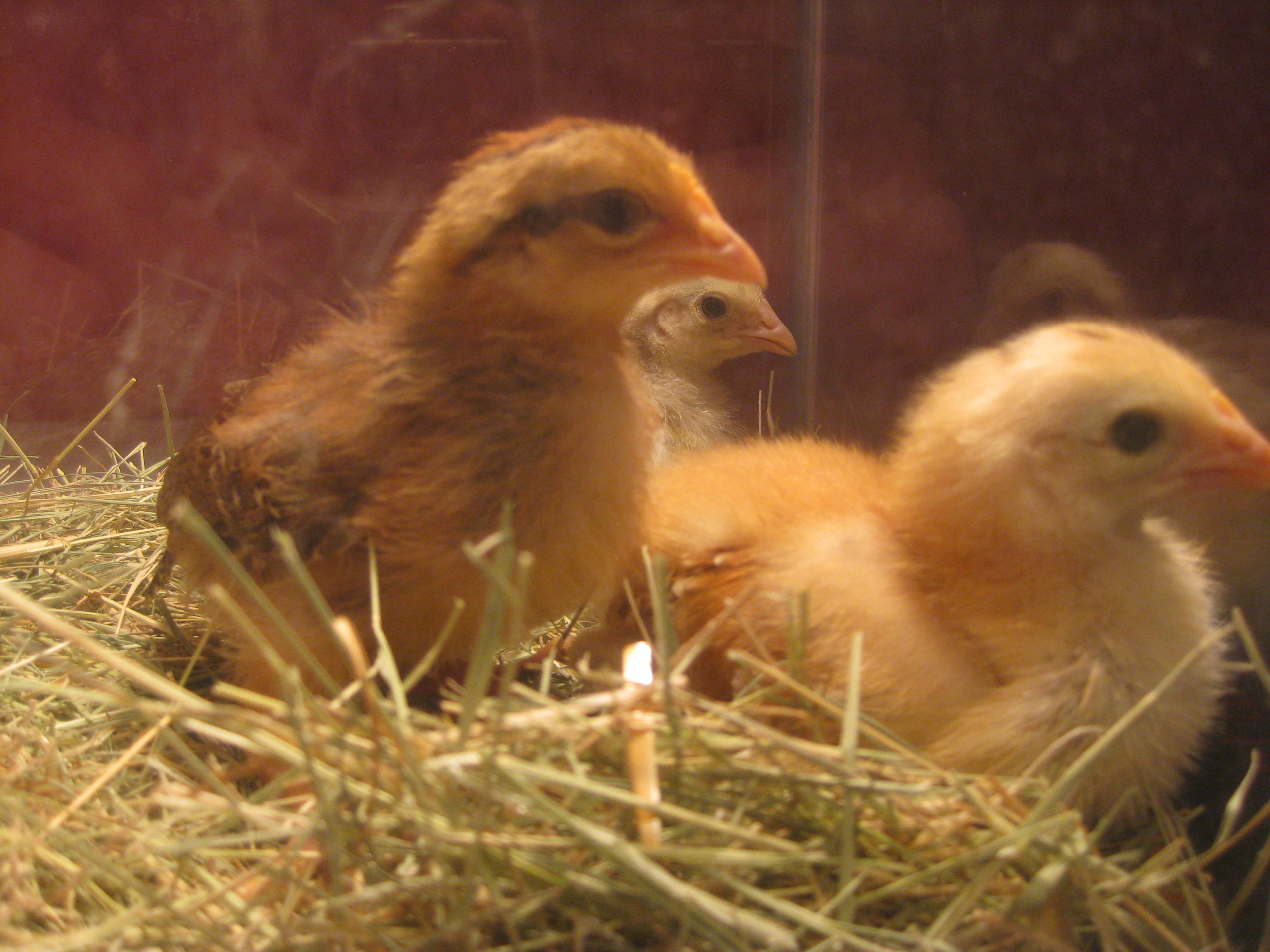
I just bought a house, so that takes a lot of my free time.  It was built in 1895, and legend has that it was built by one of the founders of TCU.  I also raise chickens, and I have a garden which I’m pretty excited about since it’s the growing season.  Yellow and green squash are coming in right now; I have also planted tomatoes, tomatillos, peppers, spinach, some lettuce, bok choy, peas, and green beans.

Where do you see yourself in five years?

That’s hard, as this job is ending in September.  I enjoyed my time at University of South Florida, so I’d like to teach.  I think teaching, but if you ask me tomorrow, I don’t know.

We’ve invited Tom to be a guest blogger; look for posts written by him in the coming months.

Melissa Nelson
Manager of Teaching in the Community

Educator Resources: Five Outside Online Resources

Several weeks ago for parts one and two of our Educator Resources series, I wrote about three wonderful DMA online resources and field trip grant opportunities.  For the third installment of our series, we wanted to introduce to you five phenomenal online resources from other arts institutions

1. Metropolitan Museum of Art Heilbrunn Timeline of Art History

The Heilbrunn Timeline, produced by Metropolitan Museum of Art curators and education staff, presents maps, timelines, thematic essays, works of art, and indexes from prehistory to the present day.  Launched in 2000, the Timeline continues to expand in scope and depth and reflect the most up-to-date scholarship.

2. ArtsConnectEd

ArtsConnectEd, a joint venture between the Minneapolis Institute of Arts and the Walker Art Center, provides two key features: “Art Finder” and “Art Collector.”  Art Finder offers textual, audio, video, and interactive resources regarding works of art from the two collections, while Art Collector allows users to save and customize resources through comments, tags, and ratings. 

3. Art 21

Art21 produces Art: 21: Art in the Twenty-First Century, an Emmy-nominated PBS series that highlights contemporary art and artists, in addition to books, online resources, and public programs.  The mission of Art21 is to create a living history of contemporary art by presenting contemporary artists discussing their work in their own words.  This is done in hopes of ultimately increasing the accessibility and knowledge of contemporary art. 

Artists represented in our galleries at the Museum such as John Baldessari, Trenton Doyle Handcock, and Bruce Nauman have been featured in past series.

4. MoMA’s Modern Teachers

Modern Teachers is an online resource offered by the Museum of Modern Art in New York City.  The site provides educator guides, lessons, and images related to the Museum’s collection.  These resources span modern art of the 1880s, including Post-Impressionism and Symbolism, to recent 21st-century works.

5. ArtBabble

ArtBabble is an initiative of the Indianapolis Museum of Art that showcases video content from a variety of arts institutions, such as the Art Institute of Chicago, Asian Art Museum of San Francisco, and the Museum of Arts and Design, among others.

Enjoy exploring these resources, and please share in the comments below any additional resources you find useful when teaching about art in your classroom!

Ashley Bruckbauer
McDermott Intern for Teacher Programs and Resources

Friday Photo Post: The Royal Wedding

Royal weddings happen once in a lifetime. From the flowers, the wedding dress, and the cake, everyone wants to know the special day’s details. They have become so popular that millions of people watch them on television and purchase memorabilia. Items made to commemorate the wedding of Prince William and Catherine Middleton include dishware, a replica royal engagement ring, PEZ dispensers, and even a Catherine Middleton doll! With the excitement surrounding today’s royal wedding, the Friday photo post focuses on works of art in the collection that include couples and objects made for royalty.

[slideshow]

Amy Wolf
Coordinator of Gallery Teaching

Community Connection: Combining Two Passions

One of the great things about working with volunteers is the opportunity to meet people with a wide range of interests, experiences, and passions.  Last fall, I interviewed Deborah Harvey, one of our Go van Gogh volunteers.  I am pleased to introduce Jennifer McNabb, another Go van Gogh volunteer, who has managed to combine two of her passions through our outreach program.  
 
Tell us a little about yourself.

I’m British, and I’ve been in the U.S. for twenty years, in Dallas for nineteen years.  I’m a longtime visitor to the DMA.   When my work situation opened up seven years ago, I was looking for a way to volunteer in the arts.  I have a background in community arts from the 1980’s in England, when I helped set up and run a group studio for artists called Red Herring Studios.  We took over derelict buildings that were to be demolished, converted the buildings to studio spaces, and had an exhibition space too.  Red Herring put visual arts on the map in Brighton and has given birth to other fabulous organizations like Fabrica.  

Jennifer with her father and sister at Chesworth Studios in West Sussex, England.

What do you like most about Dallas?

I think what I like most about Dallas is the very vivid cultural life here.  We have great museums (the Nasher Sculpture Center, the DMA, The Crow Collection of Asian Art), and I love the way the Arts District has been developing with the AT&T Performing Arts Center and the expansion of Booker T. Washington High School.  I don’t come from a place where you have zoning; in London, these places are all in different parts. Also, I love the fact that Ft. Worth is just a few miles away with another bunch of fabulous museums. Although Dallas is a town that tends to be on the map business-wise, it is also on the map culturally.  I live in Oak Cliff, so it’s very easy to get to these places.

Tell us about your relationship with the DMA.

I started out by coming to your office and asking what I can do to volunteer with the DMA.  At the time, I couldn’t give the amount of time necessary for the docent program, but I did like the idea of the Go van Gogh program.  I have a background in teaching, and I thought it would be nice to get back into the classroom.  I like that the DMA has this type of in-reach and does such a good job at taking art into the classroom, getting kids excited about it, and hopefully encouraging teachers to take kids to the museum more.  Teaching is something I feel passionate about along with the visual arts – I come from a family of artists and I like the fact that I can go into the classroom and do all the fun stuff, and the kids love me for it. 

I’d been doing Go van Gogh for three or four years when a friend said to me one day, “You should come to this meeting about Resolana and get involved with this organization that provides programming for incarcerated women.”  I am also passionate about prison reform.  When I saw the creativity workshops they did, I thought yes, this combines two things I feel strongly about.  I got involved almost immediately.  After I had been to the jail a few times, I spoke with you and Amy about the possibility of the DMA doing something in partnership with Resolana.  I was looking for ways I could take the DMA into the jail, and you suggested trying some of the programs we teach in the schools. 

Jennifer leads the Arts of Mexico Go van Gogh program with Resolana participants.

What are the greatest benefits and challenges to presenting Resolana programs?

I was very aware I was teaching a different population, but in some respects they’re kind of similar.  Being in the jail frees them up, and they are very good about trying anything you suggest.  They don’t have self-editing about what is right and what is wrong in a class setting.  The women are willing to try most things; I don’t get the same resistance I might get from sixth-grade students.  The difference is, these are adults, and I didn’t want to make them feel I was doing baby stuff with them.  I had to adapt the programs because certain supplies are not allowed in the jail.  I also tried to get the discussion portion much more pitched toward their level.  I would not lead too much, and tried to give them space.  I am also in the Master of Liberal Studies program at SMU, and I took a class with Carmen Smith, who worked at the DMA for twelve years before working at the Meadows Museum.  I learned a number of techniques for talking about art with groups of people that museum educators use and started to use some of those techniques.  What I learned about in class went straight to the jail, and I saw a remarkable difference in the quality of the discussions. 

What is capturing your time and attention at the moment?

I’m always reading something fascinating, but work right now is capturing a lot time and attention.  We now have a pod in the jail dedicated to women interested in attending Resolana classes – they all live together.  It means we have doubled the number of women we see every week, so I’m trying to increase our number of volunteers as quickly as I can.  I am also trying to develop a program to train volunteers, using Go van Gogh as a model.  The Meadows Museum has donated their studio for training sessions. That takes up a lot of my time.

My other big passion is learning. I get to take classes in all kinds of things in the Liberal Studies program. I’m knee-deep in anthropology at the moment, and I’m writing a paper about systems of value in the U.S. and in the western world in general, and how that compares to other value systems when looking at works of art.

Melissa Nelson
Manager of Teaching in the Community

Gustav Stickley and Frank Lloyd Wright in Dallas

Last Monday, our theme for docent training was “a morning of architecture in Dallas.”  I invited Katherine Seale, director of Preservation Dallas, to speak with the docents about the influence of the Arts and Crafts movement in Dallas. 
 
As director of Preservation Dallas, Katherine has firsthand knowledge of all the historic homes in Dallas. The Arts and Crafts movement hit Dallas later than on the East and West coasts, but there are many excellent examples of Stickley-esque Craftsman homes in East Dallas. 
 
Katherine spoke about Swiss Avenue and the Munger Place neighborhood, both of which I was familiar with already.  To me, the most fascinating part of Katherine’s presentation was about a neighborhood in Oak Cliff called Winnetka Heights.  Winnetka Heights is, according to Katherine, the most Arts and Crafts neighborhood in Dallas.  Craftsman bungalows–one-story homes made of wood with low-pitched roofs and exposed joinings– line the streets of this neighborhood.  I’m already planning a weekend outing to view these homes.
 
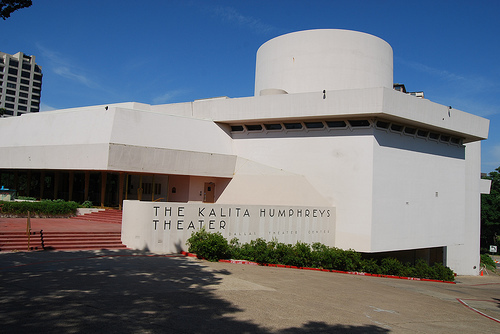
Following Katherine’s presentation, architect Ann Abernathy spoke about Frank Lloyd Wright in Dallas.  Yes, the DMA currently has an exhibition of his prints: Line and Form: Frank Lloyd Wright and the Wasmuth Portfolio.  But did you know that Wright was the architect for the Kalita Humphreys Theater?  

Frank Lloyd Wright's Kalita Humphreys Theater

Ann is the perfect person to speak about Frank Lloyd Wright, because she was the project lead for the renovation of Wright’s Oak Park home and studio.  She has also been named the project lead for the renovation of the Kalita Humphreys Theater.  This gives her the unique distinction of having worked on projects that were created at the beginning and end of Wright’s career.

The plan for the Kalita Humphreys Theater came from a 1914 theater plan that was designed by Wright but never built.  When he was asked to design a building for the Dallas Theater Center, Wright agreed, but only if he could use his 1914 plan.  What many people may not know is that the Kalita is one of the last buildings constructed by Wright–he began work on it in 1955 when he was eighty-eight years old, and it was completed after his death in 1959.

As anyone who has visited the Kalita Humphreys Theater knows, it is situated on a hillside over Turtle Creek.  The building is constructed from reinforced concrete, and is considered to have wonderful acoustics.  This comes from Wright’s own interest in the science and theory of acoustics.  The theater also features a revolving stage.  My favorite element of the theater is how the audience wraps around the stage.  Every performance at the theater feels like an intimate gathering.

Katherine and Ann’s presentations have opened my eyes to a new way of looking at buildings in Dallas.  I encourage you to spend Mother’s Day weekend at the DMA to learn more about Wright and Stickley.  Examine the drawings in Line and Form: Frank Lloyd Wright and the Wasmuth Portfolio and spend time marvelling at the beauty of Craftsman designs during the closing weekend of Gustav Stickley and the American Arts and Crafts Movement.

Shannon Karol
Manager of Docent Programs and Gallery Teaching

Trade before Planes, Trains and Automobiles

Have you ever wondered how goods and services, such as spices, fabrics, and art, traveled from one part of the world to another before the use of planes, trains, and automobiles?  The Silk Road provides a great insight for understanding early trading among different countries. It is the most well-known trading route of ancient Chinese civilization that was used during the first millennium B.C.E through the middle of the second millennium C.E under the Han Dynasty. The Silk Road was a transcontinental network of land and sea trade routes that spread across Eurasia from the Mediterranean to China and Japan. Domesticated horses and cattle as well as marine vessels were used as transportation to carry such goods and services along these routes.

Dr. Anne Bromberg, The Cecil and Ida Green Curator of Ancient and Asian Art, organized The Silk Road, an installation which illustrates how this great route of trading developed.  This exhibition also describes the spread of religions from India to Central Asia during this time. One of the greatest benefits of the Silk Road that Dr. Bromberg wanted to emphasize was the spread of agriculture. Animals not only provided transportation, but they also provided food and a mechanism for cultivating crops.


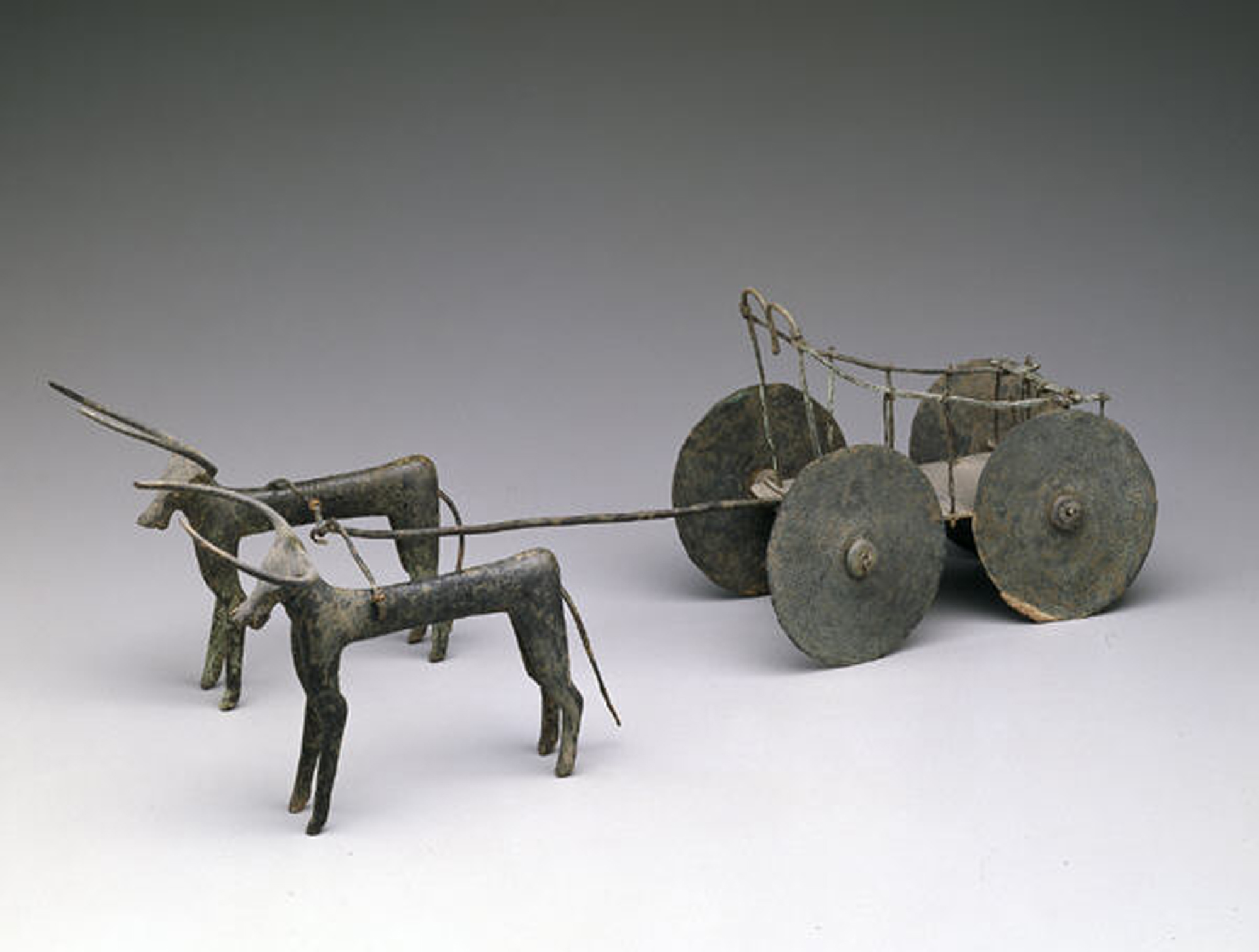
 Oxen and Cart, 2000-1800 B.C., Bronze
Dallas Museum of Art, Irvin L. and Meryl P. Levy Endowment Fund

A great deal of Near Eastern art similar to the Oxen and Cart traveled along the Silk Road. The Proto-Hittites were devoted to animals, which were vital to hunting and farming. Objects such as the Oxen and Cart were perhaps used as an offering to be left in a shrine, sacred caches or tomb. In addition,  the Oxen and Cart symbolizes the distinct moment when domesticated horses or cattle were first used as powered transportation on land.

The Silk Road provides a great opportunity to discuss with students the benefits and consequences of trading among different cultures. I’ve added a list of books and websites that will help you introduce the Silk Road to your students. These books and more can be found at the Dallas Public Library or the Museum’s Mayer Library.

Books:
Stories From The Silk Road by Cherry Gilchrist and Nilesh Mistry
The Silk Route: 7,000 Miles of History by John S. Major and Stephen Fieser
Mapping the Silk Road and Beyond by Kenneth Nebenzahl
Adventures on the Ancient Silk Road by Priscilla Galloway and Dawn Hunter
Silk Road: Monks, Warriors & Merchants by Luce Boulnois and Helen Loveday

Websites:
the Silk Road project:
http://www.silkroadproject.org/tabid/177/defaul.aspx

Silk Road Seattle:
http://depts.washington.edu/silkroad/

Enjoy,
Karen A. Colbert
Teaching Programs Intern
First grade's smartest artists

[slideshow]Last month, four volunteers and I piled into the Go van Gogh van and drove south of downtown to Rosemont Primary, a DISD PK-2 school in Oak Cliff.

While Rosemont Primary is just one of the many campuses we visit with the Go van Gogh outreach program, we have a special relationship with their first grade teachers.  Each year, we visit the first grade at Rosemont, presenting multiple programs in all eight classrooms and getting to know the students during our many visits.  Through the years, the first graders at Rosemont have played a larger role in the Go van Gogh program than they might realize; Go van Gogh staff often takes newly-developed curricula into their classrooms.  We test questions, gauge response during activities, and (most importantly) make sure that we’ve packaged an experience that’s fun, engaging, and relevant for the students.  Go van Gogh staff is grateful to our first grade friends at Rosemont for the smart observations, unexpected answers, and funny moments that have helped us refine curricula, ensuring that our programs are solid.

Needless to say, we were pretty excited to return to Rosemont last month with the Me & My World programMe & My World introduces first graders to people and places in art through stories and clues.  The program features four artworks, and our conversations range from talking about families while looking at Mary Cassatt’s Sleepy Baby to thinking about heroes while looking at our Greek Gold Wreath.  Students create an art activity inspired by another artwork in the program, Fernand Leger’s The Divers, drawing a picture on transparency film with a Sharpie, and layering it on top of a bright collage of shapes.

Photos from our fun morning at Rosemont, featuring the little artists and their creations, are above.

Enjoy!

Amy Copeland
Coordinator of Go van Gogh Outreach


Archives

Categories