Archive Page 19


Friday Photos: Let’s Talk About It

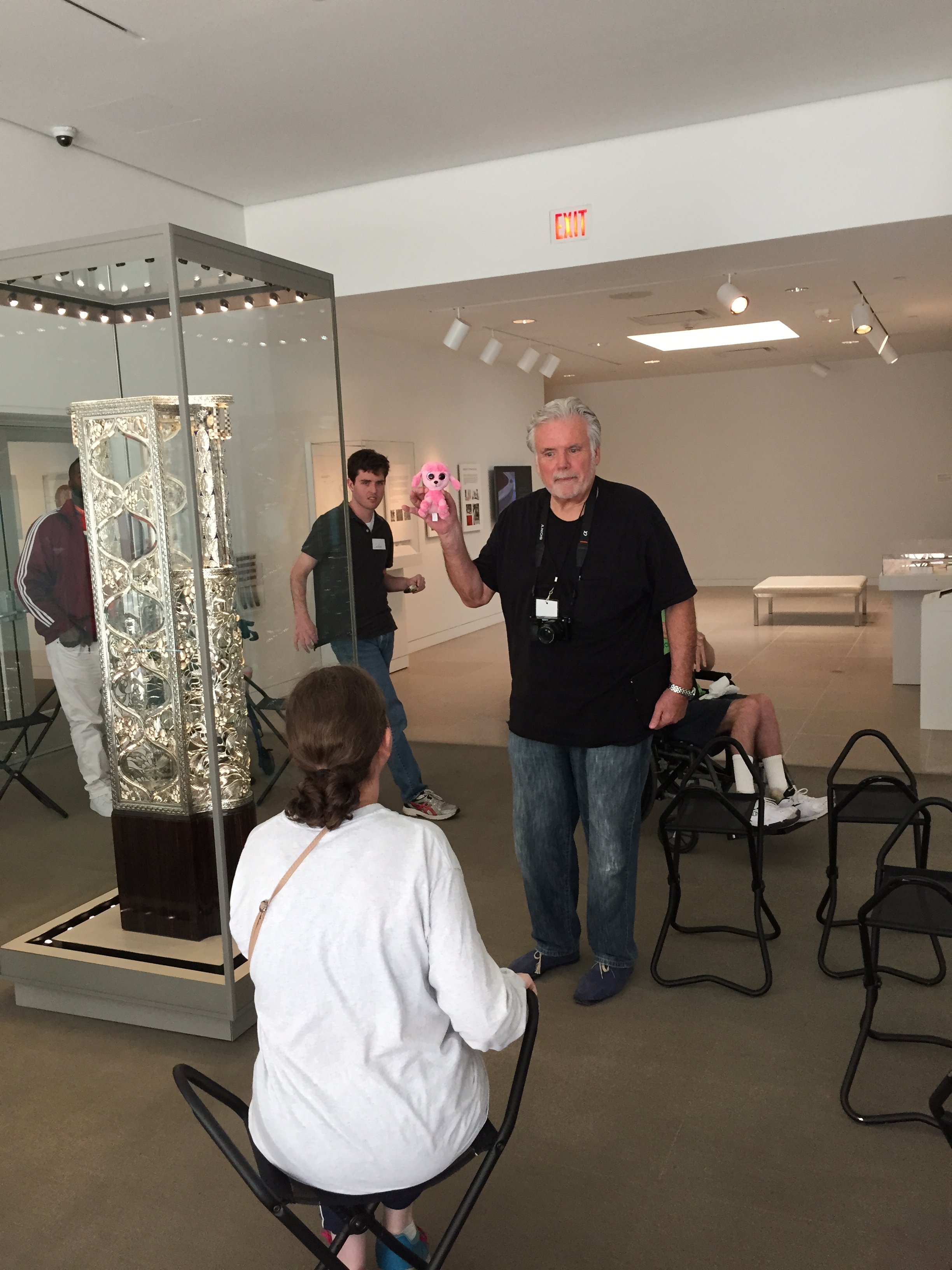
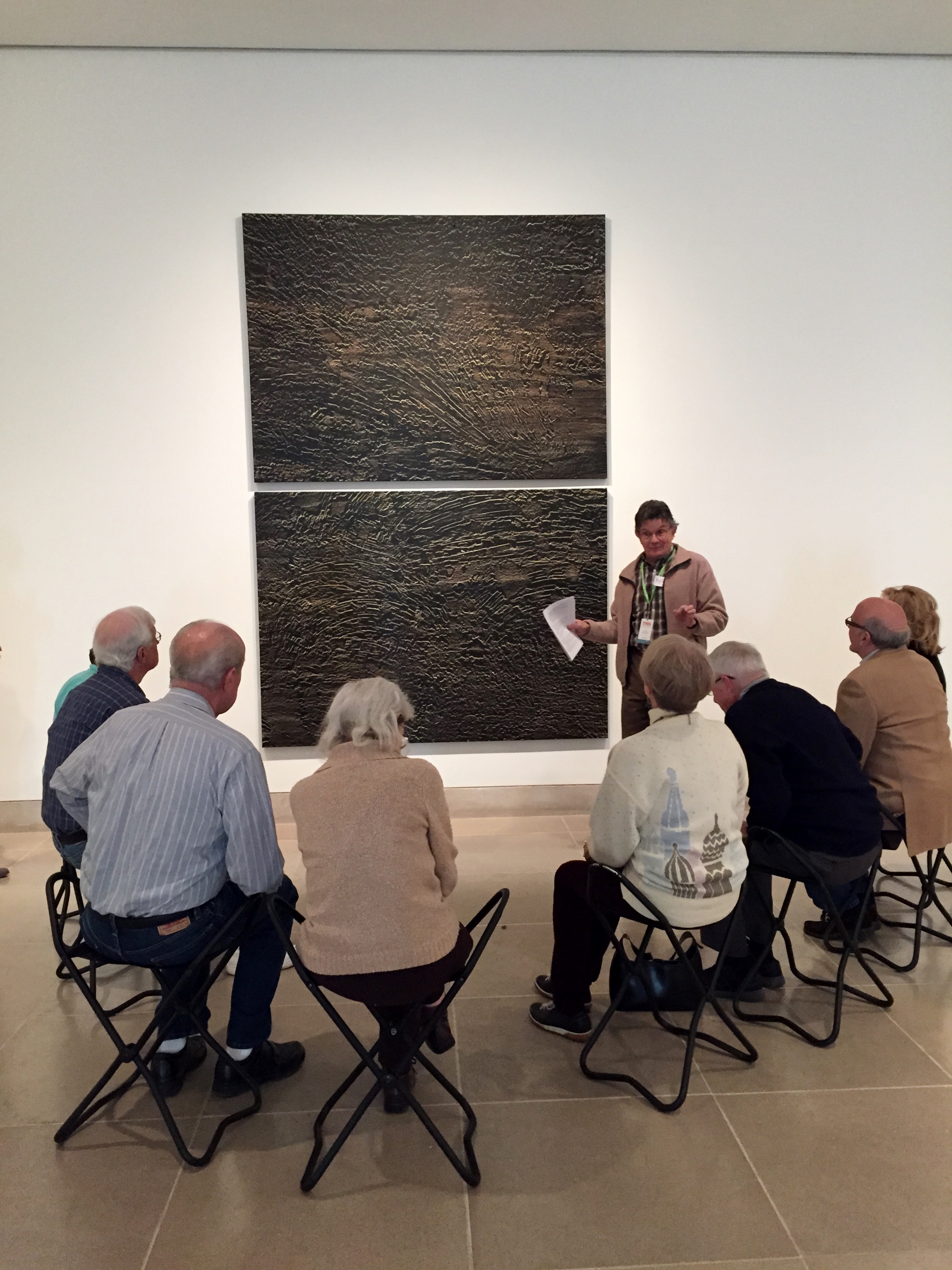
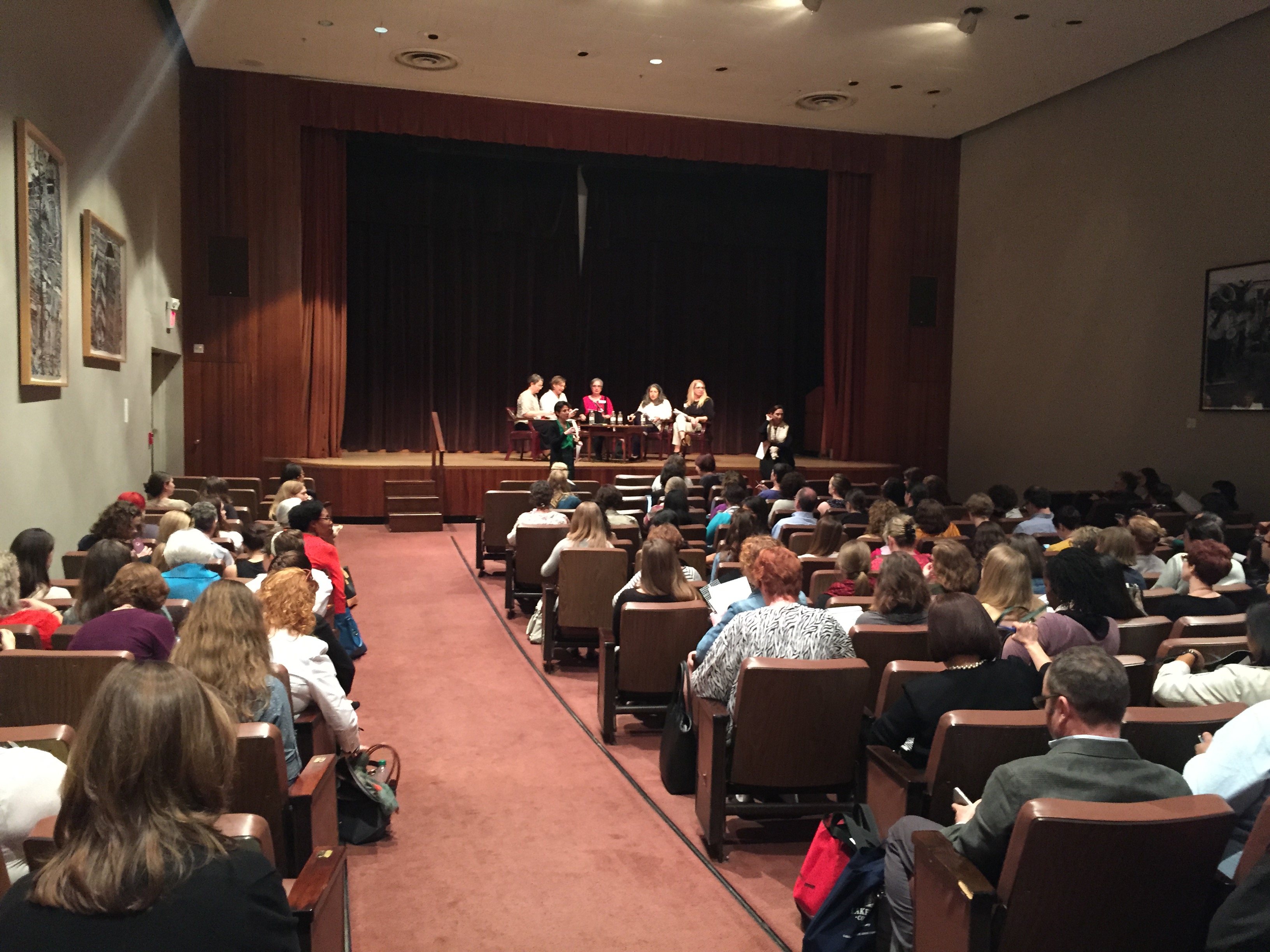
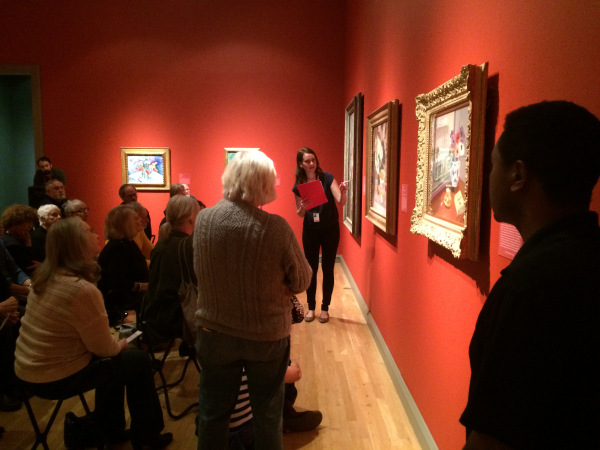
This week, the McDermott Interns came one step closer to completing our time here at the Museum. As part of the program, each intern is required to give a Gallery Talk on any topic of their choosing, and this past Wednesday, Eliel’s discussion on radical Italian art marked the last of our talks! Here’s a look back at a few photos and the gamut of topics we discussed:

Samantha Robinson, McDermott Graduate Curatorial Intern for American and Decorative Art: Modern Opulence in Vienna: The Wittgenstein Vitrine

Laura Sevelis, McDermott Curatorial Intern for European Art: Bouquets: French Still-Life Painting from Chardin to Matisse

Laura Sevelis - Bouquets: French Still-Life Painting from Chardin to Matisse

Laura Sevelis – Bouquets: French Still-Life Painting from Chardin to Matisse

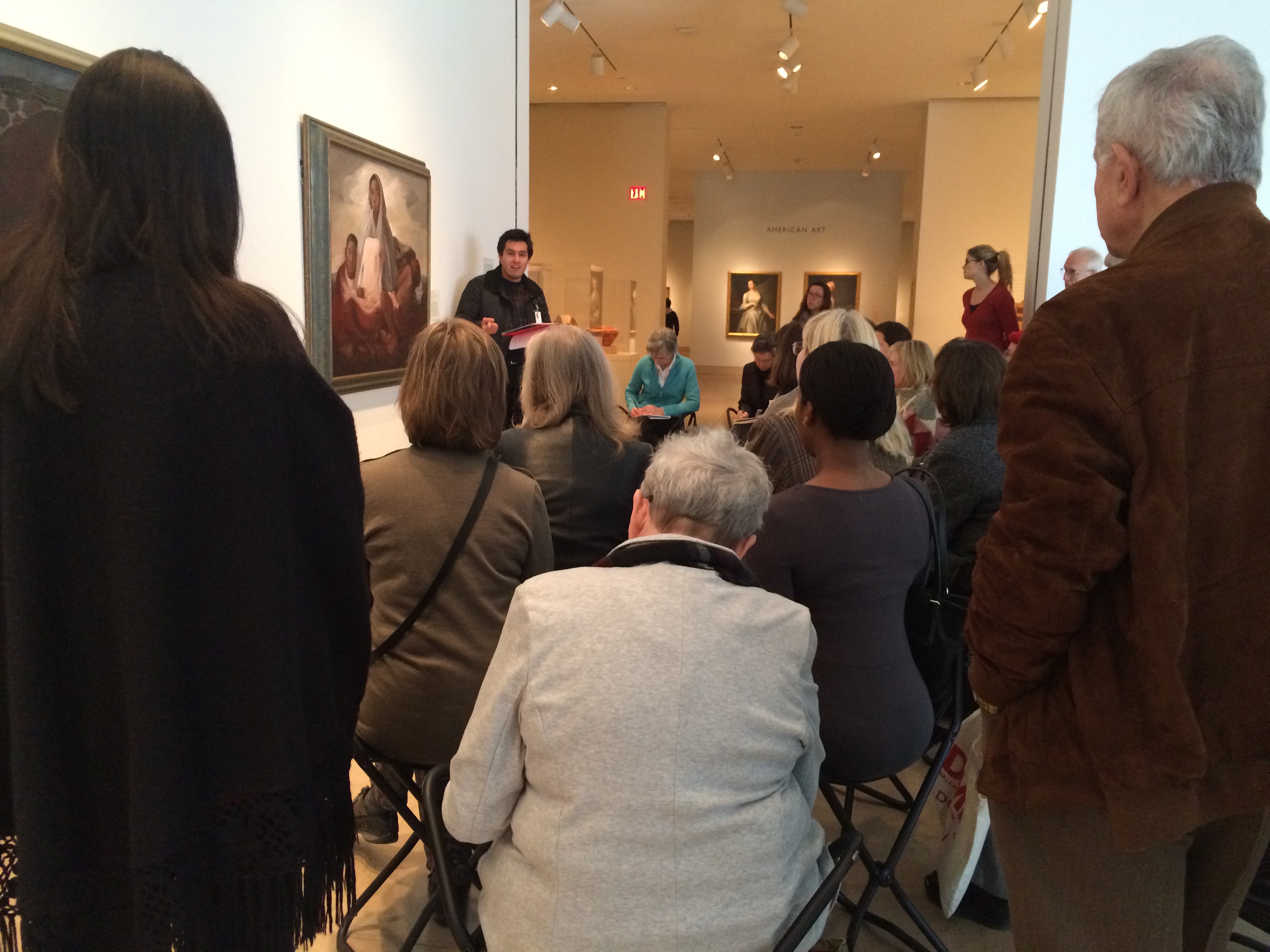
Fabian Leyva-Barragan, McDermott Curatorial Intern for Contemporary Art: Latin American Modernism

Fabian Leyva-Barragan - Latin American Modernism

Fabian Leyva-Barragan – Latin American Modernism

Elisabeth Seyerl, McDermott Graduate Curatorial Intern for African and Asian Art: Indonesian Textiles

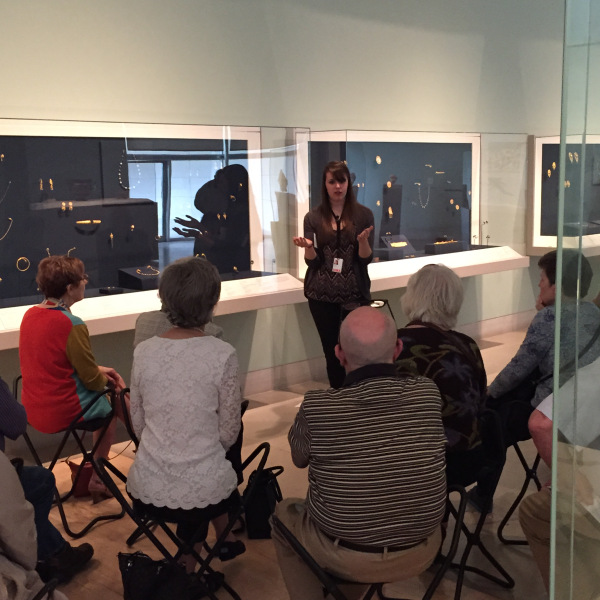
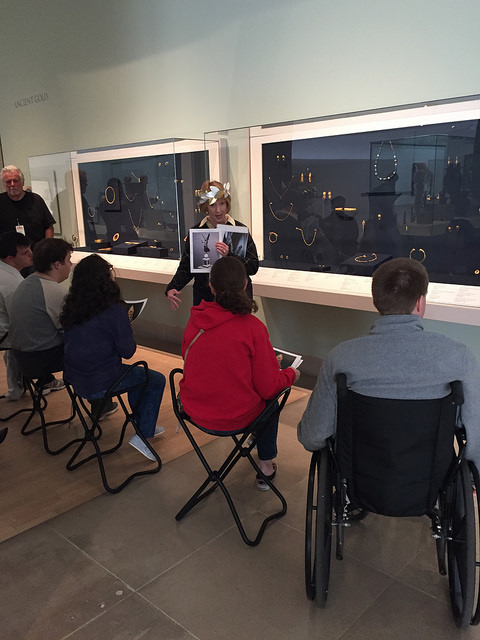
Jennifer Sheppard, McDermott Education Intern for Family and Access Teaching: All That Glitters: Ancient Greek Gold Jewelry

Jennifer Sheppard - All That Glitters: Ancient Greek Gold Jewelry

Jennifer Sheppard – All That Glitters: Ancient Greek Gold Jewelry

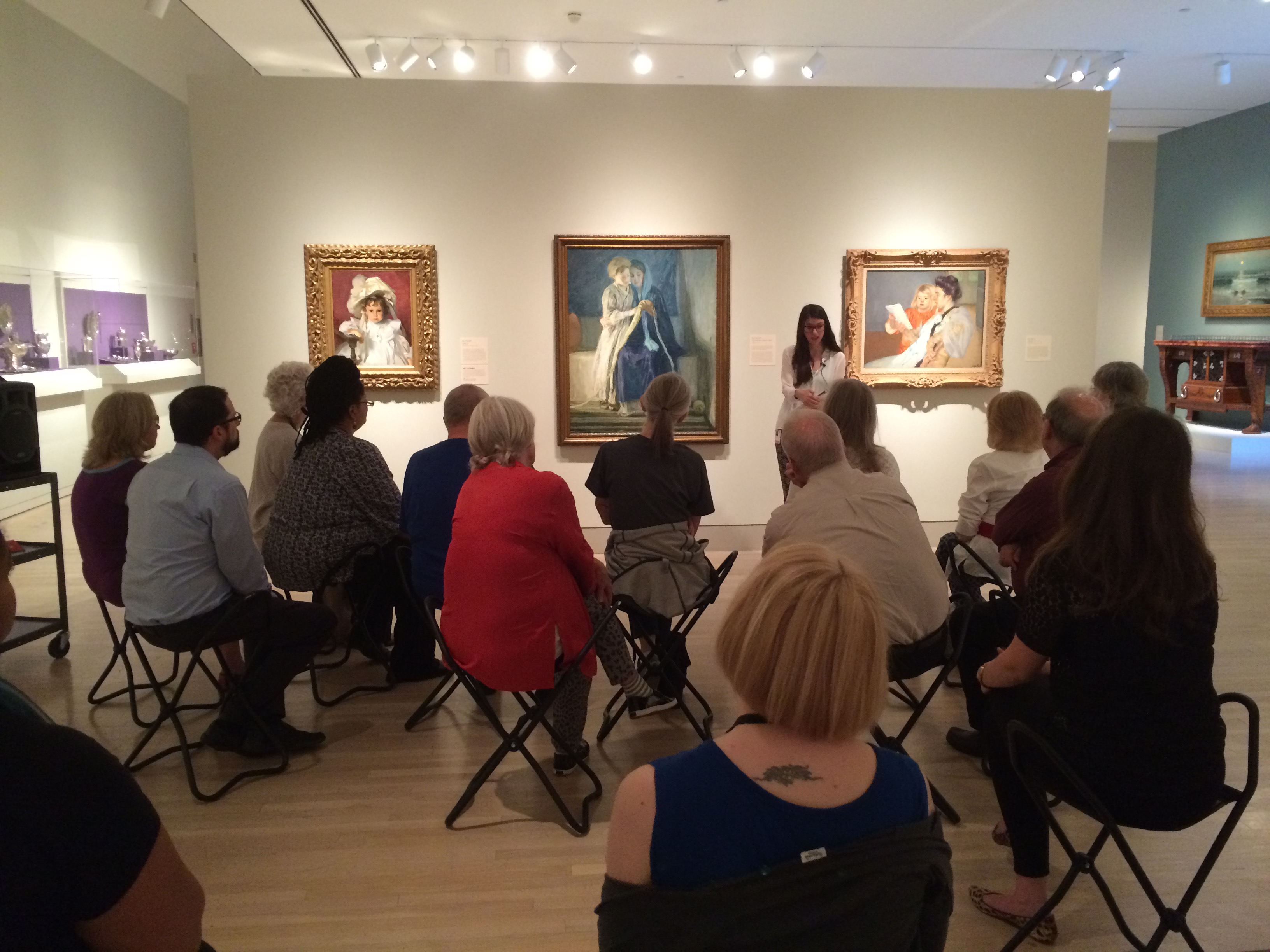
Liz Bola, McDermott Graduate Education Intern for Gallery and Community Teaching: Race & Religion: Henry Ossawa Tanner

Liz Bola - Race & Religion: Henry Ossawa Tanner

Liz Bola – Race & Religion: Henry Ossawa Tanner

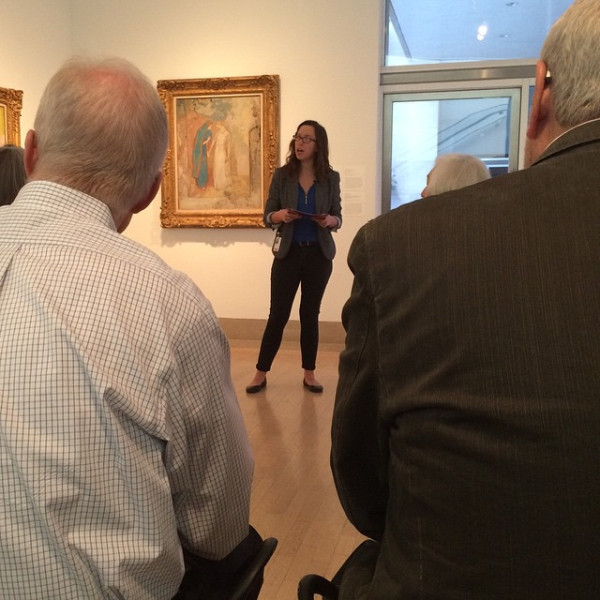
Taylor Jeromos, McDermott Education Intern for Adult Programming and Arts & Letters Live: Queering Art: Moving Beyond Identity

Taylor Jeromos - Queering Art: Moving Beyond Identity

Taylor Jeromos – Queering Art: Moving Beyond Identity

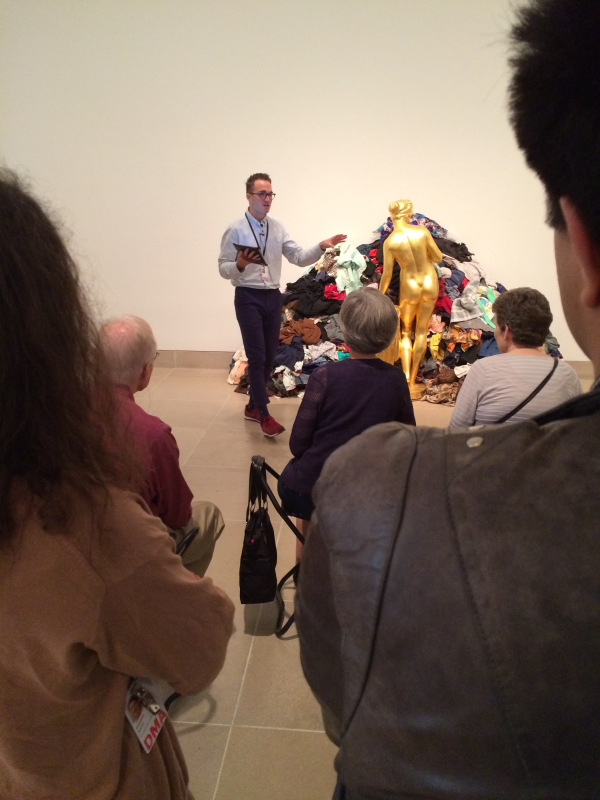
Eliel Jones, McDermott Education Intern for Visitor Engagement: Arte Povera: Mario Merz and Michelangelo Pistoletto

Eliel Jones - Arte Povera: Mario Merz and Michelangelo Pistoletto

Eliel Jones – Arte Povera: Mario Merz and Michelangelo Pistoletto

I hope that these few photos help you imagine what it would have been like to attend our talks if you missed them! And don’t forget that Gallery Talks happen every Wednesday at 12:15 p.m. and are always free and open to the public. Keep an eye out for upcoming talks – they might just cover your favorite topic next!

Jennifer Sheppard
McDermott Intern for Family and Access Teaching

Friday Photos: All in a Day’s Work

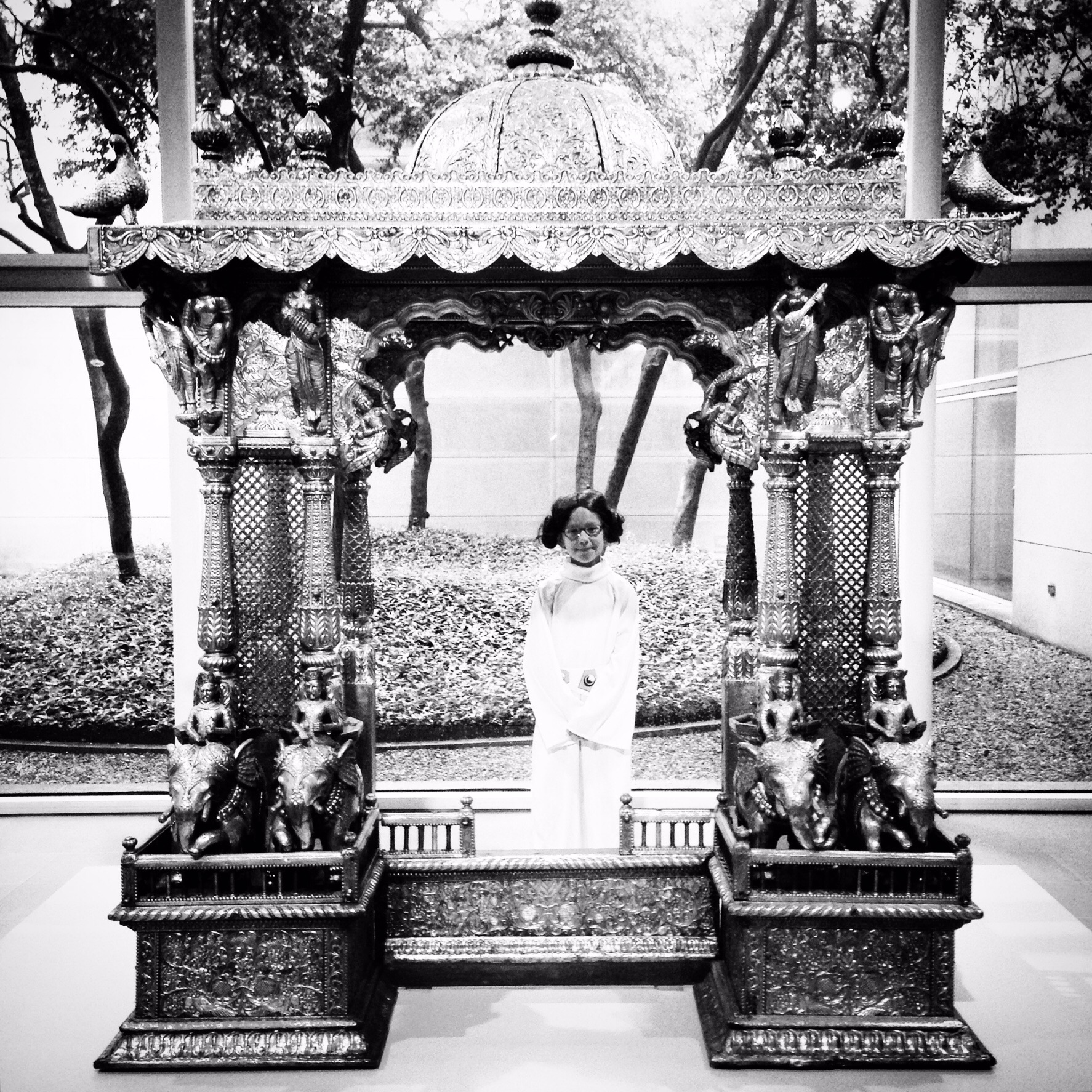
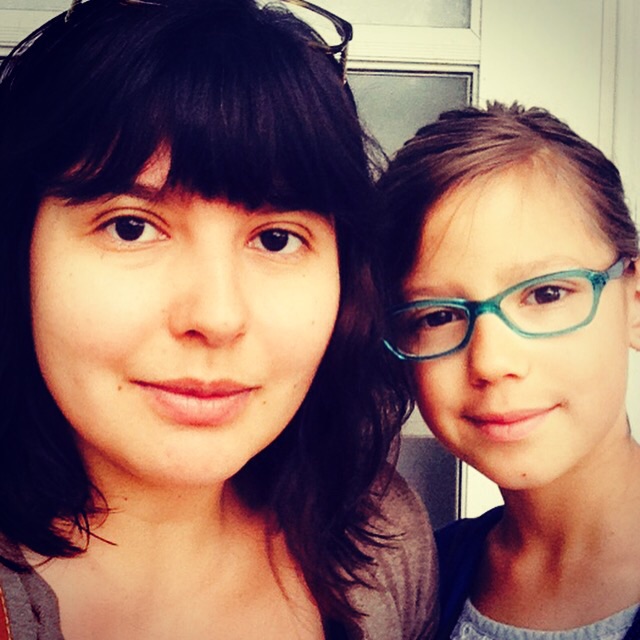
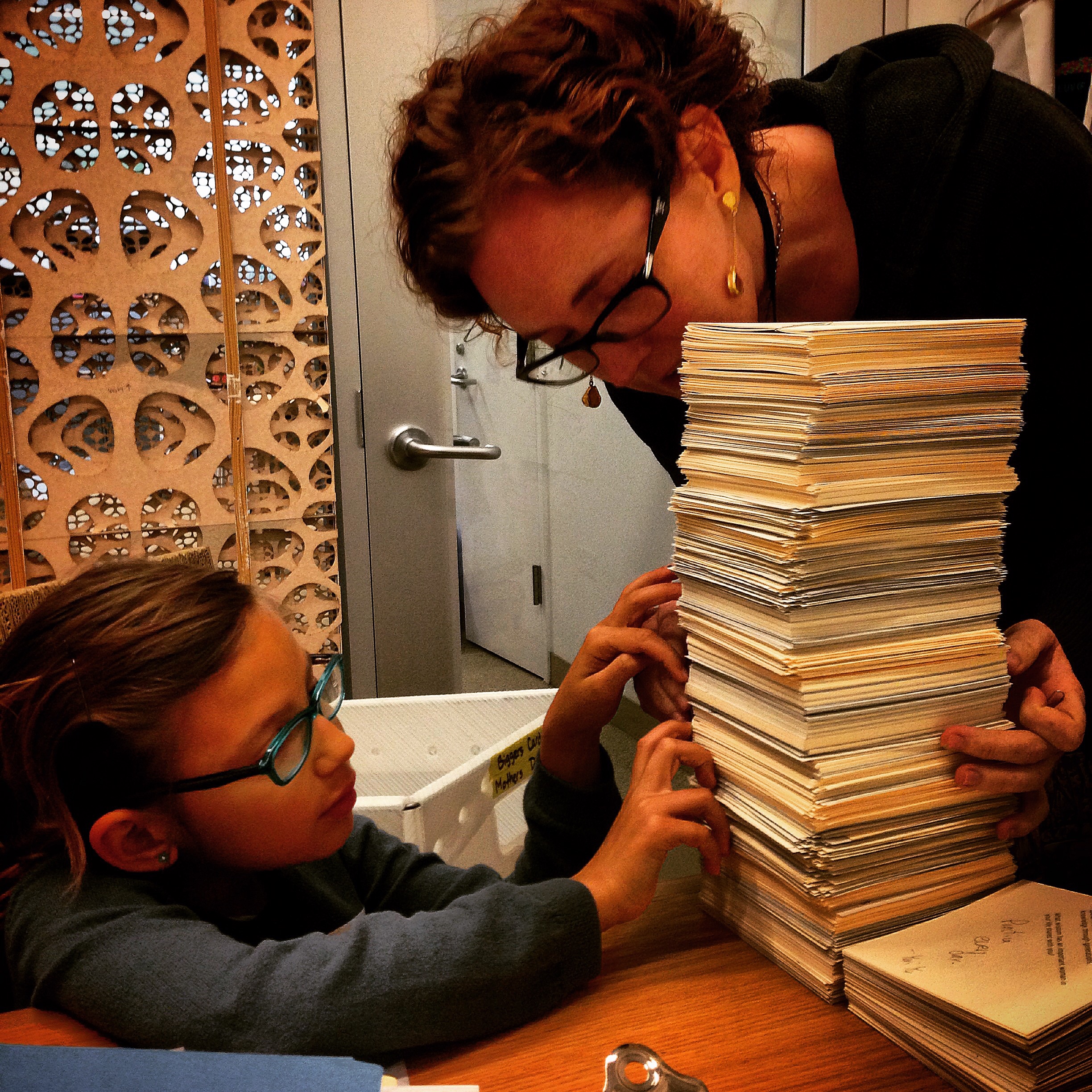
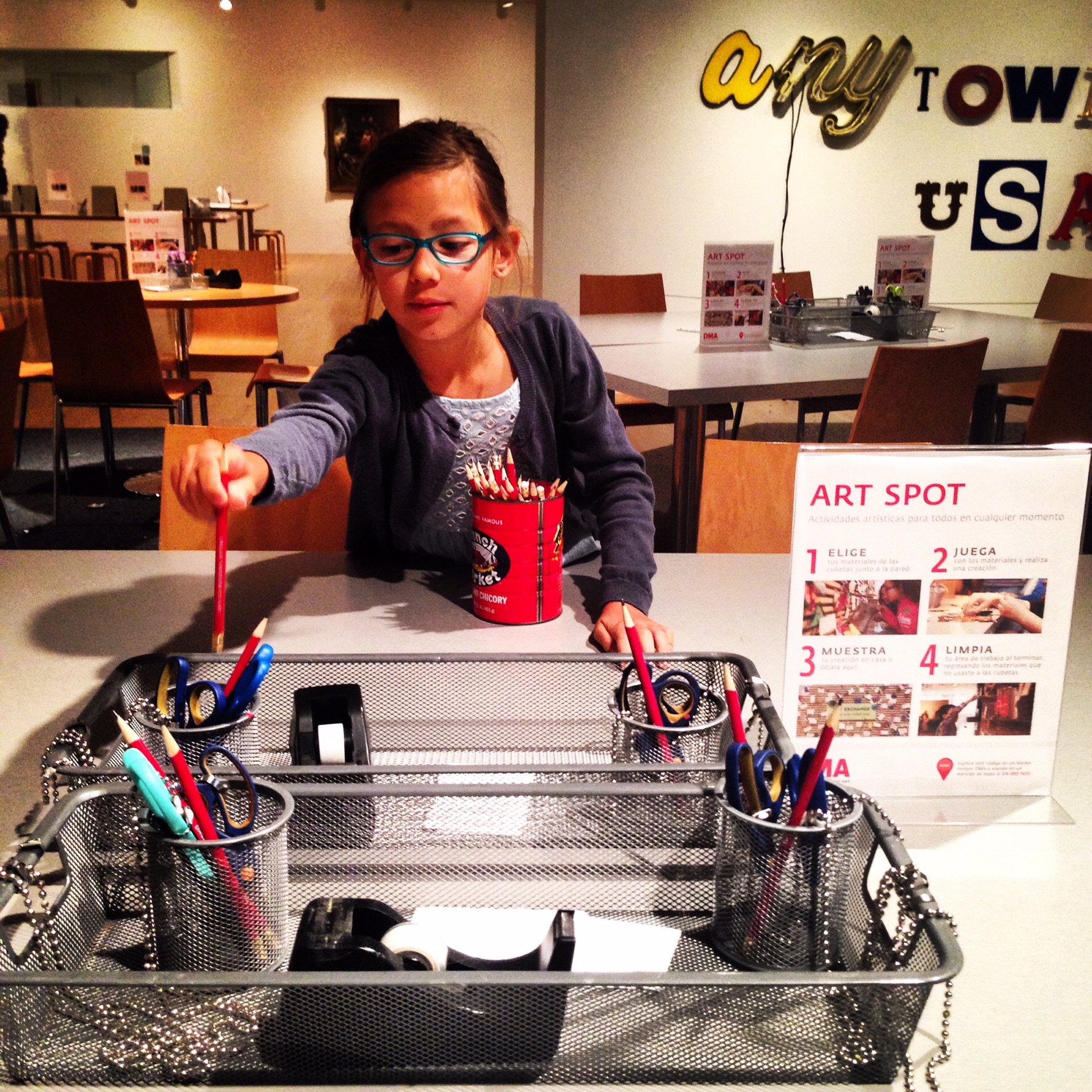
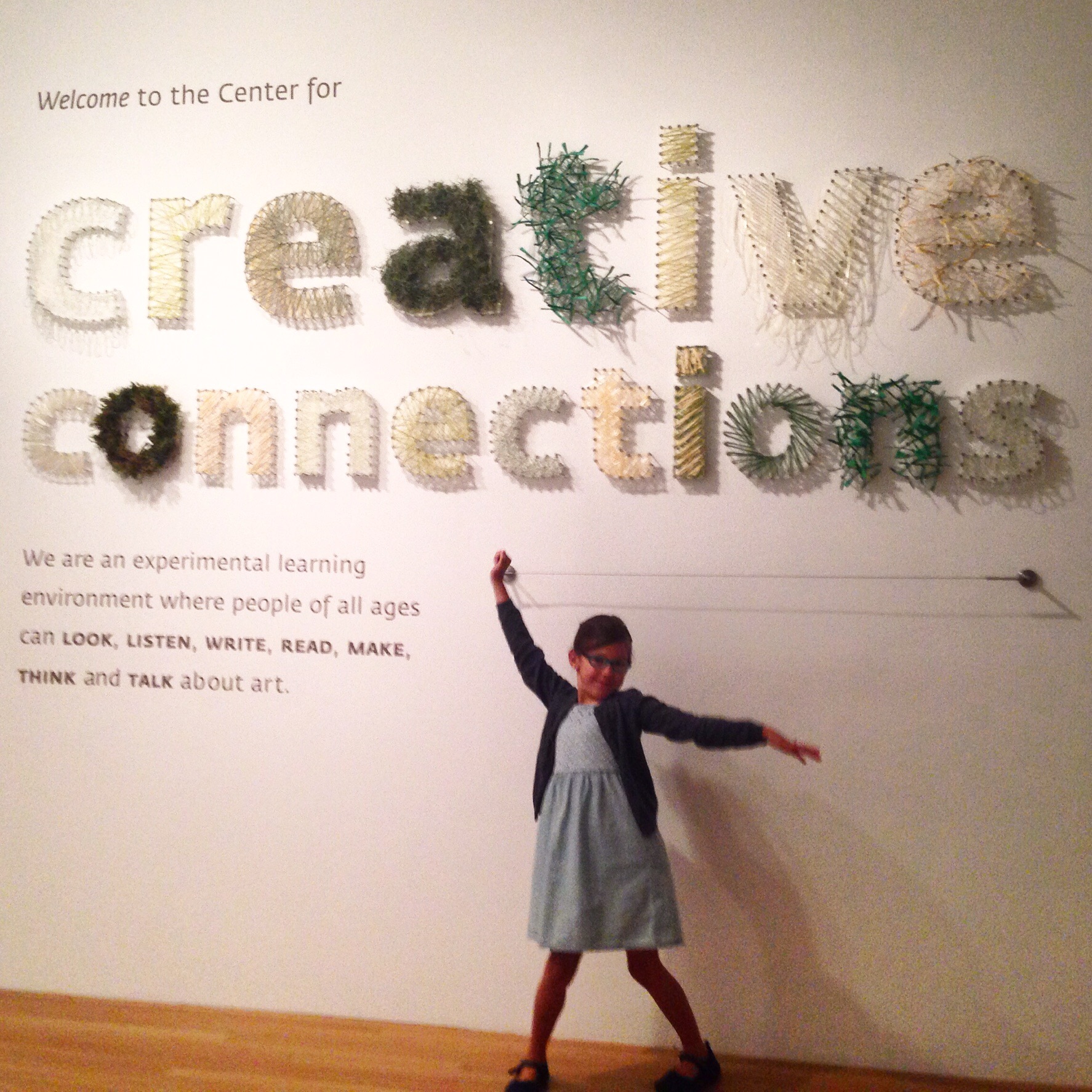
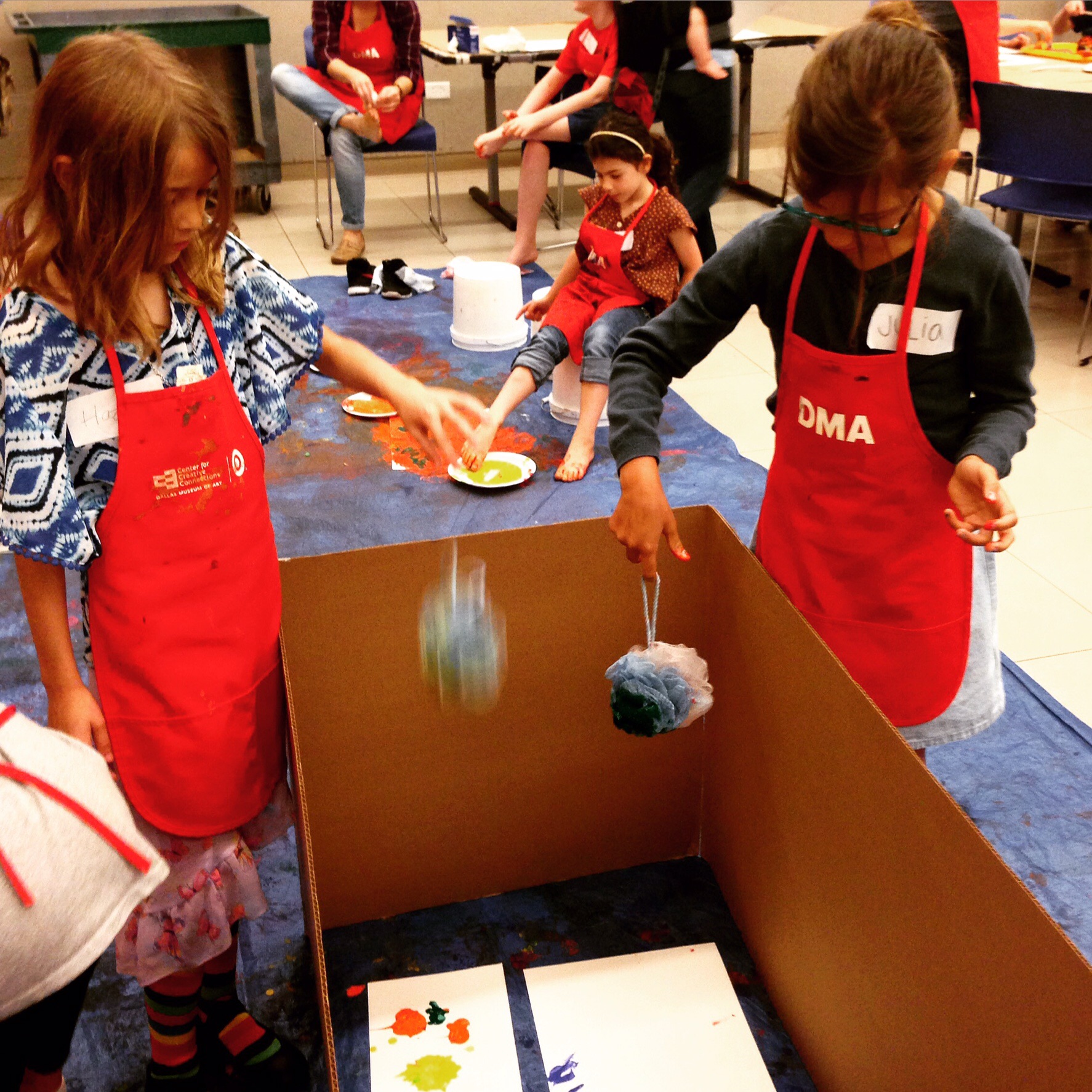
Thursday, April 23, was National Take Our Daughters and Sons To Work Day.  This year, I observed the day by bringing my daughter Julia to the Museum. She had the opportunity to help with daily tasks, attend meetings, attend a workshop, and participate in a Star Wars themed photo shoot… All in a day’s work at the DMA!

Jessica Fuentes
C3 Gallery Coordinator

Access Docents to the Rescue!

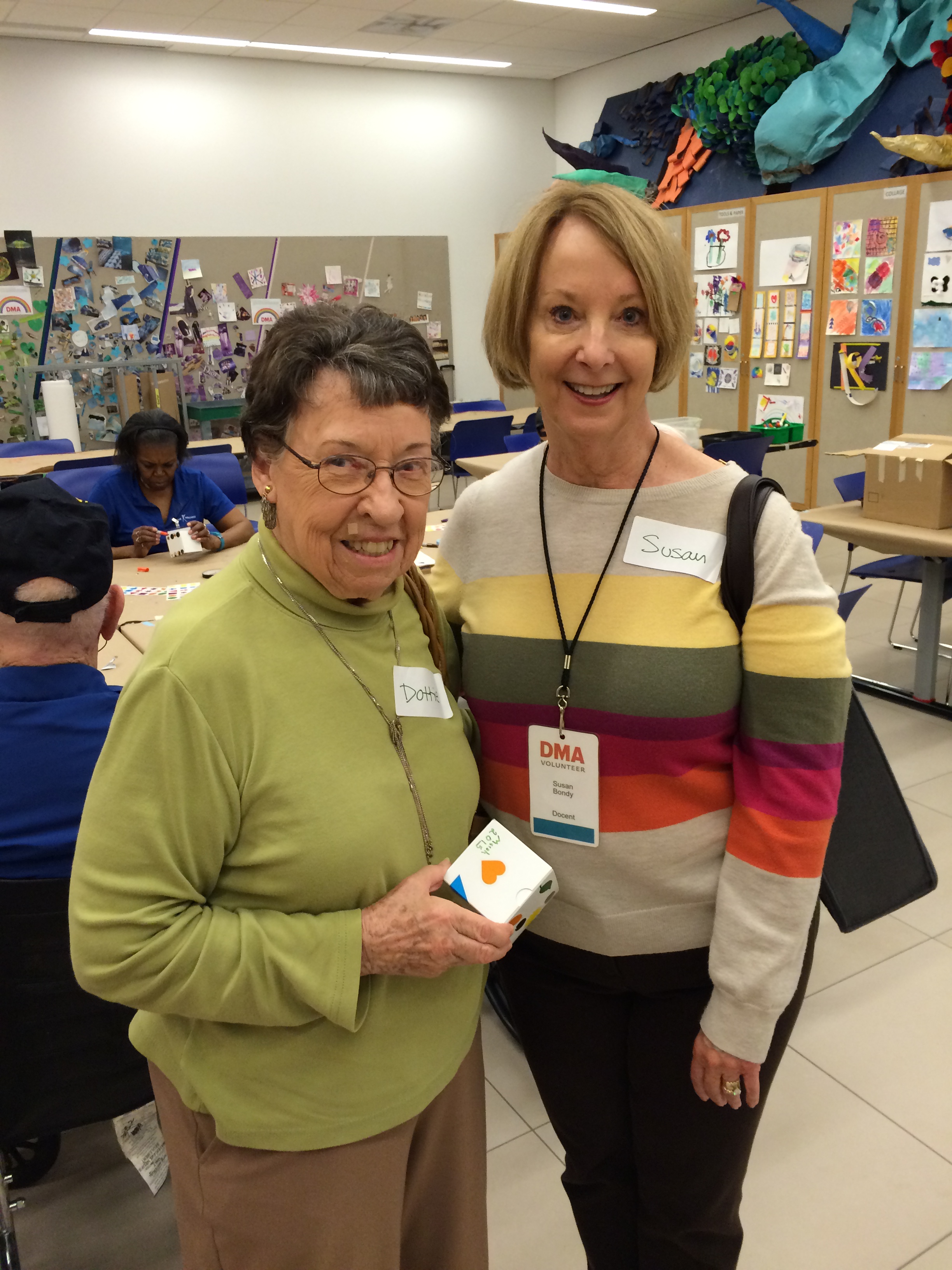
Our docent corps is a group of over 100 dedicated volunteers who are responsible for touring thousands of visitors through the Museum each year. DMA docents have a deep knowledge of the collection and work to craft their tours based on the interests and ages of their audience. And this past year we initiated our first group of DMA Access Docents–volunteers who expressed an interest in helping with DMA Access Programs, in addition to the groups they were already touring!


We began the program by meeting with a group of eight Access Docents each month to discuss access programming best practices and learn successful communication and teaching strategies for visitors with special needs. We welcomed a guest from the Alzheimer’s Association to share general information about Alzheimer’s and an autism specialist from TWU to speak about autism.

16699610507_b78440b4f0_o
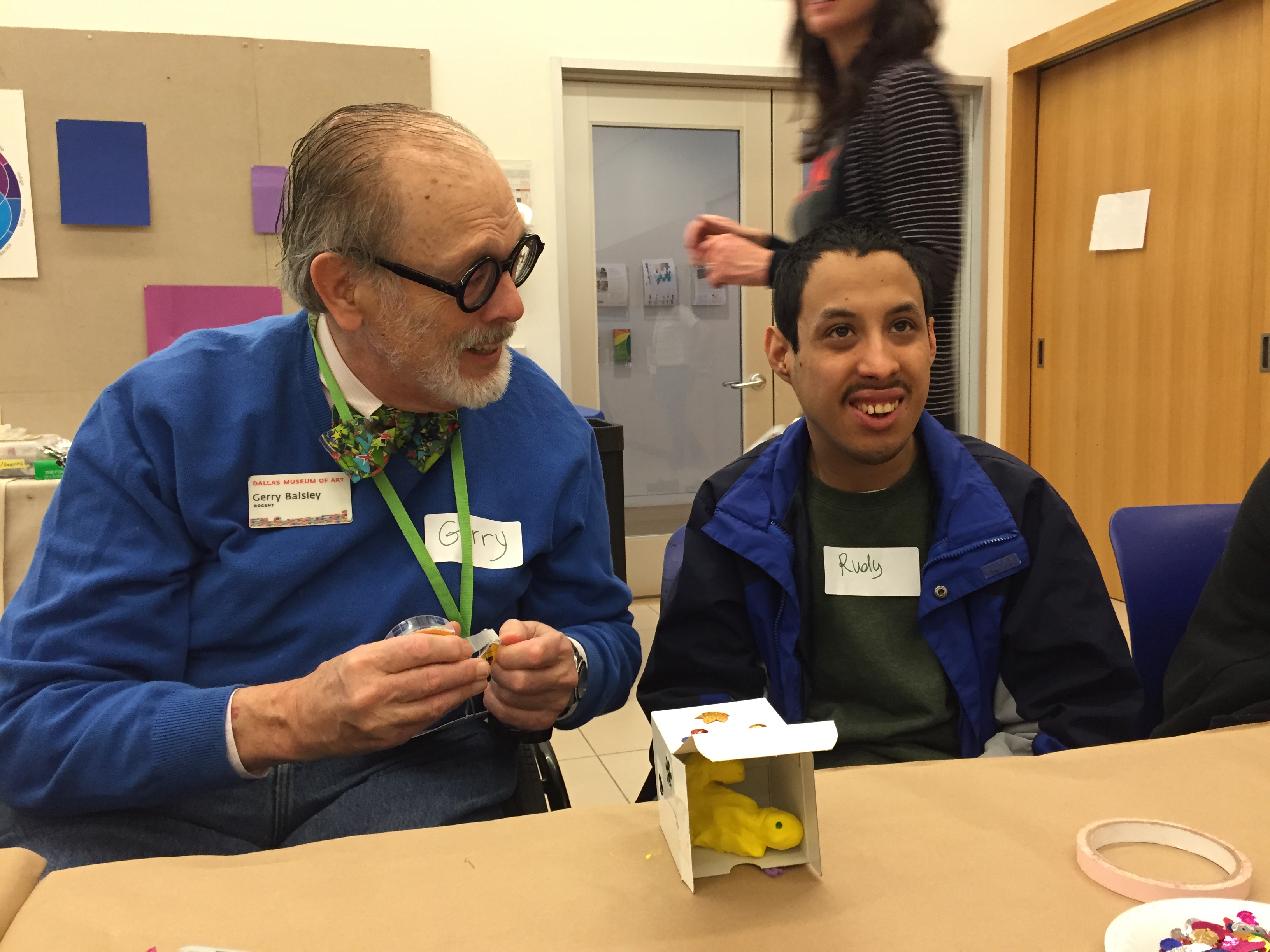
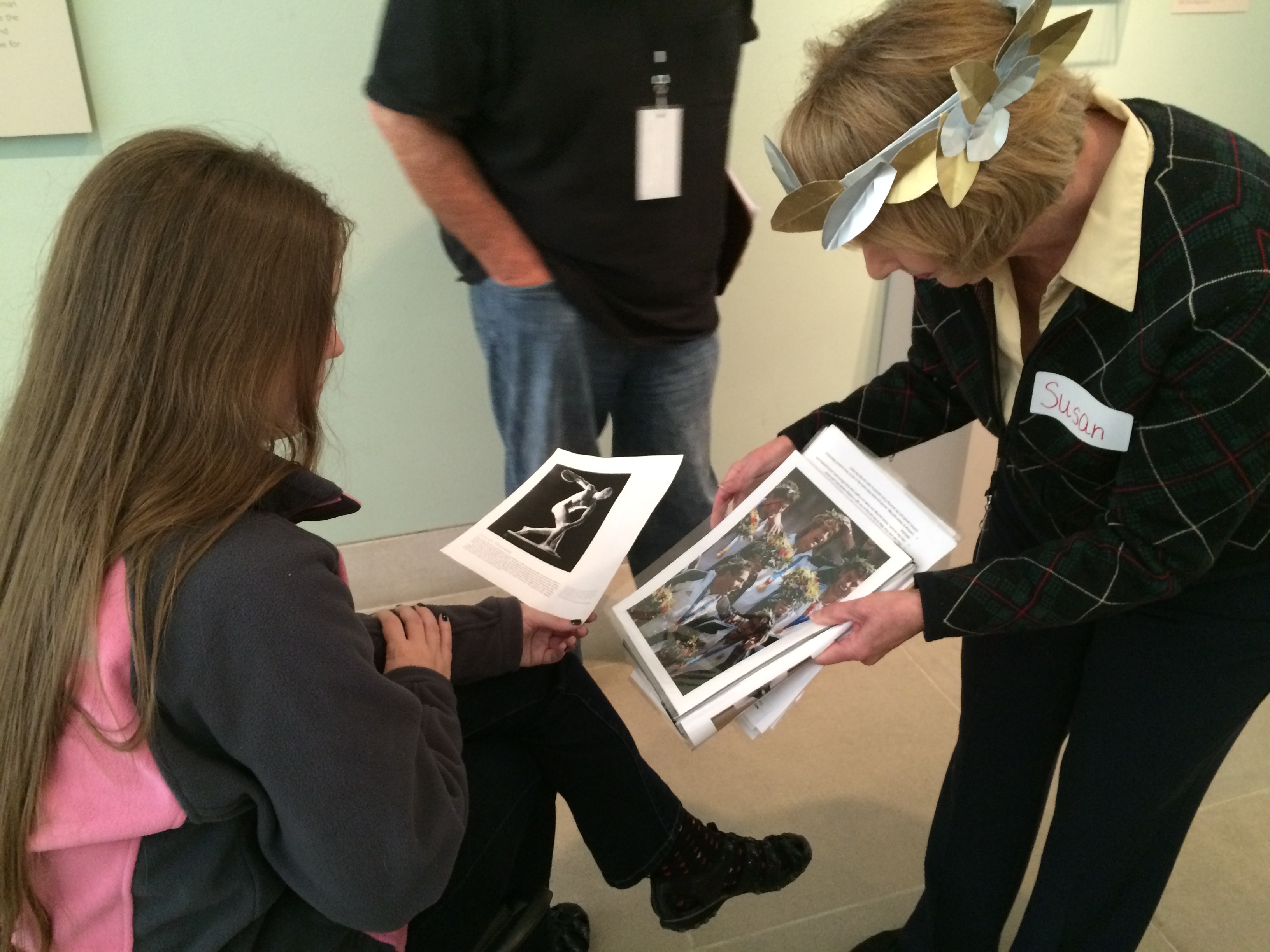
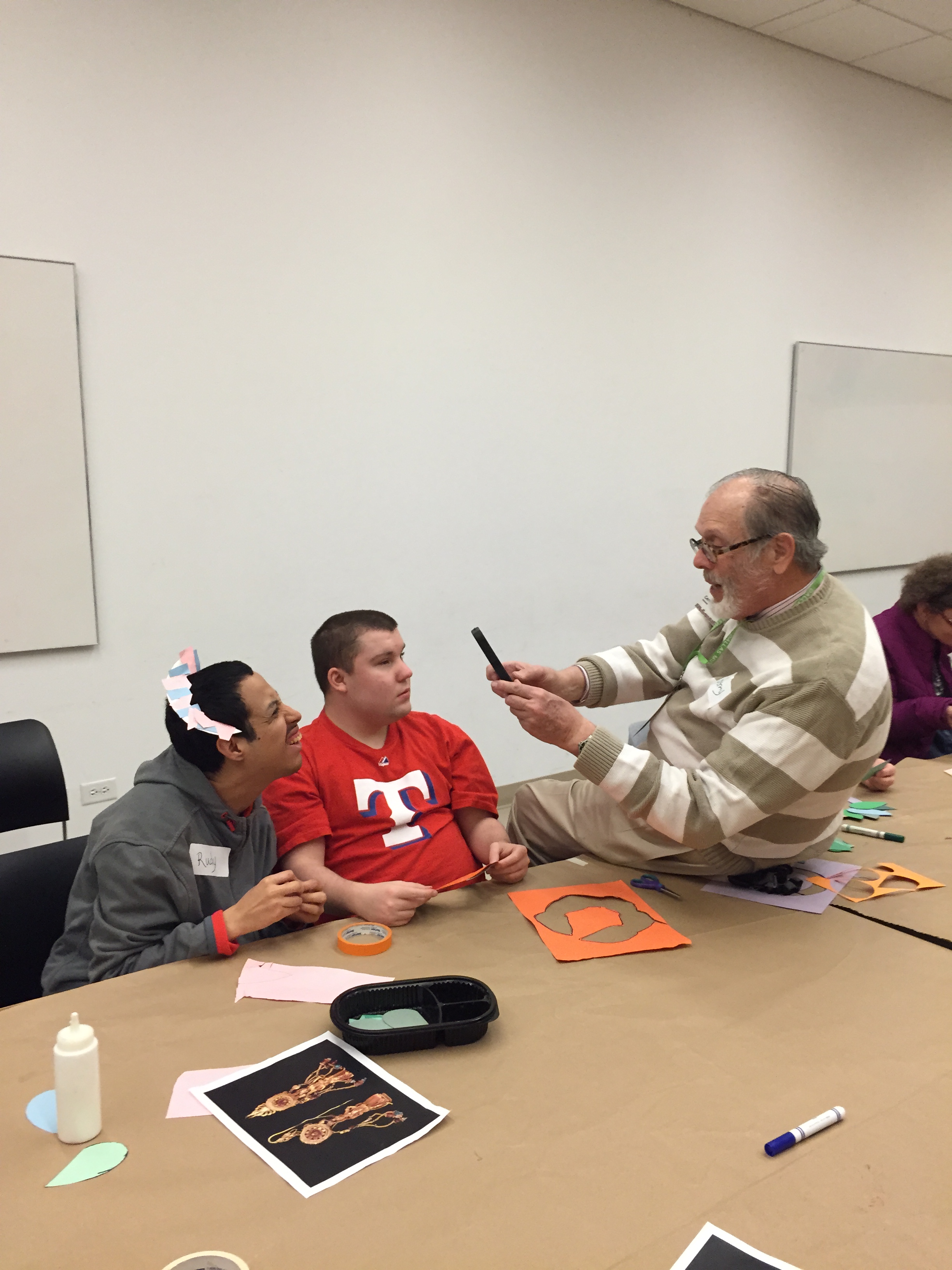
This year, our training was more hands-on and consisted of observation and team teaching. The Access Docents primarily help with our Meaningful Moments for Groups and All Access Art programs. Many of the docents volunteered with these programs throughout the year and got to know several of the regular participants.

15666324294_3d4587e059_o
We’ve found that offering Access Program opportunities to our docents is a great way to share teaching responsibilities, which allows us to schedule more programs than we’d be able to if we only relied on staff. It is also a wonderful chance for staff to get to know the docents better and learn from them. We meet often throughout the year to touch base, brainstorm upcoming program themes, and share teaching strategies.


Access Docents have shared with us the joy they feel when forming relationships and interacting with people from the same groups each month. Many of them have also mentioned that their access work has enriched their school tours: they re-purpose information and gallery games and incorporate them into tours. Since school tours generally don’t include a studio activity, many of the Access Docents have enjoyed the chance to use hands-on materials, integrating art-making into the Museum experience.


We are thrilled to have such a passionate group of specialized volunteers helping us to teach our Access Programs!

Amanda Blake
Head of Family, Access, and School Experiences

Let’s Hear It for the Kids!

Let’s hear it for the kids! This week (April 12-18) is Week of the Young ChildTM. Never heard of it? The National Association for the Education of Young Children (NAEYC) established this annual tradition in 1971 to “focus public attention on the needs of young children and their families and to recognize the early childhood programs and services that meet those needs.” This year’s theme is “Celebrating our Youngest Learners,” and here at the DMA, we love nothing more than doing just that!

In honor of Week of the Young Child, I thought I’d share what we love most about the children who have become part of our DMA family over the years.

They are honest.

AAM Feb 2015

In preschools across the country, teachers often refer to the children as “friends.” So rather than calling out “boys and girls” when it’s time to leave the playground, you might hear someone say “all my friends—it’s time to go!” I often use this language in the Arturo’s Preschool classes I teach here at the DMA. One morning as we were sitting in front of Frank Gehry’s Easy Edges chair, I asked “Friends—what material do you think the artist used to make this chair?” Without missing a beat, a little boy looked me square in the eyes and said, “I’m not your friend!” Ouch! I laughed and did my best to win him over by the time we went down to the studio. I love knowing that four year-olds will give it to you straight!

They are curious.

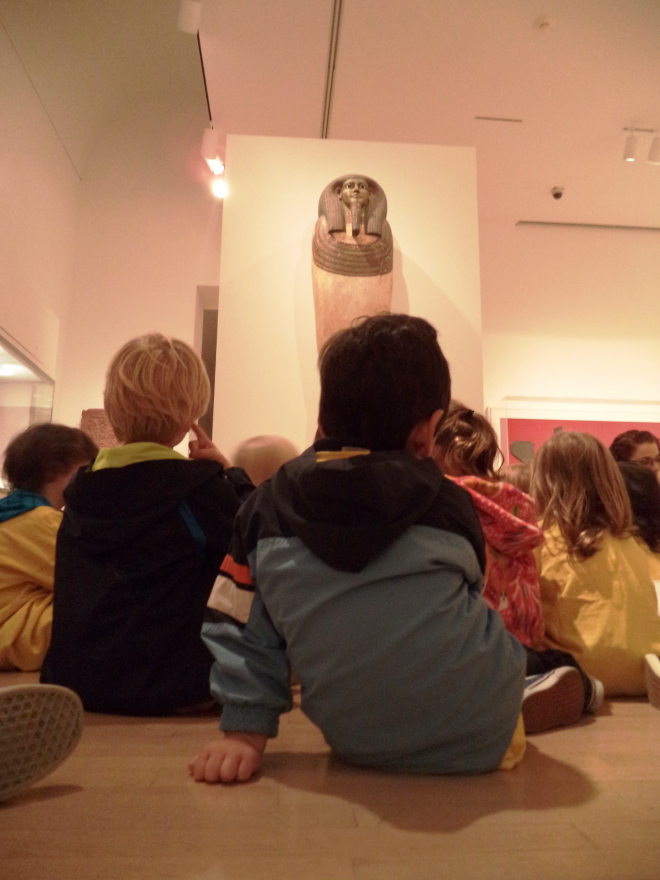
Another admirable trait I often see in the preschool crowd is that they are excited about pretty much anything! Wherever we go in the galleries, they always want to make sense of what they see and figure out how it connects to their own lives. Once during a class focused on the art of ancient Egypt, I asked the children to imagine what life would have been like with no TVs, no electricity, no cars. One little girl piped up with all the authority of a wise three year-old, “they used cans and strings, right?” She cleverly deduced that if the Egyptians didn’t have the kinds of phones we have today, they must have used tin cans and strings to communicate! She wasn’t deterred by the concept of “long ago and far away”—but instead, she found a way to relate abstract ideas to her concrete reality. Brilliant. (And I just love the image of Pharoah calling down to his court on a tin can).

They are open-minded.

Picasso Portraits

Young children are incredibly willing to entertain new ideas and explore new possibilities in art. While an adult might look at a painting and ask “why is this art?,” children move beyond “why” and ask “how,” “where,” “when” and “can I try it too?” This month we’ve been learning about the artist Pablo Picasso and Cubism. Inevitably, when I show the children a cubist portrait, they giggle and say “that’s a crazy face!” But then they take a closer look and are delighted when they find the nose and ears and eyes and can explain what the artist did to surprise us.

They are creative.

Arturo's Art and Me 12.2014

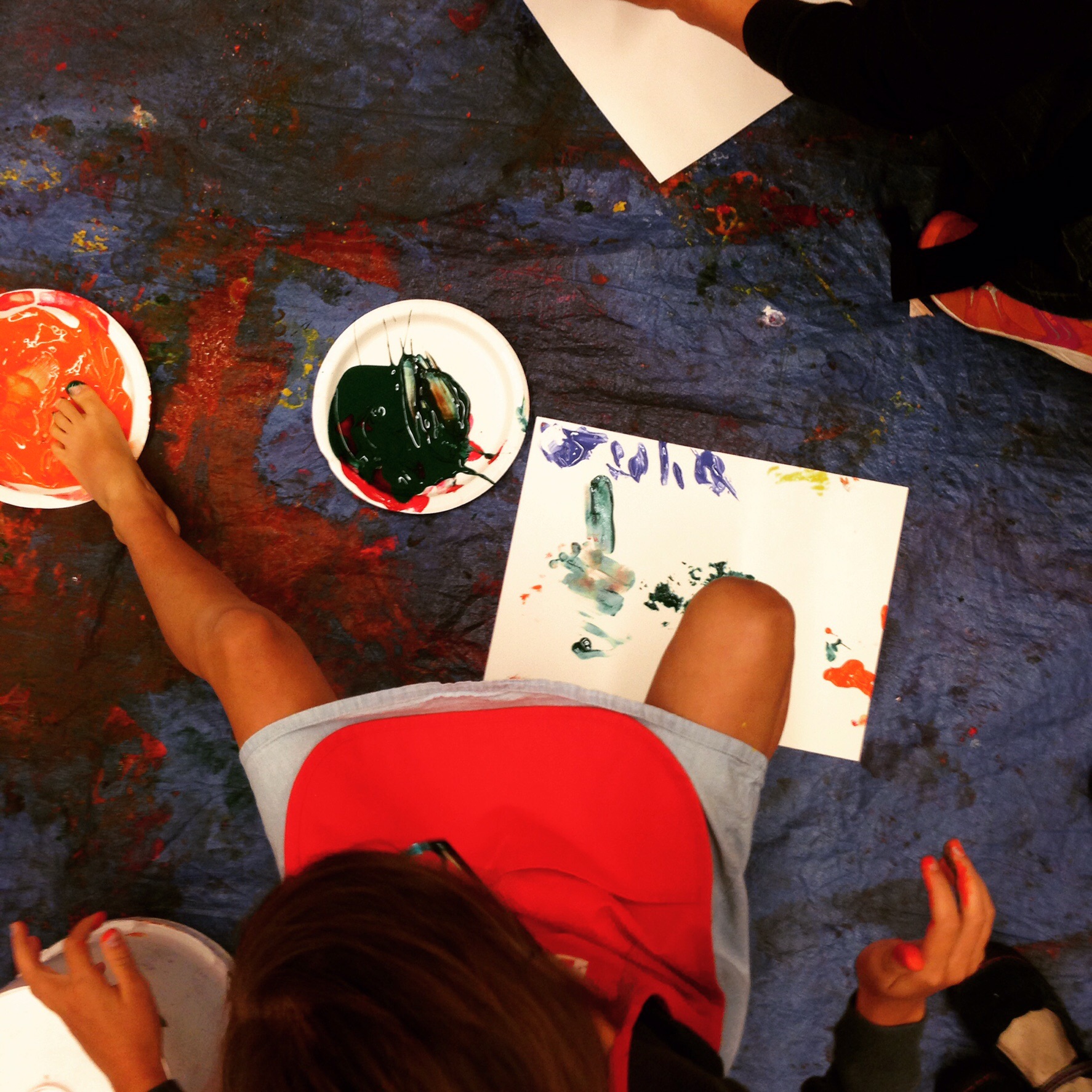
You can’t help but feel the buzz of creativity and the energy of little fingers at work when you step into an early learning studio class. Whether they are painting with their feet, concentrating on sewing stitches onto burlap, or experimenting with watercolor, young children are fearless when it comes to making art—something I think we can all aspire to. They dive in, not concerned about doing it “right” or making it look “just so.” They enjoy the materials for what they are, and love to see what paint or markers or paper or their own two hands can do! And when they’re done, they can’t wait to show off their work and tell you all about it.

This year, April 16th is Artsy Thursday, so grab your crayons and paint, and celebrate the young children in your life!

For more ideas on how you can celebrate Week of the Young ChildTM, check out the resources and suggestions on the NAEYC website.

Leah Hanson
Manager of Early Learning Programs

Turning the Tables: Student Gallery Talks

Photo Mar 24, 2 14 56 PM

Our Booker T students took a break in the Sculpture Garden after all their hard work in the galleries! Read more about these fantastic students on Uncrated.

Make This: Sound Prints

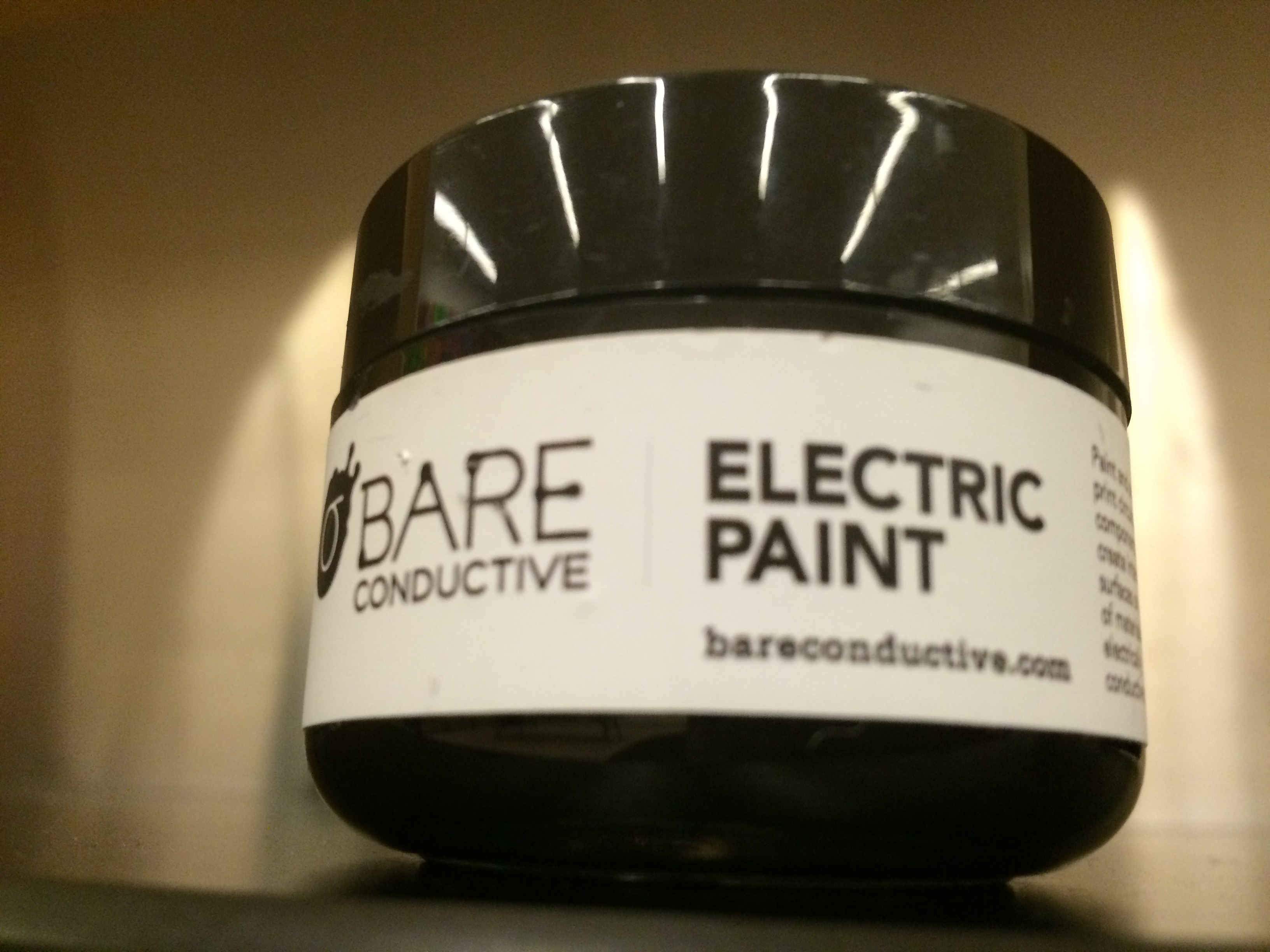
Have you ever wondered what a painting might sound like if you could listen to it? With conductive ink, a Makey Makey, and some basic software, you can add a new level of interactivity to your artwork through the use of sound! In this guide, I’ll show you how to make a print that will make sounds when you touch it. These sounds are completely reprogrammable and can be changed on the fly, giving you lots of possibilities for what you can create.

A Makey Makey is an interface that connects to your computer which allows you to create your own tactile inputs that will take the place of certain keys on your keyboard.

IMG_2684

The Makey Makey can be connected to different conductive materials to replace your keyboard’s arrow keys, space bar, mouse button, and more

For the purpose of this project, you’ll be using conductive ink to create three interactive areas on your work of art that will be hooked up to the Makey Makey and act in place of the arrow keys on your computer. We’ll then use Soundplant to map different sounds to those keys, which will allow those areas to play a sound when touched.

Supplies:

  • Copy paper for making a stencil
  • Exacto knife
  • Cutting mat
  • Conductive ink
  • Screen printing screen
  • Squeegee
  • Heavy printing paper
  • Copper tape (optional)
  • Makey Makey kit ($45; MakeyMakey.com)
  • Soundplant software
  • Computer

Step 1: Screen print your image with the conductive ink. 

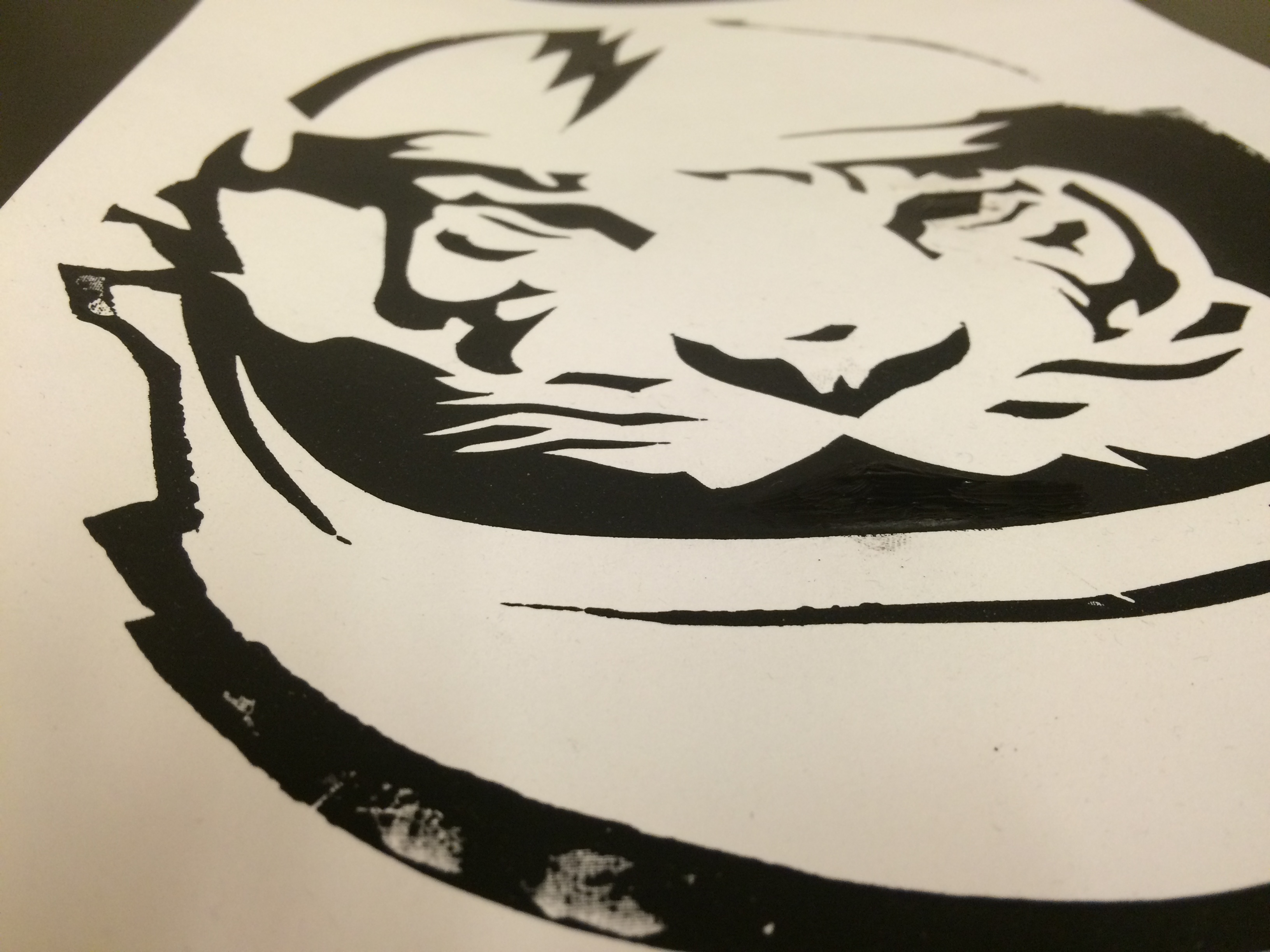
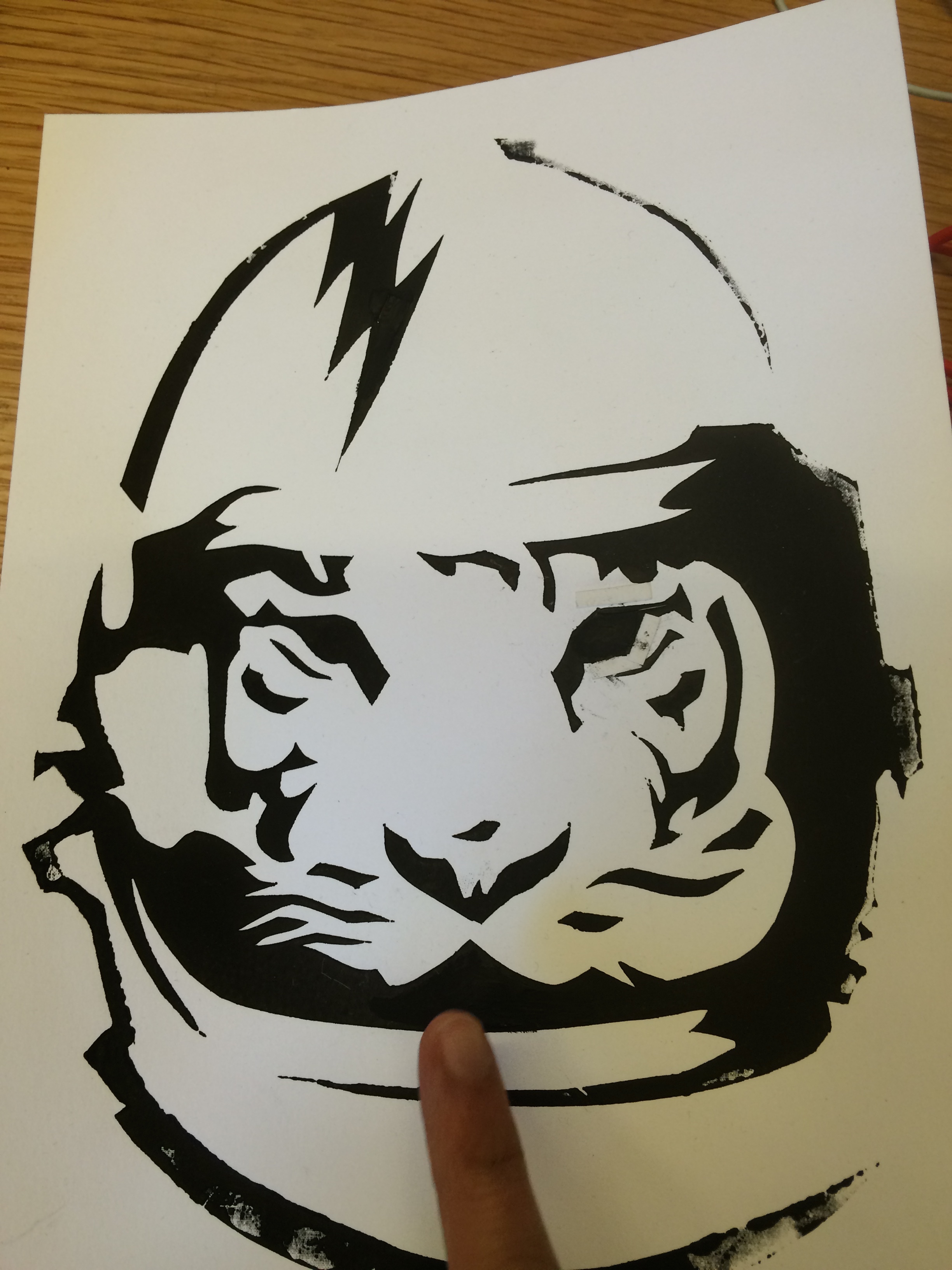
I like the paper stencil method, but use whatever technique you like best. For help on printmaking with stencils, check out my past post on screen printing. Let your print dry fully before proceeding. IMG_2673 IMG_2674 IMG_2676

Step 2: Connect your print to the Makey Makey. 

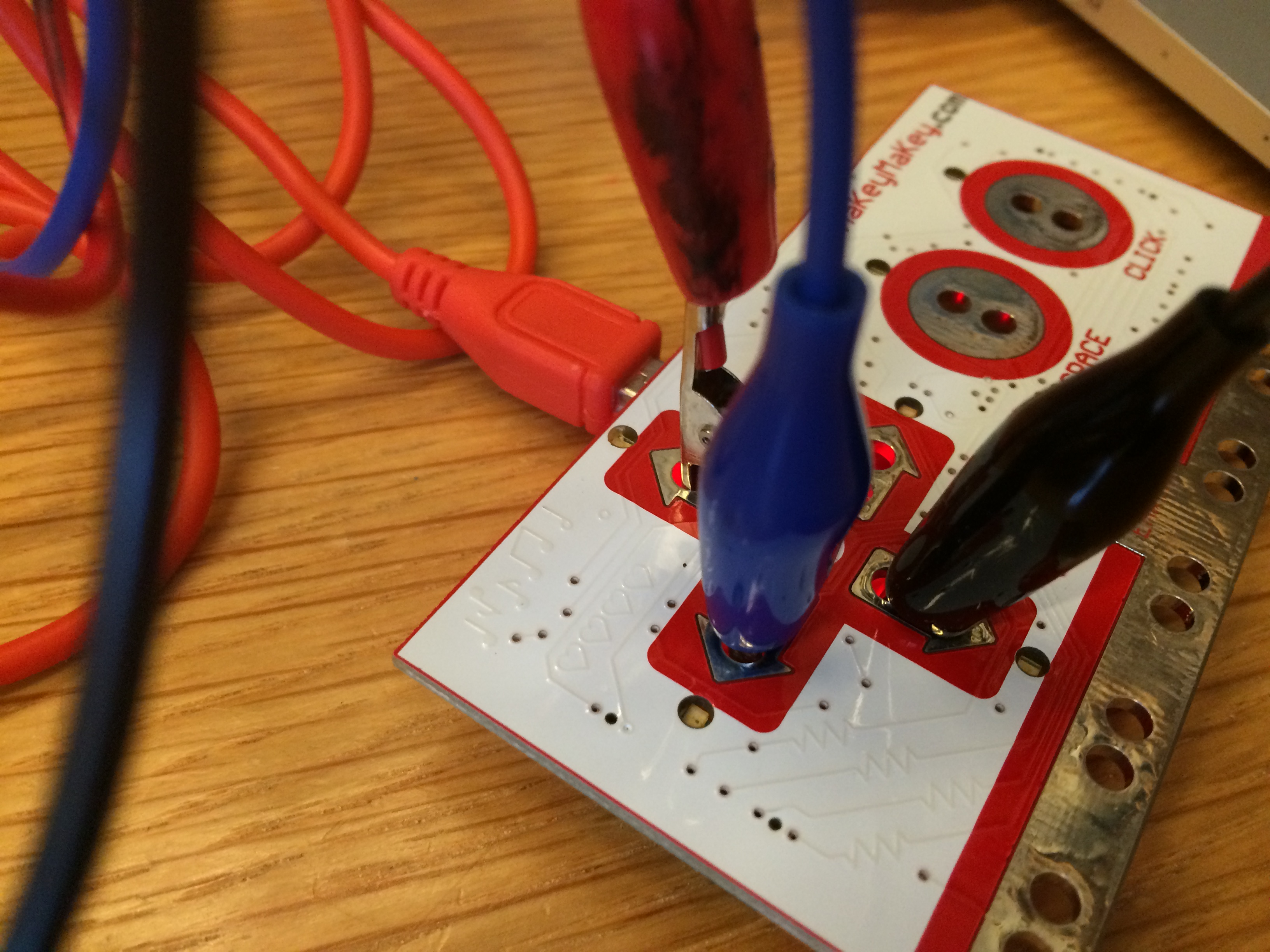
Again, for the purpose of this post, I’m choosing three areas on my print that will activate the Makey Makey when they are touched. You can connect them directly to the device using alligator clips (included in the kit). Remember to connect the clips to the proper inputs on the Makey Makey–in this case, the left, right, and up arrows.

IMG_2686

Step 3: Upload some sounds. 

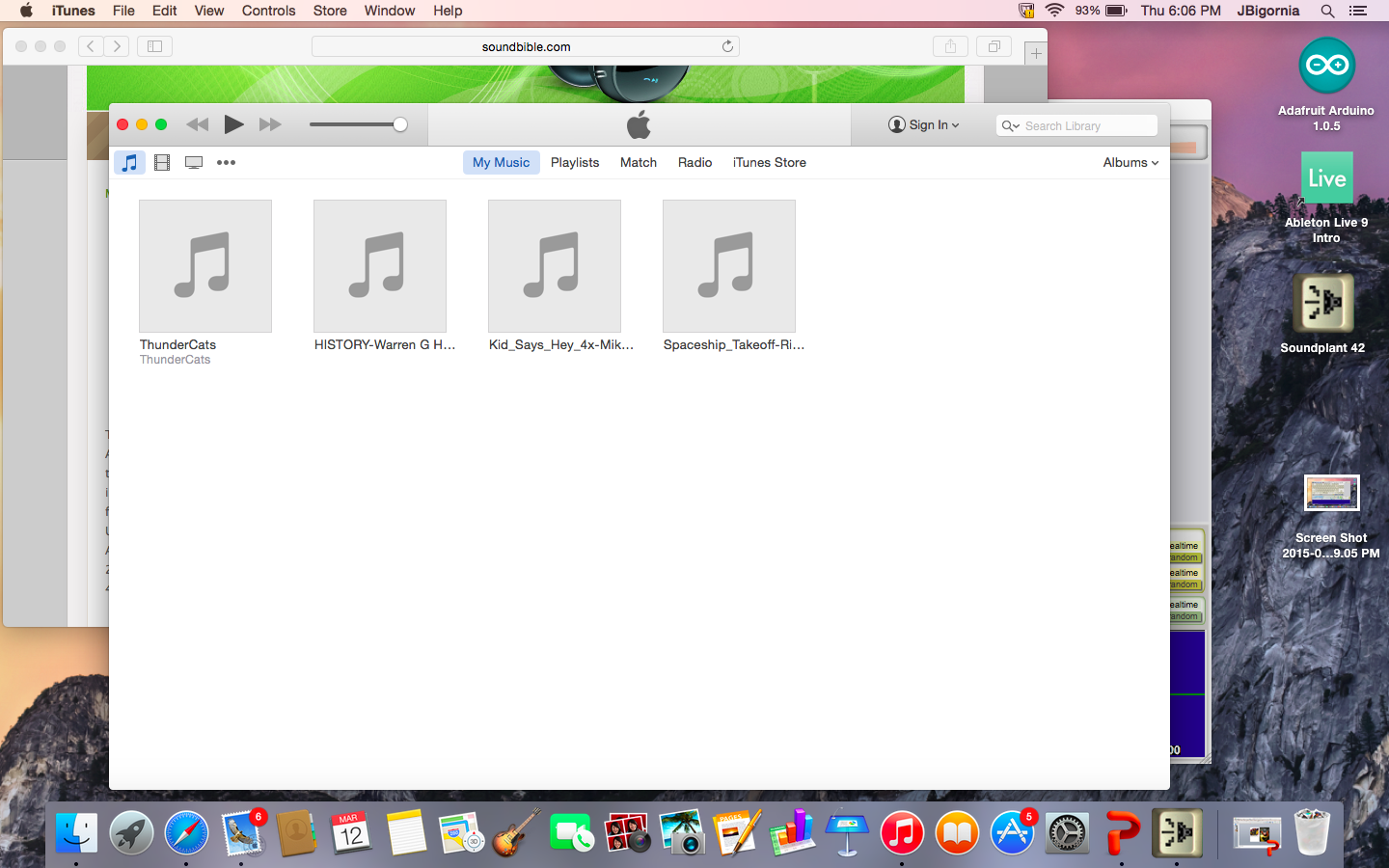
I found a bunch of sounds for this project using free online sound libraries and saved them as mp3 flies on my computer. The Soundplant site has some good suggestions for libraries to use. I tried to look for sounds that would complement my print in a weird or unexpected way.

Screen Shot 2015-03-12 at 6.06.10 PM

Step 4: Map your sounds to the keyboard using Soundplant.

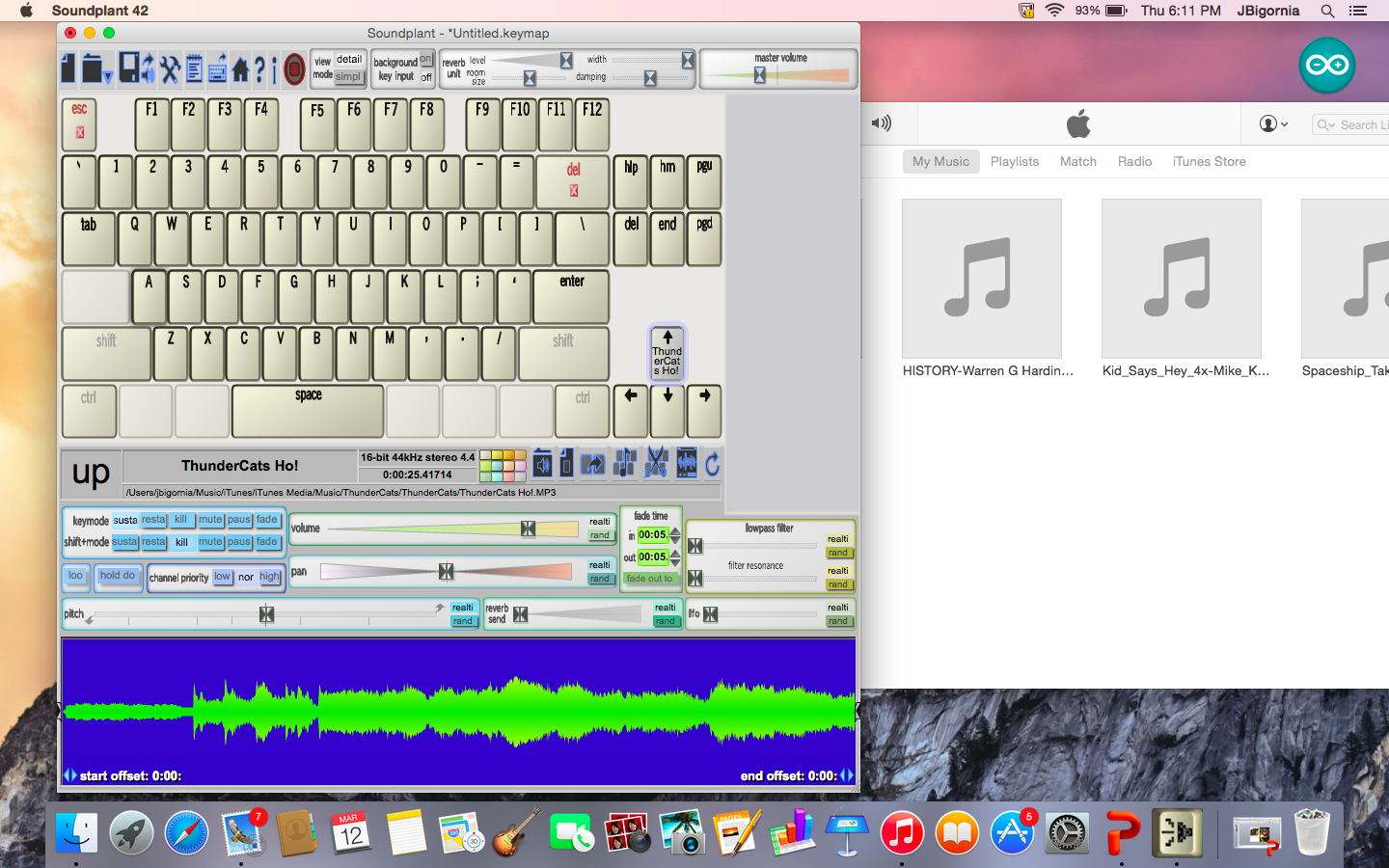
Open up Soundplant and assign one sound file to each of the left, right, and up arrow keys by dragging the file onto the software’s virtual keyboard. Soundplant even offers some basic editing tools, allowing you to adjust the length of your sound clip, add various effects, and more!

Screen Shot 2015-03-12 at 6.11.02 PM

Step 5: Connect the Makey Makey to the computer and play!

Plug the Makey Makey into your computer’s USB port. Be sure to also connect an extra alligator clip and wire to the space marked “Earth” at the bottom of the board. Hold the metal part of the alligator clip at the other end of the wire between your fingers and touch the interactive areas of your print with your other hand. Your computer should play the sounds you mapped to the different areas! You should also see the playback of your clip on the computer. If you’re having trouble getting it to work, make sure the volume is up on your computer, that all your connections are correct, and most importantly, that you are connected to the Makey Makey as well.

IMG_2687

The fun part of this project is that the sounds you choose can totally change the way people experience your artwork. A set of funny, quirky sounds will provoke a very different response from the viewer versus ones that are dark and foreboding. And because the Makey Makey will work with most conductive materials, you can create interactive sculptures, installations, and more! Additional project ideas can be found on the Makey Makey website.

JC Bigornia
C3 Program Coordinator

Friday Photos: NAEA in NOLA

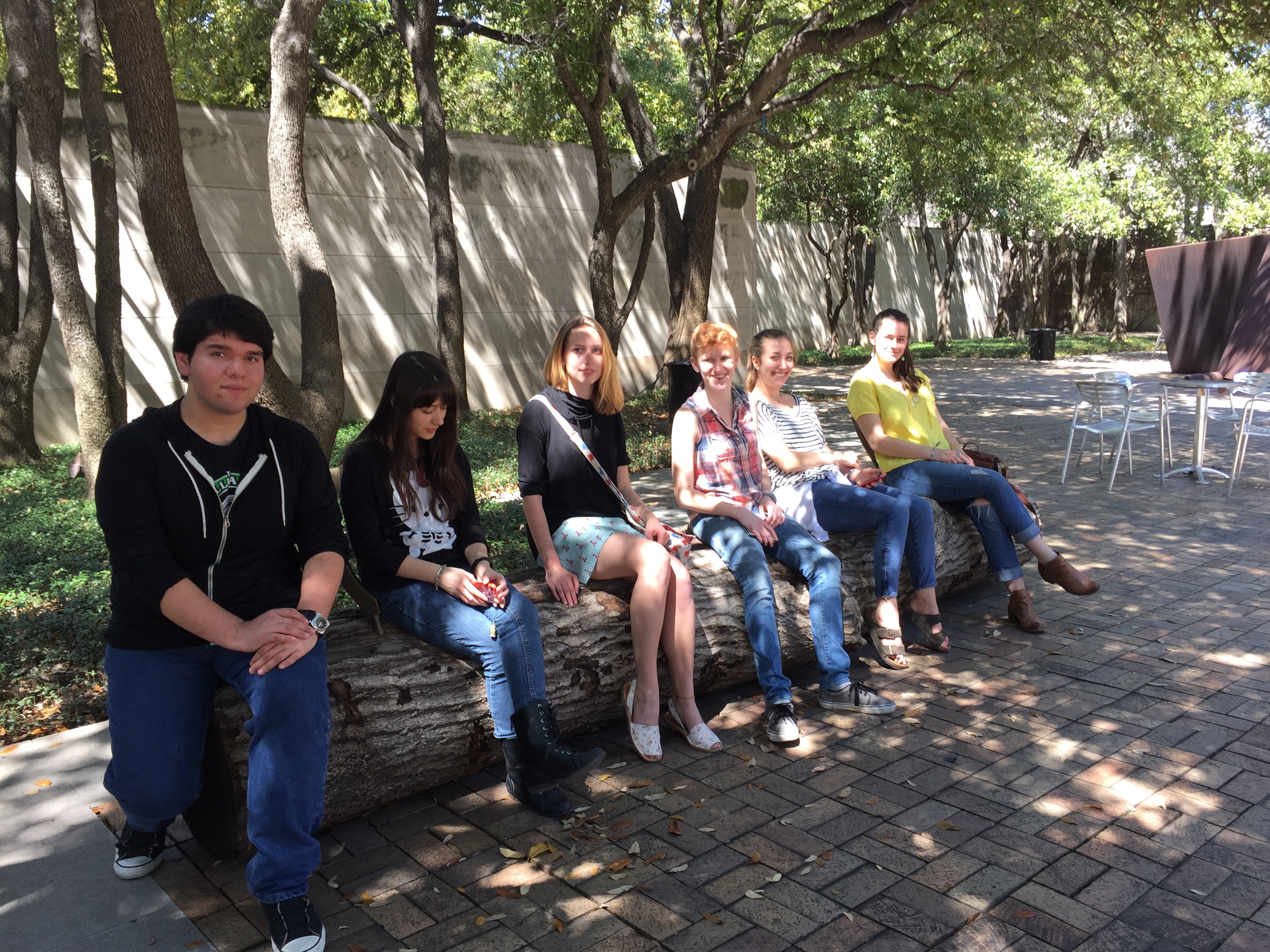
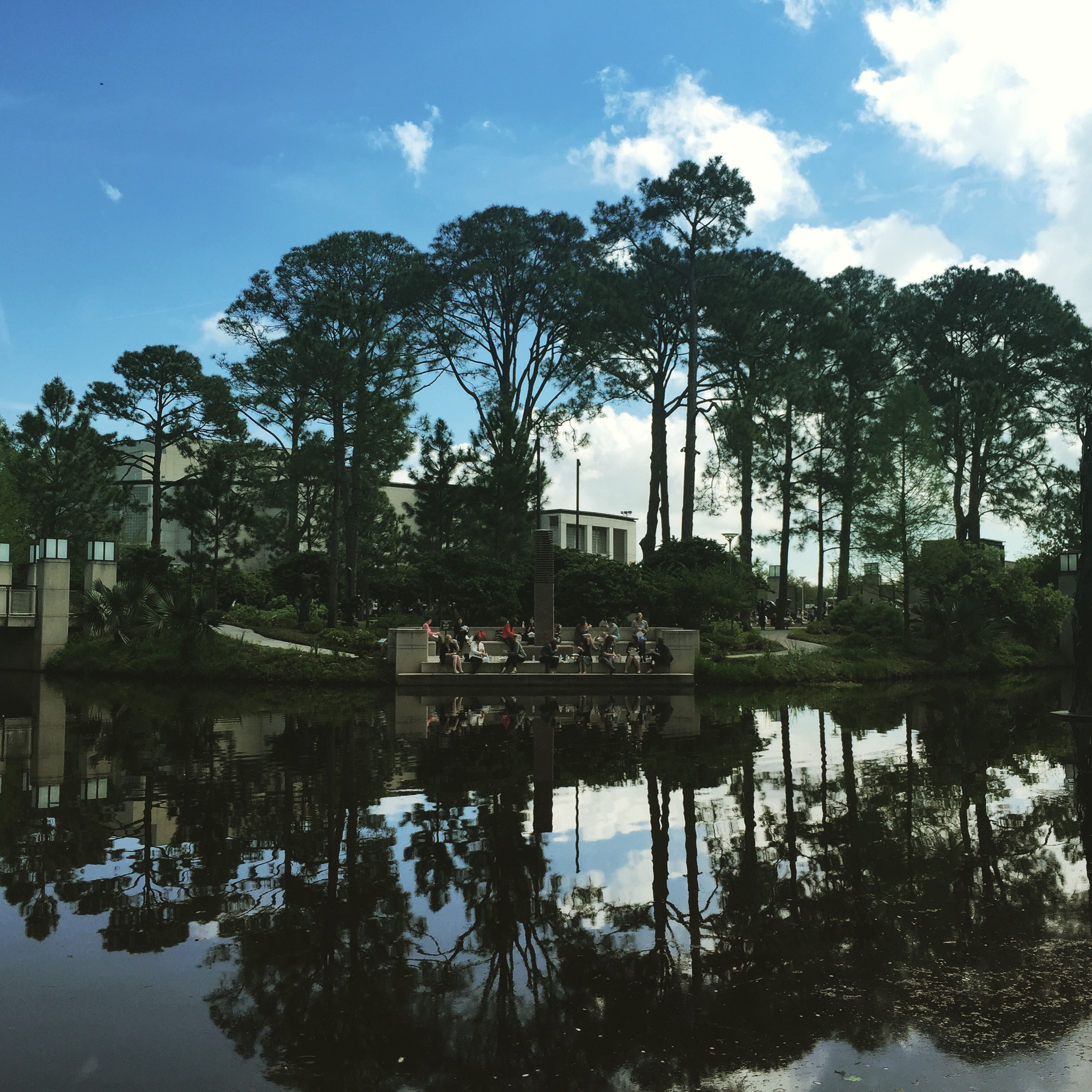
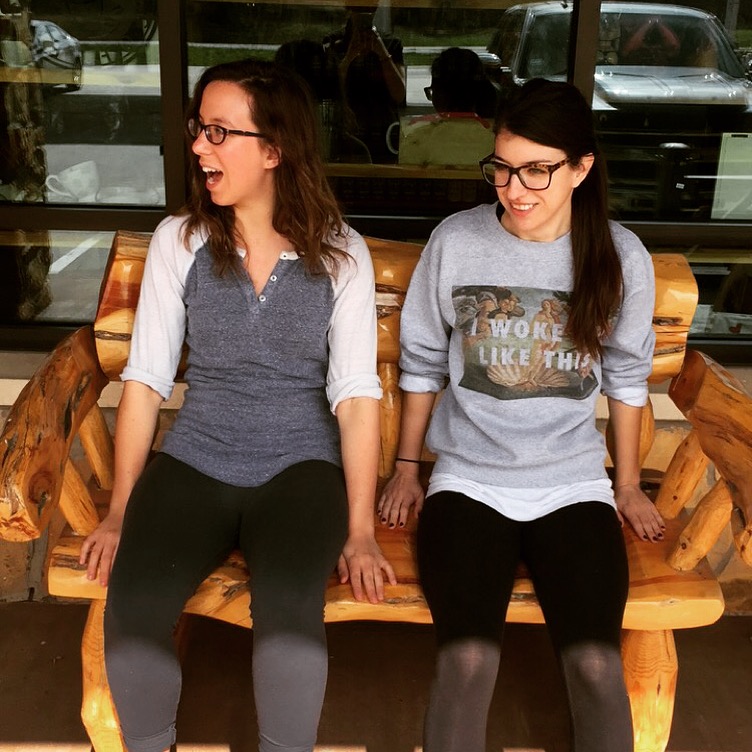
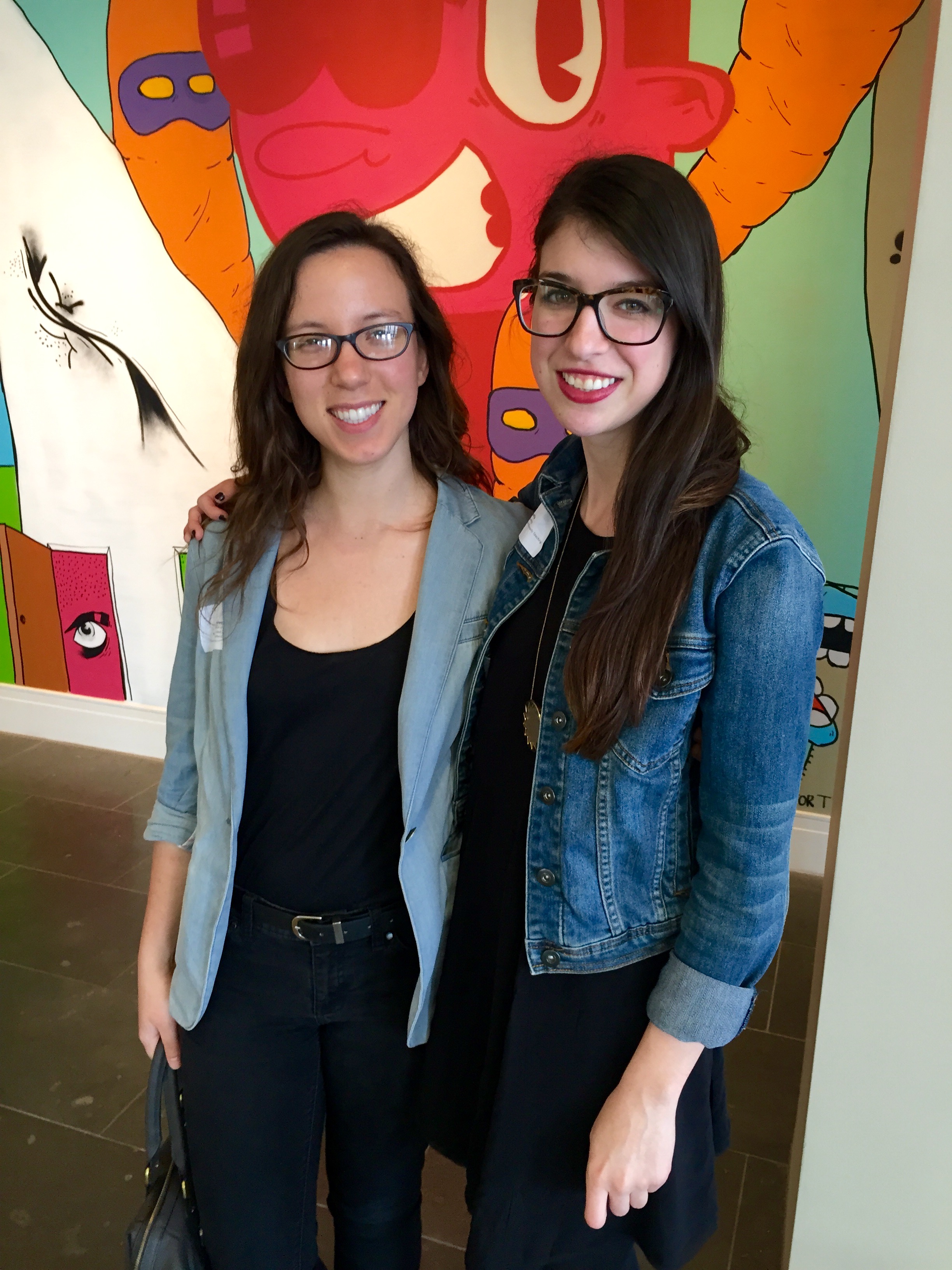
As part of our McDermott Internship, each intern is able to request funds to use for professional development–this can go towards a language class, visiting other museums to learn more about their practices, or events like conferences. This year, some of us decided to attend the National Art Education Association Conference in New Orleans.

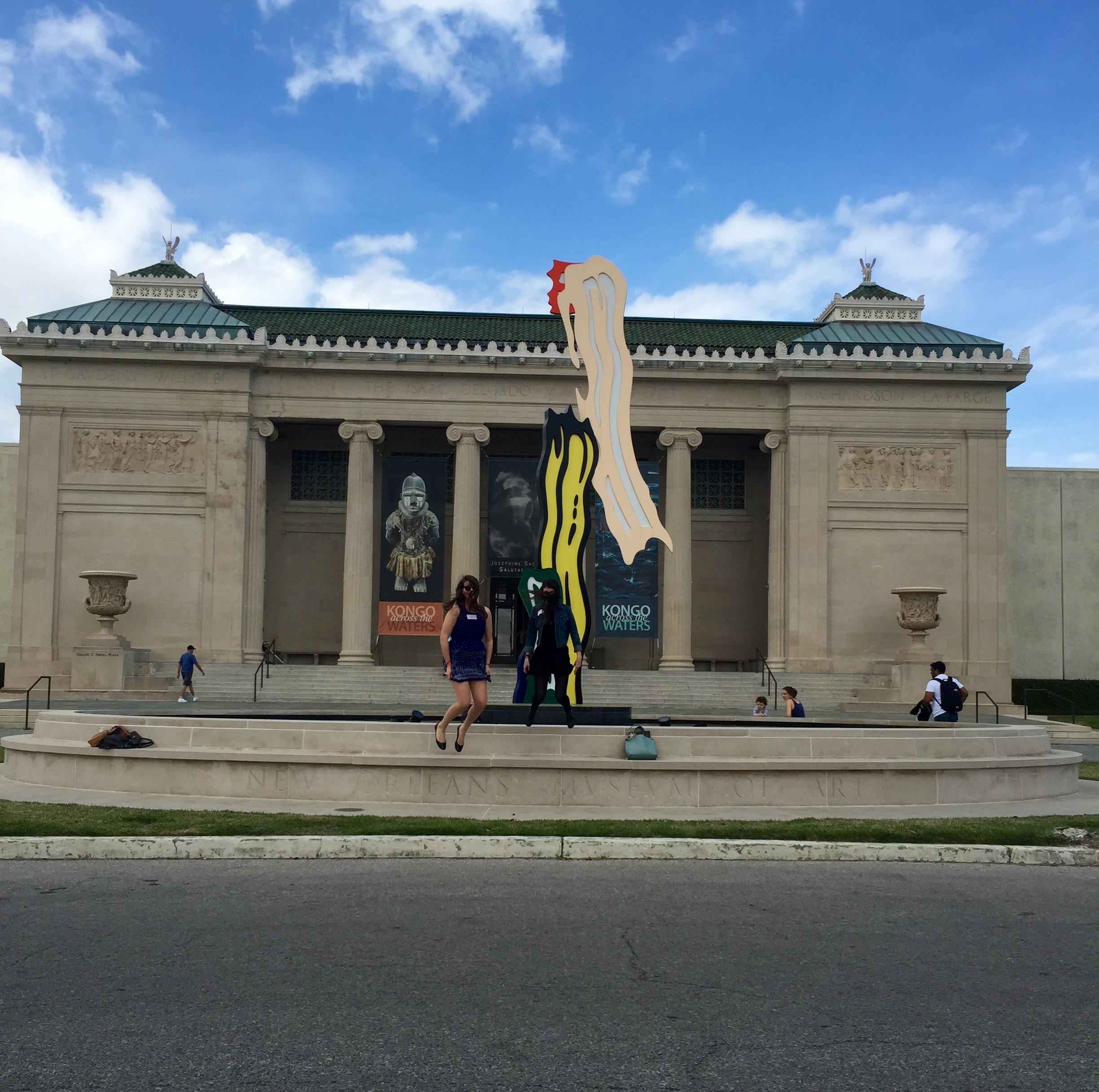
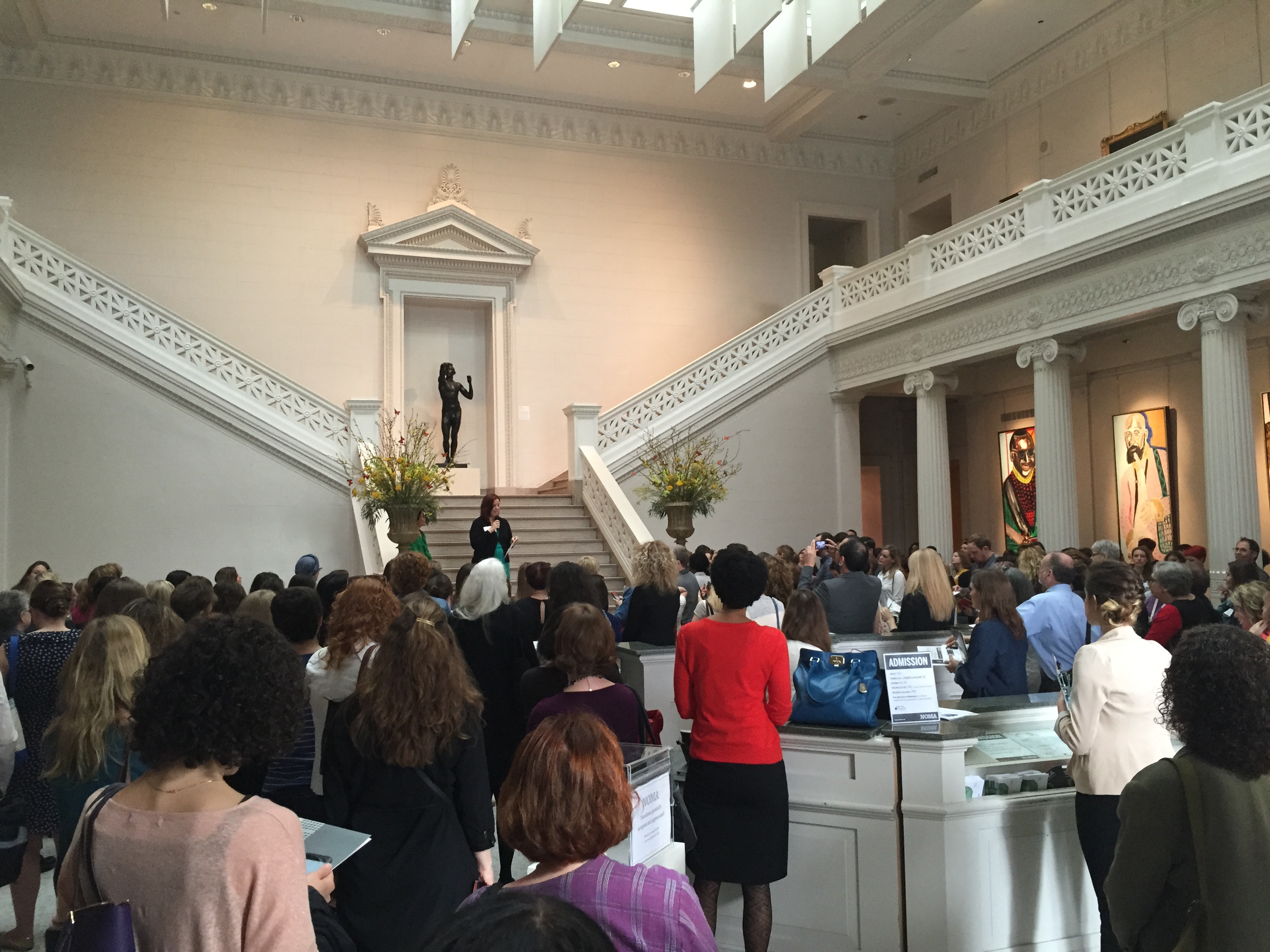
Always on board for some intern bonding, we decided to drive the 8 hours from Dallas to New Orleans. This was a great start to our trip, which has only gotten better since our arrival in the Big Easy! We’ve had a great time attending sessions, visiting local museums (New Orleans Museum of Art, Ogden Museum of Southern Art, and the Contemporary Arts Center) and learning more about the field of museum education. Here are just a few pictures of our trip so far!

We’re looking forward to bringing the knowledge and new ideas we’ve heard at the conference back to the DMA!

Liz Bola
McDermott Graduate Intern for Gallery and Community Teaching

Culinary Canvas: Mango Blueberry Puree

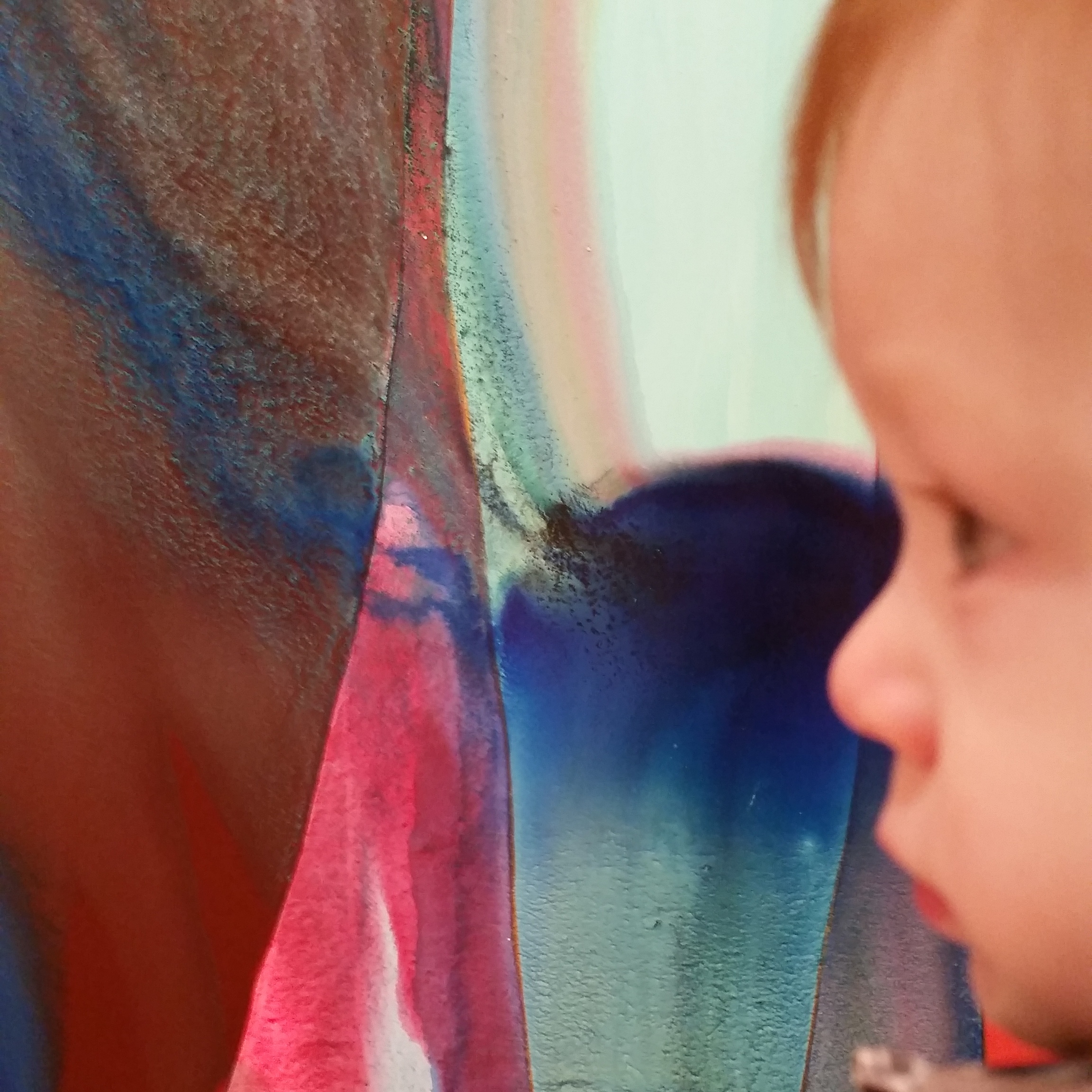
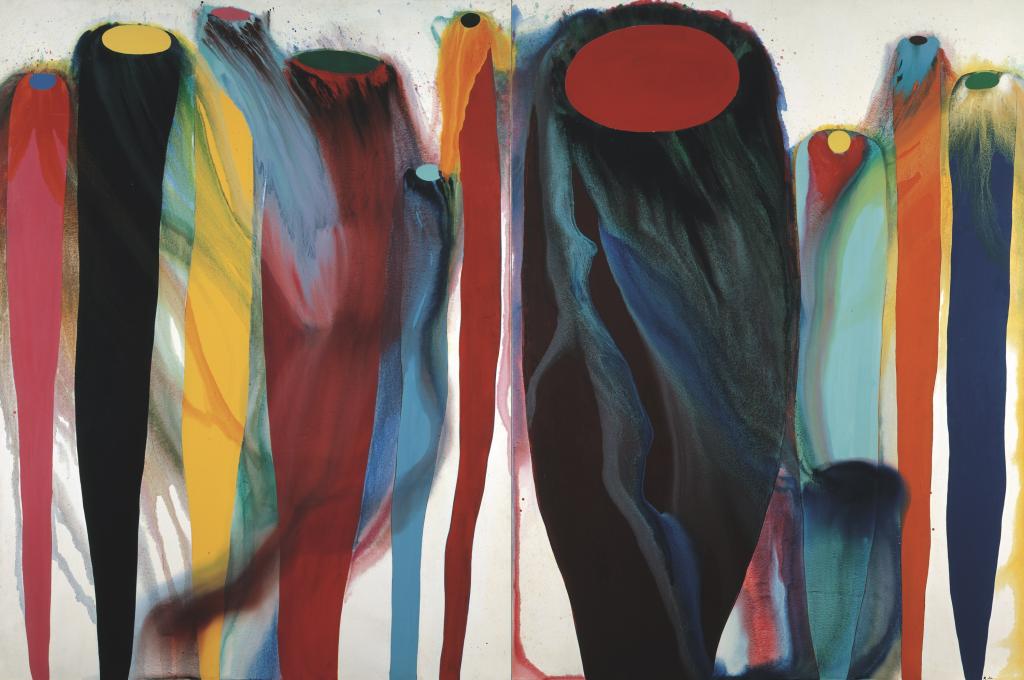
Last week, my little guy and I attended Art Babies. We started the class in our exhibition, Between Action and the Unknown: The Art of Kazuo Shiraga and Sadamasa Motonaga, exploring the large, abstract works of art. He smiled and kicked his little feet, so I could tell he really enjoyed the bright and engaging colors!

Rhys_SM

Color is something that I’ve been thinking about a lot when it comes to his diet–the more colorful the better! As you might have expected, I enjoy making food for him at home, so I wanted to share a simple recipe that you could try, inspired by the deep and vibrant colors in the exhibition. Be sure to bring your little one on your next visit, then make some colorful food for him or her to enjoy at home–you’ll be feeding his body and his mind! If you’re brave, you might even let him paint his high chair tray–at least you’ll know the paint is safe to eat!

Sadamasa Motonaga, Work 66-1, 1966, oil and synthetic resin on canvas, The National Museum of Modern Art, Tokyo © 2015 Estate of Motonaga Sadamasa

Sadamasa Motonaga, Work 66-1, 1966, oil and synthetic resin on canvas, The National Museum of Modern Art, Tokyo © 2015 Estate of Motonaga Sadamasa

Mango Blueberry Puree

Yields about 16 ounces
Appropriate for 8+ months
Level: Very Easy

1 ripe mango
1 cup fresh or frozen organic blueberries

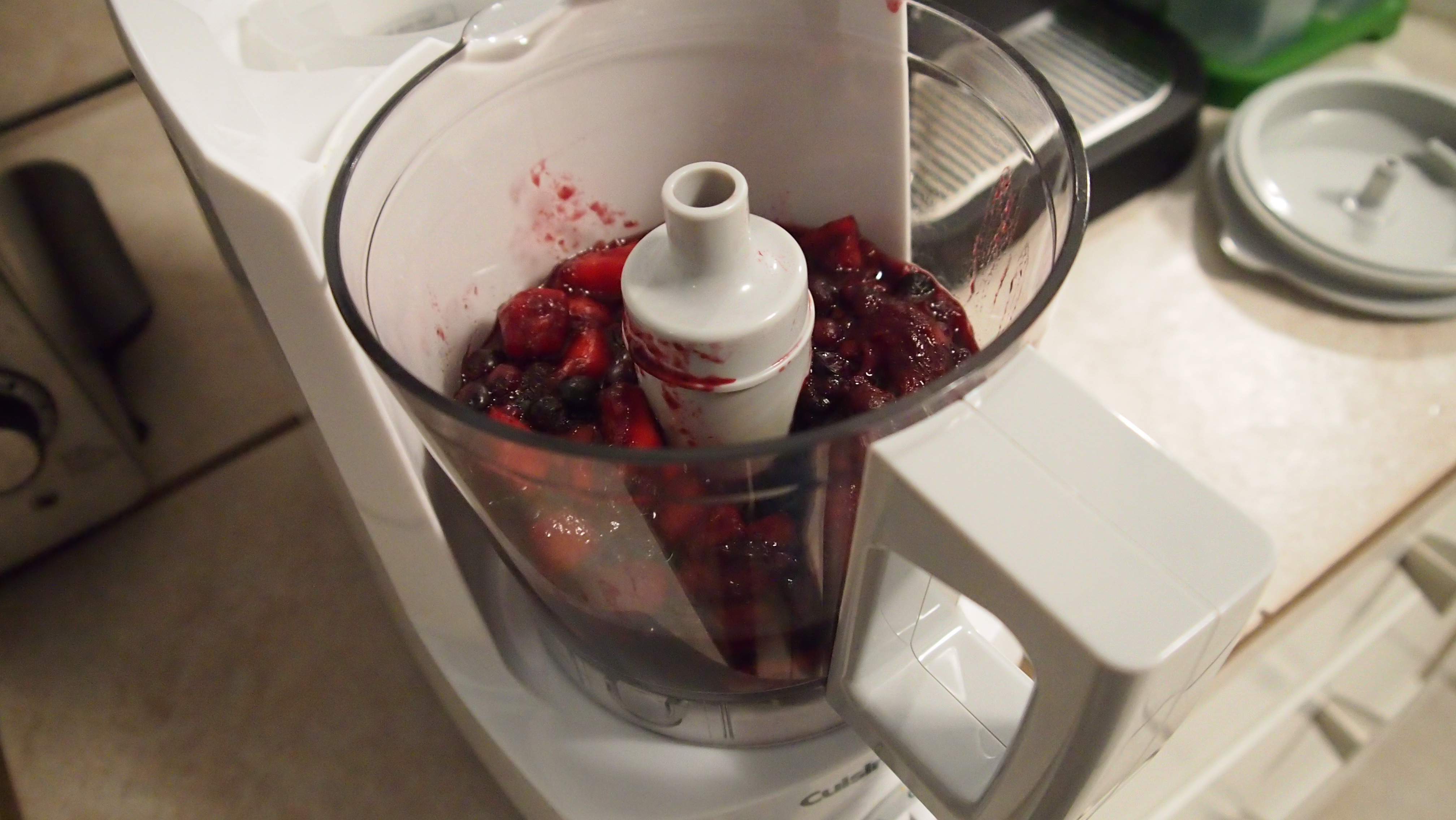
Prepare the mango by cutting it around the skin, similar to how you would cut an avocado. Note that the pit can be a bit tricky, so do your best to remove it, separating the fruit into two halves. Using a knife, score the fruit up to the skin, being careful not to cut through it. Scoop out fruit pieces and juice, and add to saucepan set on medium-low heat. Add fresh or frozen berries to pan and lightly simmer for about 5 minutes, allowing the fruits to break down slightly and meld their flavors.

Transfer fruit to the bowl of a baby food maker, small food processor, or large measuring bowl, if using an immersion blender. Puree into desired consistency for your baby.

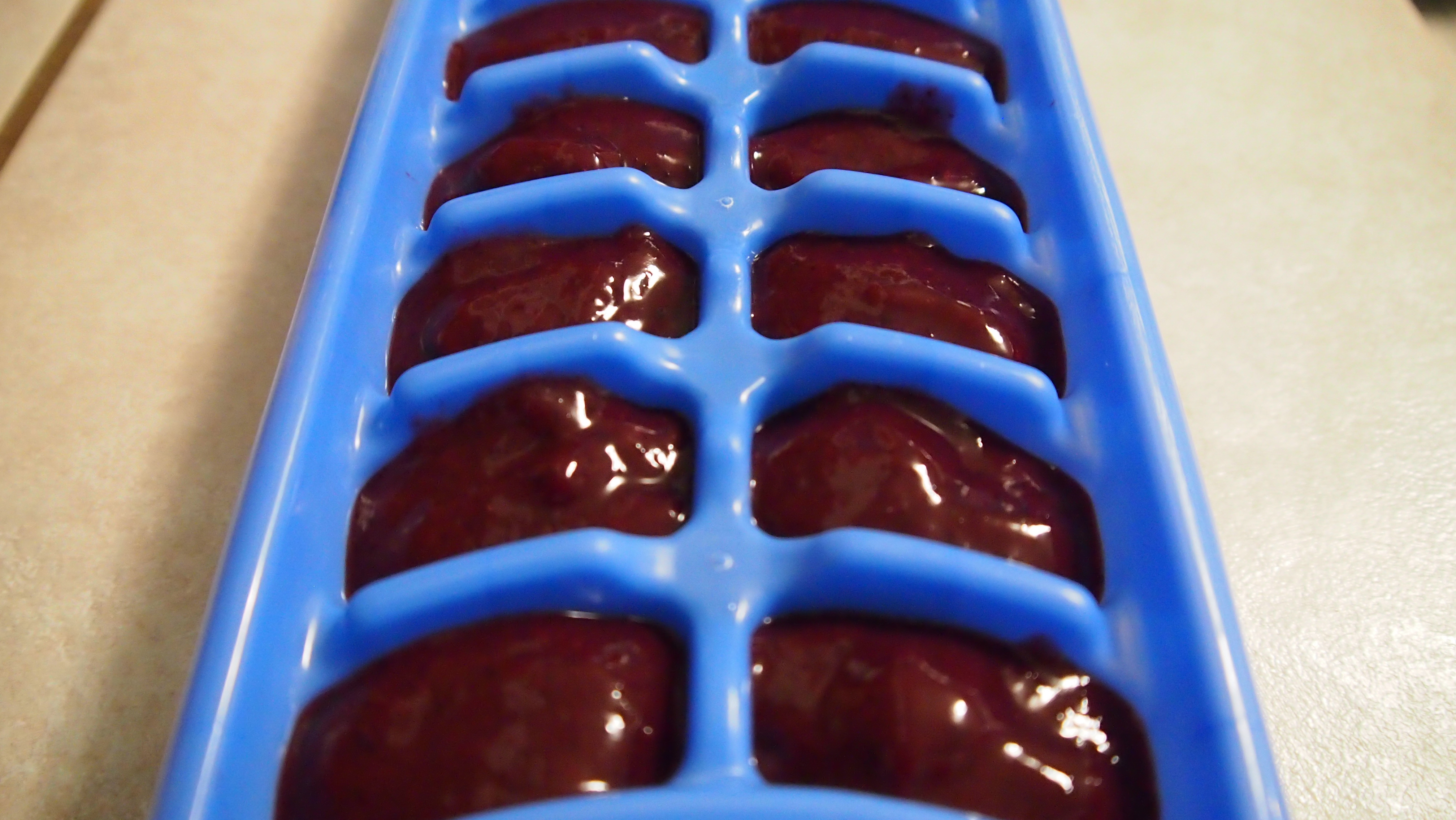
Divide puree into any portion size you’d like and freeze. I find that an ice cube tray works well for small portions that can be pulled out when needed and added to oatmeal, mixed with other fruits, or combined into a larger meal.


baby food maker

Cooked fruit in the baby food maker

blueberry mango puree

Finished puree in ice trays

Original recipe. And of course, be sure to always check with your pediatrician on the appropriate diet for your special little one.

Sarah Coffey
Education Coordinator

Friday Photos: All Access Art

This February was a milestone for the DMA education team: we celebrated the fifth anniversary of two of the Museum’s most successful access programs: Autism Awareness Family Celebrations, which currently serve over 900 visitors from North Texas each year, and Meaningful Moments, designed specifically for individuals with early stage dementia.

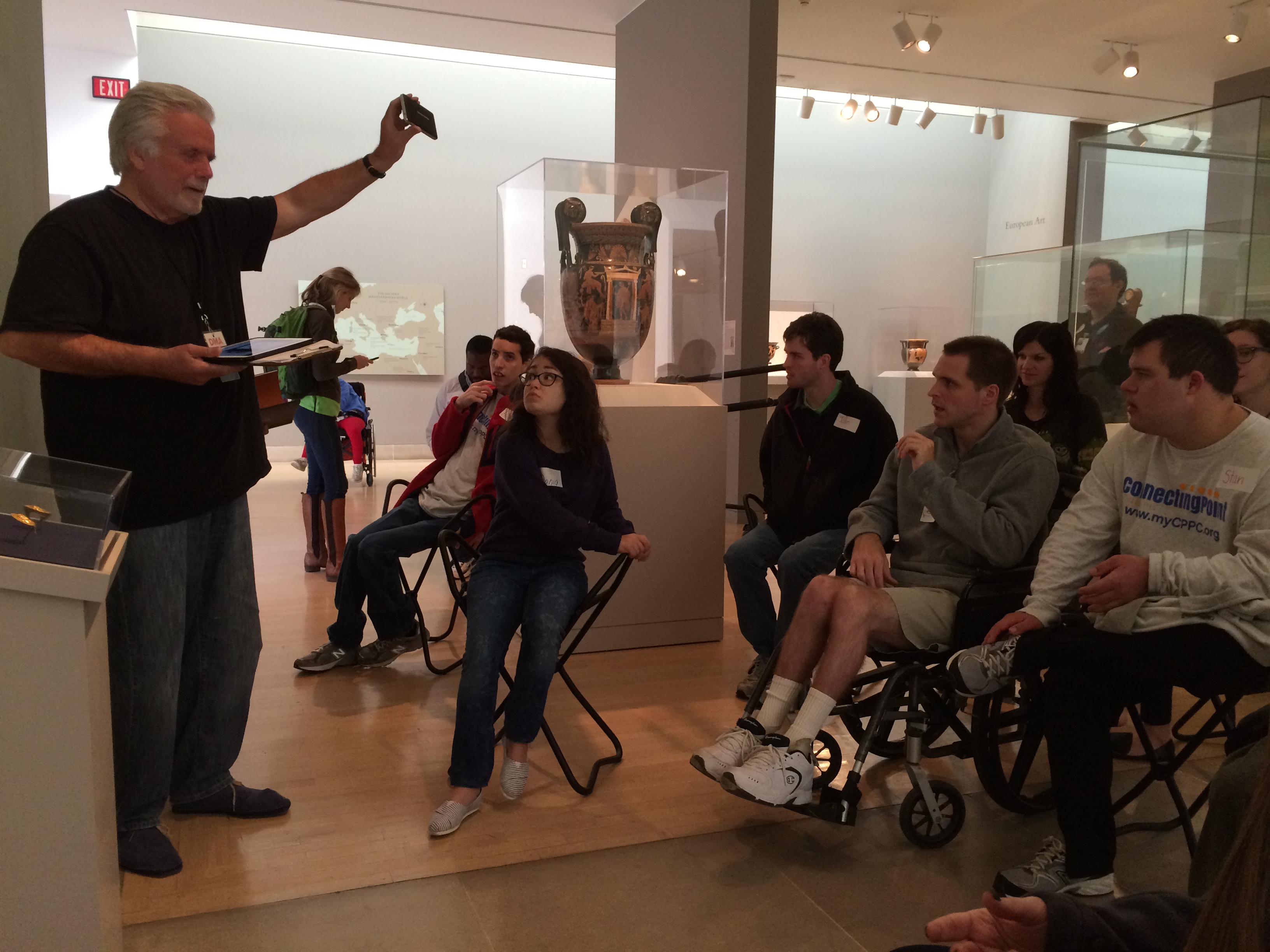
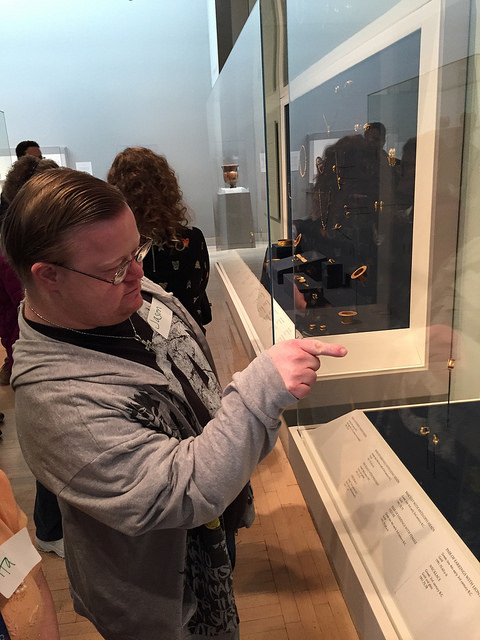
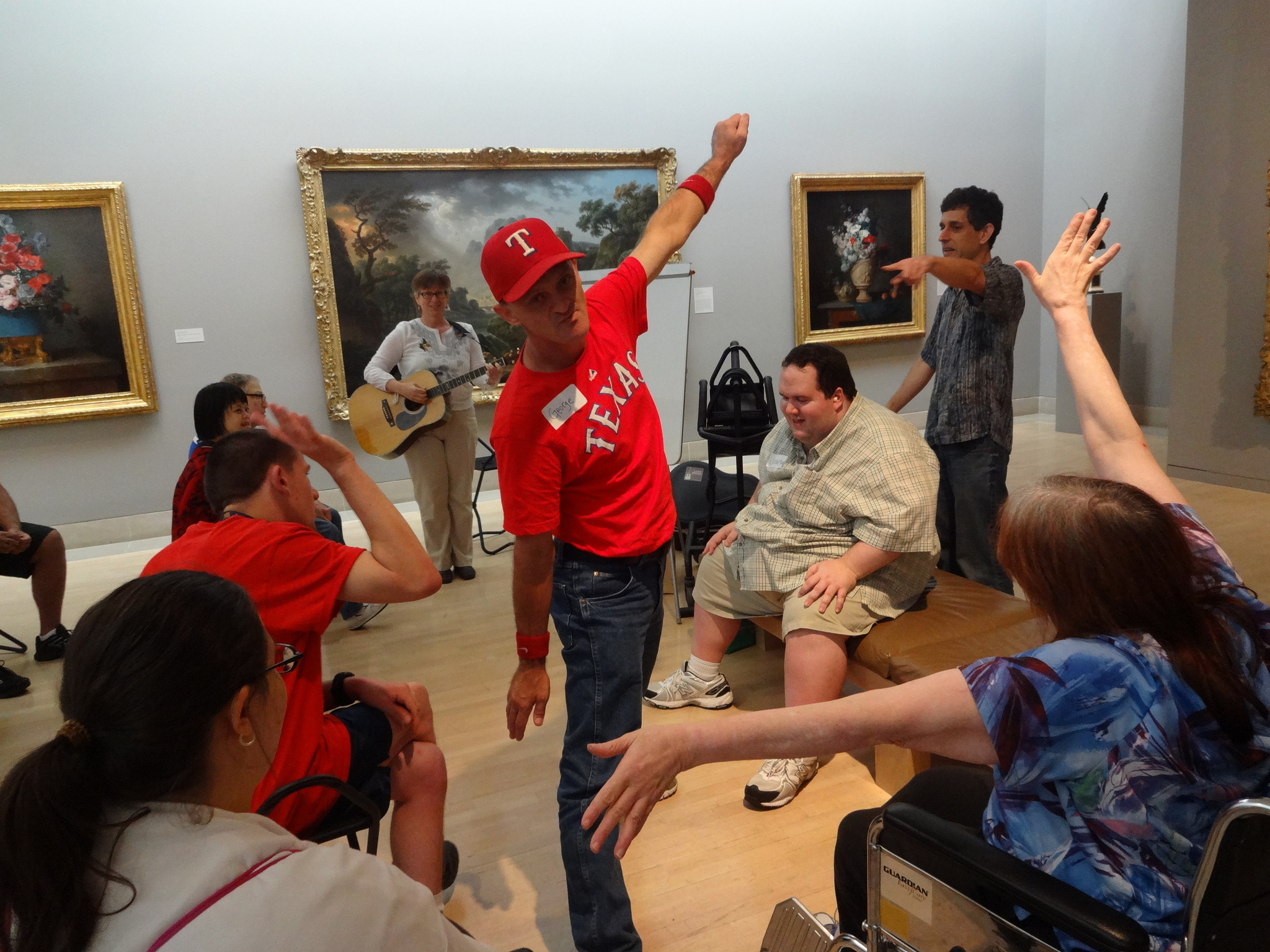
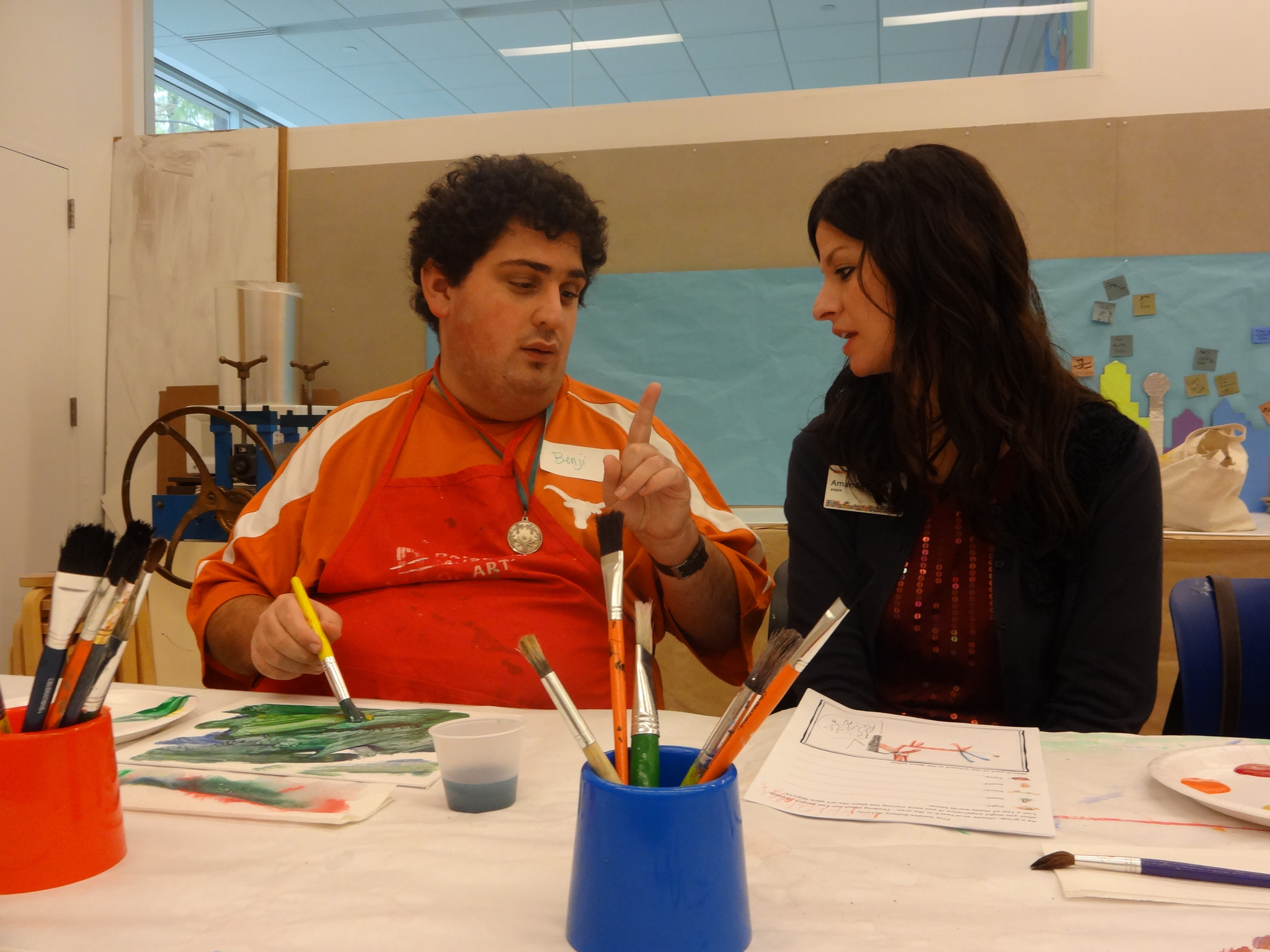
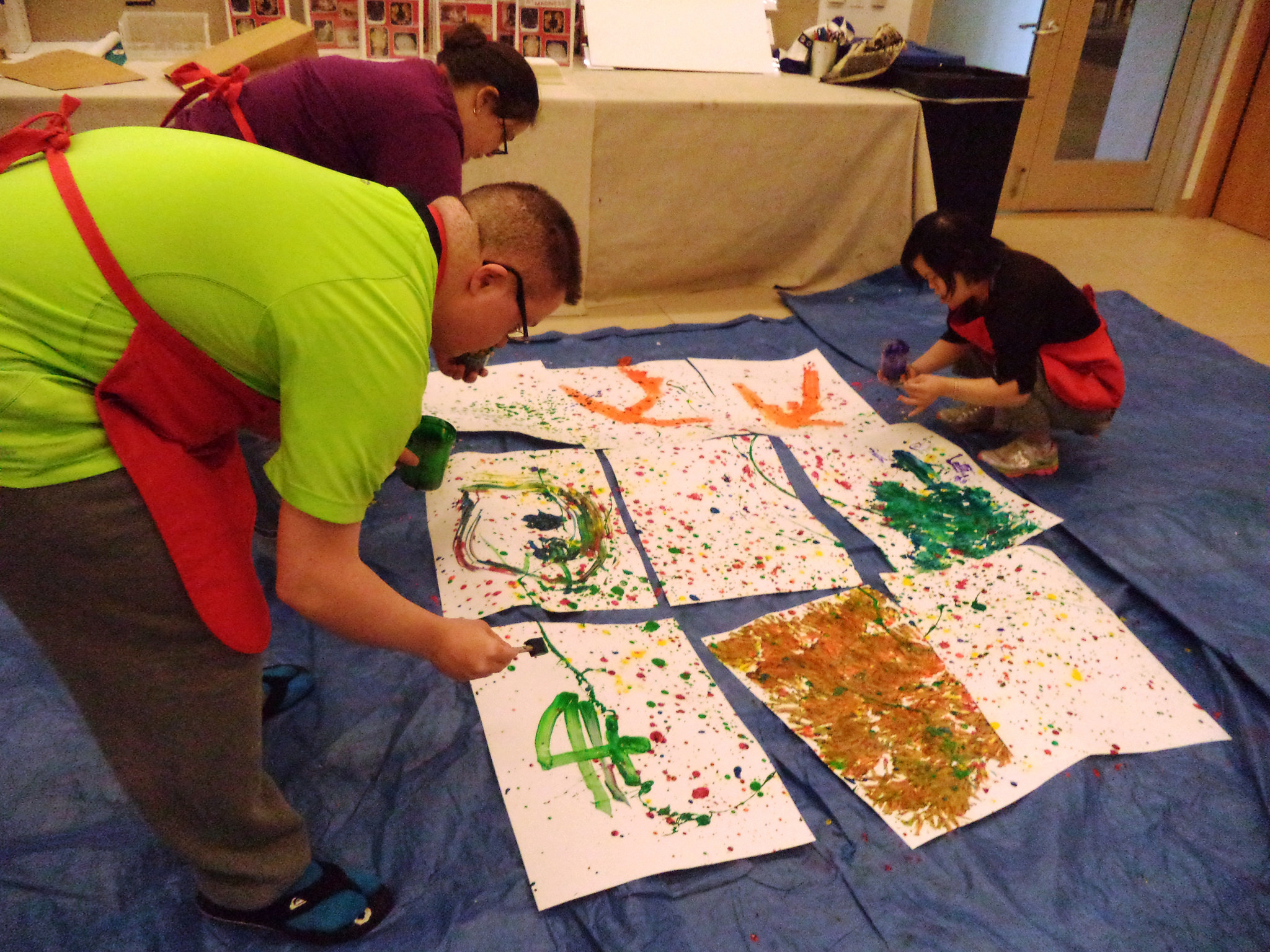
Furthermore, we announced the expansion of our access programs to include All Access Art, a program for adults with intellectual and developmental disabilities. Developed from the DMA’s long-running partnership with the Arc of Dallas advocacy group, All Access Art will now provide art-infused experiences to a wider selection of special needs groups in the DFW area, including Special Abilities of North Texas, Connecting Points of Park Cities, and Community Homes for Adults, Inc. (CHAI). During these visits to the Museum, participants explore the galleries on a theme-based tour and then return to the Center for Creative Connections Art Studio to create their own work of art.xc

We are thrilled at the expansion of this program and look forward to sharing more images and stories of our fantastic experiences with All Access Art!

Danielle Schulz
Teaching Specialist

The Little Guys

It’s the middle of March, meaning I’m well into the seventh month of my McDermott internship, and I have to say that the charms of working in a museum still haven’t worn away. I don’t know that they ever will! Part of what I love so much about my position as part of the Family and Access Teaching team is that I have gallery time built into my schedule. I’m out in the galleries multiple times a day: teaching classes, leading occasional tours, doing research for lesson plans (and blog posts!), and taking walks as a break from my desk.

After each trip through the Museum, the thought creeps into my head that, “Okay, now I’ve seen everything we have on view,” and yet time and again I’m proven wrong. Without fail, there’s always something I haven’t noticed before – something I have to stop in front of and think, “Has that always been there?” before investigating. The piece is often small or–at first glance–plain. Frederic Edwin Church’s Icebergs certainly isn’t a piece you can miss, nor is everyone’s favorite rain god, Tlaloc. These are the pieces that can catch your eye from a mile away. Today, however, I’m here to encourage you to spend a little extra time in the corners you might normally overlook, by sharing a few pieces that I passed by on so many occasions and have now come to admire.

Incised bone depicting an accession ceremony, Maya, A.D. 600-900
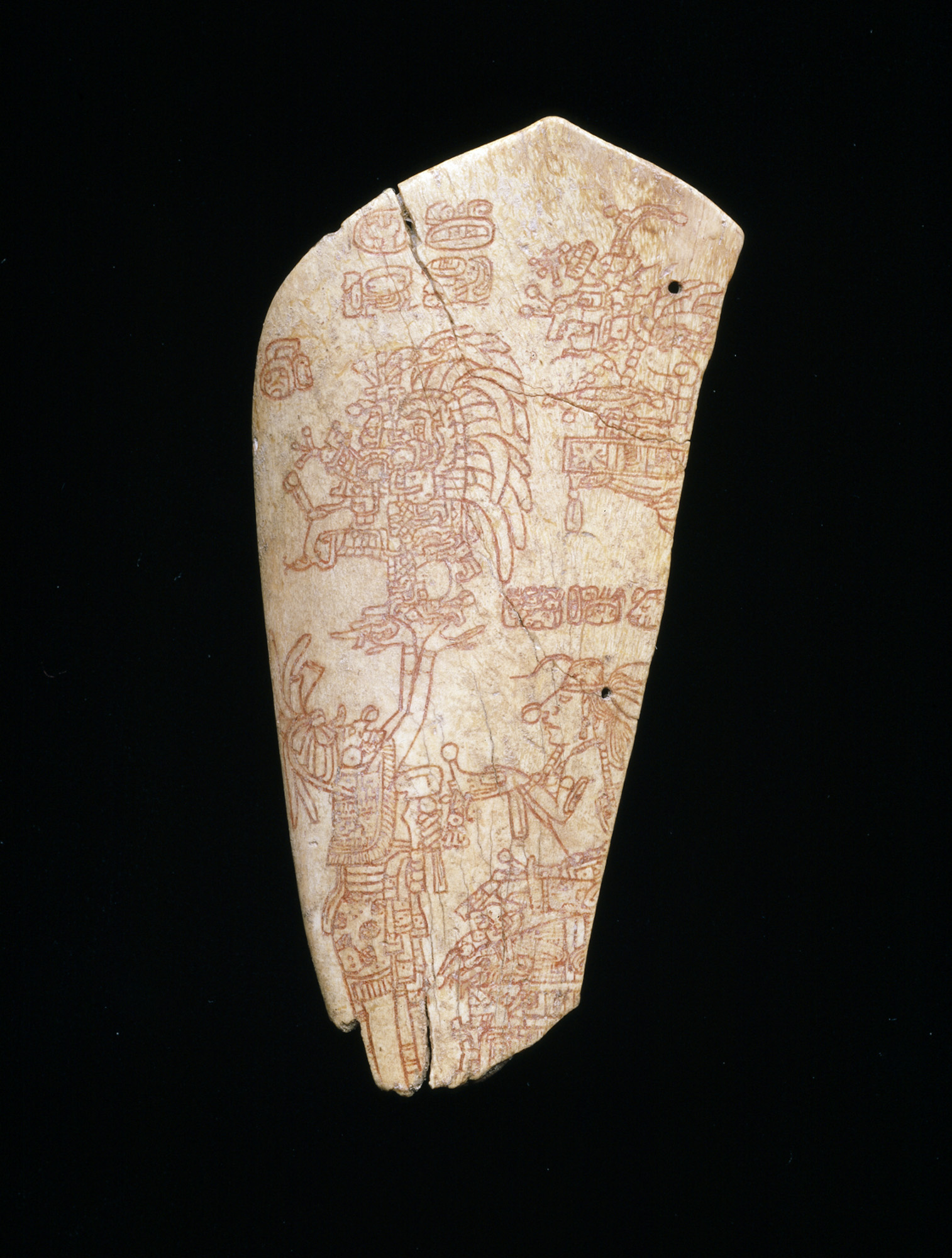
Incised bone depicting an accession ceremony, Maya, A.D. 600-900, Dallas Museum of Art, The Otis and Velma Davis Dozier Fund

Incised bone depicting an accession ceremony, Maya, A.D. 600-900, Dallas Museum of Art, The Otis and Velma Davis Dozier Fund

This fragment of bone, only 3 1/4 inches tall, was meticulously incised over a millennium ago with the scene of a young man being crowned king. The about-to-be ruler sits in the lower right of the piece, and opposite him a man raises “the great headdress of Holy Lordship,”which, according to the Museum’s label, bears the image of a mythical bird called ‘Itzam-Yeh,’ ‘The Magic Giver.’ The significance of Itzam-Yeh’s presence in this scene is rooted in the story of the bird; in short, he claimed to be something much greater than he was and was found out and punished for it. The headdress, so decorated, would serve both as a reminder and a warning to the new king.

Chess piece, India: Punjab Hills, late 18th-early 19th century
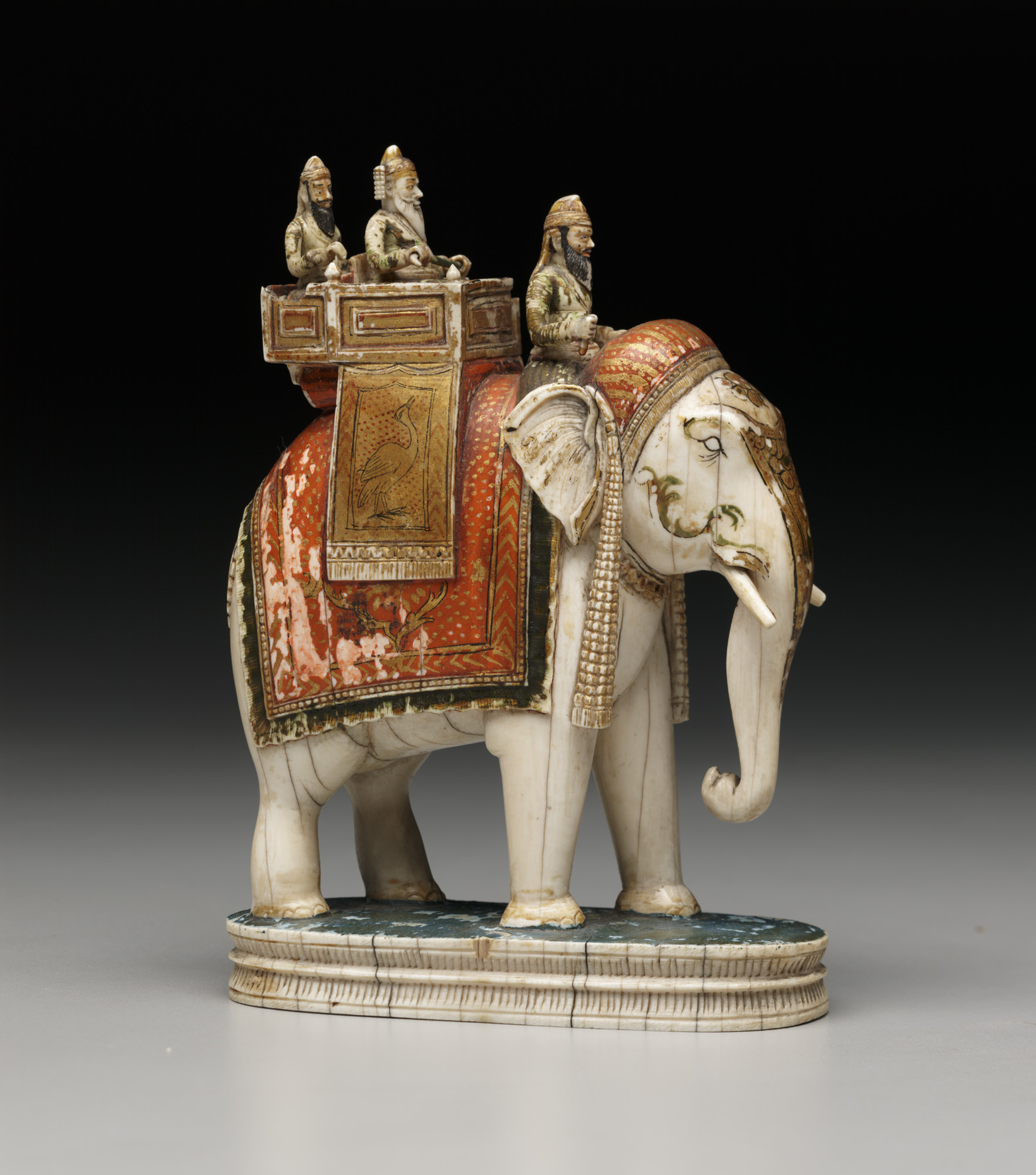
Chess piece, India: Punjab Hills, late 18th-early 19th century, intended gift of David T. Owsley

Chess piece, India: Punjab Hills, late 18th-early 19th century, intended gift of David T. Owsley

This chess piece, made of gilt and polychrome ivory, is another incredible work of delicate craftsmanship. The details are what make the piece so impressive–for example, each of the three men riding the elephant have distinct features and carefully carved beards. Some of the fine black lines are so thin and precise that they would have required a very steady hand wielding a paintbrush with no more than a strand or two of hair. This particular piece would have been used as the king–can you imagine how grand the entire chess set must have looked?

Ring with engraved carnelian, Roman, first half of 3rd century A.D.
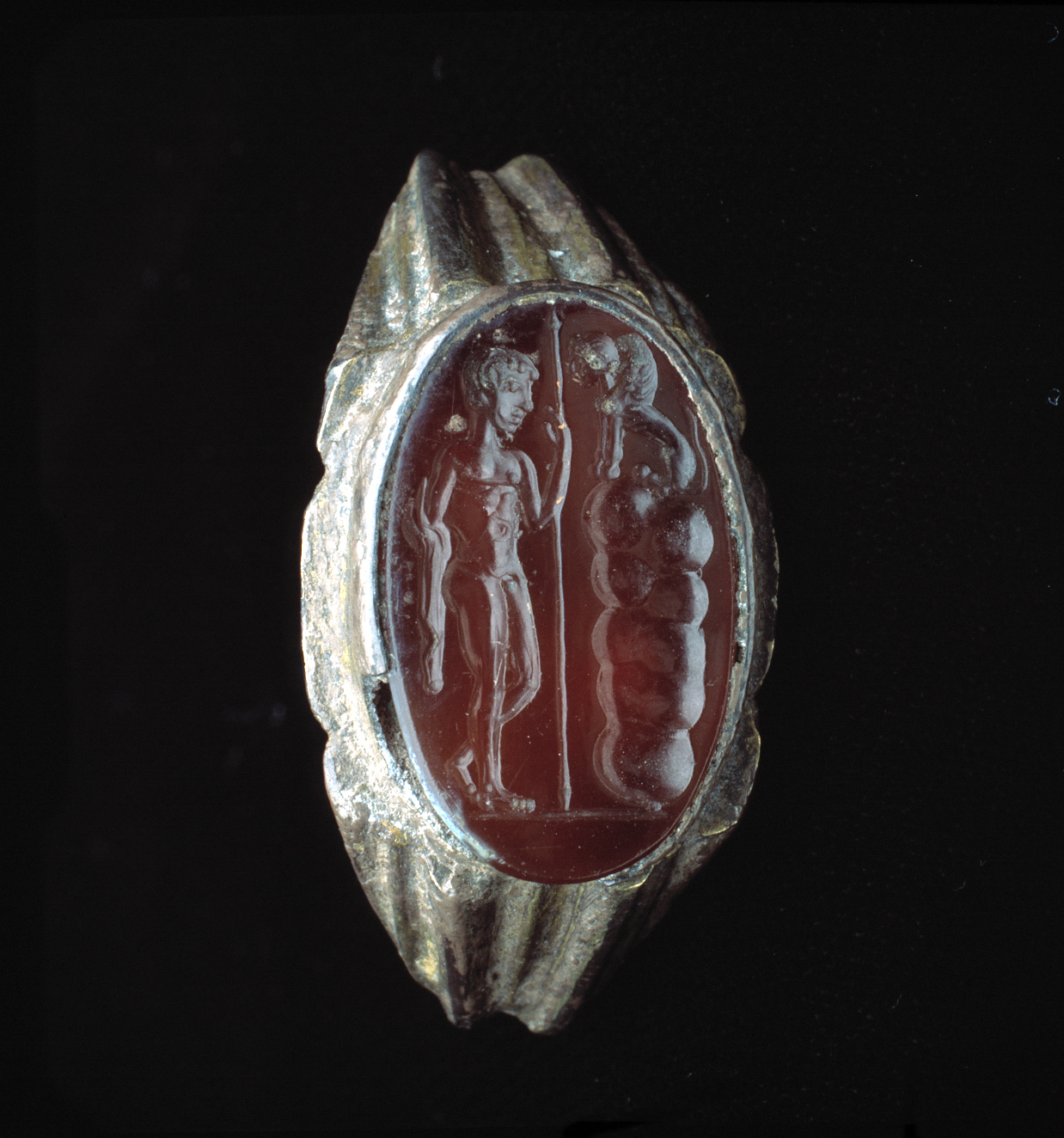
Ring with engraved carnelian, Roman, first half of 3rd century A.D., Dallas Museum of Art, Museum League Purchase Funds, The Eugene and Margaret McDermott Art Fund, Inc., and Cecil H. and Ida M. Green in honor of Virginia Lucas Nick

Ring with engraved carnelian, Roman, first half of 3rd century A.D., Dallas Museum of Art, Museum League Purchase Funds, The Eugene and Margaret McDermott Art Fund, Inc., and Cecil H. and Ida M. Green in honor of Virginia Lucas Nick

This silver ring was probably worn by a man. In the gallery, the ring is so small and the carving is so fine that the details can be hard to see without careful, close looking (the Museum’s online collection comes in handy during moments like this–there are many high-quality photographs that let you zoom in and examine a small piece like this ring with ease). To the left stands Oedipus, the king in Greek mythology who murdered his father and married his mother, unaware that they were his parents. Carved into the Museum’s carnelian is a scene from later in his story when Oedipus saves Thebes from the Sphinx by answering her riddle. The craftsman that made this exceptionally small carving was clearly remarkably skilled–I can’t imagine the patience and quiet attention that went into the creation of this ring.

These are just three of the small, wonderful pieces I’ve discovered in the galleries, and I can’t wait to see what I run across next. So remember: on your next trip to the Museum (or any museum) yes, you absolutely should pay attention to the standout pieces–the Icebergs, the Tlalocs–but don’t forget to give the little guys their due. You’re bound to be surprised by what you find.

Jennifer Sheppard
McDermott Intern for Family and Access Teaching

Archives

Categories