Posts Tagged 'Dallas Museum of Art'


Closing Celebration for Art in October

Sunday we wrapped up the month-long celebration of the Dallas Arts District, Art in October, with a day full of events throughout the district. The DMA hosted a free Carnival of Creativity and Doggies in the District. Below are few photo highlights from the day.

[slideshow]

Henri Matisse's Ivy In Flower

If you visit the DMA over the next few months, you can’t miss Henri Matisse’s Ivy in Flower, a colorful collage that measures just over nine feet on each side.
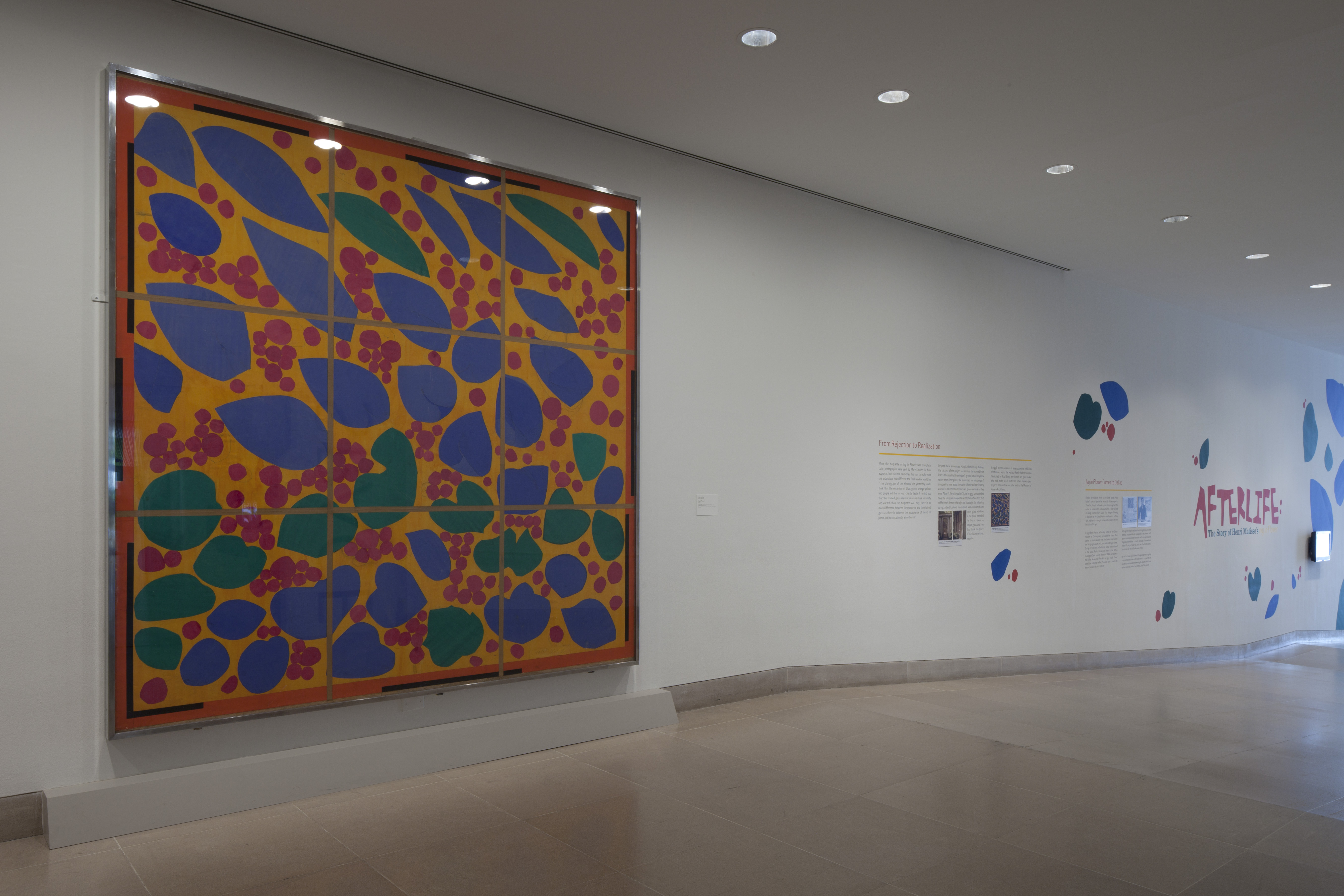
Colorful shapes inspired by the collage lead you up (or down) the DMA concourse to Ivy in Flower

Ivy in Flower is a well-known but rarely seen work of art in the DMA’s collection made with colored paper, watercolor, pencil, and brown paper tape on paper mounted on canvas.  In order to preserve and protect a work on paper, the artwork cannot be exposed to light for sustained periods of time.  For that reason, Ivy in Flower has only been on view three times in the last ten years, each time for eight months or less.  It is usually displayed in the European galleries, which are filled with natural light.  This time around, curator Heather MacDonald proposed showcasing the collage in the concourse, where there is not only less light but also plenty of space to tell the interesting history of this work of art.

The story begins with Albert Lasker, who is considered by many to be the father of modern advertising.  Lasker began his career as an office clerk at Lord and Thomas advertising agency in Chicago, and became a salesman, then partner, and eventually the president and owner of the company.  One of his most notable campaigns was for Lucky Strike cigarettes, which served as inspiration for Don Draper’s character in the television series Mad Men.

After his retirement, Albert Lasker began collecting art with his second wife, Mary Lasker.  Following Albert Lasker’s death in 1952, his wife had a mausoleum built for him in Sleepy Hollow Cemetery in New York.  Later that year, Mary Lasker commissioned  Henri Matisse to design a window for the back wall of the structure, or more precisely, nine windows that would form a ten-by-ten-foot square.

At this time, Matisse was an internationally-known artist late in his career.  Due to his poor health, he primarily created compositions by arranging shapes cut from heavy paper that he coated with paint.  With the aid of studio assistants, Matisse placed and pinned the shapes until he was satisfied with the composition.  For the Lasker commission and other works from this time period, Matisse chose to create a to-scale maquette rather than small-scale preparatory sketches.

Cutting into color reminds me of the sculptor’s direct carving.

– Henri Matisse

After much correspondence between Mary Lasker and Pierre Matisse, the artist’s son, the final design for the window was ultimately rejected.  Matisse passed away in 1954, and his family had the window executed in glass for a retrospective exhibition two years later.  The window is now owned by The Museum of Modern Art of Vienna.  As part of their original agreement, Mary Lasker retained ownership to the Ivy in Flower maquette until she donated it to the Dallas Museum of Contemporary Art (which later merged with the Dallas Museum of Fine Arts, now the Dallas Museum of Art) in 1957.

This is just a short synopsis of the history behind this colorful collageAfterlife: The Story of Henri Matisse’s Ivy in Flower  is on view through December 11, 2011, and includes illustrations of how the mausoleum may have looked with the windows designed by Matisse, as well as images of the people and places in this interesting tale.

Melissa Nelson
Manager of Teaching in the Community

Kids Say the Darndest Things!

I spy with my little eye…children at the museum!

On any given day, there are always programs being offered for our younger museum visitors. During the week, you can often spot them in lively school groups engaging in interactive docent tours. And don’t be surprised if their enthusiasm can be heard from the hallways as they participate in exciting art activities in the Center for Creative Connections. Our programs also go beyond the museum and into the community, bringing art to the classroom with Go van Gogh. These are just a few examples of the many ways the folks here at the DMA are facilitating fun learning experiences that encourage participation and self-expression. But don’t take it from me! Our young participants really say it best. Below are some of their candid comments from the 2011 – 2012 school year.

Docent Tours

  • “These paintings look weird to me,” a puzzled 4th-grade girl commented while walking through the Impressionist gallery.
  • “Wouldn’t you like to drink out of these amazing cups?” a docent asked about a group of gold Peruvian mugs. “Uh, if I cleaned them first,” replied a 4th-grade boy.
  • A 4th-grade boy noticed a Peruvian Mask with copper covered eye holes and mused, “I wonder how many times the guy wearing that ran into the wall?”
  • “Even if you are a leader, you still need help,” reasoned a 4th-grade boy when asked to interpret the proverb expressed by an African sculpture.
  • After an hour long tour, these 4th-graders still wanted more, as expressed by this excited girl who asked, “What else are we going to see? Are we going to see the really really really big artworks now?!” Referring to the Mark Bradford work they had passed by on the way in.

Center for Creative Connections

  • “They always make us paint with crazy things!” said a young girl in reaction to painting with kitchen tools in an Arturo’s Art & Me class.
  • “I thought it was going to be a person, but it turned out to be a ballerina,” explained an eight-year-old girl about her finished artwork.
  • A nine-year-old girl titled her art piece Man Gives Flowers and reflected that, while she made it, she thought of “romantic love.”

Go van Gogh Classroom Programs

  • “Hi, I am from the Dallas Museum of Art!” announced the volunteer. “Really?! Yessss. I LOVE art!!” exclaimed an enthusiastic 2nd-grade girl.
  • “Make the minutes last! Make the next two minutes an hour!” declared a 5th-grade boy after being told that only five minutes remained.
  • “Wow,” a 4th-grade boy said of the hat he was making, “mine is turning out reeeeally neat.”
  • “I have no idea what I am doing. I just went wild on it,” laughed a 4th-grade boy about his art project.

If you have any memorable museum moments with kids, please share them in the comments section!

Hannah Burney

McDermott Education Intern for Teaching Programs and Partnerships

French Twist: An Intern Abroad

The Dallas Museum of Art offers a variety of internships throughout the year in various departments. This past July, Amandine Marchal joined the Development Department. Marchal hails from Montbéliard, in Franche-Comté (eastern France) and is currently studying business at the French School, HEC Paris. We tracked her down to discuss her experience at the DMA.

Describe your internship in fifty words or less?
I am a Development intern at the DMA and occasionally I assist other departments (such as Marketing and Education). I am mainly working on the Fashion World of Jean Paul Gaultier exhibition. I keep some of the special events’ invitation lists and help organize those events.

What might an average day entail?
Every day is really different. Some days I add people to the invitation lists, other days I add information about the DMA’s works of art online, order linens and flowers for lunches, and make reservations for group tours of our collection. It is very varied!

How would you describe the best part of your job and its biggest challenges?
The best part of this internship is that I work with so many people and do so many different things. It’s also quite a challenge because it requires a good deal of organization! But I really wanted to have a good overview of how a museum works, and I feel like I have a better understanding after interning at the DMA.

Growing up, what type of career did you envision yourself in? Has interning at the DMA changed your career path in any way?
I started with business studies in France and saw myself working in publishing houses. Last year, I began taking art history courses (or lessons in history of art, as we say in France). My internship at the DMA has really made me reconsider my career path. I will certainly keep learning about art and consider any museum job opportunities when I finish my studies.

What is your favorite work in the Museum’s collection?
It’s hard to choose. I would say it is Edward Hopper’s Lighthouse Hill. He is one of the first American painters that I discovered, and I love his paintings’ atmosphere. But I love to hang around the European floor and see the incredible Monet, Vernet, and Courbet paintings; they remind me of France.

How did you find out about an internship at the Dallas Museum of Art?

I wanted to find an internship in the United States, and in a cultural field. I learned that one of my fellow students at HEC (Adrien Lenoir) was doing an internship at the DMA, and I applied too. I really wanted to go to Dallas because it seemed so unusual for a French student to have an internship here! And Adrien was so enthusiastic about his own internship and the kindness of the people at the DMA that I didn’t hesitate.

What advice would you give to other students looking for an international internship?
I would tell them not to fear the “language barrier”; they will get used to talking in English. People are very patient and nice about our mistakes. An international internship is actually an incredible experience, and a way to meet extraordinary people. So don’t hesitate!

What has been your favorite Dallas experience thus far?
I was amazed by the 4th of July parades! In France people don’t celebrate Bastille Day this way. It was a very fun and unusual thing to see for me. Now I am looking forward to seeing some Halloween parties!

Seldom Scene: Two Hundred Years Later, Together Again

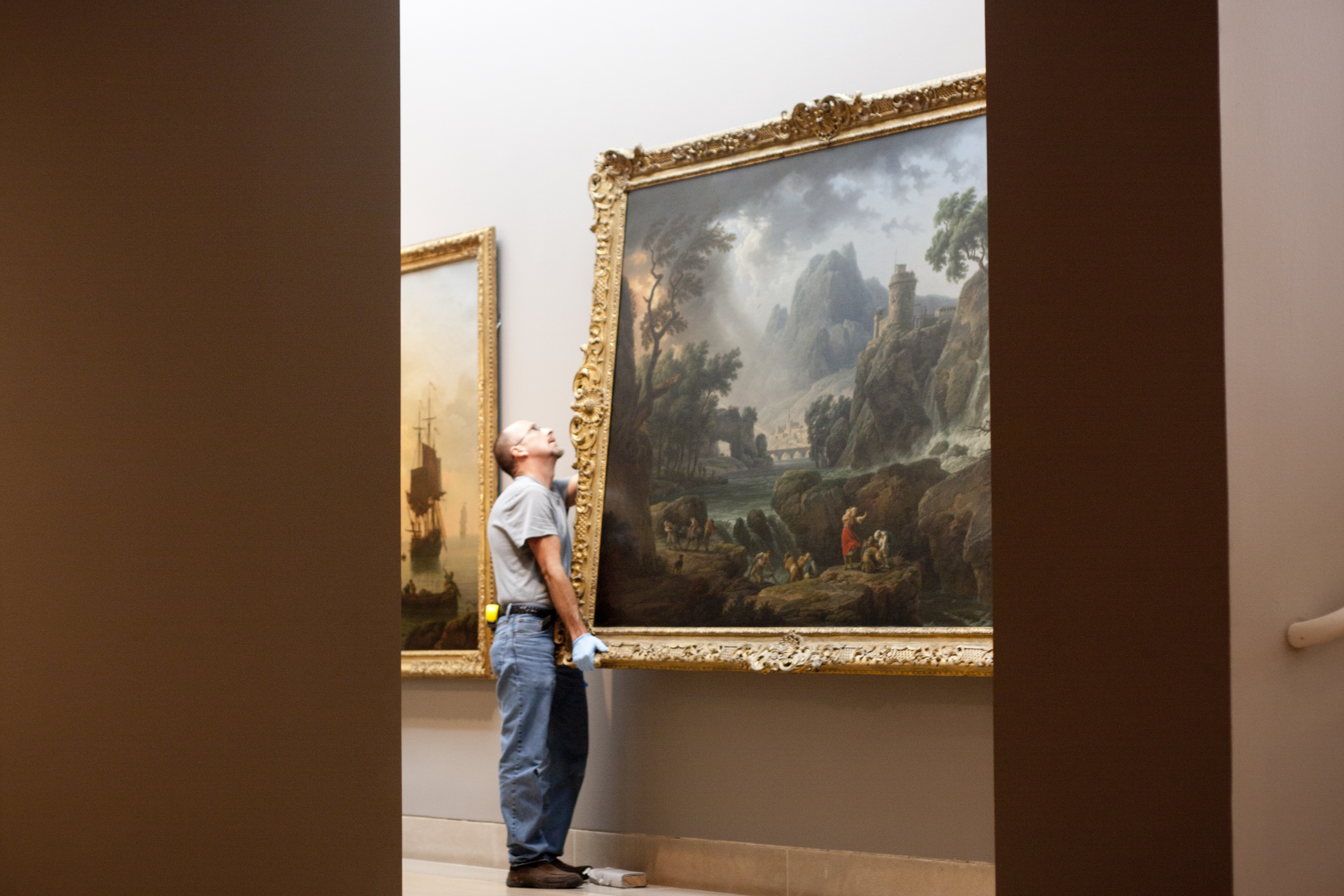
After a two-hundred-year separation, two Claude-Joseph Vernet landscapes are reunited at the Dallas Museum of Art. Commissioned in 1774 at the height of Vernet’s career by famous English collector Lord Lansdowne, the two large-scale paintings depict the complementary scenes of unruly rustic landscape and tranquil seaport. The duo, A Mountain Landscape with an Approaching Storm and A Grand View of the Sea Shore, hung together in the collector’s home, Lansdowne House, Berkeley Square, London, until his death, when the paintings were sold to separate private collections in 1806. See the works in person in the Museum’s European Art Galleries on Level 2 through December 11, 2011. To read more about the reunion, click here.

Join Dr. Heather MacDonald, The Lillian and James H. Clark Associate Curator of European Art, DMA, for a gallery talk on Vernet’s Lansdowne Landscapes on Wednesday, November 2, at 12:15 p.m.

Member Appreciation Week

The DMA’s third annual Member Appreciation Week (MAW) is less than a month away. Each year we set aside one week to celebrate our members! Membership contributions are vital to the Museum’s operations, allowing us to present exquisite special exhibitions and rich multidisciplinary programming like Late Nights. The Dallas Museum of Art is extraordinary because of the generosity and investment of its members.

We’ve added a couple of days to this year’s MAW so that we can incorporate the opening of The Fashion World of Jean Paul Gaultier: From the Catwalk to the Sidewalk. Over twenty events are planned during these nine days, which was no easy feat, and there is something that will appeal to all of our members. Some of the week’s highlights include:

  • Member previews of The Fashion World of Jean Paul Gaultier – Preparation for the Jean Paul Gaultier exhibition has been in the works for months, but we reserved time for our members to have the opportunity to view the exhibition prior to the November 13 public opening.
  • Arts & Letters Live special lecture: Vincent van Gogh and Jackson Pollock: Changing What Art Is – Authors Steven Naifeh and Gregory White Smith will discuss their new book Van Gogh: The Life as well as the similarities they found between Vincent van Gogh and Jackson Pollock, on Monday, November 14. Members will be able to attend this event free (to make reservations click here), and I’m taking this night off so that I can enjoy my membership benefits!
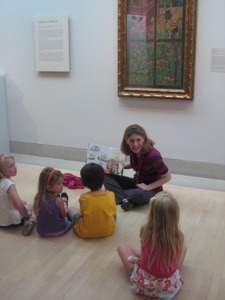
  • Story Time – Every summer the education department sends an e-mail to staff members asking who wants to read books during Story Time. I’m always one of the first to volunteer to read a children’s story in one of the collection galleries. It is a popular event with families and we want to offer our members this experience in the fall. After the story, we talk about the art. Hearing children tell me about their experience with art is one of the highlights of my job!
  • 20% off in the Museum Store – who doesn’t love a good sale! The extra 20% is just in time to start your holiday shopping.

For a full list of events, visit Events for Members. Don’t forget to stop by the Member Services Desk to introduce yourself so that we can thank you in person! For information on how to become a member, call 214-922-1247 or visit  DallasMuseumofArt.org.

Wendi Kavanaugh is the Member Outreach Manager at the Dallas Museum of Art.

Off the Wall: Alternate Universe

In our Center for Creative Connections we ask visitors to reflect on their responses to the spaces they encounter in art, as well as those they encounter in their everyday life.

For one work of art specifically, Lee Bontecou’s Untitled, we ask visitors to respond to one of three prompts:

  • To me, sharing space with this work of art feels like…
  • The words or pictures that come to mind when I look at this work of art are…
  • If this work of art was part of something larger, describe what it would be.

    Untitled (35), Lee Bontecou, 1961, Dallas Museum of Art, Foundation for the Arts Collection, gift of an anonymous foundation

We have gotten a lot of great responses from visitors and want to share a few with you. Once a month we will have an “Off the Wall” post featuring three responses left by visitors.

Next time you are in the Center for Creative Connections add your contribution to the wall and maybe you will see it on Uncrated!

A Monumental Install

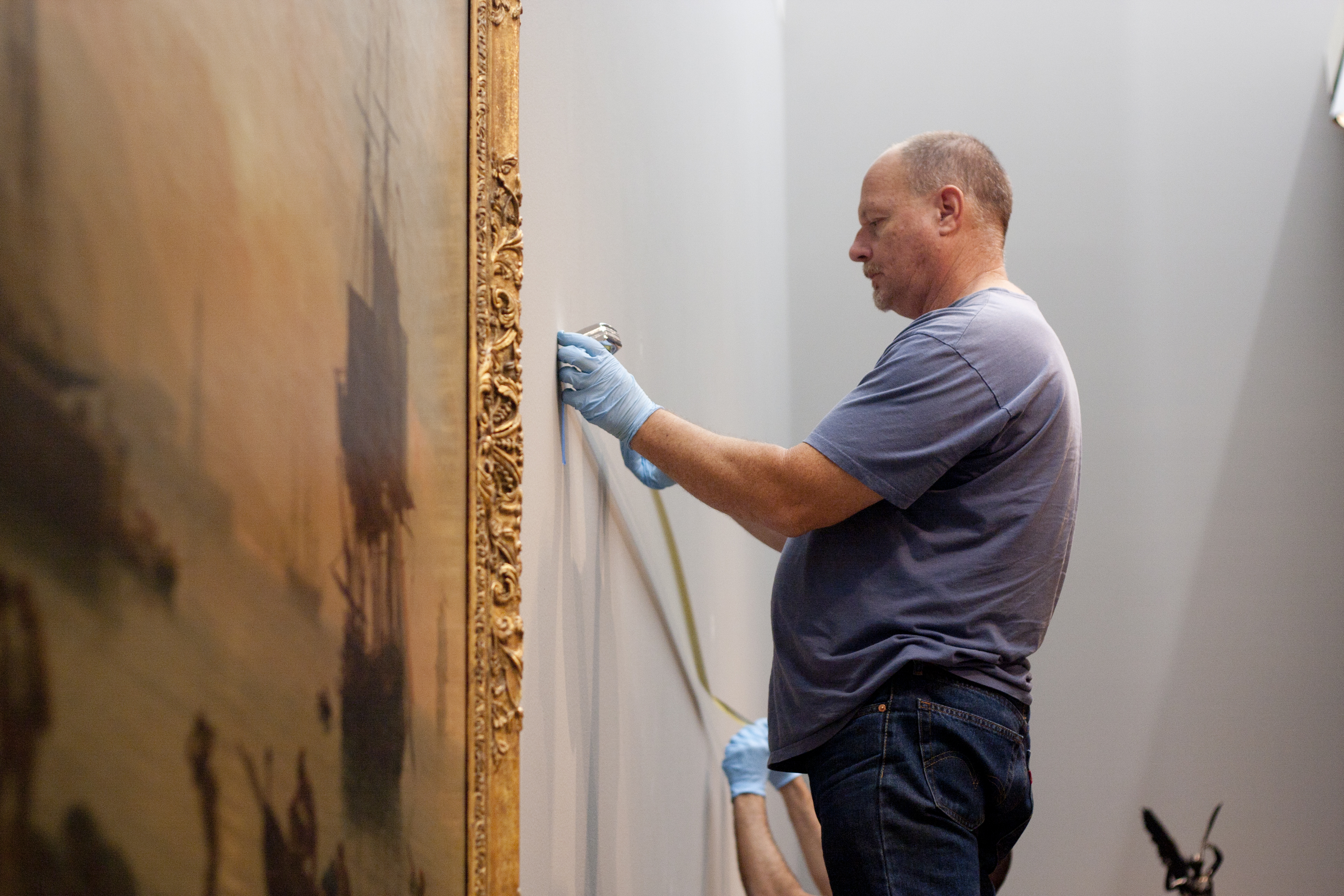
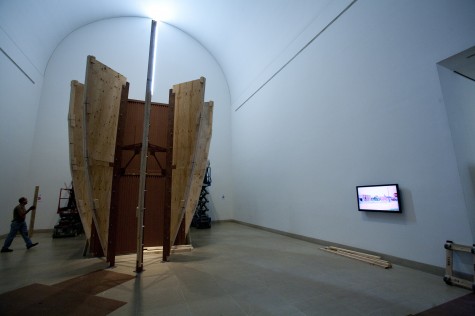
Detail, the massive ark currently grounded in the Barrel Vault, recreates part of Mark Bradford’s earlier work Mithra which was installed in New Orleans after hurricane Katrina. Detail consists of a steel and wood core to which is attached plywood panels to form the outer hull. The only part of the original Mithra that is used for this new piece is the outer plywood hull; the inner structure is new and was designed and fabricated for Bradford’s retrospective.

Because of the size and complexity of Detail, it was decided early in the planning stages of our exhibit that I would travel to Chicago to observe the piece being installed at the Museum of Contemporary Art. Being able to watch and participate in the assembly of Detail at the MCA answered most of the questions we had about its construction. Well before we began our installation, we had a very firm idea of how the piece would go together and how long it would take to build.


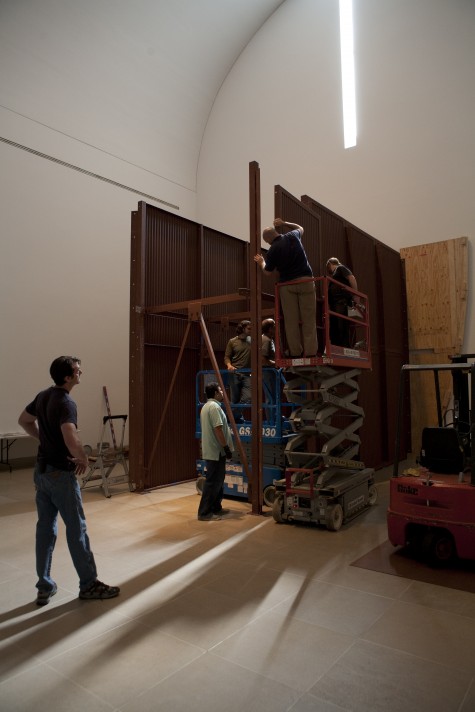
The first two days of installation were spent bolting together the inner steel core, which comprises thirteen steel uprights, sixteen corrugated steel panels, and almost forty horizontal and diagonal braces. Due to the size and weight of the individual components, and the fact that the steel panels were an extremely tight fit to the uprights, this was the most difficult part of the installation. The prep staff made judicious use of rubber mallets to “persuade” the steel panels to fit. When completed, this inner core replicates the look of the steel shipping containers used in the original MithraDetail is designed so that the viewer can get a slight glimpse of this inner structure through small gaps between the plywood panels that form the hull.

Once we were finished assembling the steel core, the installation went fairly quickly. The next step was to attach eleven large wooden “ribs”—each in two sections, a top and a bottom—that bolted on to flanges on the steel uprights. At this point what had been a huge steel box began to take on the shape of a giant boat. Next a series of horizontal wooden braces were screwed between the ribs. These horizontal braces, along with the wooden ribs, served as attachment points for the outer plywood “skin” that forms the hull of Detail. The final step was screwing the plywood panels to the ribs and horizontal braces, which completed the hull. The fit of the panels was not really precise; at this stage, we relied on our own aesthetic judgment, plus images from the installation in Chicago, to determine the exact placement and alignment of each panel in relation to the others around it.

We completed Detail in five days, right on schedule. Mark Bradford’s monumental boat and the Barrel Vault space seem to be made for each other, and Detail will certainly be as memorable a viewing experience as it was to install.

Mike Hill is a Preparator at the Dallas Museum of Art.

Sense Art: Art Beyond Sight Awareness Month

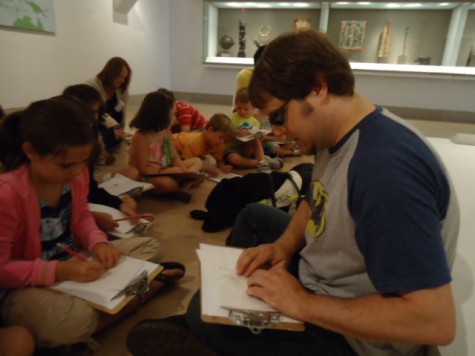
October is Art Beyond Sight Awareness month and our Family Experiences and Access Programs throughout the month are all about exploring works of art without using vision. How might we do such a thing? By using our other senses! During Art Beyond Sight programming, you might:

HEAR John Bramblitt talk about his works of art and his process of painting as an artist who is blind. In the galleries, spend time imagining how a work of art might sound during one of the ABS programs.

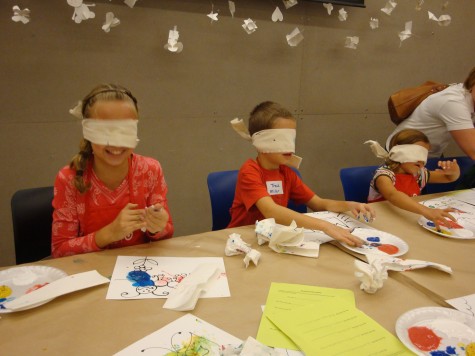
SMELL textured paint as you use your fingers to paint a raised line drawing during a blindfolded painting workshop. Or, you could visit Arturo’s Nest in the Center for Creative Connections to smell spicy notes of cinnamon in one of the sensory bins.

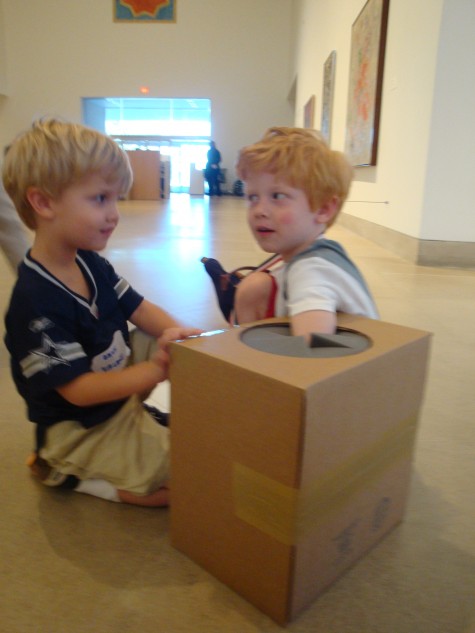
FEEL raised dots as you learn how to write your name in Braille to make a work of art in our family workshop with artist Leslie Ligon. Use your sense of touch to feel mystery textures hidden in a tactile box before drawing it with lines you can feel!

Imagine what you might TASTE while exploring still lifes with food in the European galleries or stretch your mind to imagine how different colors would taste in the Contemporary Art galleries.

Join us throughout the month of October to SEE art without vision!

Amanda Blake is the Manager of Family Experiences and Access Programs.

Matching Game: Words to Works

Who said it???

You’ve seen these artists express themselves with brushstroke, line, paint, and color, but have you ever heard them express themselves with words? Do these two forms of expression match up?

Play my game to see if you can match the art work to the art word!

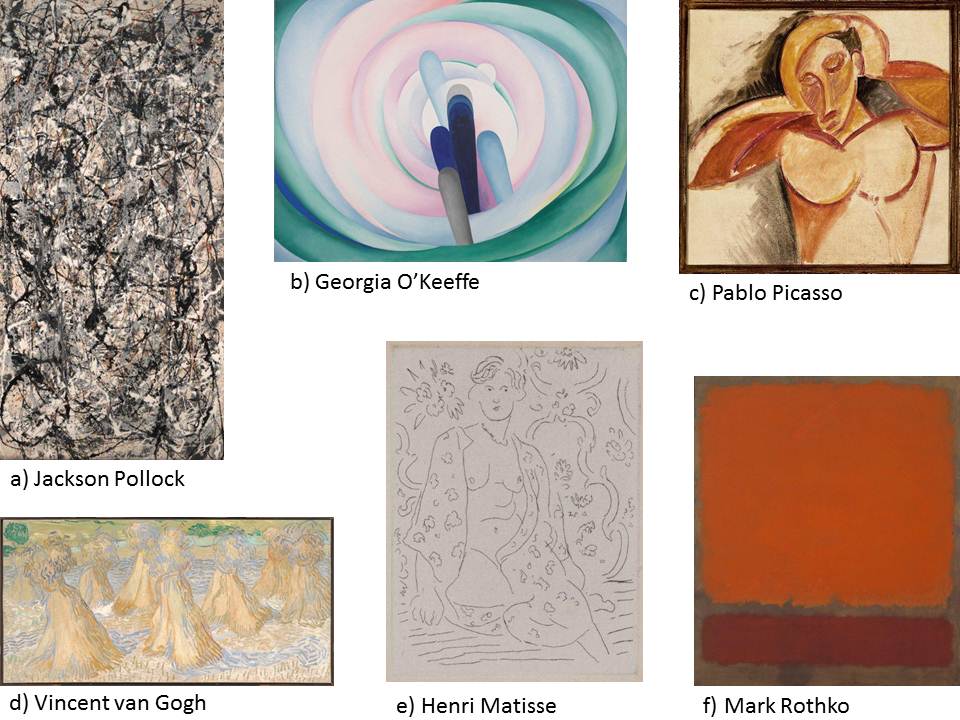
Below you will find a list of quotes straight from the mouth of some of the masters of modern and contemporary art. Following the quotes are images of artworks by these artists in the DMA collection. They have been all mixed up, so it is up to you to pair the quote and the artist. I will reveal the answers next week in the comments section of this post.

Good luck!

  1. “The fact that one usually begins with drawing is already academic. [I] start with color.”
  2. “So I said to myself – I’ll paint what I see…but I’ll paint it big and they will be surprised into taking the time to look at it – I will make even busy New Yorkers take time to see what I see of flowers.”
  3. “On the floor I am more at ease. I feel nearer, more part of the painting, since this way I can walk around it, work from the four sides and literally be in the painting.”
  4. “I want to touch people with my art. I want them to say ‘he feels deeply, he feels tenderly.’ I put my heart and my soul into my work, and have lost my mind in the process.”
  5. “It took me four years to paint like Raphael, but a lifetime to paint like a child.”
  6. “Drawing is like making an expressive gesture with the advantage of permanence.”


Hannah Burney

McDermott Intern for Teaching Programs


Archives

Categories