Posts Tagged 'Dallas Museum of Art'


Cindy Sherman Transformed

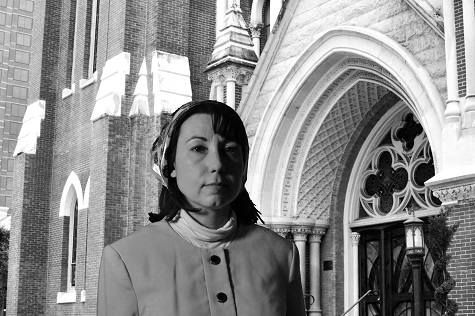
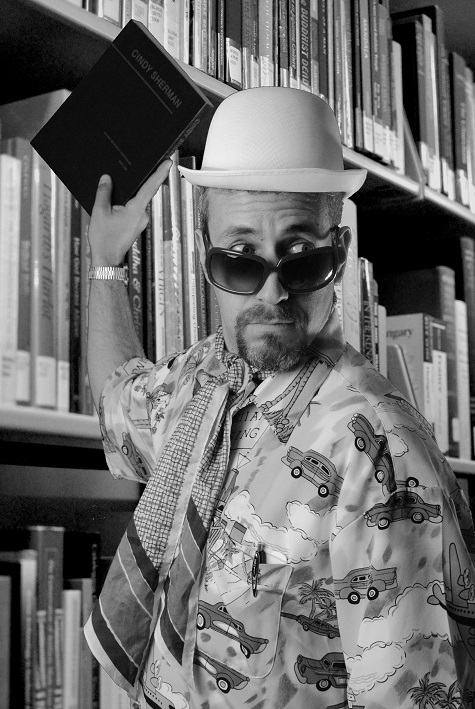
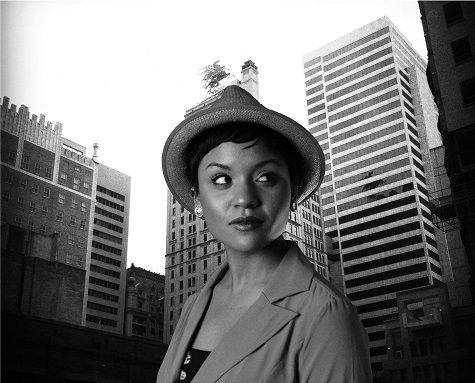
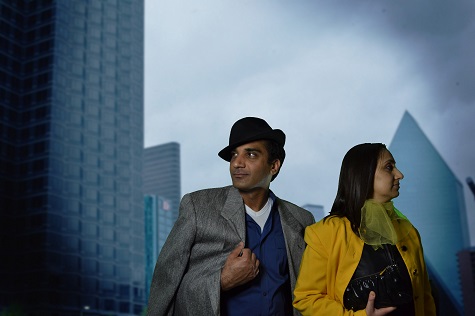
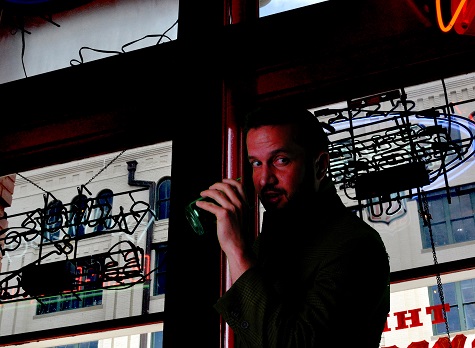
On Friday, DMA Late Night visitors stopped by the Tech Lab to dress up and pose in a Cindy Sherman-like scene. Check out their transformations in these photographs taken by Greenhill School photography students and visit the Cindy Sherman exhibition to find the inspiration for the backdrops in the photos below. Stop by the Tech Lab during the Late Night on May 17 to participate in a Body Beautiful-themed Late Night Art Bytes, in celebration of our exhibition The Body Beautiful in Ancient Greece: Masterworks from the British Museum.

Because so many visitors stopped by the photobooth, we are still editing images. Check the DMA’s Flickr page throughout the week to see new additions to the group.

Transform yourself at home into Cindy Sherman to earn the DMA Friends Super Fan: Cindy Sherman Badge! Find out how on the DMA Friends Highlights page.

Jessica Fuentes is the C3 Gallery Coordinator at the DMA.

Human Heroes & The Body Beautiful

I have worked on many big, exciting exhibitions at the DMA since I came here in 1975, ranging from Pompeii AD 79 to Chola Bronzes from South India, Splendors of China’s Forbidden City, and Tutankhamun: The Golden Age of the Pharaohs, but The Body Beautiful in Ancient Greece: Masterworks from the British Museum is one of the most extraordinary. On my many visits to London, I am always amazed at the treasures in the British Museum, and now Dallas has a chance to see some of their best art at the DMA.

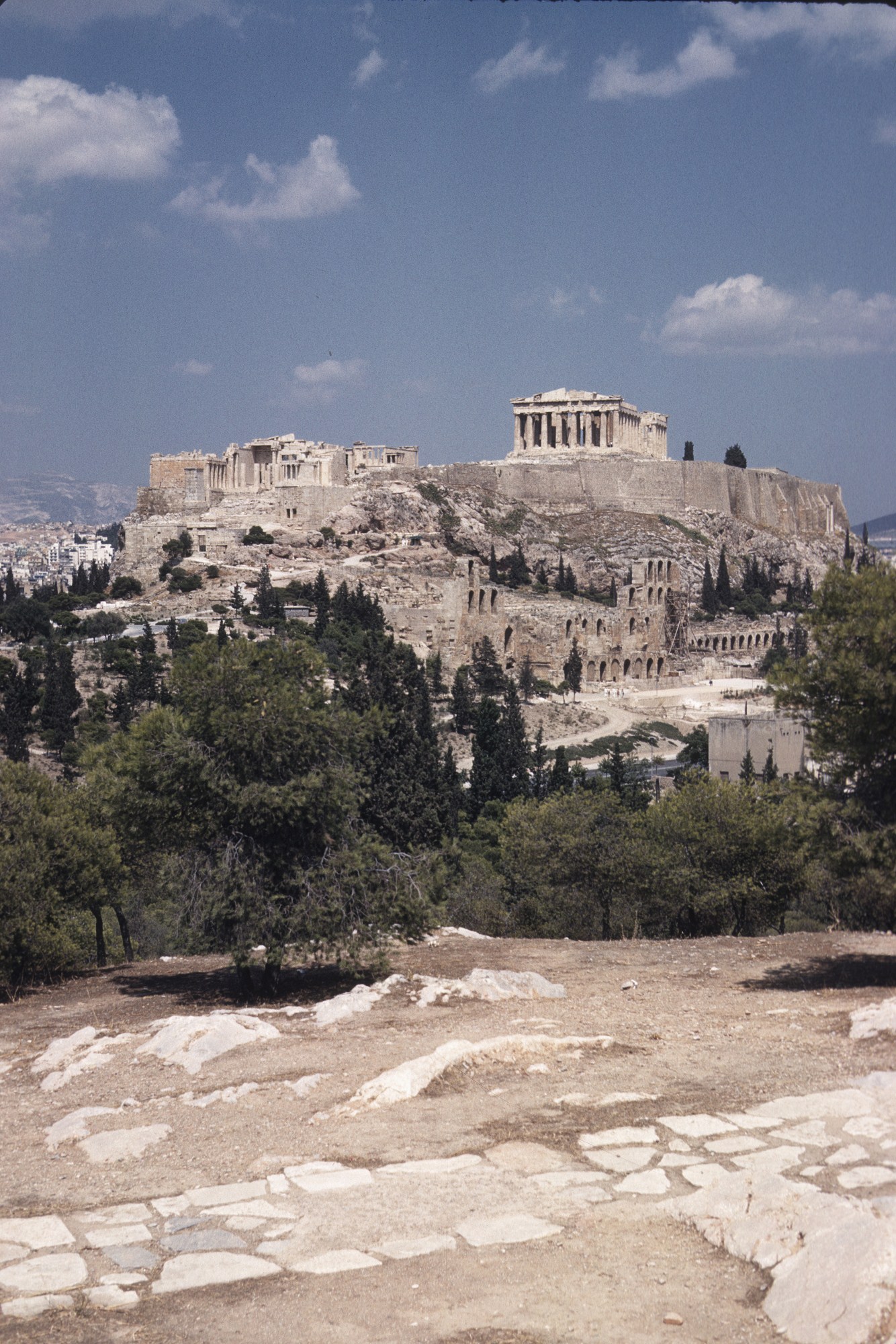
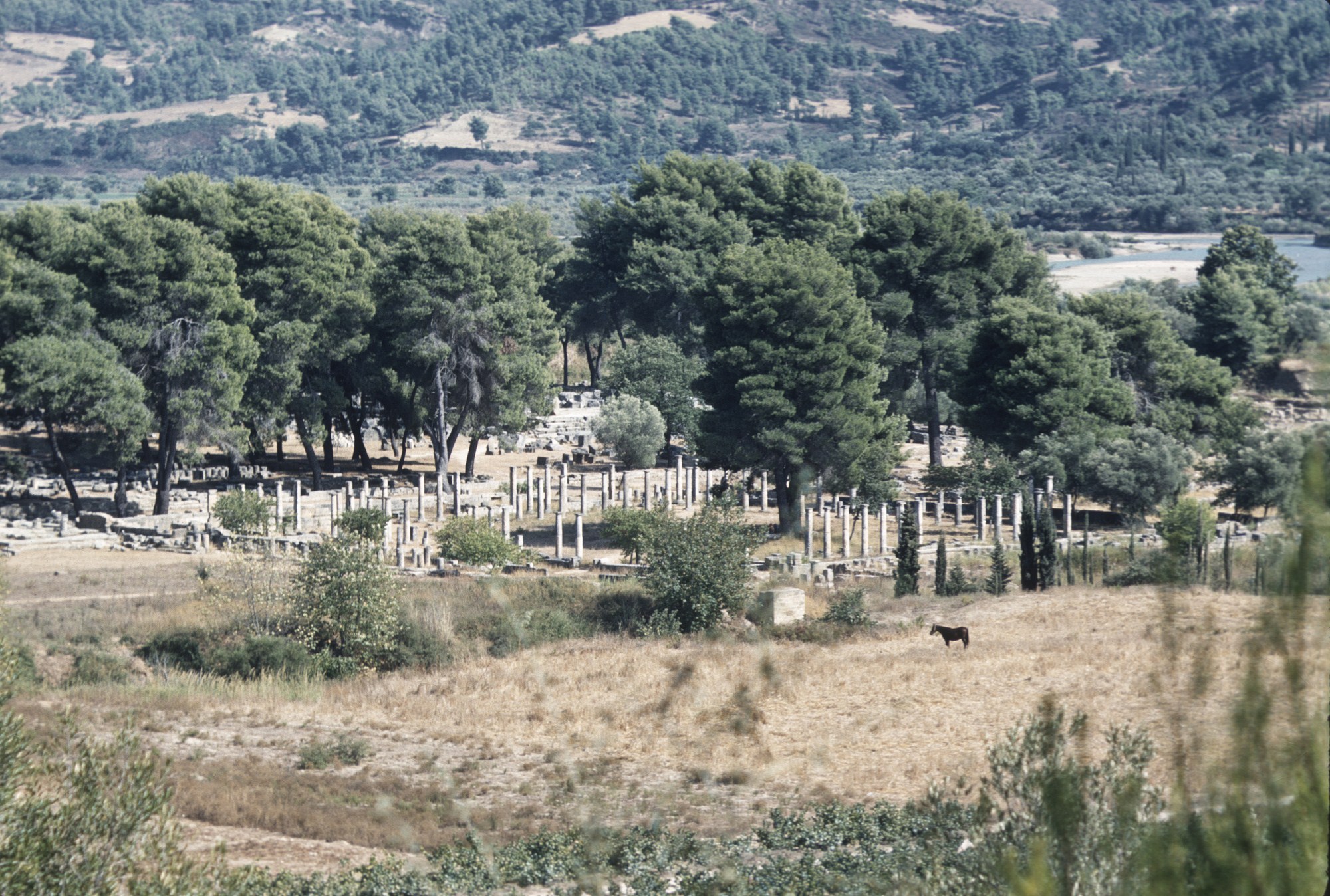
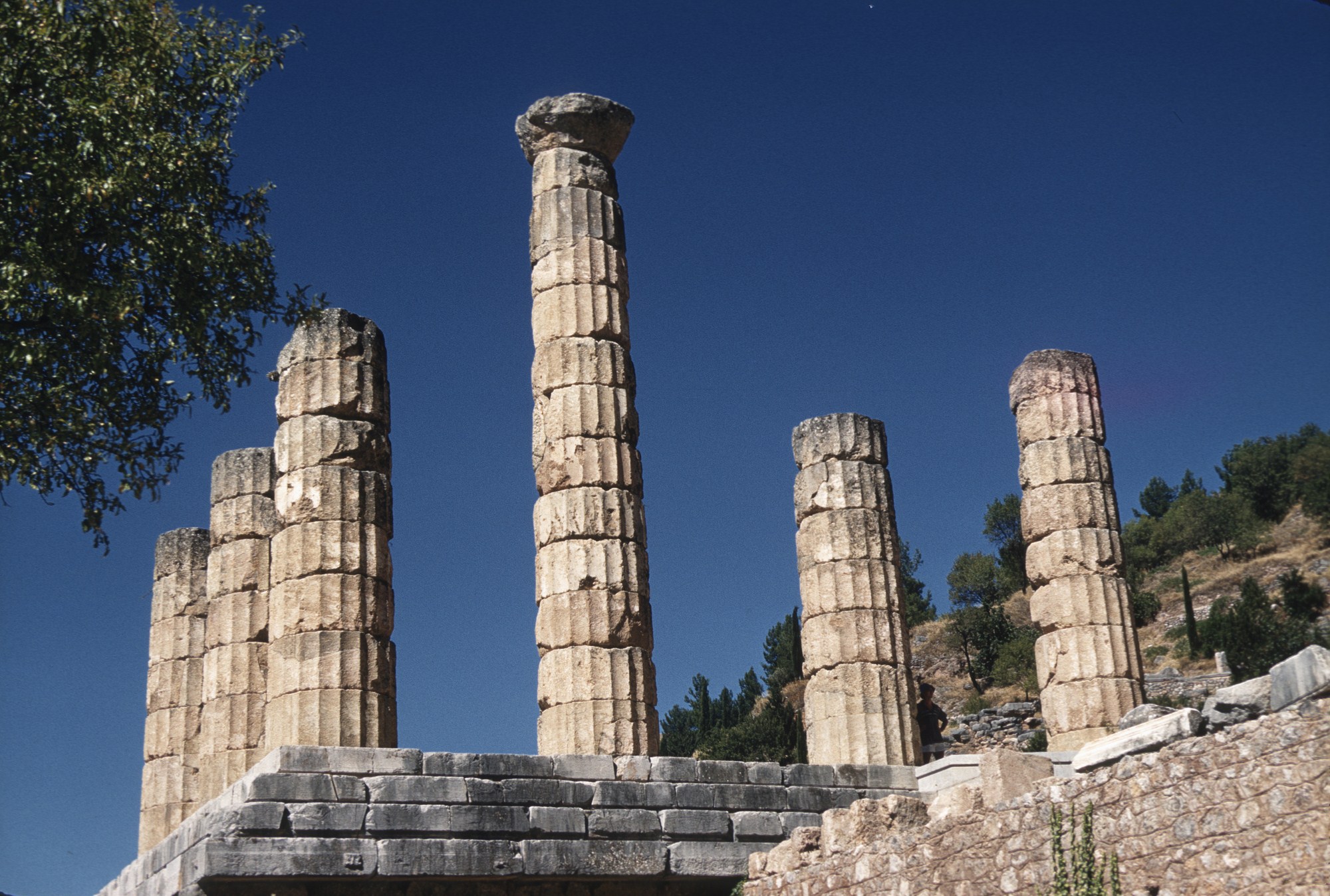
I still remember my first trip to Greece in 1960. My husband, Alan, and I roamed, sometimes as the sole visitors, over the acropolis in Athens, the AcroCorinth Mountain looming over the ancient city of Corinth, the temple of Apollo at Delphi, with its precipitous view straight down a mountainside to the sea, and the ruins of Olympia, where the Olympic Games began. No one was at Olympia then, except a boy herding black goats and someone playing a flute. Otherwise, the wind blew over the grasses and fallen stones. It was like visiting Pan, the god of nature, on his own turf. I fell in love with great sculptures like the youthful Charioteer at Delphi and the majestic Poseidon in Athens, feeling for the first time the stunning impact of ideal human beauty envisioned in art. Some of Alan’s photos from our trips to Greece will be part of an educational video on the sites of the Panhellenic games.
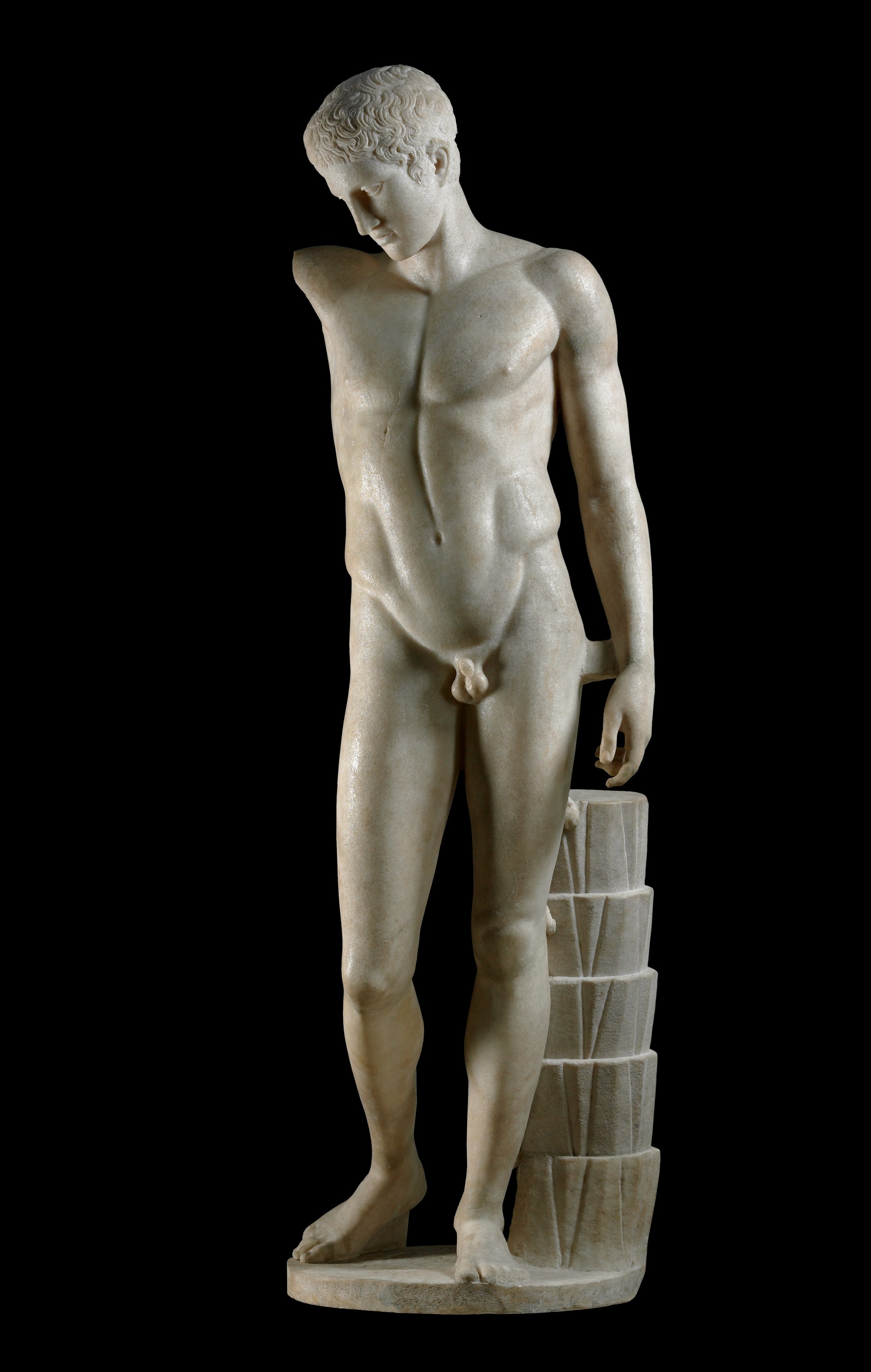
Marble statue of a victorious athlete, Roman period, first century AD, after a lost Greek original of about 430 BC, GR 1857,0807.1 (Sculpture 1754) © The Trustees of the British Museum (2013). All rights reserved.

Marble statue of a victorious athlete, Roman period, 1st century AD, after a lost Greek original of about 430 BC, © The Trustees of the British Museum (2013). All rights reserved.

The Body Beautiful in Ancient Greece: Masterworks from the British Museum displays this Greek vision of ideal human figures, particularly male nude figures. Such sculptures were admired by the Greeks because they believed that a young man who was a victor in one of the great athletic games, and who performed naked, had reached the height of glory that a man could achieve. Such victories were akin to dying heroically in battle. The same vision is best expressed in literature in Homer’s Iliad, where Achilles leads the Greeks to victory over Troy, but dies before the war is over. This ideal of human triumph is expressed in several works in the exhibition, particularly the discus thrower by Myron and the young athlete by Polykleitos. Although both of these works are shown in later Roman versions, they embody the Greek ideal of a radiant youthful victor. In a way the figures look ideal and “classical,” and in another way they are very seductive. They remind me of Keats’ description of Greek figures in Ode to a Grecian Urn: “Forever warm and still to be enjoyed; forever panting and forever young.”
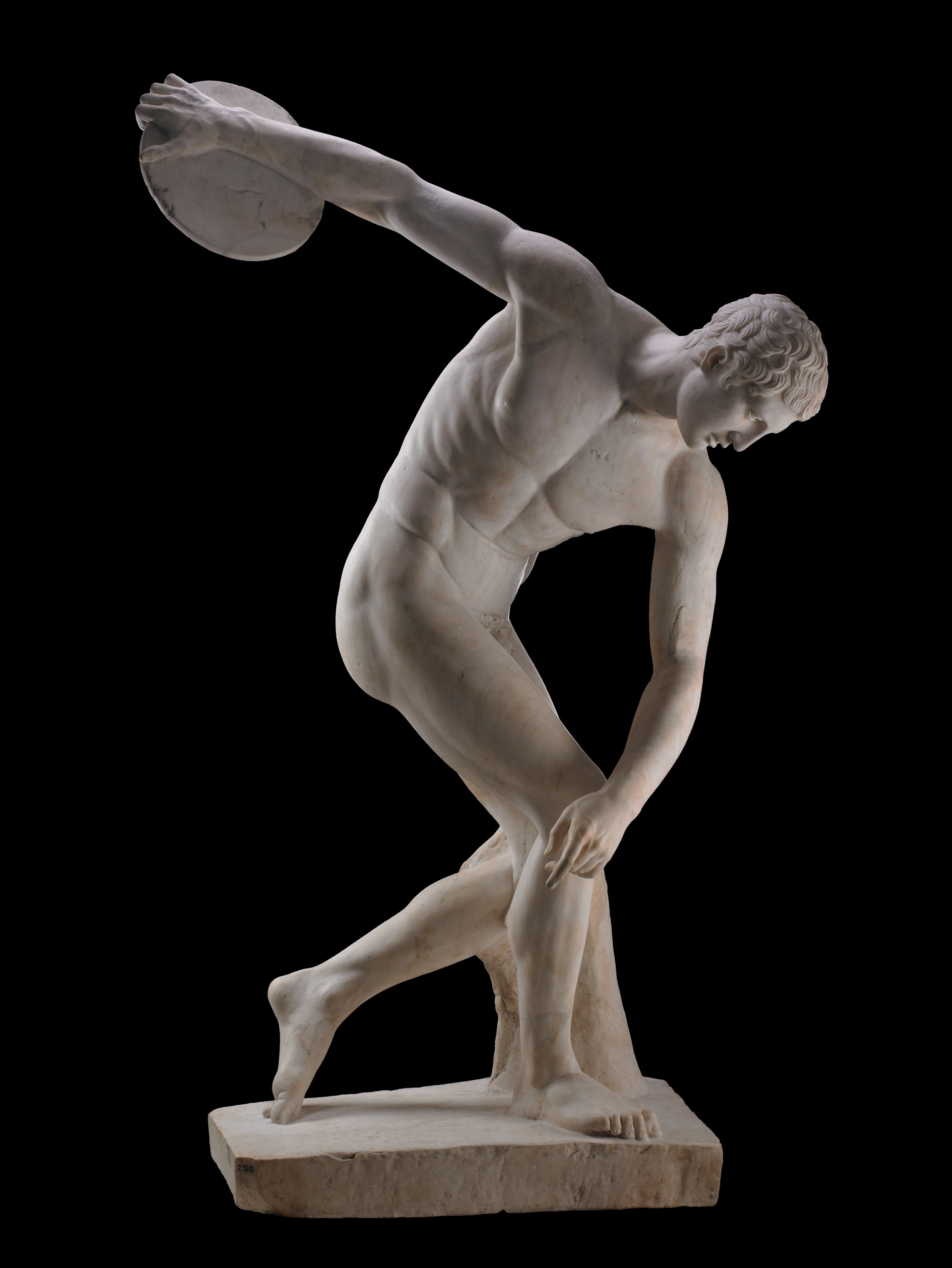
Marble statue of discus thrower (diskobolos), Roman period, second century AD, after a lost Greek original of about 450–440 BC, from the villa of the emperor Hadrian at Tivoli, Italy, GR 1805,0703.43 (Sculpture 250) AN 396999, © The Trustees of the British Museum (2013). All rights reserved.

Marble statue of discus thrower (diskobolos), Roman period, 2nd century AD, after a lost Greek original of about 450–440 BC, © The Trustees of the British Museum (2013). All rights reserved.

Works like the discus thrower and several other pieces in the show come from the great villa of the Emperor Hadrian at Tivoli, built in the 2nd century AD. They are testaments to the influence and vitality of Greek art during the Roman Empire. Hadrian was a very cultivated man who collected Greek art and commissioned many artworks in the Greek tradition. He was also personally a lover of young men. His character and life are well described in Marguerite Yourcenar’s novel Hadrian’s Memoirs. Hadrian’s villa is another delightful place that Alan and I visit often: it is a gorgeous temple of art and landscaping.
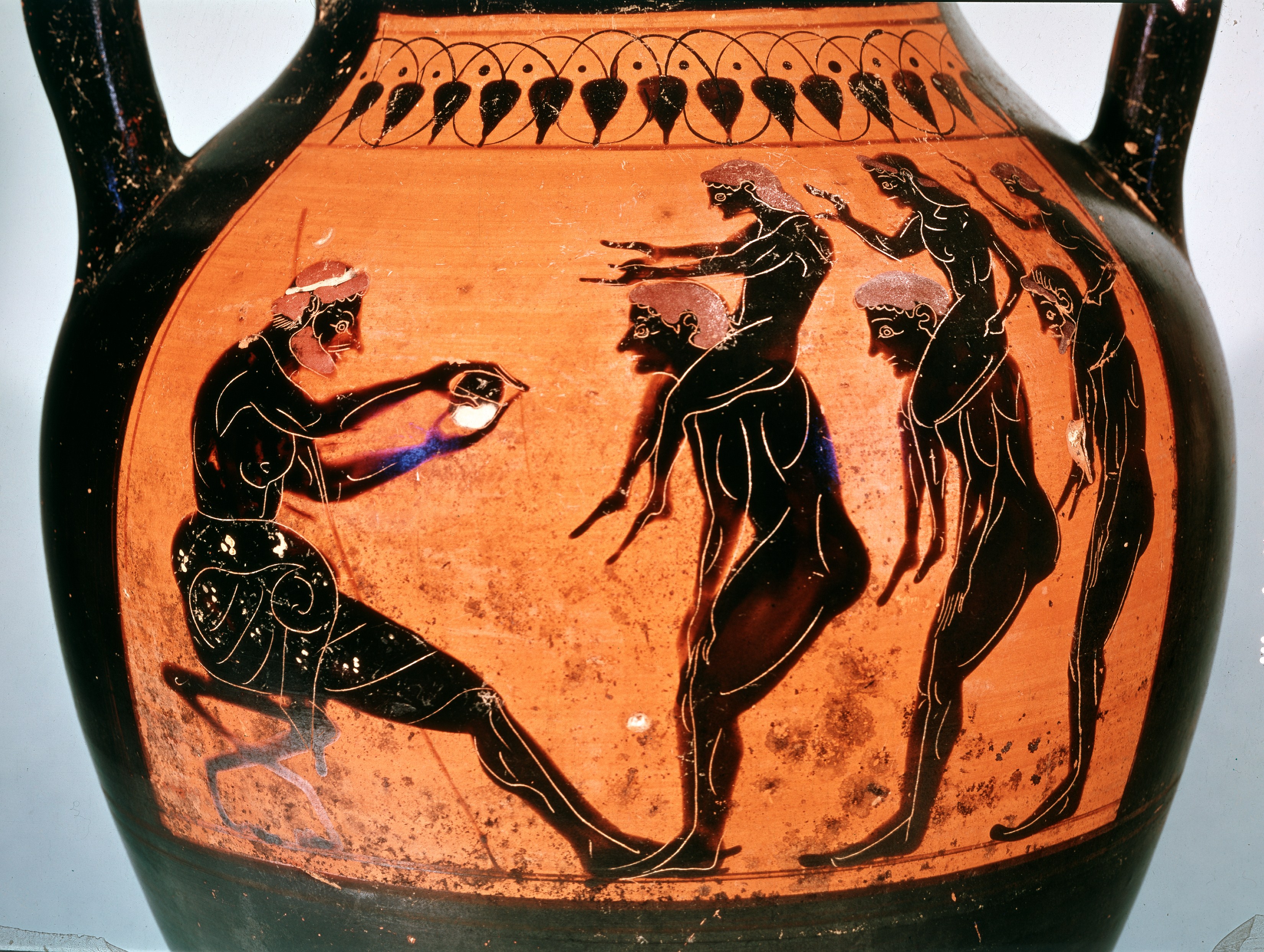
Black-figured amphora, Greek, made in Athens, about 540-520 BC, attributed to the Swing Painter, probably from Etruria, Italy, GR 1837,0609.65 (Vase B182) © The Trustees of the British Museum (2013). All rights reserved.

Black-figured amphora, Greek, made in Athens, about 540-520 BC, attributed to the Swing Painter, probably from Etruria, Italy, © The Trustees of the British Museum (2013). All rights reserved.

Besides the marble and bronze sculptures, the exhibition includes numerous painted vases, which bring to life the kinds of sports performed at Greek athletic competitions, stories, and myths of gods and heroes, and many scenes of ordinary life, including erotic encounters. Alan and I have collected ceramics all our lives, including some Greek examples. Greek vase painting has a narrative appeal; many images suggest the dramatic scenes found in the Greek theater, as well as actual scenes of masked actors. The love of real life and people is as important in Greek culture as idealizing art. I always think that it’s important to remember that the Greeks were keen observers. The kind of study of living bodies that you see in Greek sculptures is similar to the understanding that led to advances in science and medicine.
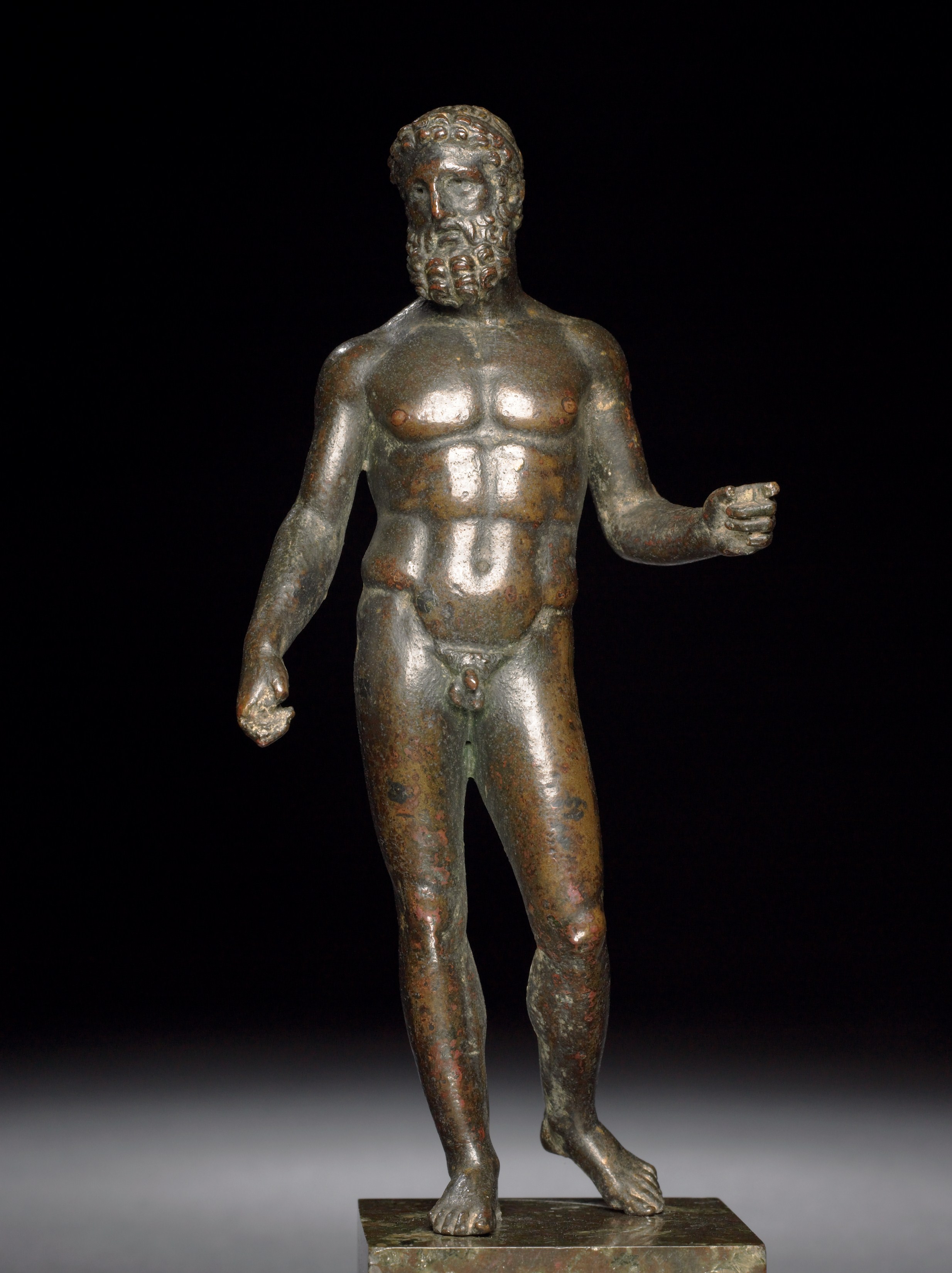
Bronze statue of Zeus, Roman period, first century AD, after Greek original of about 440 BC, said to be from Greece, GR 1824,0446.16 (Bronze 910 AN381063001) © The Trustees of the British Museum (2013). All rights reserved.

Bronze statue of Zeus, Roman period, 1st century AD, after a Greek original of about 440 BC, said to be from Greece, © The Trustees of the British Museum (2013). All rights reserved.

One of the most significant figures in The Body Beautiful in Ancient Greece is Herakles, a human hero, but also the child of Zeus, king of the gods. Herakles accomplished superhuman labors triumphantly (such as killing the Nemean lion, whose skin he is shown wearing), but he also suffered greatly. Driven mad by the jealous goddess Hera, he killed his first wife and children. At the end of his life, he was poisoned in ignorance by his second wife. In great pain, he burned himself alive on a funeral pyre. Yet Zeus and the other gods accepted him after death on Mt. Olympus, the only human to achieve immortality. His splendid, but painful, life exemplifies the Greek belief that “those whom the gods love die young.” Better to go at the height of youthful strength and beauty.

Dr. Anne R. Bromberg, the DMA’s Cecil and Ida Green Curator of Ancient and Asian Art.
Breaking Ground

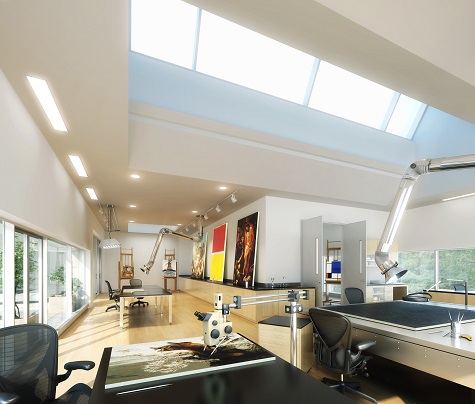
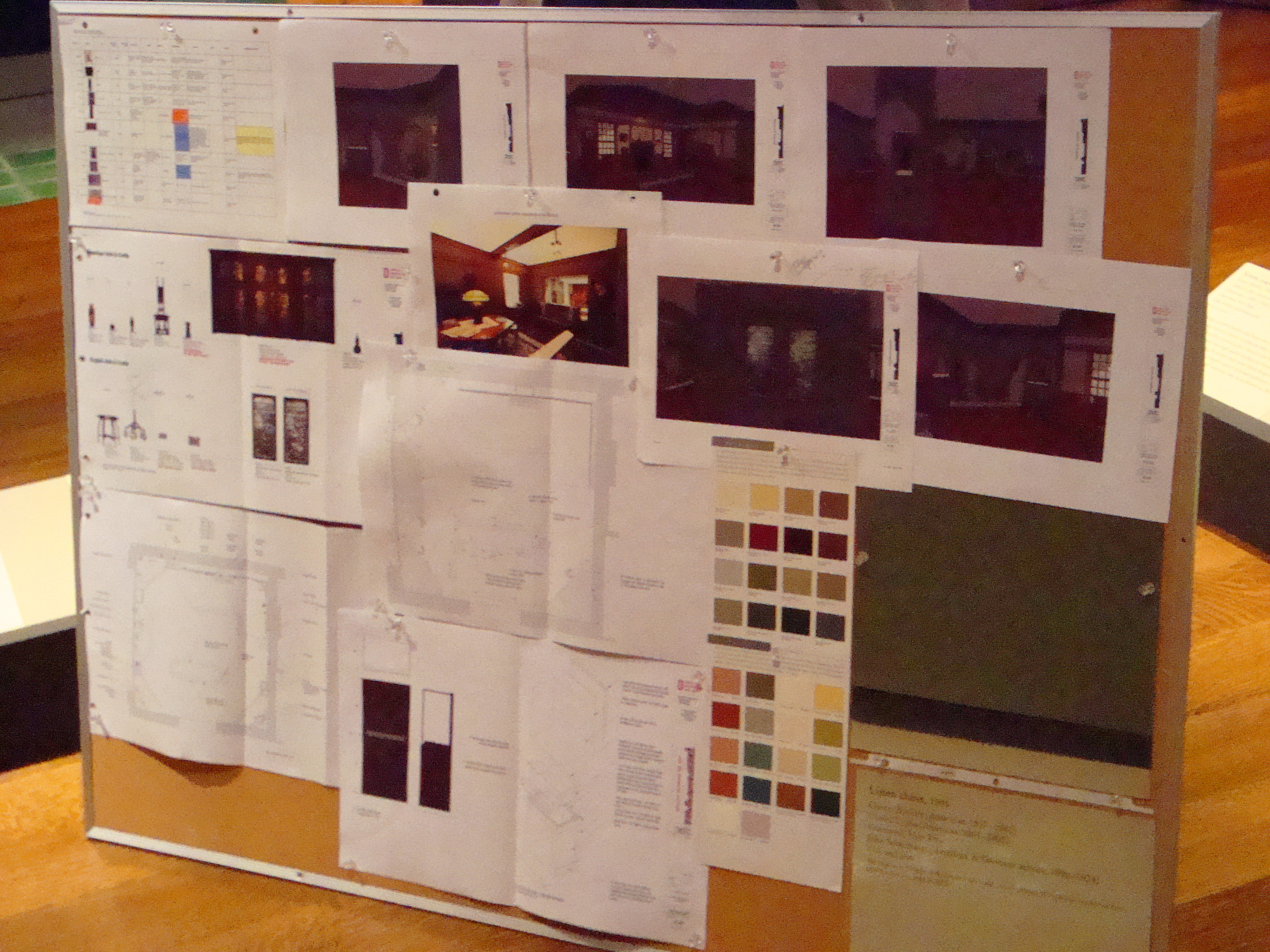
We “broke ground” today on the Museum’s new paintings conservation studio! The conservation studio is located on the top level of the DMA, near the south entrance, and will include a gallery space and sculpture courtyard (accessible to you!) designed by Samuel Anderson Architects (SAA). For the first time at the DMA, visitors will be able to see behind the scenes on a daily basis, watching artwork actively being conserved by the DMA’s first Chief Conservator, Mark Leonard. Construction is scheduled for completion this fall.

Check the DMA’s social media and Uncrated throughout the summer for updates on the construction of the conservation studio. Below are photos from today’s official first day of construction.

Wright windows removed Wright windows in storage  25 26

What I Learned from the Stark Museum

Last week, I traveled to Beaumont with Jessica Harden, the DMA’s Director of Exhibition Design, to present at the Texas Association of Museums Annual Conference.  Together, we presented on the topic of Building an Interactive Art Exhibition with two colleagues from the Stark Museum of Art: Allison Evans, Registrar, and Elena Ivanova, Chief Educator.

Hands-on spaces and interactive art exhibitions have been on the rise in art museums. In 2008, we launched the Center for Creative Connections (C3), a permanent space dedicated to providing interactive learning experiences for visitors of all ages. Our portion of the presentation addressed the changing nature of the C3.  Over the years, the space has evolved and transformed, bringing in new works of art and offering a variety of experiences. The Stark’s portion of the presentation spoke to their experience of developing a temporary interactive exhibition called Explore Art: Materials and Methods Revealed. From July-September 2012, this exhibition enabled visitors to “discover the techniques and tools artists use and have the opportunity to create their own art in hands-on areas.”

When gauging the success of these types of exhibitions, art museum educators are hoping visitors will slow down, spend time looking, and have a meaningful experience with works of art. On average, visitors to the Stark spent thirty minutes in the exhibition. 57% of visitors stopped and looked at works of art for a significant amount of time and 48% of visitors were able to mention a specific work of art that they remembered from the exhibition.

Being a smaller institution, the Stark cannot dedicate a permanent space like C3 within their museum. However, they have been able to implement some of these interactive aspects into their new exhibitions. Take a look at some of the recent interactives they have integrated below.

Many museums look to us at the DMA as an example of how to achieve this type of exhibition. We are fortunate to have supportive staff and donors who believe in the mission of C3, and enable us to continually offer these types of experiences to our visitors. What I learned from the Stark Museum was that small institutions are also prime places for similar initiatives, on a smaller scale.

Jessica Fuentes
C3 Gallery Coordinator

Exchange Student

SANDRA blogportrait

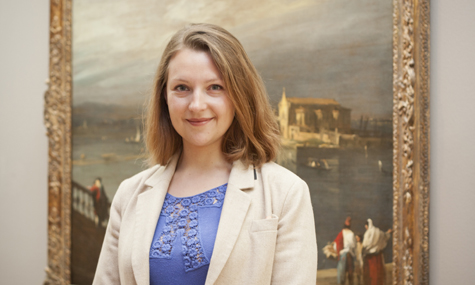
Sandra Buratti-Hasan, a Museum Curatorial student from Paris, France, has been the guest of the DMA for the past couple of months as the last step of her curatorial training. Uncrated recently caught up with her in the galleries to find out more about her visit to the U.S.

Tell us a bit about yourself and why you’re visiting the Dallas Museum of Art: I am currently finishing my training as a museum curator in Paris at the Institut National du Patrimoine (National Heritage Institute). Every curator in France has to go through an eighteen-month training after passing a competitive examination. I am a specialist in Western 19th-century art, especially the symbolist period and the links between literature, music, and visual arts. The training consists of lectures on museum management, exhibition coordination, law, budget management, and various trainings within museums, both in France and abroad. For my international training, I wanted to discover from the inside the U.S. museum system, and I thought it would be very interesting to be hosted by my former teacher at the Ecole du Louvre in Paris, Olivier Meslay, who is now the Associate Director for Curatorial Affairs and The Barbara Thomas Lemmon Curator of European Art at the DMA.

What has an average day been like for you while at the DMA? There was no average day—my stay at the DMA has been full of surprises! However it has been a good balance between attending meetings, especially the curatorial and the budget and management team meetings, having a thirty-minute interview with a member of staff (in every department: gallery attendants, Visitor Services Desk, IT, Museum Store, conservation, marketing, and so on). I also spent lots of time in the galleries and in the Center for Creative Connections participating in programs for various visitors (schoolchildren, people with special needs, etc.). And I should not forget the Friday Late Nights and Jazz in the Atrium on Thursdays. I also had the great opportunity to visit Texas museums, which are full of treasures.

How would you describe the best part of your job and its biggest challenges? There are several “best parts” in being a museum curator. One of the most exciting is to give life to works of art you find really important and that have been previously neglected. It fulfills one of a curator’s greatest challenges: to help people become involved with art, no matter what their educational background is. Another challenge is to find the balance between managing the collections, coordinating exhibitions, and having enough time for your scientific research, which needs to be constantly updated.

Growing up, what type of career did you envision yourself in? Did you think you’d work in an art museum? I had several dreams. I wanted to be a painter, an archaeologist, a judge, or a natural scientist. But I was always fascinated by art, especially paintings, and as a child I would consider Leonardo as a friendly figure from the past, a bit like an unknown grandfather (certainly because of portraits showing him with a white beard). So I think working in an art museum was a dream, but an unconscious one.

What is your favorite work in the DMA’s collection? Definitely the Canaletto (San Cristoforo, San Michele, and Murano from the Fondamenta Nuove, Venice). I was fascinated by it as soon as I approached it on my first day at the Museum. It is a very striking piece, wide and uncommon in Canaletto’s work. He manages to capture the poetry of Venice, the gray sky, the mystery of the water; you feel as if the painting is going to swallow you. I would love for my soul to be likewise kidnapped by art. It is exactly for that feeling that I wanted to work among paintings.

Is there a past exhibition that stands out in your mind as a favorite, or is there a particular upcoming show you’re looking forward to seeing? I remember a striking show in Amsterdam in 2006, Rembrandt-Caravaggio. The room was really dark, with bright highlights on the paintings. You felt like you were entering a marvelous cave, and indeed, treasures were hung on the walls. Seeing the two masters at the same time deeply touched me. I have never felt such a strength in the brushstrokes, such a depth in the layers of the paintings or the looks on the faces.

What’s in a Badge?

One of the many ways to earn points in the DMA Friends program is by completing badges. Badges can also give you ideas on how to use the DMA in ways you might not have thought of. You not only earn points with the activities needed to achieve a badge—like checking into the Africa, Asia, and Pacific galleries to earn the Globe Trekker Badge—you also get bonus points for completing all of the badge steps!

Some badges are only offered for a limited time, so make sure you don’t miss an exclusive badge opportunity. In fact, we are announcing a new badge, Super Fan: Cindy Sherman, today on Uncrated! Check out the two steps required to earn the badge below, and start channeling your inner Cindy Sherman:
Cindy_Super_Fan
Super Fan: Cindy Sherman
Visit the Cindy Sherman exhibition and be inspired by the artist’s work. Transform yourself into another character through costume, makeup, and environment, and then photograph yourself. Be one of the first ten DMA Friends to share your Cindy Sherman-inspired photo via Twitter with the hashtag #DMASuperFan to receive the Super Fan: Cindy Sherman Badge.

Artist Cindy Sherman transforms herself through hair, makeup, and costume for her photographic work. Visit the DMA’s exhibition Cindy Sherman, on view March 17-June 9, 2013.

Badges enable you to earn extra points, and they’re fun to collect. You can review your badges at the DMA Friends kiosk or from your computer at home, and they enable you to earn extra points. Before you know it, you will be packing your bag to spend the night at the DMA when you redeem your points for the Overnight at the DMA reward. If you have questions about DMA Friends, including how to earn badges, e-mail friends@DMA.org.

Kimberly Daniell is the Public Relations Manager at the Dallas Museum of Art.
Art and Access at the DMA

April is Autism Awareness Month and autism-focused events, fundraisers, walks, and lectures abound all over the country. While most people have likely heard of autism, Autism Awareness Month highlights the growing need for awareness and promotes ways to support and accept people on the autism spectrum. Chances are that you know of someone with autism, since an autism spectrum disorder occurs in about 1 in 88 individuals.

Autism is different for everyone. Symptoms may include mild challenges for those who are high functioning, while others may have more severe symptoms affecting their daily life. Because it’s difficult to predict the behavior of children with autism, parents can feel intimidated bringing their child to an art museum and tend to be more comfortable participating in specifically designed activities alongside other similar families.

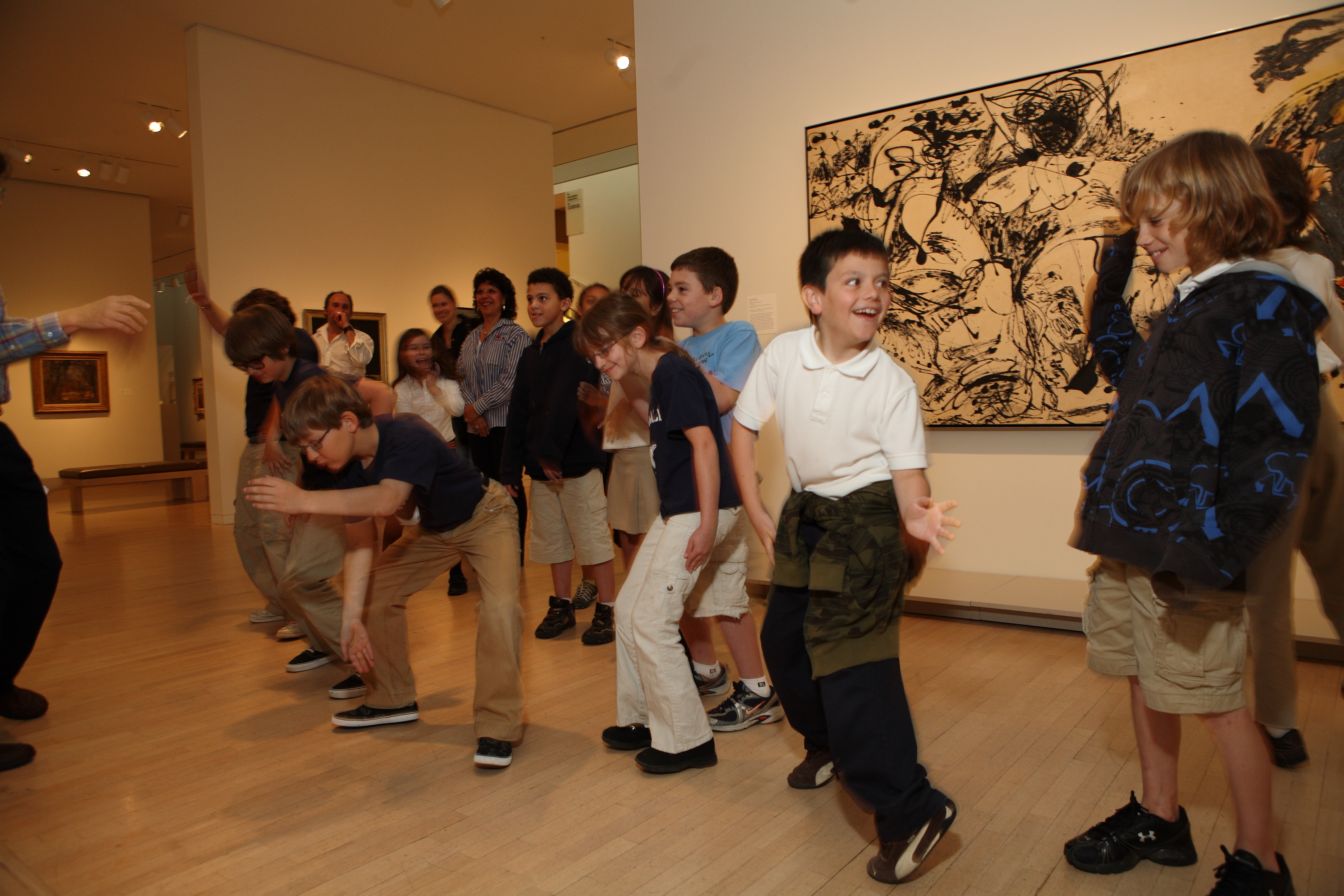
The DMA’s Autism Awareness Family Celebrations, which take place throughout the year, provide a safe, comfortable way for children with autism and their families to experience the Museum together. In the Center for Creative Connections, families can participate in gallery experiences, enjoy an interactive musical performance, explore hands-on activities in the courtyard, relax in a quiet sensory room run by occupational therapy students from Texas Women’s University, and create works of art in the C3 Studio – all before the Museum opens to the public.

We work closely with an autism specialist and Autism Speaks to plan programming for Autism Awareness Family Celebrations, taking into account the specific needs of the audience and the innovative tools available in C3. This invaluable partnership results in the creation of customized social stories about visiting the DMA, which are sent to parents in advance of each event so they can talk through the visit with their child at home.

Many parents note that after attending an Autism Awareness Family Celebration, they feel more comfortable with their child in a museum setting. One such mother, Jennifer Linde, had trouble finding opportunities for her family to be creative together and interact alongside other families. Her goal as a mom is to teach her son with autism, Alex, how to be as independent as possible. Jennifer never considered taking her two children to a museum because of Alex’s behavioral issues. After discovering the Autism Awareness Family Celebrations at the Dallas Museum of Art, Jennifer  now feels differently. The events give her family a wonderful opportunity to allow her son to develop his social skills and explore new interests while not worrying about the reactions of other people, something she says is often an issue for their family. The Linde family attends most Autism Awareness Family Celebrations and Alex has participated in our summer art camp for kids with autism for the past two years.

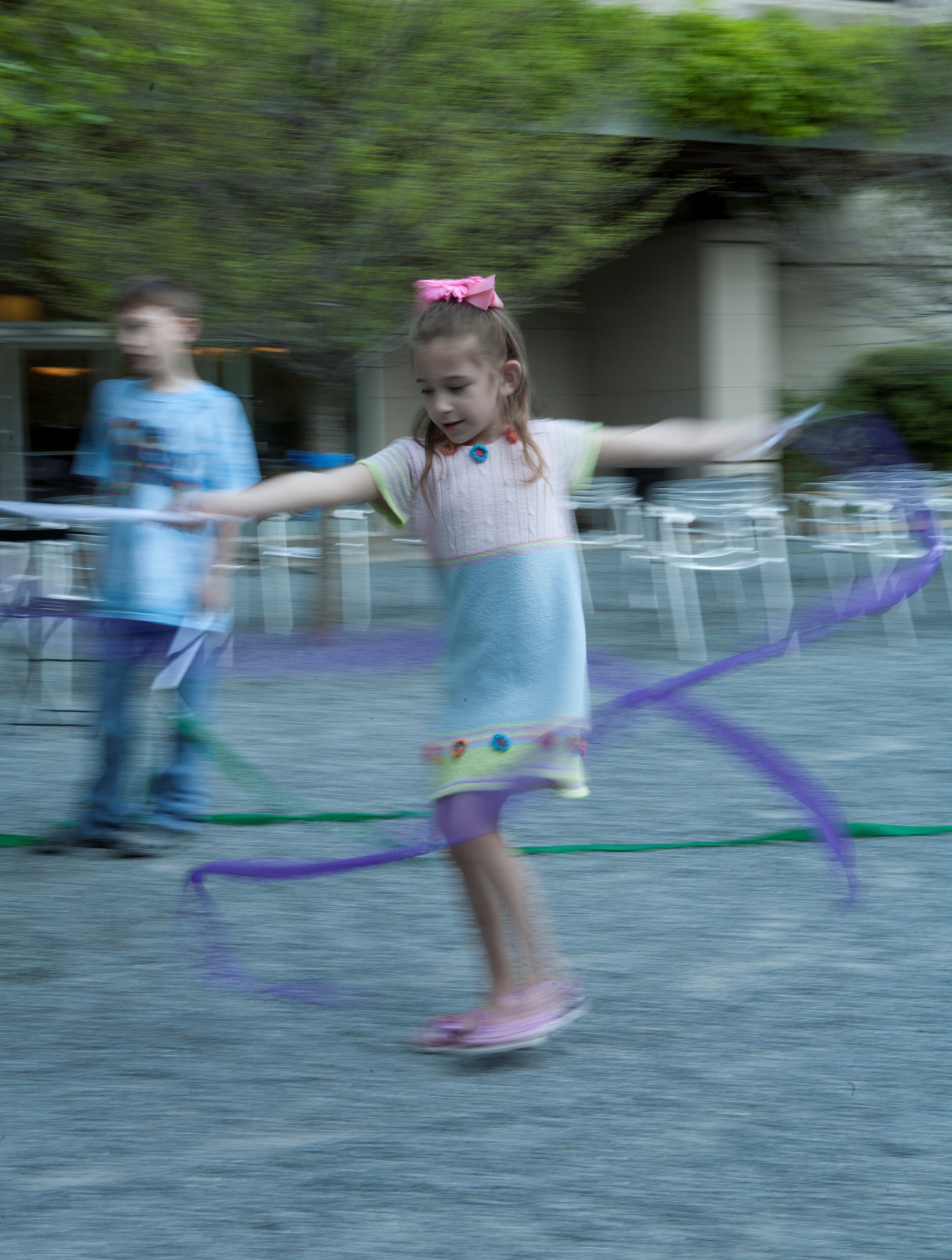
Alex loves to draw and usually draws machines and robots–never figures–in black and white. At the Autism Awareness Family Celebration in April 2011, Alex participated in sketching in the galleries and then went to our courtyard to experience music by the Dallas Symphony Orchestra, where he saw kids using streamers to move to the music. After the performance, Alex returned to sketching and created another drawing. His mother was overjoyed when she saw what he had drawn: figures all over the paper with streamers–in color! It was a magical morning for the Linde family. Check out photos of Alex below – including his colorful streamer drawing!

We are excited be in our fourth year of offering Autism Awareness Family Celebrations and our third year of offering a summer art camp for kids on the spectrum. Our next event happens this Saturday, April 6, and is themed around music and nature with a special performance by a violin duo from the Dallas Symphony Orchestra. We look forward to seeing families connecting with one another and with works of art while having fun together at the DMA!

Amanda Blake
Head of Family, Access, and School Experiences

The Arc of Dallas at the DMA

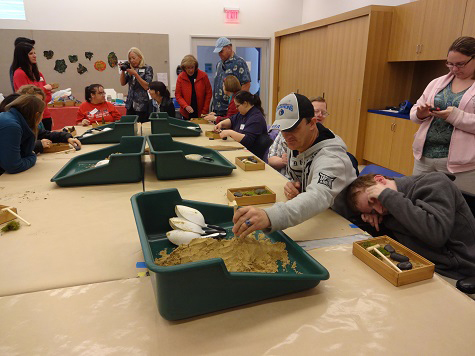
Visitors may be unaware of a special program the Dallas Museum of Art provides for adults with developmental disabilities. For the past five years, the Museum has offered a private program for The Arc of Dallas. Clients visit the Museum monthly and participate in a gallery tour and studio art-making activity. Some clients have participated for all five years, and we have a group of regular attendees. Because of their ongoing attendance, many participants feel comfortable with the Museum’s staff and in the galleries.

The Eight Immortals of the Wine Cup, Japan, c. 1600, ink and pigment on gold, Dallas Museum of Art, The Eugene and Margaret McDermott Art Fund, Inc.

The Eight Immortals of the Wine Cup, Japan, c. 1600, ink and pigment on gold, Dallas Museum of Art, The Eugene and Margaret McDermott Art Fund, Inc.

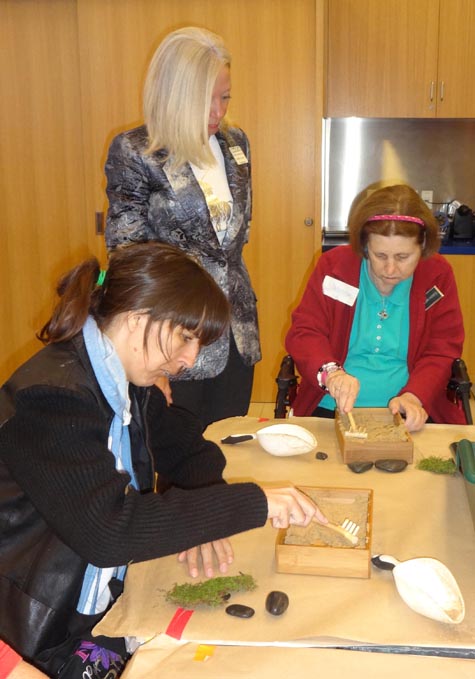
This past month we were joined by Susan Morgan, Senior Manager of Therapeutic Horticulture at the Dallas Arboretum and Botanical Garden. We discussed the importance of how nature is depicted in Japanese art, particularly the lotus flower. Clients enjoyed learning the symbolism of different plants from Sharon. Later, they walked around the Asian galleries looking for lotus flowers in the art. Back in the studio, clients created their own Zen rock gardens.
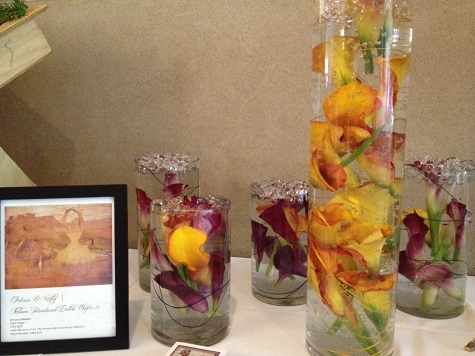
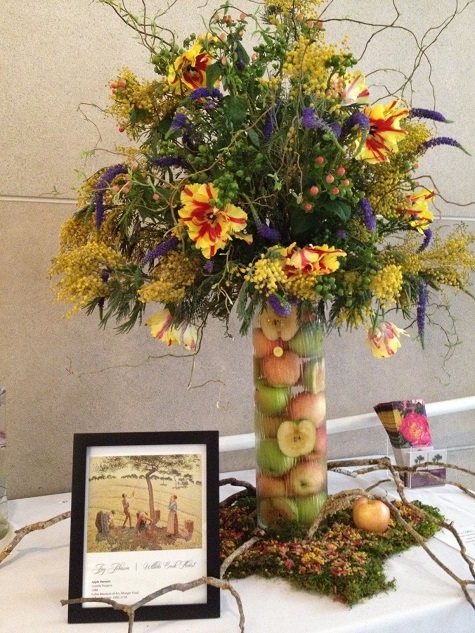
image two

According to their website, The Arc of Dallas “promotes and protects the human rights of people with intellectual and developmental disabilities and actively supports their full inclusion and participation in the community throughout their lifetimes.” The DMA is proud to include this audience in our programming. Sherry Wacasey, Executive Director for The Arc of Dallas, believes disability does not always affect creativity, and the DMA program meets the goals to empower this population. She argues that art is another form of communication and it can touch people who in other ways cannot communicate—art can close the gap.

I worked with this program in the fall of 2012 for my master’s thesis from the University of North Texas. One of my favorite aspects of working with The Arc of Dallas clients is observing the personal connections they make to the artworks. For example, when we toured the exhibition The Legacy of the Plumed Serpent in Ancient Mexico, during the sketching portion one client identified with a ceramic figure because one arm was longer than the other, a trait that mirrored her own proportions.

Our staff enjoys The Arc of Dallas’s monthly visits and always appreciates their many hugs at the program’s conclusion. We visit different galleries every month, and next month’s visit to the exhibition Chagall: Beyond Color is certain to be a good one.
image one

Holly York is the McDermott Education Intern for Family Programs at the DMA.

Digital Art for the DMA

Today the Dallas Museum of Art announced the acquisition of a pair of digital art pieces, adding to the Museum’s impressive contemporary holdings. The video installations are web-based, enabling a broader reach for the Museum’s collection. Below are highlights from each work.

[youtube http://www.youtube.com/watch?v=TZ860P4iTaM]

[youtube http://www.youtube.com/watch?v=gY0MSuyaKMk]

April Fool’s!

Everything’s Turning Up Chagall

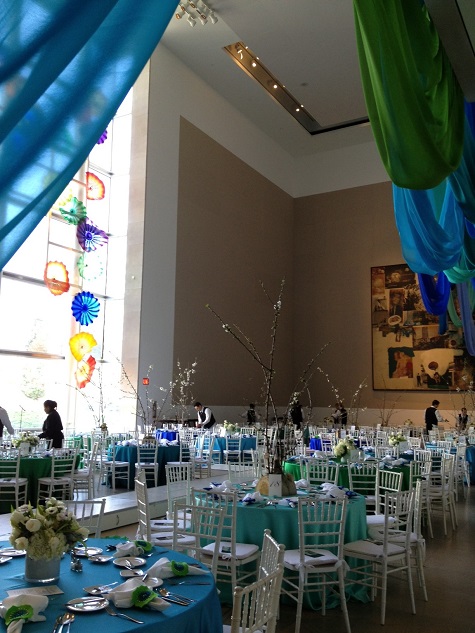
Art in Bloom guests were immersed in a world of art, color, and flowers today at this year’s floral symposium and luncheon. Bella Meyer, a New York-based floral designer and the artist Marc Chagall’s beloved granddaughter, entertained the audience with stories about life in the Chagall family, the symbolism in her grandfather’s art, and interpretations in flowers of several of his paintings. Over lunch, complete with edible flowers, a colorful fashion presentation by Allie-Coosh provided inspiration for what was to follow . . . a tour of the DMA’s exhibition Chagall: Beyond Color. Did you know that we are the only U.S. venue for this internationally touring exhibition?

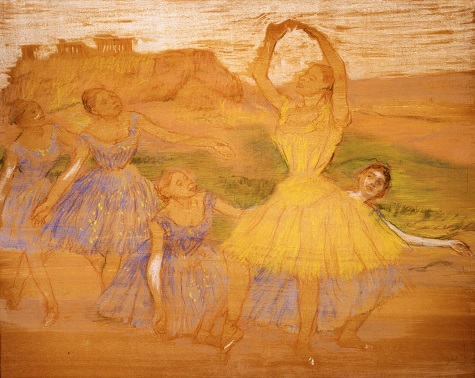
Floral arrangement inspired Edgar Degas’ Group of Dancers in the DMA’s collection

Floral arrangement inspired Edgar Degas’ Group of Dancers in the DMA’s collection

Edgar Degas, Group of Dancers, c. 1895-1897, pastel and gouache on panel, Dallas Museum of Art, The Wendy and Emery Reves Collection

Edgar Degas, Group of Dancers, c. 1895-1897, pastel and gouache on panel, Dallas Museum of Art, The Wendy and Emery Reves Collection

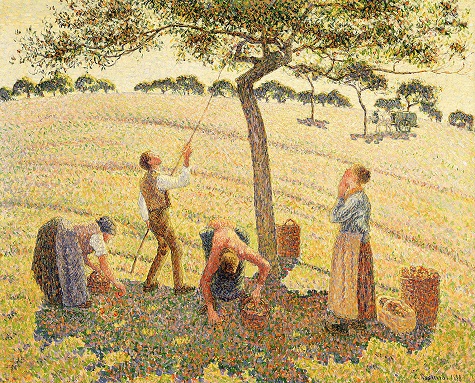
Floral arrangement  inspired by Camille Pissarro’s Apple Harvest in the DMA’s collection

Floral arrangement inspired by Camille Pissarro’s Apple Harvest in the DMA’s collection

Camille Pissarro, Apple Harvest (Cueillette des pommes), 1888, oil on canvas, Dallas Museum of Art, Munger Fund

Camille Pissarro, Apple Harvest (Cueillette des pommes), 1888, oil on canvas, Dallas Museum of Art, Munger Fund

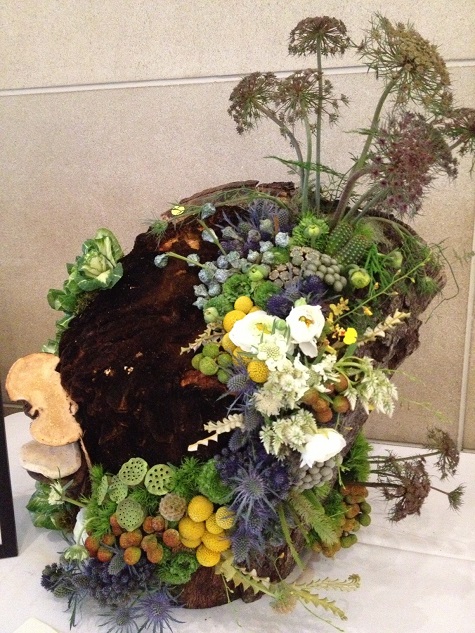
Floral arrangement inspired by Victor Higgins’ A Mountain Ceremony in the DMA’s collection

Floral arrangement inspired by Victor Higgins’ A Mountain Ceremony in the DMA’s collection

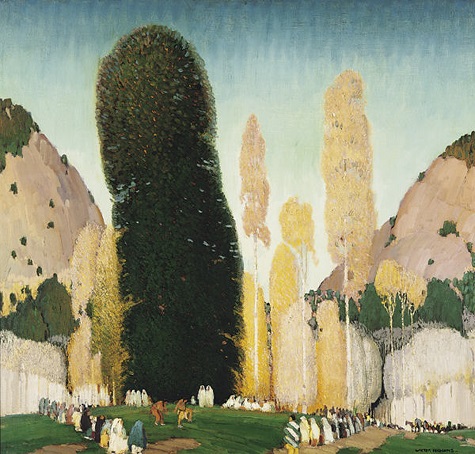
Victor Higgins, A Mountain Ceremony, c. 1930, oil on canvas, Dallas Museum of Art, anonymous gift

Victor Higgins, A Mountain Ceremony, c. 1930, oil on canvas, Dallas Museum of Art, anonymous gift

Preparing for Art in Bloom in the DMA’s Atrium

Preparing for Art in Bloom in the DMA’s Atrium

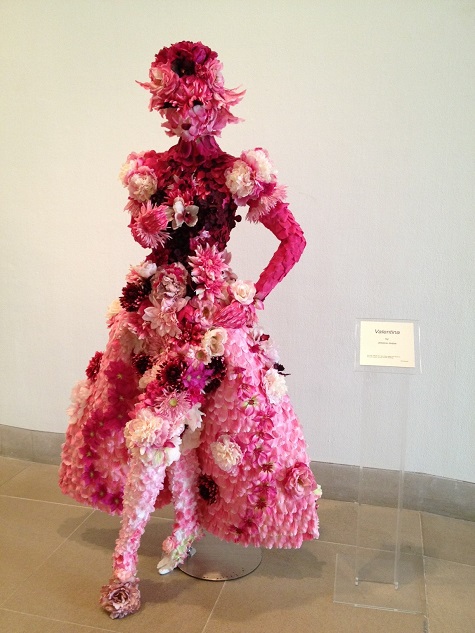
“Valentina” by Jessica Jesse

“Valentina” by Jessica Jesse

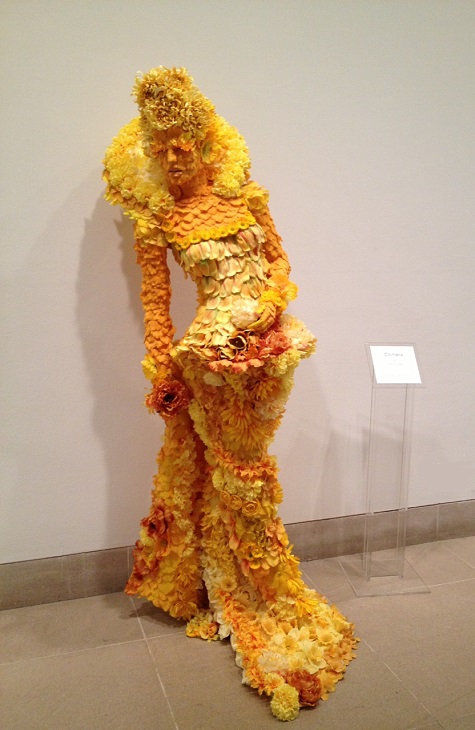
“Chimera” by Jessica Jesse

“Chimera” by Jessica Jesse

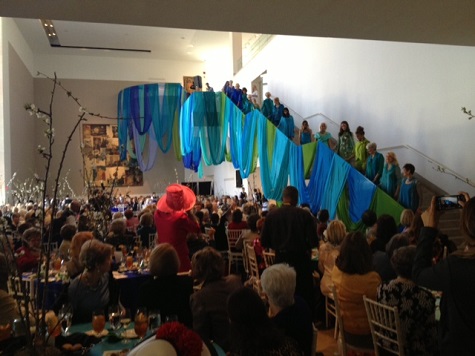
Dallas League Members and models during Art in Bloom 2013

Dallas League Members and models during Art in Bloom 2013

Debbie Stack is Director of Special Events and Volunteer Relations at the DMA.


Archives

Categories