Archive Page 49


We [Heart] Office Supplies

Especially when we repurpose them as art materials!

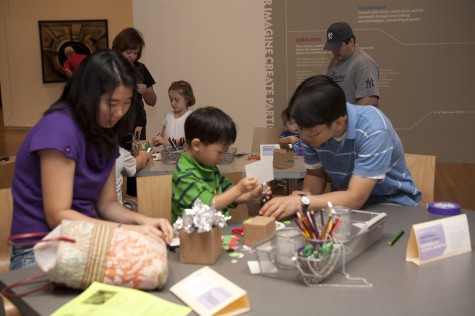
Teachers, here’s a fun challenge to give your left brain a break (should you or your students need one after standardized testing).  This DMA Creativity Challenge, aka art-making activity where limited materials and time are provided, is guaranteed to flex your brain muscle and challenge your creativity. 

We [Heart] Office Supplies Challenge
The Challenge: To create a sculpture using only materials commonly found in office desk drawers. 

  • Begin by gathering materials.  Try combinations of the following to create your artwork: binder clips, post-it notes, rubber bands, file folders, paper clips.  Grab a pair of scissors, but leave the tape, glue/glue sticks in the desk drawer for more of a challenge.
  • Sketch out your ideas on blank paper.  
  • Give yourself a time limit.  The pictures below are artworks made over an hour’s time, but making sculptures in ten or fifteen minutes is just as fun.
  • Make a label for your sculpture: title it, date it, name the artist(s), and write a short creative description of it.
  • Display your artwork in the classroom or wherever else you keep your creations.

 Ready, go!

Amy Copeland
Coordinator of Go van Gogh Outreach

Let’s Celebrate the Arts

On Saturday we were excited to launch Art in October in the Dallas Arts District with a free admission day of activities and even an exhibition sneak peek.


Art in October


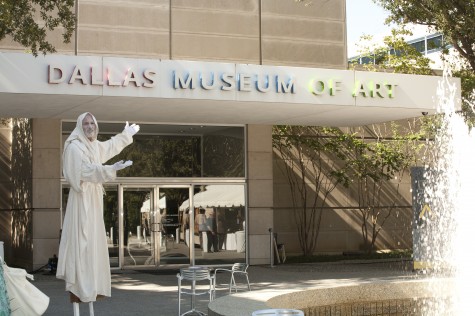
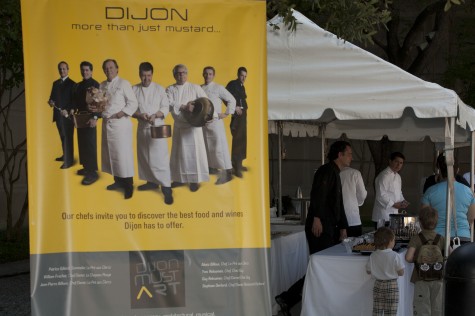
There are so many wonderful cultural events happening every day in Dallas, and especially in the Arts District, that we need a month to celebrate them all!  Here at the DMA we hosted a delegation from Dallas’s “Sister City,” Dijon, France–five Michelin-starred chefs and one sommelier–outside our Flora Street Entrance.


Chefs from Dijon shared some amazing dishes with visitors.


Some delicious French food prepared by our visiting chefs from Dijon.


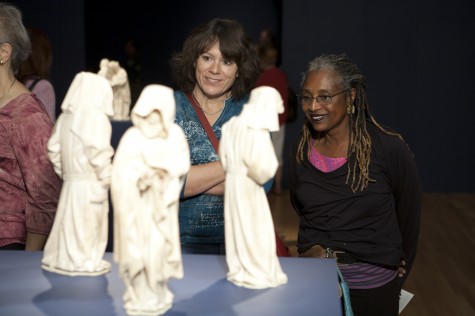
For four hours they prepared and offered samples of food and wine  from Burgundy, the land of The Mourners.


Visitors enjoying a free sneak peak at "The Mourners"


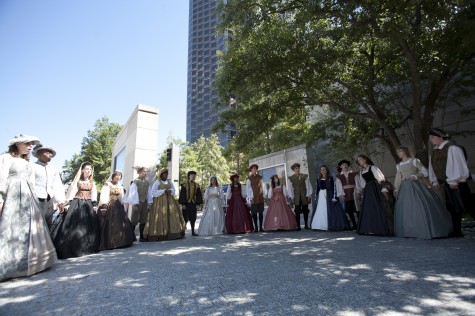
Inside, we had performances throughout the day, including spoken word pieces by Booker T. Washington students, flash mob dances, and an appearance by the Plano Senior High Chamber Singers in full medieval dress (see them again on the October 15 Late Night).


The Plano Senior High Chamber Singers


Masterpieces in the works at the Space Bar in C3


Your Museum staff happily joined in on the fun, even grabbing a few bites of escargot panini along with our more than 4,500 weekend visitors. We can’t wait for the rest of the Art in October celebration!

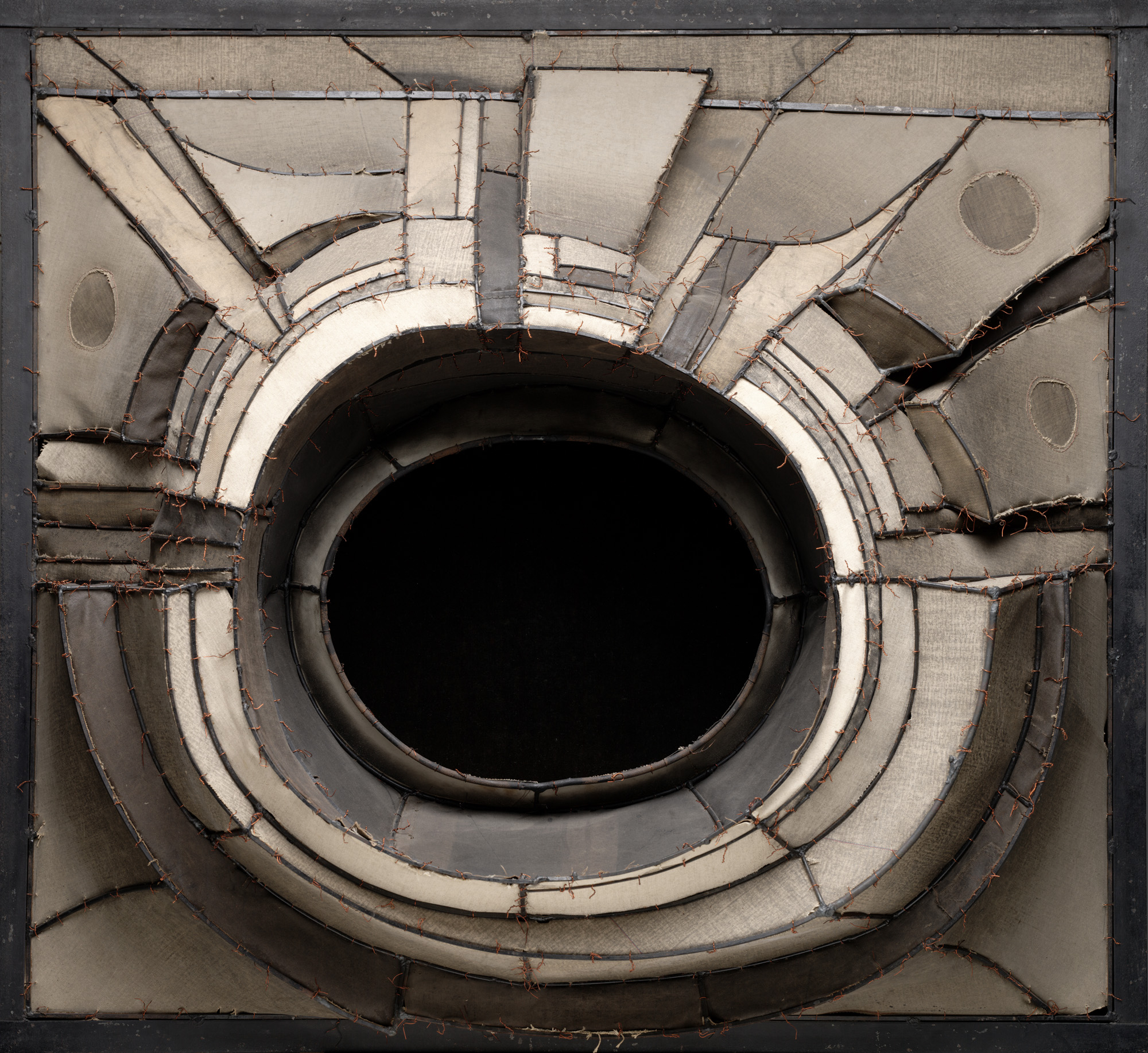
The hole goes all the way down to space…

Lee Bontecou, Untitled (35), 1961, welded metal and canvas, Dallas Museum of Art, gift of the Meadows Foundation, Incorporated, 1963.92.FA.

We spend a lot of time here in the Education Department thinking about works of art in our collection and how we can engage visitors with them in provocative, meaningful ways.  The fun part comes when we go out into the galleries to talk to visitors about what they see and what artworks mean to them. 

This past Tuesday afternoon, I spent some time in the Center for Creative Connections talking to a few visitors and one staffer about Lee Bontecou’s Untitled (35), an artwork in the new Encountering Space installation.  Next to Untitled (35), we have a metaphor response wall where visitors can leave their thoughts about the artwork, in response to a few prompts.  I asked visitors a variation of one of the prompts:  What words or pictures come to mind when you look at the work of art?  Below are their responses (look for visitors in the slideshow!). 

It looks like a well, an endless well.  It goes down deep in the ground, so deep you can’t see it.  Not even a flashlight would help.  If you keep imagining, the hole goes all the way down to space, you can see stars.
    
-Corinthia, 9 years-old

It looks like something’s in it.
     
-Kody, 4 years-old

It’s mysterious, and very intriguing.
     
-Brittany, Kody’s mom

Upon walking up, it looks like a carpet design coming out at you.  Like it used to be flat, but it’s coming out at you.  I thought it looked like a volcano, too.
     
-Victoria

From far away it looks like a stadium, but then I got closer, and it looks like a building.  It reminds me of the movie Inception–how the buildings come apart.
      -Ivan

It looks like it should be in the Nightmare Before Christmas.
     -Jennifer
[slideshow]

Readers, what words or pictures come to mind when you see this artwork?

Amy Copeland
Coordinator of Go van Gogh Outreach

Encountering Space in the New C3

Amy Copeland is the Coordinator of the Museum’s Go van Gogh outreach program to local elementary schools and a frequent blogger on the DMA Educator Blog. She has graciously agreed to share some of her experiences with the new exhibition in our Center for Creative Connections, aka C3. Last Saturday, more than 3,000 visitors helped us celebrate the opening of Encountering Space in the completely reconfigured C3 on National Museum Day. Stop by during Art in October, a monthlong celebration of the Dallas Arts District, for a chance to experience Encountering Space for yourself.

And now, here’s Amy . . .

One of my favorite things to do is poke around the Museum when exhibitions are being installed. I like seeing the bare walls pre-installation, and then watching as they get painted, and the vitrines begin to appear in the galleries, and objects are brought into the space, bringing it to life. I usually only catch glimpses of this process, but I’ve had a fun last few weeks walking through the Center for Creative Connections every day during the construction of the new Encountering Space exhibition. (My office is at the back of the space–lucky me!)

Below are pictures from the installation and a few from the opening day celebration last Saturday. They show just a fraction of this incredibly dynamic space, so I hope you’ll come explore it for yourself.

[slideshow]

Amy Copeland is the Coordinator of the Dallas Museum Art’s Go van Gogh outreach program

Finger Painting

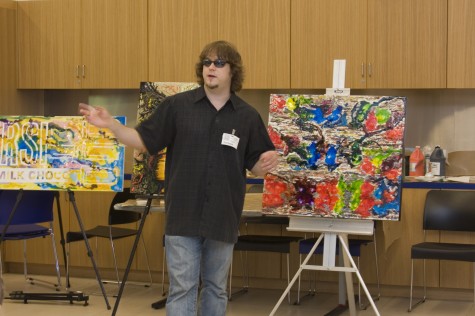
Imagine visiting the Dallas Museum of Art to see your favorite painting by Claude Monet or Jackson Pollock. Now imagine how you might experience those works without your vision. How would you “see” them? That’s exactly what I did at a workshop with artist John Bramblitt, and this is what visitors to the Museum’s Center for Creative Connections will have a chance to experience in October when John rejoins us as the Artist of the Month.

John as our guest artist during a summer camp this year.

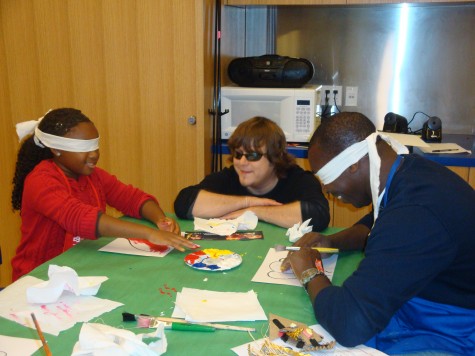
October is Art Beyond Sight Awareness Month, organized by Art Education for the Blind to make art and culture a part of life for adults and children affected by sight loss. At the DMA, we’re planning some cool programs for kids and adults with vision impairment, but we’ll also repeat a family workshop that I took with John that shows how we can make art using our other senses.

John leading a family workshop last October.

Always passionate about art, John didn’t begin to paint until he lost his sight almost ten years ago while in his late 20s. His work is intensely personal, taken from real people and events in his life. And his art-making workshops are unique, spanning the gap between beginning and professional artists, and including adaptive techniques for people with disabilities.

DMA campers learning more about John's method for sightless painting.

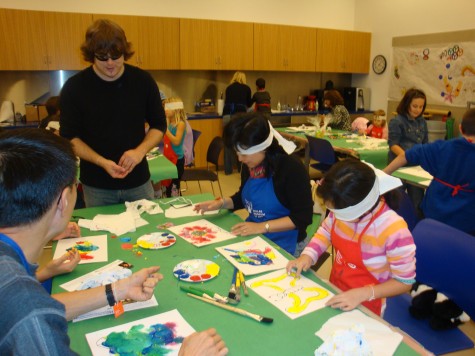
He’s developed a method of sightless painting that centers on the textures of paint in order to distinguish the color of it. When I worked with him, we mixed flour into the red paint, birdseed into the yellow, and sand into the white, and added nothing to the blue. We put on a blindfold and were asked to imagine what we would be painting, to “see” it first in our mind’s eye. Then, touching the colors and using our fingers, we painted.

The texture of the paint lets the families know what color they are using.

This workshop, and many more exciting hands-on activities with John, will be held at the Museum during October. For more information, visit http://www.dm-art.org/Family/AccessPrograms/index.htm . To learn more about John Bramblitt, visit www.bramblitt.net.

Amanda Blake is Manager of Family Experiences and Access Programs at the Dallas Museum of Art

Encountering Space

One of my favorite things to do is poke around the Museum when exhibitions are being installed.  I like seeing the bare walls pre-installation, and then watching as they get painted, the vitrines begin to appear in the galleries, and objects are brought into the space, bringing it to life.  Usually I only catch glimpses of this process, but I’ve had a fun last few weeks walking through the Center for Creative Connections every day during the construction of the new Encountering Space exhibition.  (My office is at the back of the space–lucky me!). 

Below are pictures from the installation.  They show just a fraction of this incredibly dynamic space, so I hope you’ll come explore it for yourself. 

Opening Day for Encountering Space is tomorrow.  It will be a perfect day to stop by the Museum; performances, art activities, and artist workshops are scheduled throughout the day, and best of all, the Museum will be free.

Amy Copeland
Coordinator of Go van Gogh Outreach 

[slideshow]

Foursquare perks

We adore our visitors and we enjoy connecting with them through Facebook, Twitter, Uncrated, and Foursquare. It is a great way for us to hear directly from you, like on Ask a Curator Day on Twitter, and now, we want YOU to help us pick our special on Foursquare.

Specials can be for the Mayor (the person with the most amount of check-ins at one location, for more info click here), a certain number of total check-ins, and maybe even for a particular badge.

We will accept suggestions for a week on Facebook, Twitter, and our blog, and then we will let you vote on the top four suggestions. It needs to be something special since it is a special, but it also has to adhere to a few guidelines. We encourage you to use your creativity when coming up with specials, but we request that you keep in mind our social media guidelines. Also, we won’t be able to include requests like hanging your art in the Museum galleries or behind-the-scenes passes to our art storage in the running for the special. Some examples of things we would be able to do are discounted admission for certain badge holders (the Warhol badge is pretty cool), discounts at the store after a certain number of check-ins, and Sneak Peeks for the Mayor.

We can’t wait to hear what you come up with!

From Idea to Exhibition

There are few moments in a curator’s career more thrilling than the realization of a major exhibition project. While more modest exhibitions may take months of development, others require curators to commit years of their professional lives to researching the topic, seeking loans of works of art, and bringing together the necessary participants and funding to craft a touring exhibition and a substantial scholarly catalogue.

Following my organization of the DMA’s last major decorative arts exhibition, Modernism in American Silver: 20th-Century Design, in 2005, I began work in earnest on a topic that I had considered years earlier, that of the work of one of the leading figures of the American Arts and Crafts movement, Gustav Stickley (1858-1942). In recent decades, Stickley’s name had become nearly synonymous with the boldly functional Craftsman furniture more broadly known as “Mission furniture” (a term that he despised), and examples of his factory’s works had been included in major Arts and Crafts survey exhibitions in New York, Boston, Los Angeles, and elsewhere. Given this, I found it curious that no museum had yet undertaken a monographic study of Stickley’s production for a major touring exhibition. As I later discovered, some colleagues had pondered the topic but for various reasons were unable to pursue it. It was, for me, and for the DMA, an opportunity to forge another strong link between the Museum’s development of its 20th-century decorative arts and design collections and an exhibition idea that seemed to resonate with possibilities. Stickley, as an orchestrator of design and a proselytizer for the simple life – he even published a magazine, The Craftsman, to promote his progressive ideas – was far more than an owner of a furniture factory. In the first decade of the 20th century, he sought to change the way Americans thought about the home, machine-made goods, craft, and, ultimately, their lifestyle. The subject was about not only furniture as design but the very art of how one could, or in Stickley’s mind, should, live.
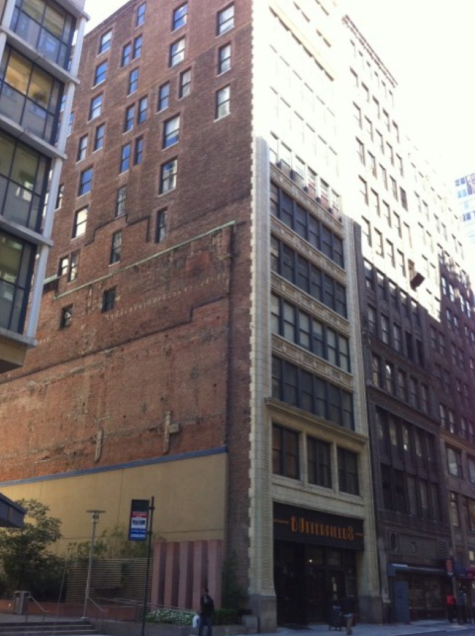
An appointment in Manhattan provided me with an opportunity to walk by Stickley’s Craftsman Building, which still stands right off of 5th Avenue and 38th Street (it’s now a restaurant and offices). He leased the entire 12-story structure in 1913 and used it as a headquarters and a department store. Furniture, garden supplies, household equipment, rugs, and a host of goods were sold here; there was even a “Craftsman Restaurant” on the top floor. What exactly was in a Craftsman fruit cocktail anyway?
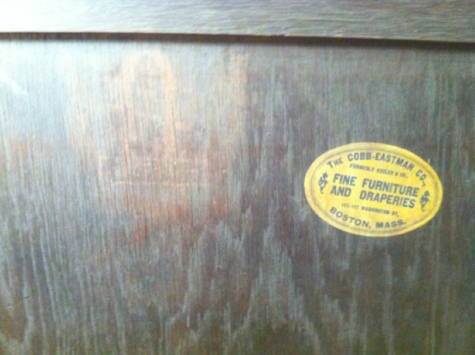
On the left, one can just barely make out the Stickley mark as a red decal on the back of this desk. A joiner’s compass (an archaic woodworker’s tool used to lay out circles) surrounds his borrowed motto “Als ik kan” (If I can) and below is a copy of his signature. While subtle differences in this mark can tell us what year this piece may have been made (this work is from 1903 or 1904), the paper label to the right is especially interesting to me – it indicates where the piece was originally sold. Surviving retailer tags such as this one are far rarer than Stickley’s own mark. Dallas had two retailers of Gustav Stickley’s Craftsman furniture between 1902 and 1916.
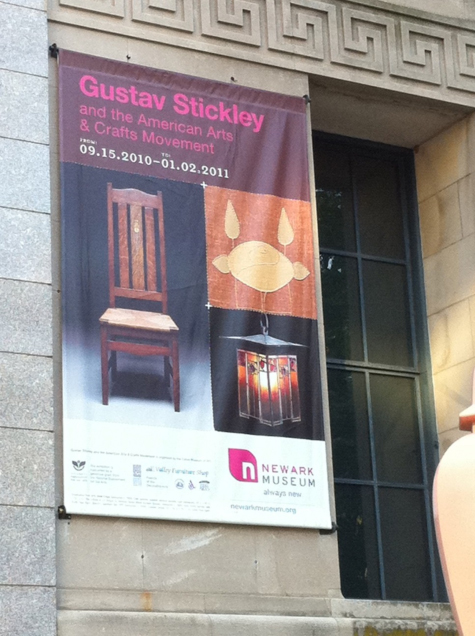
Stickley comes to Newark.

Five years later, on September 15, 2010, we celebrated the public opening of the exhibition Gustav Stickley and the American Arts & Crafts Movement at the Newark Museum. Although it is unusual to premiere an exhibition at a museum other than the organizing one, there was a happy synchronicity in that Craftsman Farms, once Stickley’s New Jersey home (and located a mere twenty minutes from Newark), is celebrating their centenary. The night before the public opening, lenders, colleagues, museum members, press, and other guests convened at the museum for the usual slate of honorific speeches, convivial chats, and a sneak peek at what would be revealed when the doors officially opened the following day. Arriving at this point required hundreds of hours of research into Stickley’s career, pouring over surviving business papers at Winterthur, examining original sales catalogues, advertisements, photographs, inventories, and other documents, and, with this information in mind, reviewing the actual pieces of furniture, metalware, textiles, and architectural drawings that are included in the exhibition. This research is the very heart of such exhibitions and associated catalogues and not only allows us to satisfy our curiosity as scholars – the why, when, and how these works were made and for whom – but also provides us with the knowledge for shaping a new and compelling story for our visitors and readers.
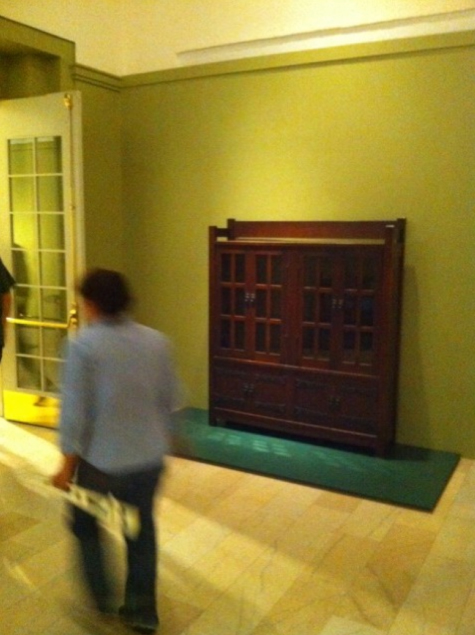
The Newark Museum’s staff never slowed down for a moment – preparing for an opening, especially one with large pieces of furniture and a recreation of an entire dining room, is not a simple matter. Each work must be handled with care, its condition well documented, labels written by the curator and placed by the preparation staff. That’s the condensed version. One of Stickley’s rectilinear oak bookcases from 1901 looms in the background, awaiting its public premiere.
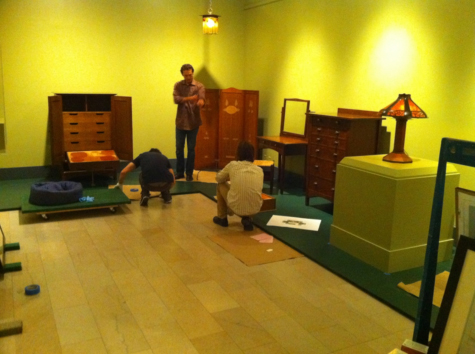
DMA registrar Brent Mitchell consults with Newark’s team as we prepare to install Stickley’s own chest of drawers (far left). The best laid plans must always be adjusted to accommodate those unexpected challenges.

After spending nearly two weeks supervising the installation of the exhibition with DMA registrar Brent Mitchell and the dedicated staff at the Newark Museum, including Ulysses Dietz, their curator of decorative arts, I at last felt a sense of relief and exhilaration as the last object was placed. The exhibition is done, at least for now – come February 13, 2011, the doors will open to the DMA’s presentation of Gustav Stickley and the American Arts & Crafts Movement.
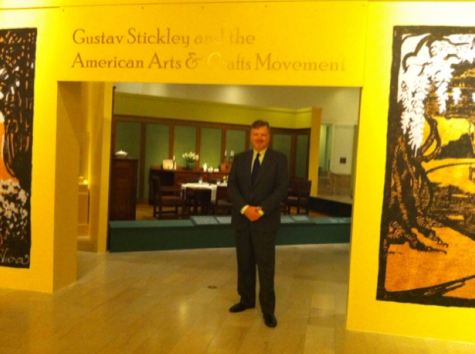
Done!
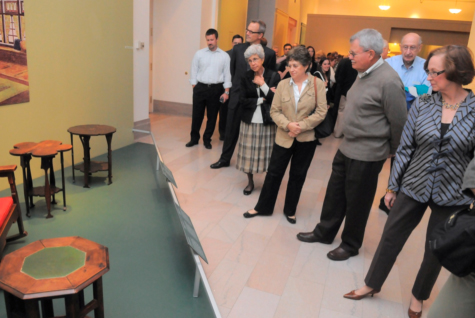
Opening night.

Kevin W. Tucker is the The Margot B. Perot Curator of Decorative Arts and Design at the Dallas Museum of Art.

Celebrating Mexico's Bicentennial

José Guadalupe Posada, La calavera catrina, 1889-95, woodcut, anonymous loan

The Dallas Museum of Art is celebrating the bicentennial of Mexico’s independence with a special project called Mexico 200.  This project includes a bilingual brochure that highlights works of Mexican art throughout the collection, including Maya, Spanish Colonial, and modern Mexican artworks.

Additionally, two special exhibitions of works on paper are on view this fall. Jose Guadalupe Posada: The Birth of Mexican Modernism showcases prints by this prolific artist who is considered the most influential Mexican artist of the early 20th century.  Tierra y Gente: Modern Mexican Works on Paper is installed in the Concourse and features works of art by Diego Rivera, Rufino Tamayo, and other 20th-century Mexican artists.

Check out our Online Teaching Materials to learn more about Mexico 200, or participate in the Late Night on Friday, September 17.  The theme is Mexico 200, and teachers get in free with their educator ID!  Share the arts of Mexico with your students by scheduling a Museum Visit or Go van Gogh Outreach Program

Molly Kysar
Head of Teaching Programs

Q&A with a DMA Docent

We have a corps of over one hundred volunteer docents who lead tours for students K-12 as well as for our adult visitors. They play an important role at the DMA, introducing our collections to museum-goers and sharing their passion for the beauty and importance of art. We are proud of their hard work and dedication and would like to introduce you to several of them over the coming months.

First up, meet Tom Matthews. Who knows, you might even run into him the next time you’re in the galleries. Rumor has it that he and his fellow docents spend a lot of their free time enjoying the art.

Number of years as a docent at the DMA: 10

A little bit about me: When I was a boy, my father piqued my interest in art by taking me to the Art Institute of Chicago. Though not trained in art, my father – an attorney – had a keen eye and did much reading on his own. His comments about art and artists stirred a life-long fascination for me. In my adult years, this interest continued. On family vacations, we usually stopped – often despite the protest of our daughters – at museums. My understanding was deepened by a twenty-five-volume series the Met in New York did for the public on art history and appreciation. While I was serving as pastor of a church in the coal fields of western Pennsylvania, a highlight of the month would be the arrival of one of these volumes. My wife alerted me to the docent program by referring me to an article in the Dallas Morning News.

My favorite experience as a docent at the DMA: I feel I have succeeded as a docent when I have “opened” a piece of art for the viewer. What does it feel like to be a griever in Jacob Lawrence’s Visitors or to “walk” as one of the figures in Giacometti’s sculpture? Assisting others in engaging with a work of art brings me satisfaction.

My three favorite works of art to share with visitors at the DMA:


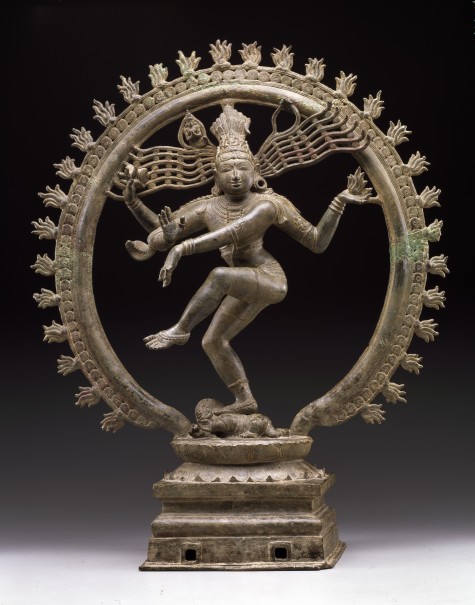
Shiva Nataraja, India, 11th century: The dancing figure, holding strange objects and surrounded by a ring of fire, mystifies and entices.


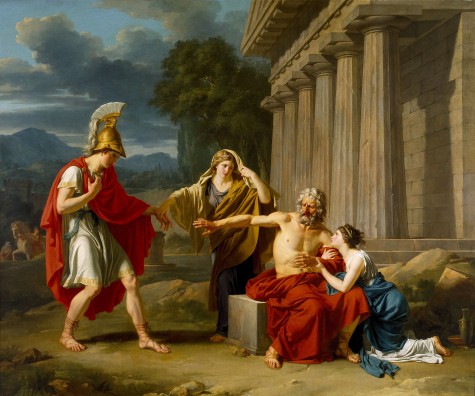
Oedipus at Colonus, Jean-Antoine-Theodore Giroust, 1788: The story of Oedipus always commands attention. Giroust captures the pathos of the final moments.


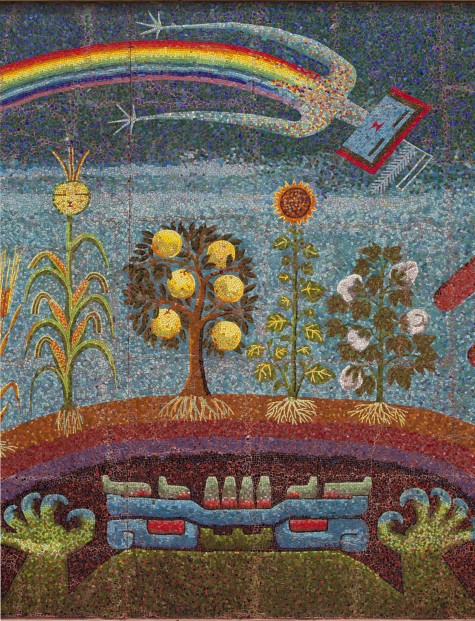
Genesis, the Gift of Life, Miguel Covarrubias, 1954: Viewers are fascinated by the colors, imagery, and technique of mosaic making.

If you would like more information on the docent program at the Dallas Museum of Art, click here.


Archives

Categories