Archive Page 58


Chance Encounters with Mark Bradford

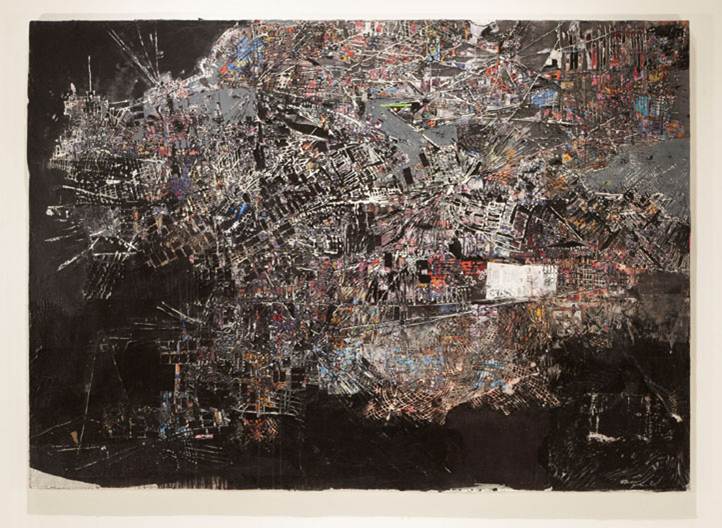
Although Mark Bradford refers to himself as a painter, his pieces are far from traditional.

By using paper instead of paint and replacing brushes with his hands, he has really made this medium his own. Bradford gathers most of his paper materials from his environment, and layers them into thick, tactile, almost sculptural, artworks. By using this active process, he really considers himself more of a maker or creator than an artist. Initially, some of his supplies came from his mother’s salon, where he spent most of his childhood. Later, he ventured out to the streets of his neighborhood and collected flyers, posters, advertisements, and billboard paper. He typically works on eight pieces over eight months, keeping them all in a state of flux as he adds materials and takes them away by tearing, ripping, and sanding. This method of collage and décollage creates compositions that spontaneously reveal bits and pieces of hidden layers. So, as your eyes move across the canvas, you’re never quite sure what you are going to find next.

One thing that really struck me about this process of artmaking is the element of chance involved. From what Bradford happens to stumble upon in the streets, to what ends up exposed in the final product, there seems to be a constant negotiation between choice and chance. As I walked through the galleries, I really enjoyed searching for those moments where you can see the hand of fate working alongside the hand of the artist. What I noticed most were words and phrases that were inadvertently exposed throughout some of his pieces. Below I reveal just some of the chance encounters you could have with his work, but you’ve got to come to the exhibition to find more!

“Oh my god, AHRQ! What if these weirdos don’t like people just dropping in?”
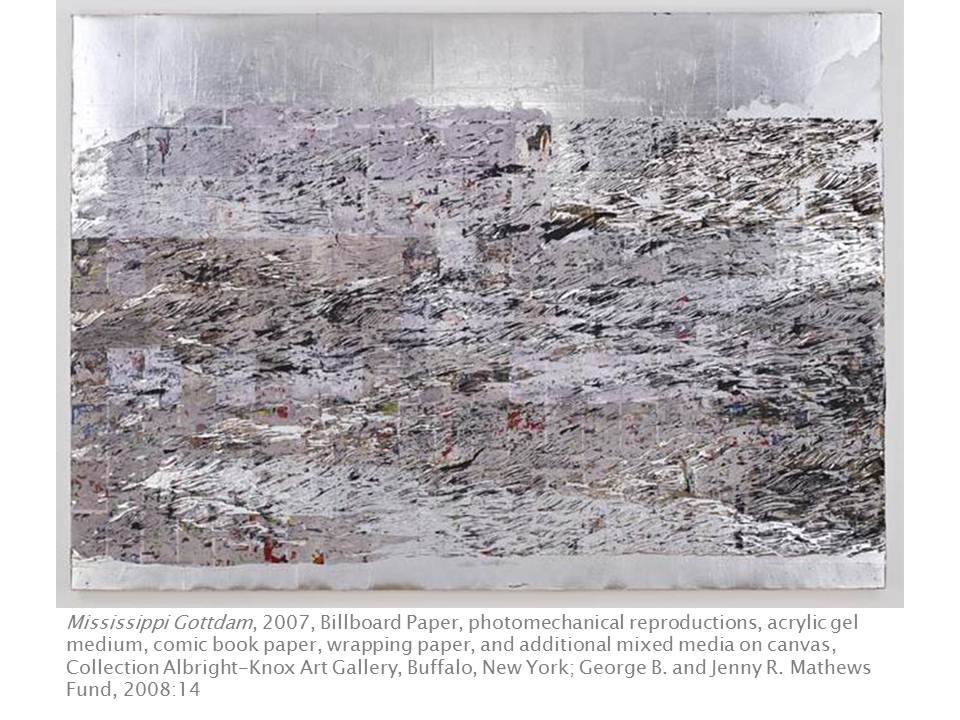
“Whatever you’re getting is fine.”
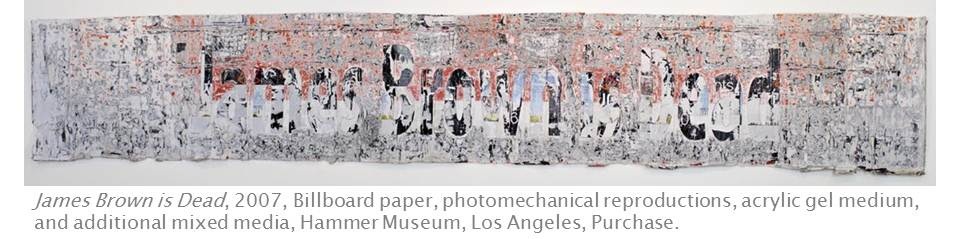
“Scathingly funny!”
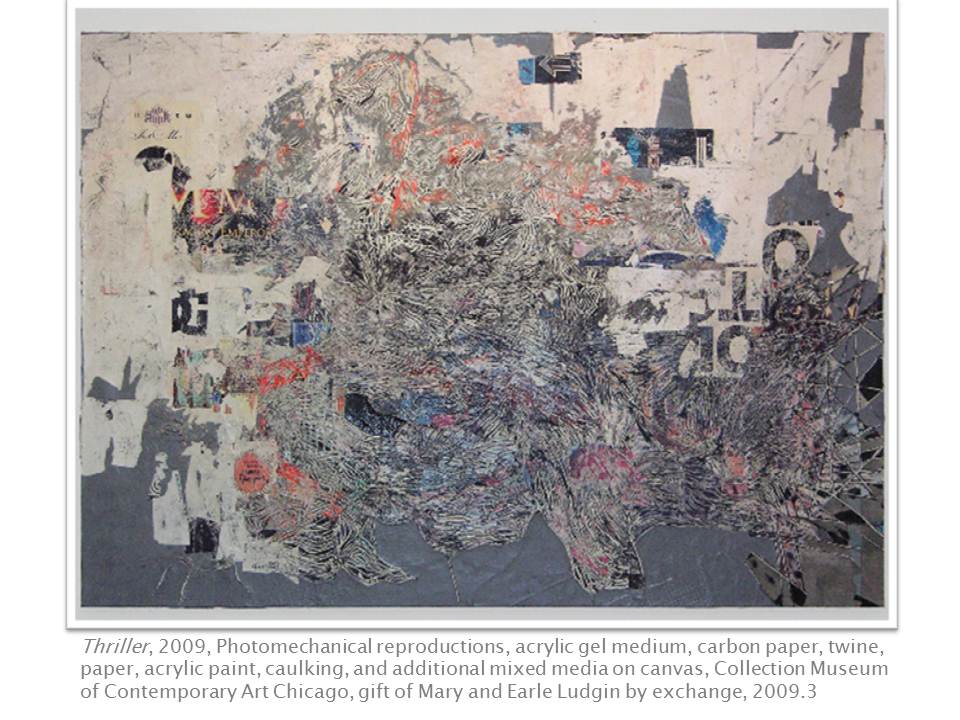
“Close your eyes”
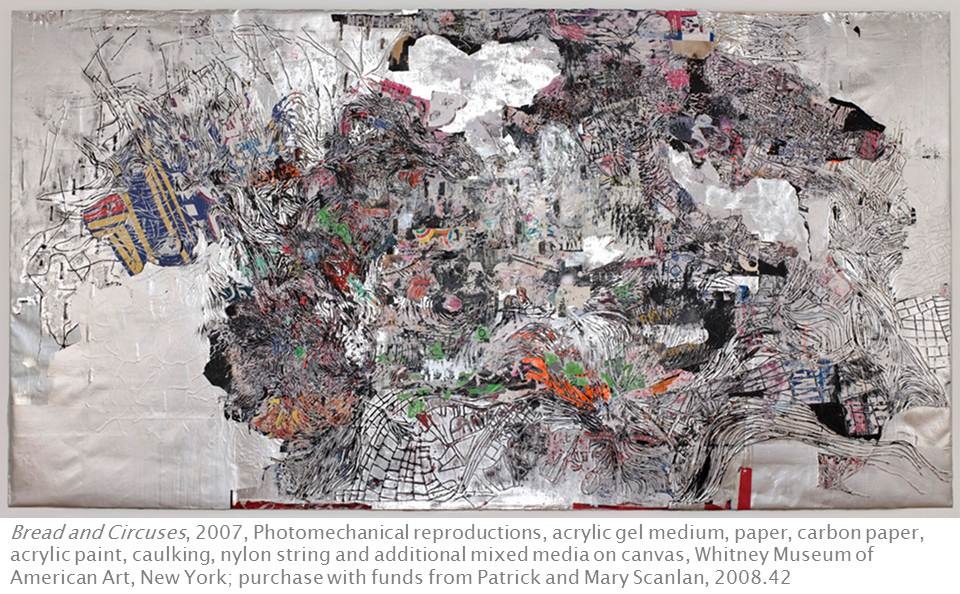
Vicious

“…But I think I’d rather hang around here.”

“I had confidence in your razor-sharp instincts.”

“That was supposed to be our secret!”

“I see you’ve been having fun…”
Students can have fun with this too. Using seek and find games, there is a lot to discover in these works. It may also be a fun way to reframe their idea of “mistakes” as (what I often call) happy accidents that can be incorporated into their art pieces.

Want to dig into Mark Bradford’s process a little deeper? Come to next week’s Gallery Talk with artist Diedrick Brackens.

Hope to see you all next Wednesday!

Hannah Burney

McDermott Education Intern for Teaching Programs and Partnerships
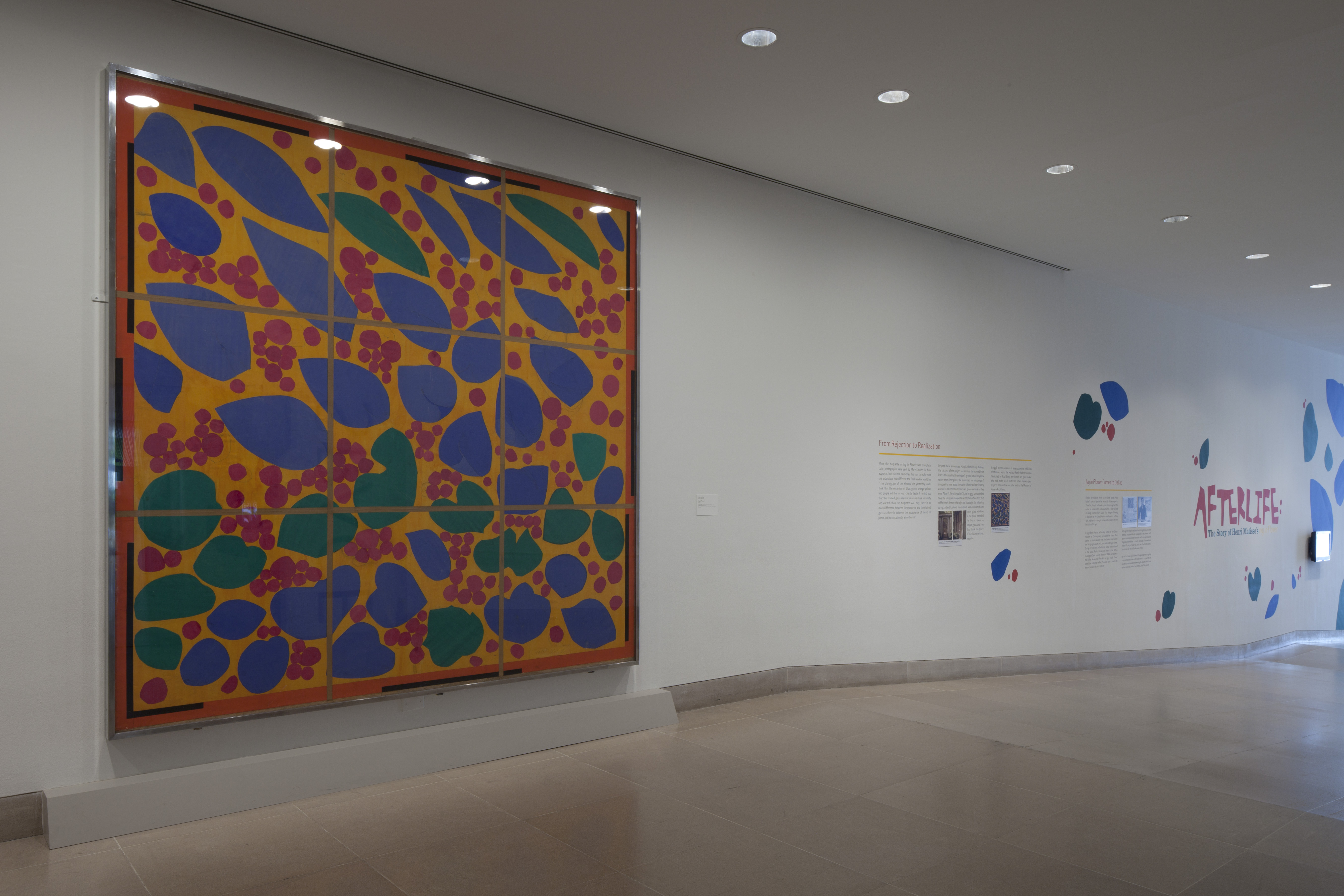
Henri Matisse's Ivy In Flower

If you visit the DMA over the next few months, you can’t miss Henri Matisse’s Ivy in Flower, a colorful collage that measures just over nine feet on each side.

Colorful shapes inspired by the collage lead you up (or down) the DMA concourse to Ivy in Flower

Ivy in Flower is a well-known but rarely seen work of art in the DMA’s collection made with colored paper, watercolor, pencil, and brown paper tape on paper mounted on canvas.  In order to preserve and protect a work on paper, the artwork cannot be exposed to light for sustained periods of time.  For that reason, Ivy in Flower has only been on view three times in the last ten years, each time for eight months or less.  It is usually displayed in the European galleries, which are filled with natural light.  This time around, curator Heather MacDonald proposed showcasing the collage in the concourse, where there is not only less light but also plenty of space to tell the interesting history of this work of art.

The story begins with Albert Lasker, who is considered by many to be the father of modern advertising.  Lasker began his career as an office clerk at Lord and Thomas advertising agency in Chicago, and became a salesman, then partner, and eventually the president and owner of the company.  One of his most notable campaigns was for Lucky Strike cigarettes, which served as inspiration for Don Draper’s character in the television series Mad Men.

After his retirement, Albert Lasker began collecting art with his second wife, Mary Lasker.  Following Albert Lasker’s death in 1952, his wife had a mausoleum built for him in Sleepy Hollow Cemetery in New York.  Later that year, Mary Lasker commissioned  Henri Matisse to design a window for the back wall of the structure, or more precisely, nine windows that would form a ten-by-ten-foot square.

At this time, Matisse was an internationally-known artist late in his career.  Due to his poor health, he primarily created compositions by arranging shapes cut from heavy paper that he coated with paint.  With the aid of studio assistants, Matisse placed and pinned the shapes until he was satisfied with the composition.  For the Lasker commission and other works from this time period, Matisse chose to create a to-scale maquette rather than small-scale preparatory sketches.

Cutting into color reminds me of the sculptor’s direct carving.

– Henri Matisse

After much correspondence between Mary Lasker and Pierre Matisse, the artist’s son, the final design for the window was ultimately rejected.  Matisse passed away in 1954, and his family had the window executed in glass for a retrospective exhibition two years later.  The window is now owned by The Museum of Modern Art of Vienna.  As part of their original agreement, Mary Lasker retained ownership to the Ivy in Flower maquette until she donated it to the Dallas Museum of Contemporary Art (which later merged with the Dallas Museum of Fine Arts, now the Dallas Museum of Art) in 1957.

This is just a short synopsis of the history behind this colorful collageAfterlife: The Story of Henri Matisse’s Ivy in Flower  is on view through December 11, 2011, and includes illustrations of how the mausoleum may have looked with the windows designed by Matisse, as well as images of the people and places in this interesting tale.

Melissa Nelson
Manager of Teaching in the Community

Friday Photos: Eerie Images

October is my favorite month.  It brings the transition from summer to fall, never-ending sweets, and Halloween: a hair-raising holiday that demands a sugar rush, costumes, and scaring people.  To pay homage to my favorite holiday, today’s Friday Photos feature eerie images found in our collection.  Remember, what is considered spooky is in the eye of the beholder; many of the objects listed here also represent significant cultural beliefs. 


Don’t forget to come search for other spine-chilling subjects in the Museum on October 30th, the last day of Art in October (and it’s free!).

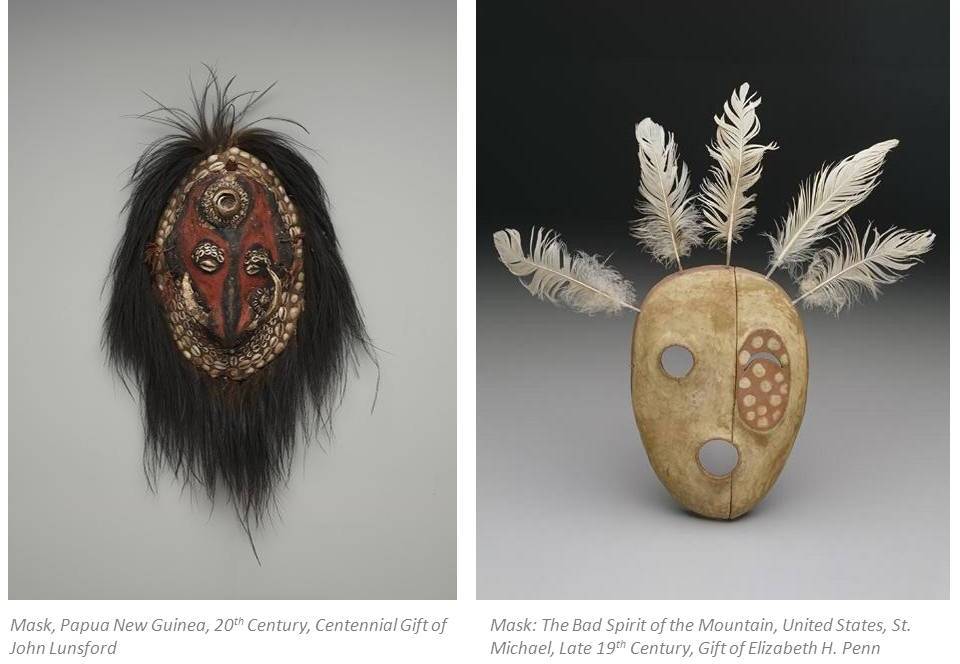
 Masks are always appropriate for Halloween.

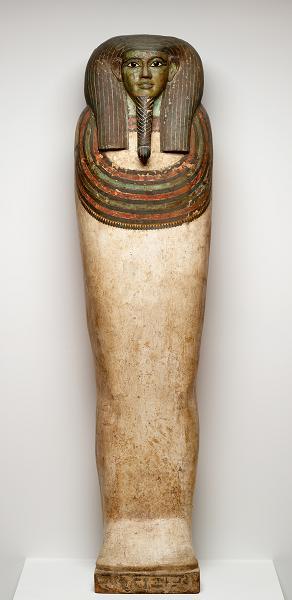
The coffin does not bother me, it’s what could be inside…

Coffin of Horankh, c. 700 B.C., Cecil and Ida Green Acquisition Fund


 I’m pretty sure his eyes follow me when I walk by.

Captain John Pratt (1753-1824)

Ralph Earl, Captain John Pratt (1753-1824), 1792, Gift of the Pauline Allen Gill Foundation


Wishing you all a safe, yet thrilling Halloween,

Loryn Leonard
Coordinator of Museum Visits

Kids Say the Darndest Things!

I spy with my little eye…children at the museum!

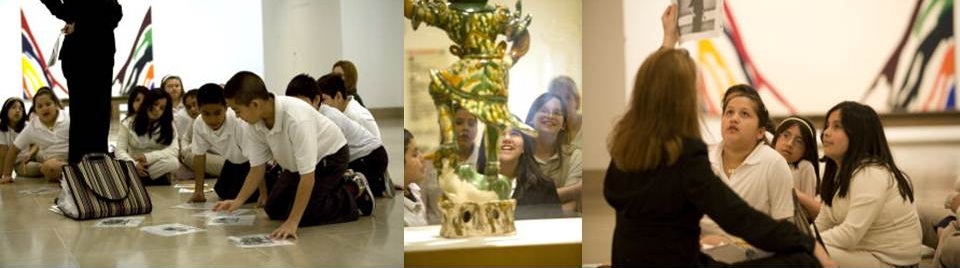
On any given day, there are always programs being offered for our younger museum visitors. During the week, you can often spot them in lively school groups engaging in interactive docent tours. And don’t be surprised if their enthusiasm can be heard from the hallways as they participate in exciting art activities in the Center for Creative Connections. Our programs also go beyond the museum and into the community, bringing art to the classroom with Go van Gogh. These are just a few examples of the many ways the folks here at the DMA are facilitating fun learning experiences that encourage participation and self-expression. But don’t take it from me! Our young participants really say it best. Below are some of their candid comments from the 2011 – 2012 school year.

Docent Tours

  • “These paintings look weird to me,” a puzzled 4th-grade girl commented while walking through the Impressionist gallery.
  • “Wouldn’t you like to drink out of these amazing cups?” a docent asked about a group of gold Peruvian mugs. “Uh, if I cleaned them first,” replied a 4th-grade boy.
  • A 4th-grade boy noticed a Peruvian Mask with copper covered eye holes and mused, “I wonder how many times the guy wearing that ran into the wall?”
  • “Even if you are a leader, you still need help,” reasoned a 4th-grade boy when asked to interpret the proverb expressed by an African sculpture.
  • After an hour long tour, these 4th-graders still wanted more, as expressed by this excited girl who asked, “What else are we going to see? Are we going to see the really really really big artworks now?!” Referring to the Mark Bradford work they had passed by on the way in.

Center for Creative Connections

  • “They always make us paint with crazy things!” said a young girl in reaction to painting with kitchen tools in an Arturo’s Art & Me class.
  • “I thought it was going to be a person, but it turned out to be a ballerina,” explained an eight-year-old girl about her finished artwork.
  • A nine-year-old girl titled her art piece Man Gives Flowers and reflected that, while she made it, she thought of “romantic love.”

Go van Gogh Classroom Programs

  • “Hi, I am from the Dallas Museum of Art!” announced the volunteer. “Really?! Yessss. I LOVE art!!” exclaimed an enthusiastic 2nd-grade girl.
  • “Make the minutes last! Make the next two minutes an hour!” declared a 5th-grade boy after being told that only five minutes remained.
  • “Wow,” a 4th-grade boy said of the hat he was making, “mine is turning out reeeeally neat.”
  • “I have no idea what I am doing. I just went wild on it,” laughed a 4th-grade boy about his art project.

If you have any memorable museum moments with kids, please share them in the comments section!

Hannah Burney

McDermott Education Intern for Teaching Programs and Partnerships
Decorative Dining

Everyone needs to eat, right?

We spend plenty of time thinking about what we are going to have for dinner every day, but how often do you think about the objects that contain, serve or cut your food? In the age of the microwave and the drive-thru, it may seem crazy to think about breaking out your finest silver pieces to serve dinner. To wealthy and upper middle-class Americans during the Victorian era (or more specifially, The Gilded Age) the practice of dining was an art, and fine silver was a key component.

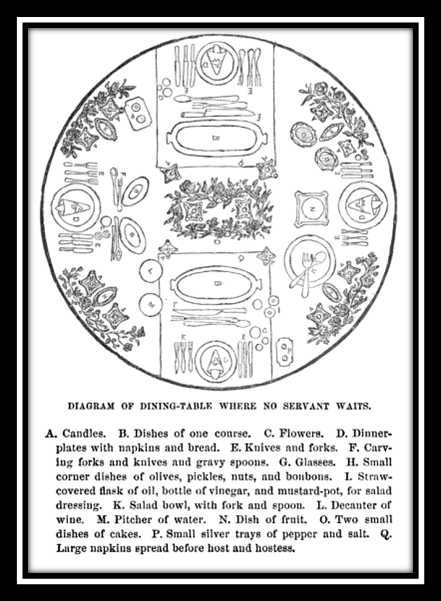
Let’s start with an example of how Mrs. Maria Dewing suggests a proper dinner table should be set in her helpful guide, Beauty in the Household, published in 1882.

Image from Maria Richards Dewing’s Beauty in the Household (New York: Harper & Brothers, 1882), page 72.

As you can see, even a small gathering without servants (gasp!) called for a very specific placement of dishes. It is, then, no surprise that such great care was taken in the appearance of the serving utensils and dishes. Not only was there a specific placement of the pieces, but they were also often decorated and designed in accordance with their function.

Here are a few flatware examples from one of the largest (it totaled about 1,250 pieces) and grandest (it was made from a half ton of silver) dinner and dessert service that Tiffany & Co. made in the 1870s:

Egg Spoons

Oyster forks

Grape scissors

Asparagus tongs

Salt spoons

Marrow spoons

Melon knives

Berry spoons

We feel stressed today if we use the wrong fork for our salad — can you imagine being forced to choose between an egg spoon and a berry spoon? Well-bred Victorians would have known the difference.

Luckily, if they had a moment of doubt, the silver designers often provided hints as to how the item may be used. The DMA’s Decorative Arts collection has some wonderful examples of these types of silverware.

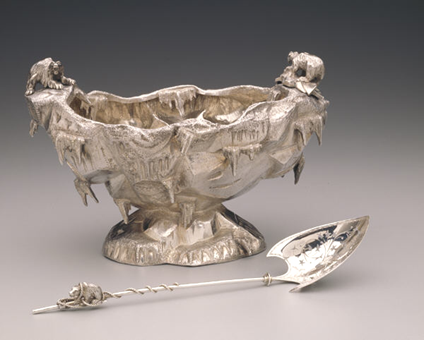
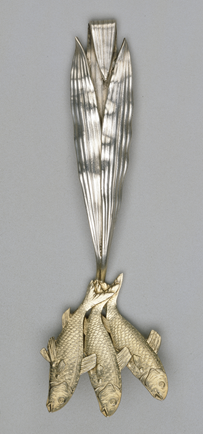
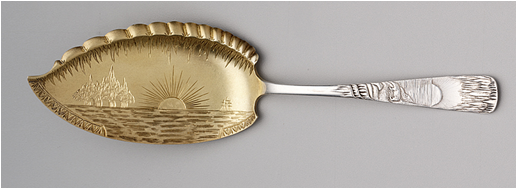
Sometimes, specific foods were incorporated into the designs.

Gorham Manufacturing Company, Ice Bowl (with spoon), c.1871, Dallas Museum of Art, The Eugene and Margaret McDermott Art Fund, Inc.

George W. Shiebler and Company, "Grass" Pattern Sardine Server, c. 1880-1890, Dallas Museum of Art, The V. Stephan Vaughan Collection, gift of the 1991 Silver Supper

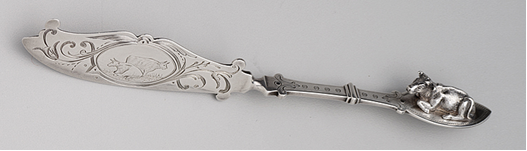
Others may subtly hint at the type of food for which they were used.

R. Wallace and Sons Manufacturing Company, Ice Cream Slice, c. 1880-1890, Dallas Museum of Art, gift of Dr. and Mrs. Dale Bennett

John R. Wendt & Company, Cheese Knife, c. 1870, Dallas Museum of Art, gift of Dr. and Mrs. Dale Bennett

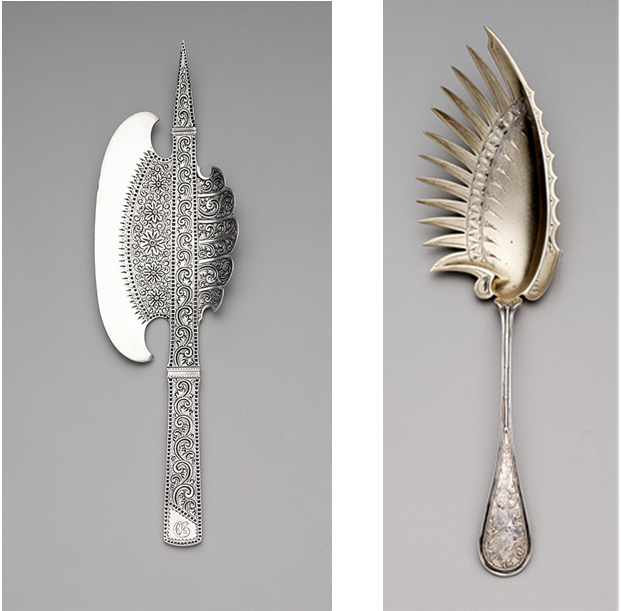
On the other hand, designers did not always give such helpful hints. Instead, they creatively designed an item using influences from non-food related objects.

Both of the items below have very specific uses; what do you think they are? Leave your ideas in a comment and I will provide the answers in the comment section next week!

Left: Gorham Manufacturing Company, c.1880, Dallas Museum of Art, gift of Dr. and Mrs. Dale Bennett Right: B.D. Beiderhase & Co., 1872, Dallas Museum of Art, gift of Dr. and Mrs. Dale Bennett

While most Victorian families may not have purchased such whimsical silver pieces as these, the widespread market for silver gave designers the freedom to create wonderfully dynamic works of art that we can marvel over today at the DMA.

Bon Appétit!

Jessica Kennedy

McDermott Intern for Gallery Teaching

Friday Photos: Reunited, and It Feels So Good

Earlier this month, a beloved DMA painting was reunited with its pendant, the work of art that was meant to hang next to it.  These two paintings have been separated since 1806, when they were sold into two private collections.  I have heard about this mysterious pendant painting to A Mountain Landscape with Approaching Storm for years, but its location was unknown.  That all changed earlier this year, and A Grand View of the Sea Shore is hanging in the DMA’s European galleries until December 11.  I hope you’ll stop by and admire  it next time you’re at the Museum.

[slideshow]

Shannon Karol
Manager of Docent Programs and Gallery Teaching

Urban Armor: Urban Art

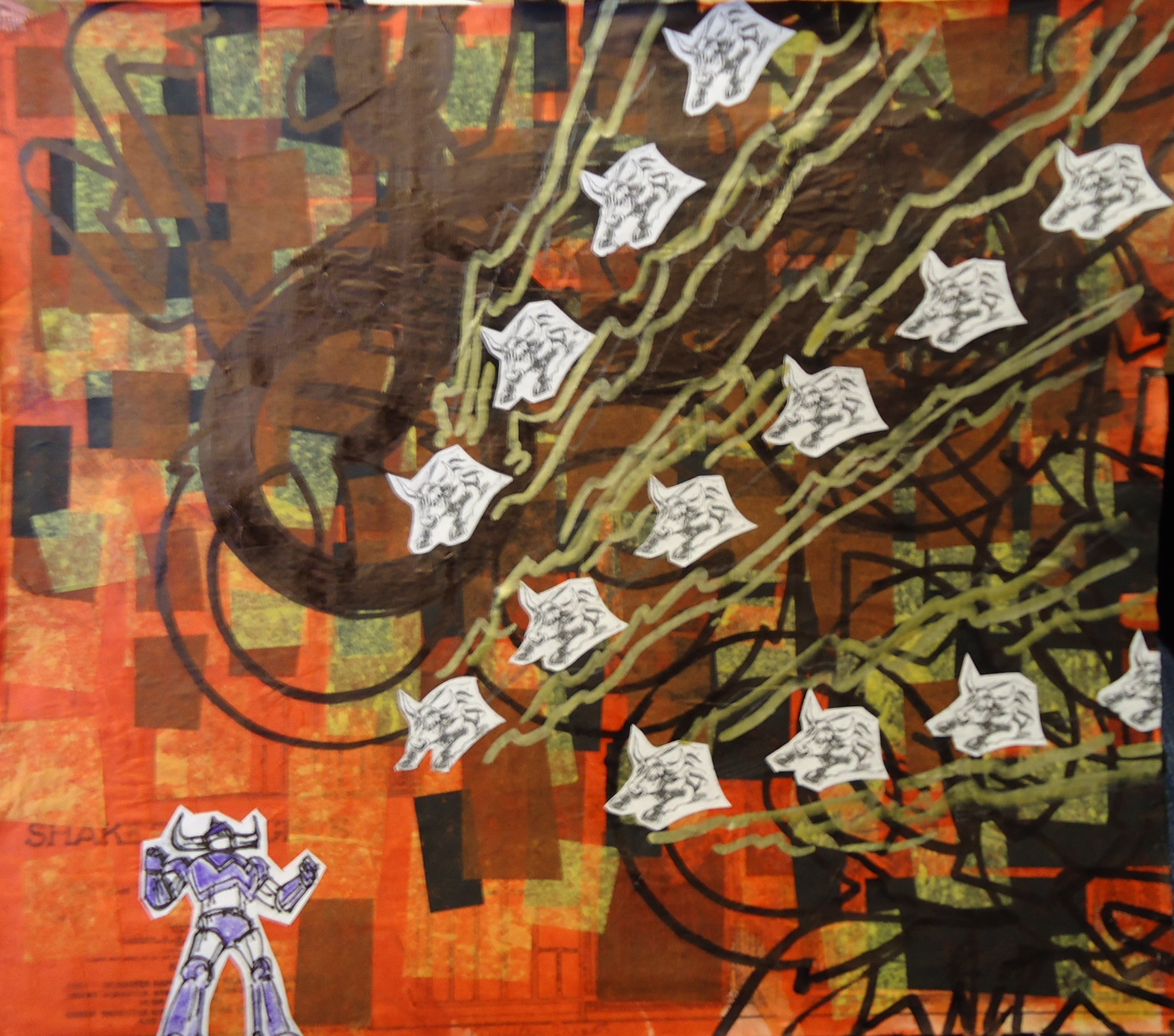
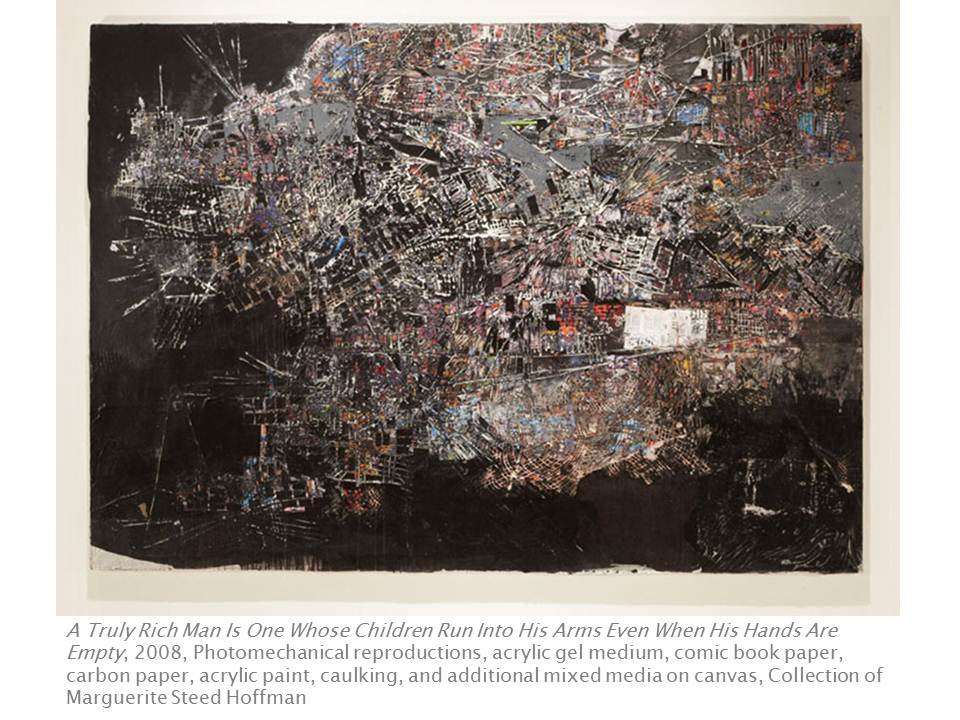
Urban Armor is a program for tweens and teens focusing on building identity through discussion and artmaking. This month, we’re offering a graffiti workshop inspired by the Mark Bradford  exhibition.  We’ll look at several works in this incredible show, and talk about the relationship between place and identity on both a personal and communal level.

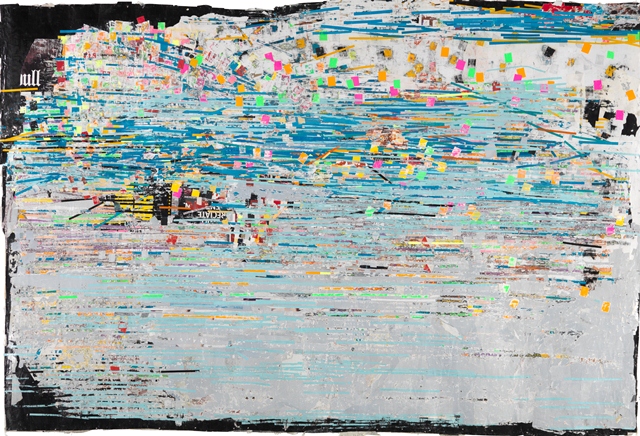
Mark Bradford, A Truly Rich Man Is One Whose Children Run into His Arms Even When His Hands Are Empty, 2008, Collection of Marguerite Steed Hoffman

What has me excited about this workshop is the opportunity to discuss with participants the idea that not only are we influenced by our environment, we in turn leave our mark on the spaces we inhabit through our presence and actions. For teens, I think this desire to make someplace your own is particularly strong—from their rooms at home, lockers at school, to their personal space (how they dress, for example). This connection between place and identity is fundamental not only to Mark Bradford’s work but to street art as well, which is something we’ll explore during the workshop. Teens will also  have the chance to talk about their own reactions to Bradford’s work in terms of his materials and his use of layers.

Participants will then have the opportunity to make a work of graffiti art using a wide variety of materials that focus on their individual creative strengths.  Some may feel more comfortable with  drawing, others with collage, etc. Regardless of the medium they choose, we’ll emphasize the notion of self-expression through the use of layers. They’ll learn how to make their own stencils and how these can be used to create patterns through repetition in their artwork as well as a way of personalizing their own stuff at home after the workshop.

My sample, Training Wheels/Bull Market, shows layering and stencil processes

Urban Art will be offered Friday, October 21 from 9:30-11:30 p.m. and Saturday, October 29 from 1:00-3:00 p.m.  The October 29 workshop is currently full, and registration is encouraged for the October 21 workshop (drop-ins will be welcome but space is limited and on a first-come, first-served basis).  All supplies will be provided, and the program is free with paid admission to the Museum.

JC Bigornia
Coordinator of Family Experiences

Friday Photos: Artist Encounters

We love Mark Bradford!

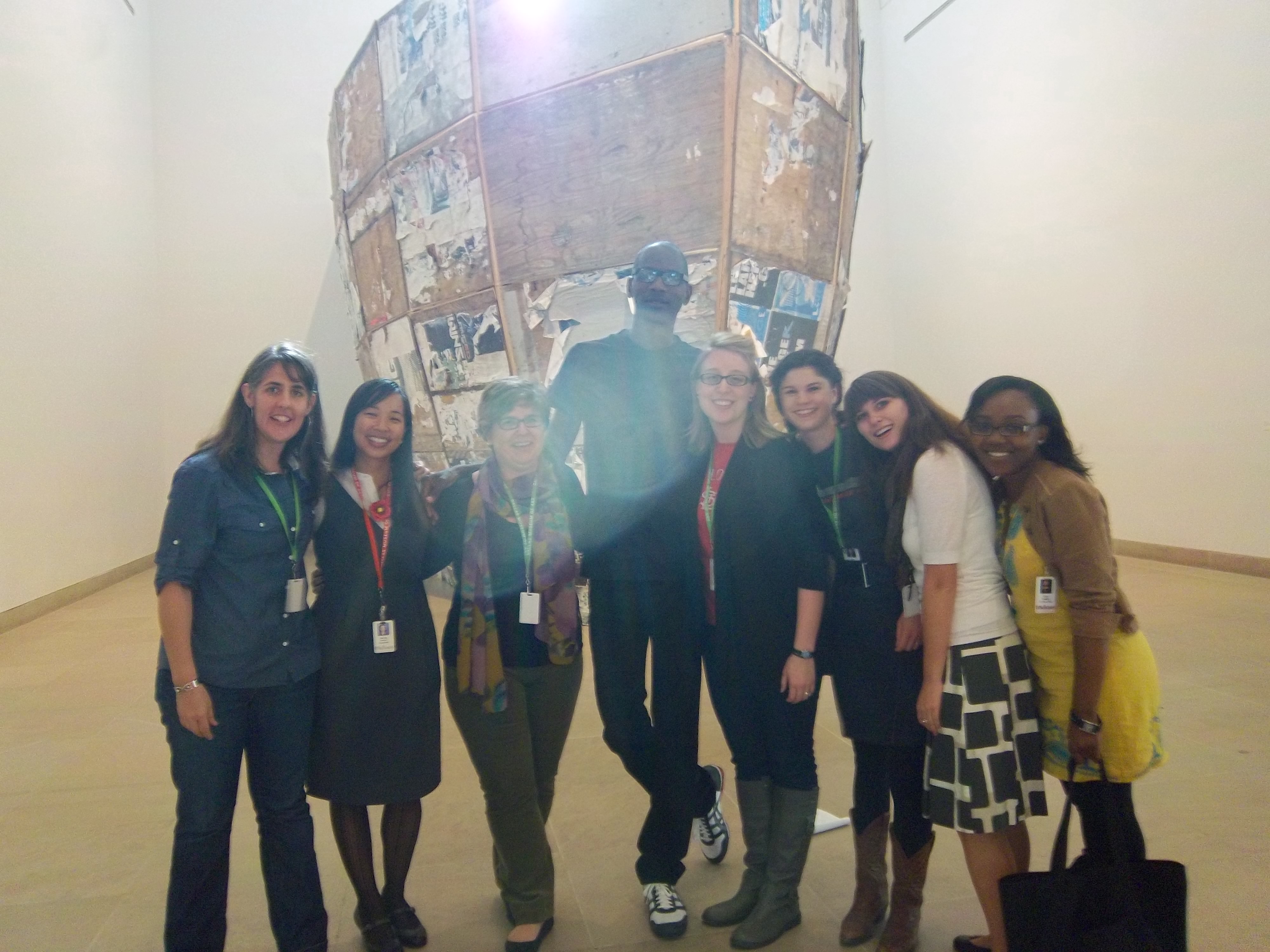
Teaching Programs and Partnerships staff with Mark Bradford.  An exhibition spanning ten years of his career opens at the DMA on October 16th.
Educator Resources: Mark Bradford

Mark Bradford opens this Sunday, October 16 at the Dallas Museum of Art and you do not want to miss this exhibition.  Bradford’s abstract, large-scale, mixed-media paintings look beautiful and comfortable in the expansive contemporary art galleries at the DMA.  As you plan your own visit or a visit for your students, there is great information about Bradford, his work, and his process available on several websites.  Spend some time with the following resources to learn more about Bradford and to gather ideas for dialogue and studio projects with your students.

Potable Water, 2005, Billboard paper, photomechanical reproductions, acrylic gel medium, and additional mixed media, 130 x 196 inches, Collection of Hunter Gray, Photo: Bruce M. White

1.  Pinocchio is On Fire
This is the official website for the exhibition Mark Bradford, organized by the Wexner Center for the Arts in Ohio.  When you visit the site, you have four ways to dive into Bradford’s work. Select “the studio” and view a unique presentation of two videos featuring Bradford talking about his process.   “The art” guides us through a look at several works in the exhibition.  Finally, you can choose “the artist” to learn more about Bradford’s biography, or select “process & materials” to learn more about what media he uses and how he creates.

2.  Art21
This popular PBS documentary about art in the 21st century features Mark Bradford and eighty-five additional contemporary artists presently working in the United States.  Each season of Art21, which is now in its fifth season, explores several thematic episodes that bring together multiple artists for consideration within the specified theme.  Bradford is featured in the “Paradox” episode, season four, which looks at how contemporary artists address contradiction, ambiguity, and truth.  For Bradford and each of the artists featured on the website, visitors can access videos, slideshows, interactive resources, and educational materials.

Mark Bradford in his studio, fall 2009, Photo: Fredrik Nilsen

3. Open Studio
Mark Bradford conceived of Open Studio as part of the Getty Artists Program.  Designed for K-12 teachers, the resource is a collection of art-making ideas developed by Bradford and ten international artists that he engaged in the project.  Open Studio art lessons reflect the contemporary world that we live in and the ways in which young people move through this world (often faster than the rest of us as Bradford suggests).  The website also includes biographies and several color images for each artist.

4. Exhibition smARTphone tour
If you are coming to the exhibition or wish to reconnect with the artworks after visiting the exhibition, don’t forget that you can pull out your smartphone (iPhones, Androids, Blackberrys, etc.) and listen to Mark Bradford talk about several works in the exhibition.  This tour has been available at many of the exhibition venues.  If you do not have a smartphone, just type “www.dallasmuseumofart.mobi” into your internet browser to view the resources on your computer.  Select “Mark Bradford,” then select the artwork of your choice to listen.

Nicole Stutzman
Director of Teaching Programs and Partnerships

Einstein's Dreams of the DMA

If you’re a follower of the DMA Educator Blog, then you’ve read about our Staff Reading Group.  Last Friday, our reading group combined a work of fiction with works from the collection in an engaging and provocative conversation.

Melissa selected five excerpts from Einstein’s Dreams by Alan Lightman.*  The novel imagines what Einstein may have been dreaming about during the time that he was developing the theory of relativity.  Our instructions from Melissa were simple: read the  excerpts, each of which offers a definition of time, and select one work of art from the collection to illustrate that definition.  This idea was first introduced by Amy in a blog post over the summer.

Six staff members participated in the conversation, and we were shocked when we learned that we had each responded to the same excerpt: 14 April 1905.  In this chapter, time is defined in the following way: “Suppose time is a circle, bending back on itself.  The world repeats itself, precisely, endlessly” (Lightman, 6).

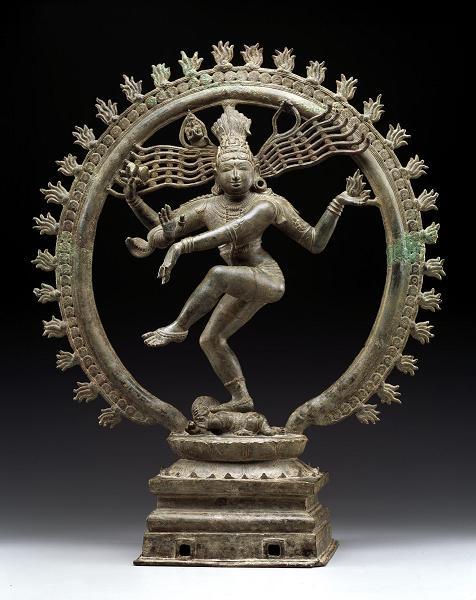
Both Hannah and Melissa selected Shiva Nataraja as the art equivalent of time as a circle.  Shiva is the Hindu deity of creation, destruction, and rebirth, and in this sculpture he dances out the rhythm of the universe.

Shiva Nataraja, India, 11th century, Dallas Museum of Art, gift of Mrs. Eugene McDermott, the Hamon Charitable Foundation, and an anonymous donor in honor of David T. Owsley, with additional funding from The Cecil and Ida Green Foundation and the Cecil and Ida Green Acquisition Fund

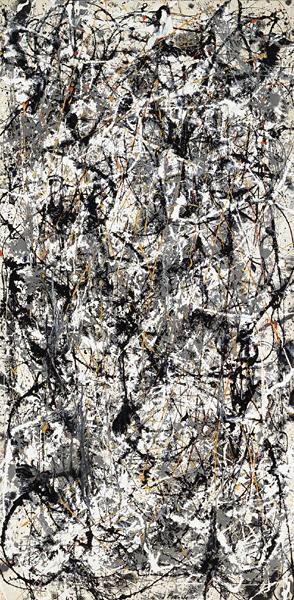
Our part-time intern, Mary Nangah, thought Jackson Pollock’s Cathedral best represented this concept of time.  It’s difficult to identify and starting and ending point for each line.  Time is also represented through the repetition of color and line on the canvas.

Jackson Pollock, Cathedral, 1947, Dallas Museum of Art, gift of Mr. and Mrs. Bernard J. Reis

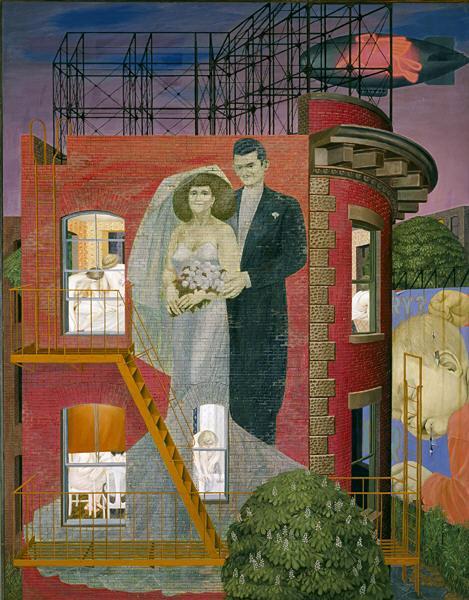
Jessica selected Harry Koerner’s June Night, which shows an intimate view of an apartment complex.  Jessica felt that these vignettes could happen any time, anywhere.  The images of the bride and groom, as well as the baby, also reminded her of the cycle of life.  The final line of this excerpt reads “For in each town, late at night, the vacant streets and balconies fill up with their moans” (Lightman, 9).  Jessica could imagine hearing sorrowful moans on the fire escape of this painting.

Henry Koerner, June Night, 1948-1949, Dallas Museum of Art, Foundation for the Arts Collection, gift of Joshua L. Logan

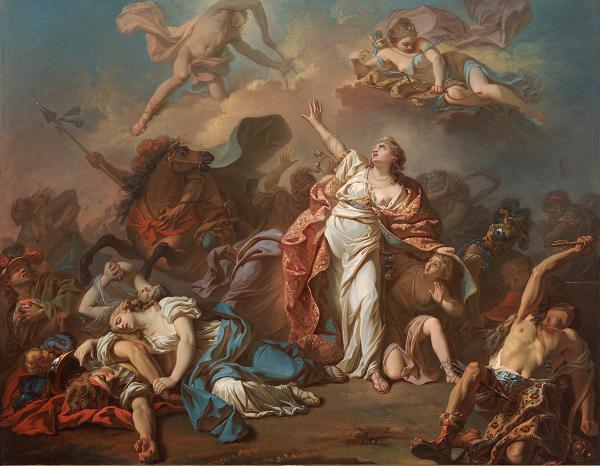
My selection was Apollo and Diana Attacking the Children of Niobe by Jacques-Louis David.  I was especially struck by the last paragraph of the reading, which was about people with unhappy lives who realize that they cannot change their actions and their mistakes will be repeated over and over again.  Here, Niobe pleads with Apollo and Diana to spare the last of her fourteen children from death.  She is being punished for her pride after boasting that her children were more beautiful and strong than Apollo and Diana.  Her final punishment comes when she is turned into a sculpture, forced to mourn for eternity.

Jacques-Louis David, Apollo and Diana Attacking the Children of Niobe, 1772, Dallas Museum of Art, Foundation for the Arts Collection, Mrs. John B. O'Hara Fund in honor of Dr. Dorothy Kosinski

If you were going to select one work of art from the DMA’s collection to represent time as a circle, what work would you choose?  I look forward to reading your responses in the comments!

Shannon Karol
Manager of Docent Programs and Gallery Teaching

*Alan Lightman, Einstein’s Dreams, New York: Vintage Books, 1993.


Archives

Categories