Archive Page 191

Artist Spotlight: Yinka Shonibare MBE

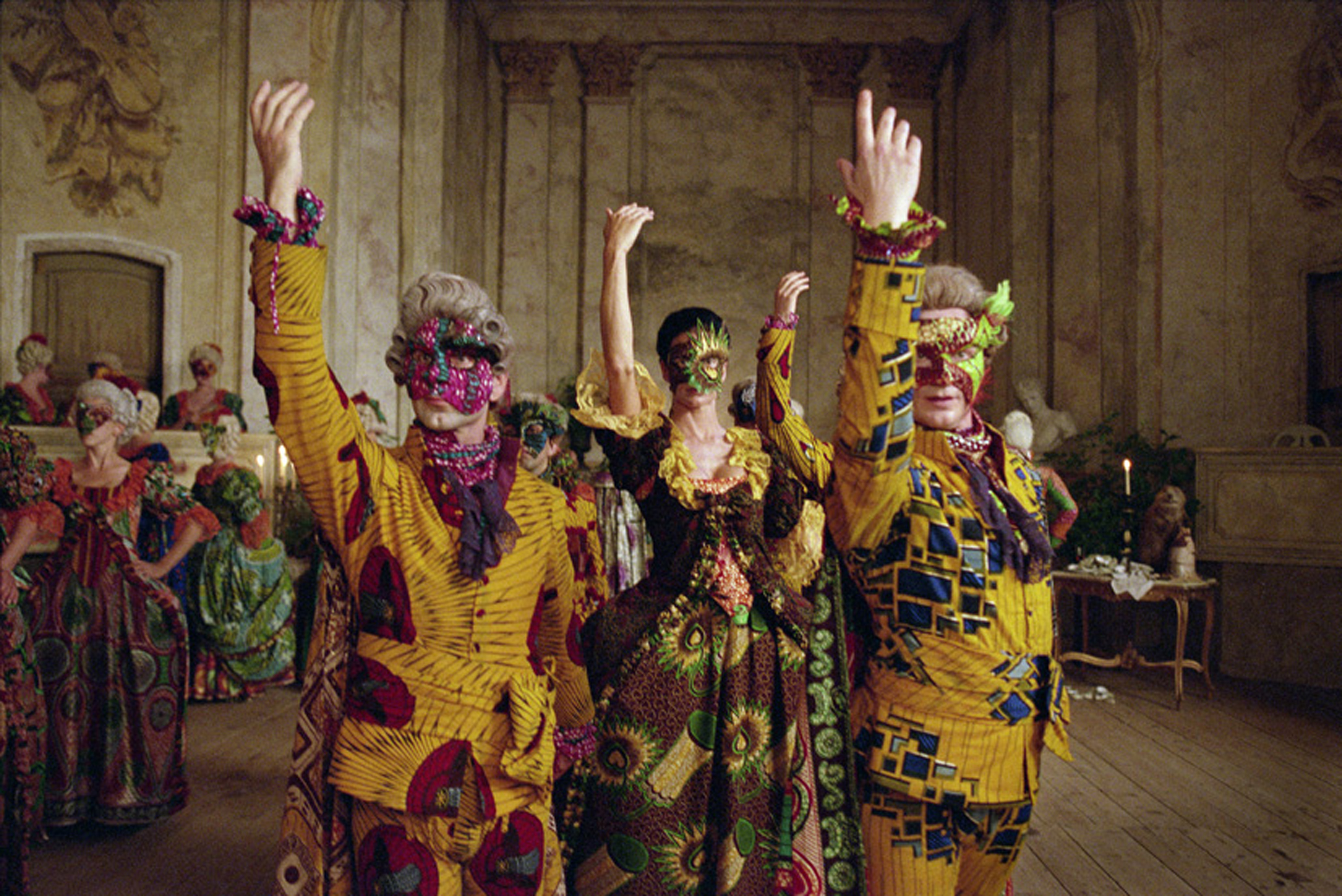
One of the Dallas Museum of Art’s most recent and exciting exhibitions, Performance/Art, centers around contemporary works of art. Along with paintings and installations, the exhibition includes two films, one by Eija-Liisa Ahtila and the other by Yinka Shonibare. Shonibare’s film, Un ballo in maschera (A Masked Ball), is based on an opera by the same name by Giuseppe Verdi and is a visual spectacle that will attract and intrigue visitors.
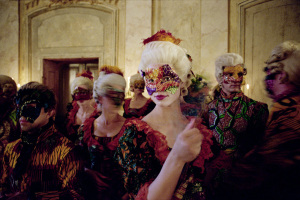
Shonibare, Un ballo in maschera

Un ballo in maschera, Yinka Shonibare MBE

While the story underlying Shonibare’s film is interesting (the assassination of King Gustav III of Sweden), so too is the real life of the artist. Shonibare was born in London in 1962 but raised in Nigeria. This duality of experience and identity is explored in much of his work, which extends beyond film and includes sculpture, painting, photography, and installation. As apparent in the brilliant costumes in Un ballo in maschera, Shonibare frequently works with dyed fabrics which complicate issues of history, colonialism, and our global economy.

Shonibare’s art delves into complex ideas, often layered with multiple points of view, and he emphasizes the aesthetic experience in the process. Some works, such as Lady on Unicycle and Hopscotch, both large-scale installations, include mannequins dressed in Dutch wax-printed cotton. Others, like Dorian Gray, are two-dimensional and include less flamboyant imagery, in this case neutral-colored prints.

Since being awarded the MBE (Member of the Order of the British Empire) in 2005, Shonibare has taken the honorary title as part of everyday usage of his name. This small action hints at what much of his artwork overtly discusses, specifically the ambiguous and contradictory relationship he has with his nationality and identity. More information about Yinka Shonibare and his artwork can be found online at Art:21.

If you would like to experience Un ballo in maschera as well the other works in Performance/Art and All the World’s a Stage, come to our Teacher Workshop this Saturday, November 7, where we will be going through the exhibitions and talking about performance. To sign up, e-mail teacherprograms@DallasMuseumofArt.org or select the Teacher Programs link on our ticketing Web site  to register online.

Logan Acton
McDermott Teaching Programs Intern
November Programs for Teachers

We are gearing up for two exciting programs for teachers this month:

Our first program will be on Saturday, November 7 at 9:00 a.m.  My colleague Logan Acton and I will be leading a teacher workshop on our special exhibitions that take a fresh look at the Museum’s collections through the theme of performance: All the World’s a Stage and Performance/Art.  This workshop starts before the Museum opens to the public, giving teachers the opportunity to explore these exhibitions before other visitors arrive.  Complete details, including registration, can be found on the Web site.

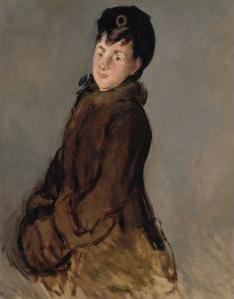
Portrait of Isabelle Lemonnier, Edouard Manet, c. 1879, Dallas Museum of Art

Portrait of Isabelle Lemonnier, Edouard Manet, c. 1879, Dallas Museum of Art

For our Thursday Evening Program for Teachers this month, we will be joining the public lecture Manet, Models, Portraits, and “La Vie Moderne,” given by Dr. Nancy Locke, Associate Professor of Art History, Penn State University, on November 12 at 7:00 p.m.  Admission to this lecture is free for teachers, upon presentation of faculty ID.  Advance registration is not required and seating is limited.  Teachers are welcome to arrive early and join education staff in the “Teachers Lounge” in the Atrium Café.

Information about these and other upcoming programs for teachers can be found at www.DallasMuseumofArt.org/teachers.  We hope to welcome you to the Museum soon for one of these programs!

Molly Kysar
Head of Teaching Programs

The Fourth Graders are Coming!

Three years ago, we embarked on a partnership with the Dallas Independent School District  and Dallas ArtsPartners to provide every 4th grader in the district with a docent-guided visit to the Dallas Museum of Art.  Over the past two years, we have welcomed over 22,000 DISD 4th graders to the DMA for “A Looking Journey” tours.  This week marks the start of these visits for the 2009-2010 school year.

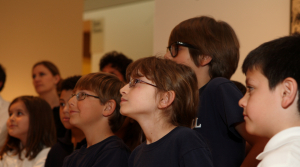
I had the chance to tour with a group of fifteen 4th graders from John Reagan Elementary on Tuesday.  They were bright, observant, and enthusiastic—and I think every person in my group participated in our dialogue in the galleries.  I always set up the idea of taking a journey at the beginning of my tour, and these students really got into it.  As we moved from one work of art to the next, they imagined we were on an airplane flying from New York to Africa and Egypt and then on to Europe.  At one point, I even heard train noises coming from behind me!    

Students1

4th Grade Students in the Galleries

I have been looking forward to the start of these visits since July (when I first scheduled these tours), and I was downstairs on Tuesday when the first DISD students arrived at the Museum.  It was such fun to hear their wonder and amazement as they walked through the doors and saw our Barrel Vault for the first time.  Some of my favorite gallery experiences have happened with DISD 4th graders, and I can’t wait to see what adventures the next year holds.

Shannon Karol
Tour Coordinator

Lights, Camera, Action!

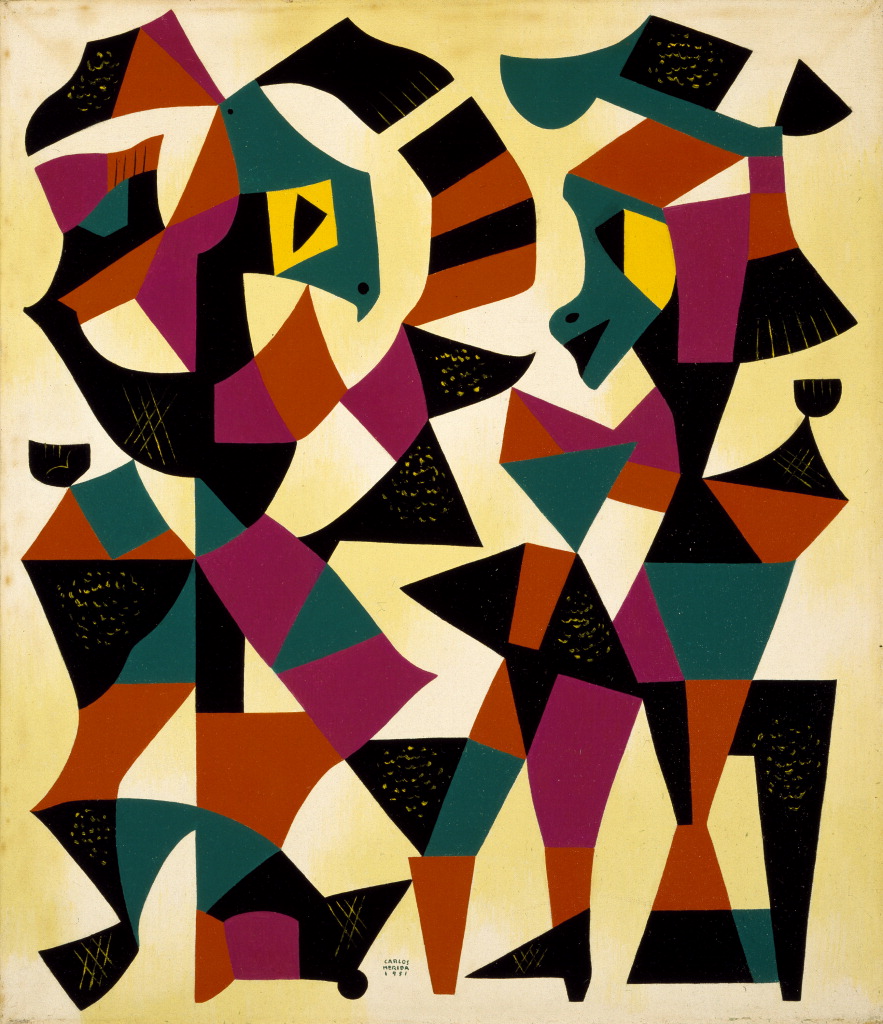
Dancers of Tlaxcala (Danzantes de Tlaxcala), Carlos Mérida, 1951

Dancers of Tlaxcala (Danzantes de Tlaxcala), Carlos Mérida, 1951

It’s an exciting time in the Arts District with the grand opening of the AT&T Performing Arts Center.  In honor of our new neighbor, we’ve developed a new Go van Gogh school outreach program called Creative Connections: Lights, Camera, Action! that focuses on three diverse works of art in the Museum collection and invites students to respond creatively through movement and drama.  Creative Connections programs are 90-minutes long, during which students participate in what we call “experiments” that involve collaborating with others, applying multiple approaches to solving problems, and producing a creative expression.  These programs can be messy, loud, and challenging – and they are definitely a lot of fun.

If you’re a 3-6th grade teacher and don’t mind a little bit of noise in the classroom, I hope you’ll consider this program for your students.   I promise you’ll be amazed and impressed by the creativity, thought, and enthusiasm they put into their performances.  Requesting a program is easy with our online form

With a background in art history and a bit of studio art, the task of writing a program about performance intimidated me.  However, I have the great fortune of working with talented people, and I interviewed some of them during my initial research.  I spoke with Lanita Sene, who I know through our partnership with the South Dallas Cultural Center.  Lanita leads African dance and culture classes during Summer Arts at the Center.  I also spoke with Blanca Reyna and Calvin Rollins, who I met through our partnership with the Ice House Cultural Center summer camp.   Blanca specializes in Aztec culture, and Calvin is a dance student at Southern Methodist University (he also attended Booker T. Washington High School for the Performing  and Visual Arts).  Last, I spoke with my colleague Amy Copeland who studied dance at Booker T. Washington and other studios in the Dallas area. 

This talented group provided many helpful ideas, like warm-up exercises that capture the students’ attention and focus.  Another great suggestion was empowering students by giving them specialized roles in their performances and encouraging them to lead peer critiques. 

I tested the program with 4th graders and 6th graders who created dances, music, masks, and skits inspired by artworks in our exhibition All the World’s a Stage: Performance in the Visual Arts.  The shyest students contributed by helping to plan, write, and direct the performances.  The boldest students reveled in the opportunity to show off in front of their peers.  Afterward, one teacher remarked that it was fun seeing her students in a new light, and the other felt it was a great program for bilingual students.

 This past Friday, I trained our volunteers and gave them the same challenges students experience during the program.  I watched as they worked together in groups, sometimes giggling, at times with their brows furrowed.  They all agreed that they can’t wait to bring the program to Dallas classrooms.

 It’s showtime!

Melissa Nelson
Manager of Learning Partnerships with the Community

The Artistic Furniture of Charles Rohlfs

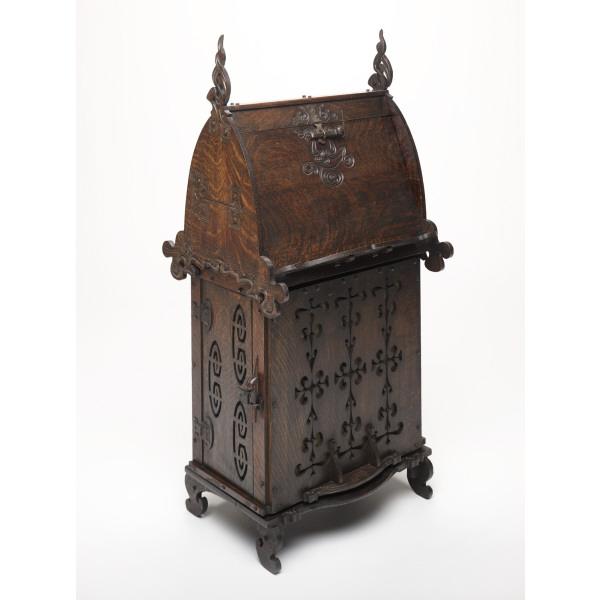
Desk (Model #500) Charles Rohlfs c. 1899-1901

Desk (Model #500) Charles Rohlfs c. 1899-1901

Decorative arts at the DMA has again soared to new heights with the opening of the exhibition The Artistic Furniture of Charles Rohlfs. The exhibition showcases over forty pieces of furniture and related objects produced around the turn of the twentieth century. What makes the show so exciting is the artistic designs and individuality of each hand-crafted piece. Curving lines and intricate forms come together to make inventive designs that demonstrate the artist’s interest in the creation of “artistic furniture.” Rohlfs chose not to be aligned with any particular artistic movement, but instead produced furniture that was bold and imaginative. Many of these works of art are displayed so visitors can walk around them as if they are sculptures.

My favorite work of art in this exhibition is the Desk (Model #500). Curving, smoke-like designs rest on top of an arch reminiscent of a Gothic cathedral while carved patterns on the lower half allow one to look through to the inside. Wood grain patterns on the surface create meandering playful ripples across the desk’s surface. While looking at the desk, I think about how Rohlfs chose to make a functional piece as well as an artistic work of art. This is something that must be seen in person!

The Artistic Furniture of Charles Rohlfs will be on view until January 3, 2010.

-Amy Wolf
Teaching Programs Coordinator

DMA Tech Lab 101

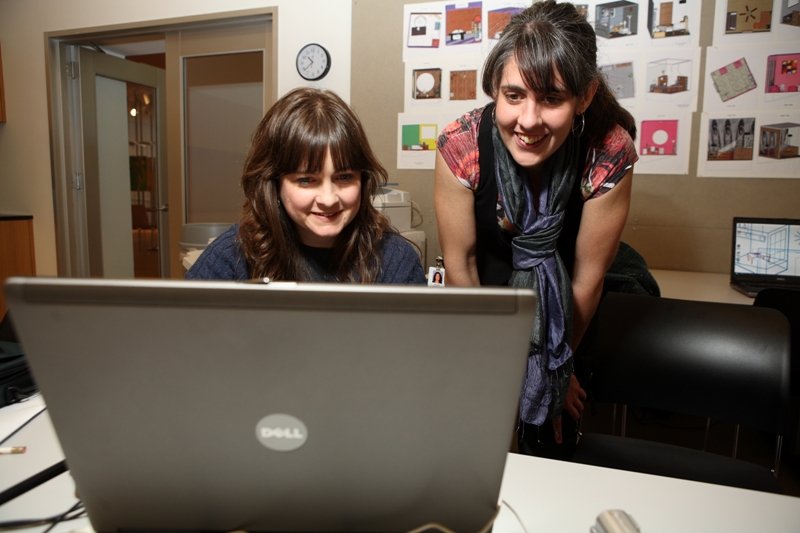
BloggingSeminar_02_2009_037 III invite you to make your way soon to the Tech Lab in the Center for Creative Connections at the Dallas Museum of Art for a new experience with art and technology.  On most days laptops await you and your students in an open lab setting.  You can research one of the many artworks and artists viewed in the Museum galleries.
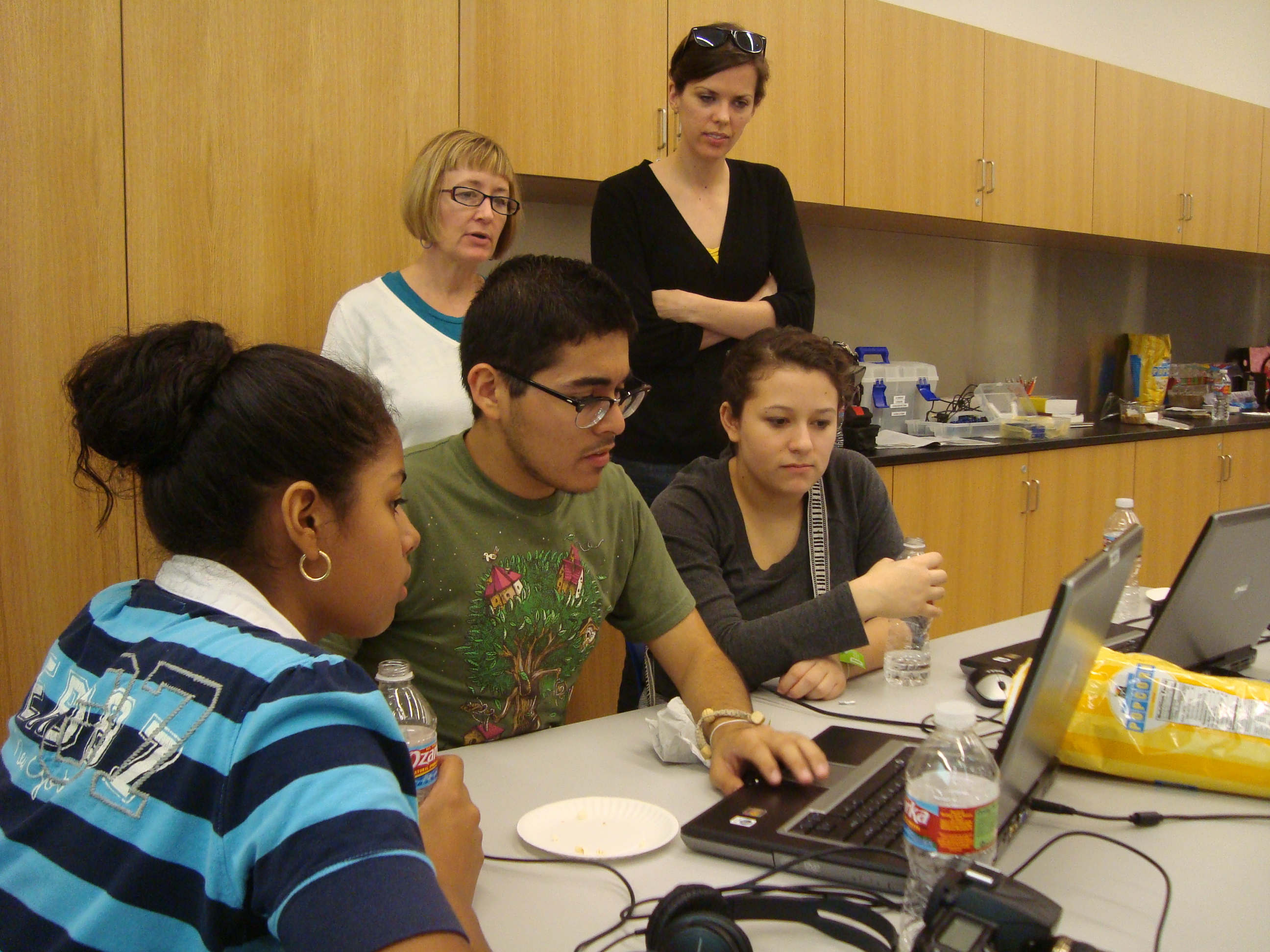
Workshops and special programs for all ages enliven the Tech Lab space on Thursday nights, Late Nights, and weekends.  This past Saturday, the  Booker T.  Washington DSC01561High  School video club met with  local painter and filmmaker,  Trayc  Claybrook.  The task  at  hand?  Make a one-  minute movie using the  theme “chairs”.  Inspired by  the design and film work  of Charles and Ray Eames,  the students ventured into  the galleries for filming and  initiated the editing process in the Lab.  Other workshop topics for families, kids, teens, and adults include stop-motion animation, podcasting, graphic design with Photoshop Elements, mini-documentary, and photography.  Workshops include time in the galleries connecting with works of art and time in the Tech Lab working creatively with technology tools to produce original work.  Check the Web site for workshop listings — a new calendar will be posted soon!
Drop by the Lab on the second Thursday of every month and every Late Night for hands-on Open Lab sessions with Technology experts.  Coming up at the November Late Night: University of North Texas art students present interactive art you can touch!

Nicole Stutzman
Director of Learning Partnerships with Schools and the Community

New Resources for Teachers

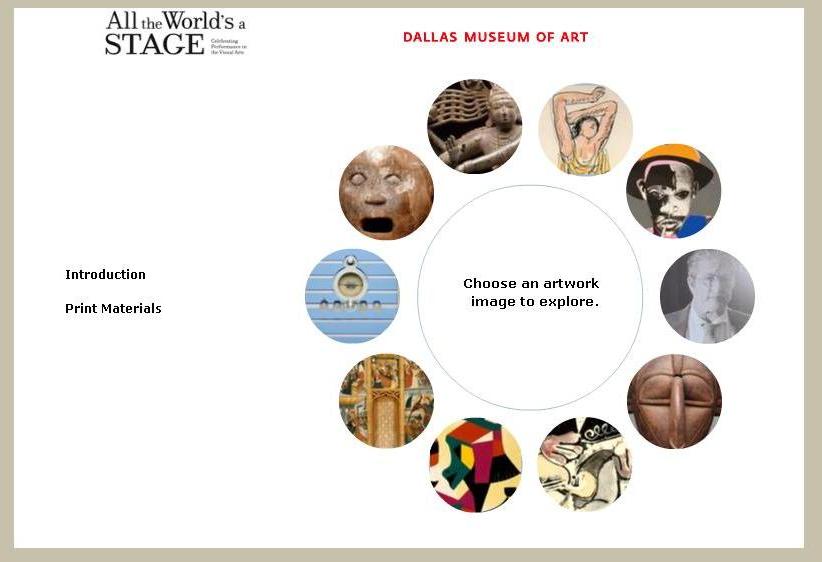
ATWAS Pachy imageExplore ten works of art in the new All the World’s a Stage:Celebrating Performance in the Visual Arts teaching materials.   These resources include information, images, music, and  much more! 

I encourage you and your students to discover ways that these works of art communicate ideas about the power of performance.

Until next time…

Jenny Marvel
Manager of Learning Partnerships with Schools

Performance/Art

Yinka Shonibare, MBE, Un ballo in maschera, 2004

Yinka Shonibare, MBE, Un ballo in maschera, 2004

Amid Dallas Arts District excitement last Thursday, the DMA opened Performance/Art, an exhibition featuring works of six contemporary artists who respond to and reshape ideas about performance, theater, and opera. 

 Argentine artist, Guillermo Kuitca, uses the seating chart from the Dallas Opera House as inspiration for several artworks—digitally altering seating chart colors, printing them on photo paper and spraying them with water—creating beautiful, diaphanous abstractions that resemble watercolor paintings. (Kuitca will visit SMU next week to discuss his works.)  Also featured in the exhibition are pieces by David Altmejd, Eija-Liisa Ahtila, and Dallas artists Frances Bagley and Tom Orr.

 My favorite work is by British-born, Nigerian artist, Yinka Shonibare.  Shonibare’s Un ballo en maschera (A Masked Ball) is a film based on Giuseppe Verdi’s opera of the same name.  The opera combines true and fictionalized elements of the assassination of King Gustav III of Sweden, at a masked ball. In the piece, Shonibare merges his African and European roots; dressing the film’s dancers in stunning Roccoco-inspired costumes made of Dutch Wax cloth, a colorful, patterned trade cloth sold by the Dutch to West Africans. He also plays with narrative in his re-imagining of the story: once the King has been assassinated, the story plays in reverse, and (amazingly!) dancers perform choreography backwards. The film has no music or dialogue, but other sounds have a powerful presence; dancers whisper gossip that fills the ballroom and punctuate their movements with quick, sharp inhalations (which also get reversed!). 

 I asked fellow educators to share a word or phrase that captured their experience of Un ballo en maschera.  Below are their thoughts—we’d love to hear yours, too!

Striking—vivid—breathtakingly beautiful—colorful action—swirling drama—heartbeat—intense

Amy Copeland
Coordinator of Learning Partnerships with Schools and the Community

Community Connection: Connecticut to Dallas to Houston and back.

This month’s Community Connection is Vicki Meek, Manager of the South Dallas Cultural Center. I would be hard-pressed to find someone else in Dallas who embodies the words “community” and “connection” more than Vicki. Not only is she a prominent member of the Dallas arts community, but of the Houston arts community as well. Read below to find out more!

Tell us a bit about yourself.

I’ve been involved in the Dallas arts community since 1980. I first actually came here as an artist, coming from being a Senior Program Administrator at the Connecticut Commission on the Arts. I came here to get married and decided I was just going to be an artist. That lasted about 2 years.  Then, I had a baby boy and had to get a “real” job again. In summary, from 1977 to the present I’ve had arts administration experience on a state agency level as an Arts and Education Coordinator and then as a Senior Program Administrator.  I followed that with multiple positions developing programs for local arts agencies. I am now the Manager of the South Dallas Cultural Center, and have been with the Center since 1980. 

Tell us about your work at Project Row Houses in Houston.

Round 31 Life Path 5: Action/Restlessness was designed to celebrate the 15th anniversary of Project Row Houses by taking it back to its original intent: using visual art as an agent for social change and community engagement in that community. I was the curator of Round 31; I selected the artists involved with the project and also did a house myself. My house is the Imani/Nia House. The house is designed to get people to think about how their spiritual selves motivate their activism. I worked on the installation for two weeks, and just returned to Dallas this past Sunday. 

What advice would you give to young artists?

Be vigilant in your pursuit of excellence. It’s a very hard field to be in, and if you’re not absolutely passionate about what you’re doing, you will not survive it. 

Finish this sentence: In 10 years, I’d like to be…

Happily married in Senegal. I’m actually doing this in three years.

The Dallas Museum of Art partners annually with the South Dallas Cultural Center during their Summer Arts at the Center program. In 2009, DMA staff worked with the teens at the Center to create a presentation on their summer topic, the Middle Passage.  The group met twice a week throughout the five-week program, and worked collaboratively on the research, writing, and design of the presentation.  In addition, they selected works of art from the DMA’s African collection to help illustrate their topic.  Much of their time was spent in the DMA’s Tech Lab, where the teens wrote and built their presentation. 

Melissa Nelson
Manager of Learning Partnerships with the Community

Art Beyond Sight

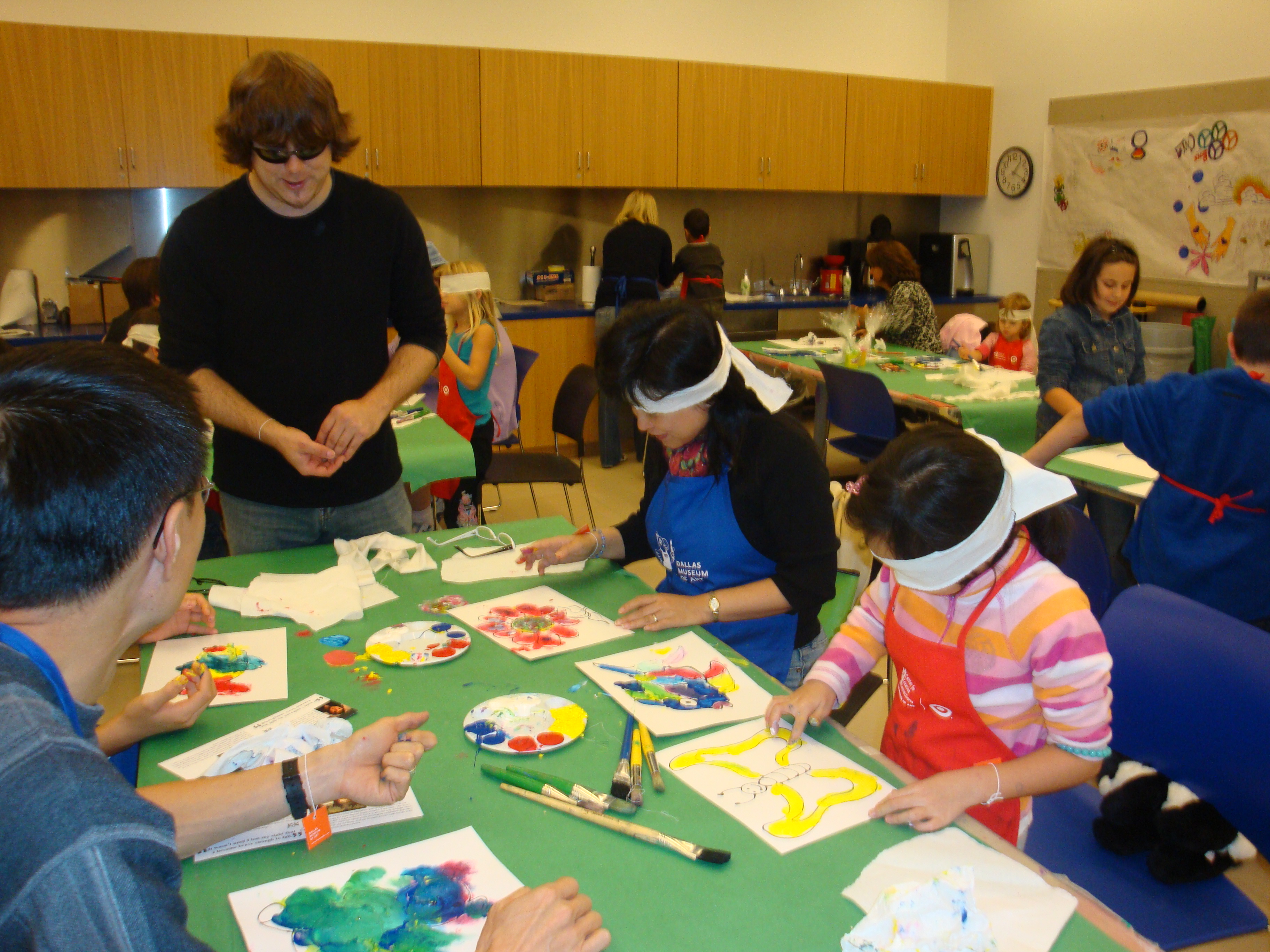
DMA guest artist, John Bramblitt, instructs workshop participants

DMA guest artist, John Bramblitt, instructs workshop participants

Have you ever made an artwork blind-folded? 

This past Saturday, visitors to the Museum did just that—painting purely through the sense of touch—under the skilled direction of blind painter, John Bramblitt.  Bramblitt is a guest artist at the DMA in October, in conjunction with Art Beyond Sight Awareness month. Organized by Art Education for the Blind (AEB), Art Beyond Sight Awareness month raises awareness about integrating art into the lives of adults and children affected by sight loss. Bramblitt will demonstrate his process and hold another participatory workshop at the Museum on Thursday, October 29th from 6:30-8:30 in the Center for Creative Connections

We hope you’ll join us then!

Amy Copeland   
Coordinator of Learning Partnerships with Schools and the Community


Archives

Categories