Archive for the 'Education' Category


#DMAGiveMore

DSC_0800
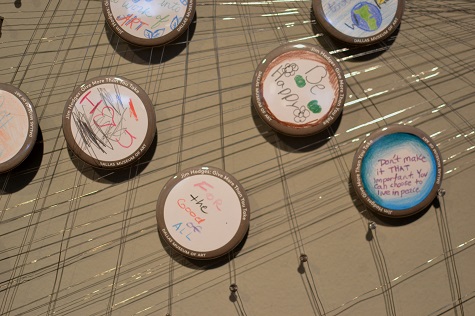
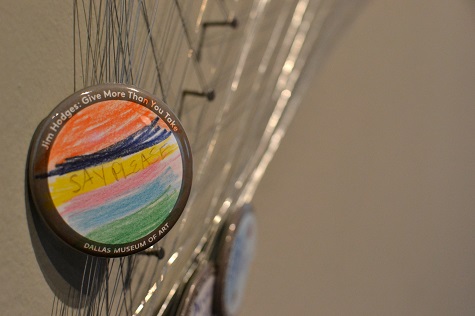
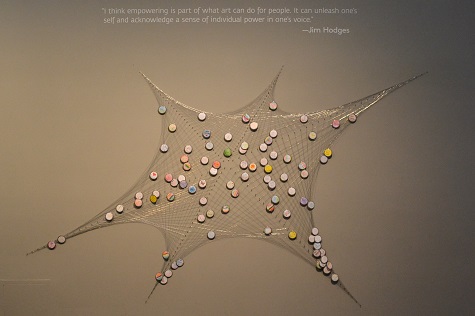
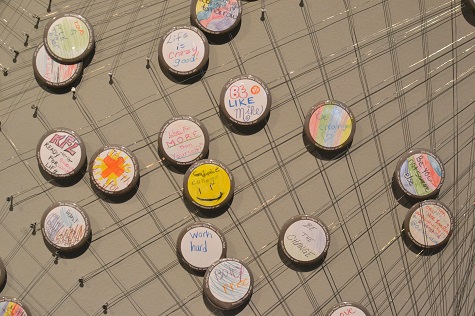
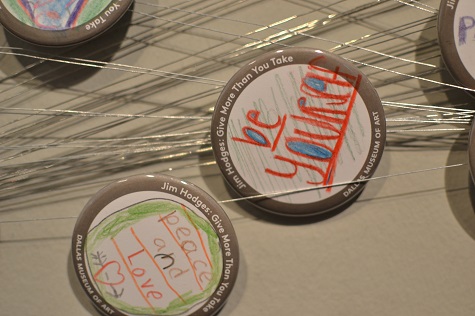
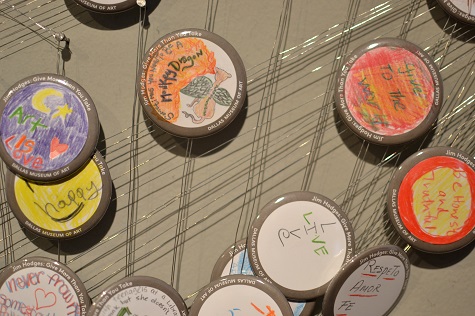
The Center for Creative Connections (C3) has taken the Jim Hodges exhibition title, Give More Than You Take, as a call to action. Hodges gave the exhibition this title after reflecting on what it means to be an artist and have a voice in our community. Inspired by this idea of the power of our individual voices, we are offering visitors a chance to consider how they might use their voices in creative and positive ways.

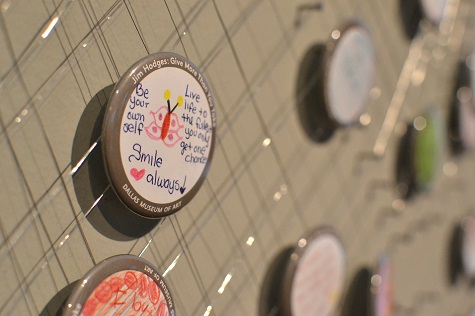
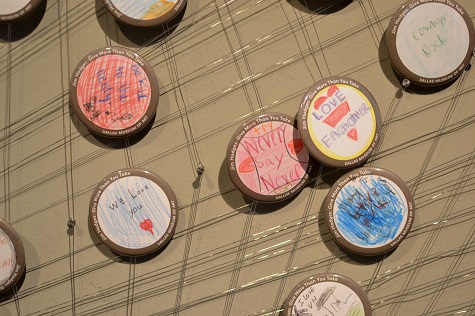
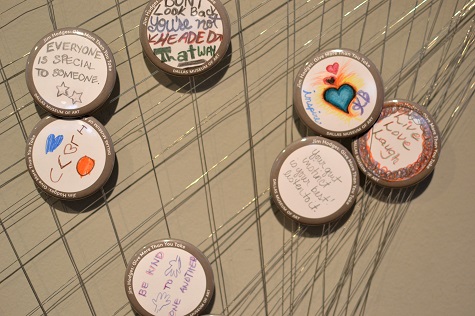
Throughout the run of the exhibition Jim Hodges: Give More Than You Take, we are hosting a Community Exchange in C3. You can make a button with a personal, positive motto that you want to share with the community. Then leave the button you create on our Community Exchange wall and take someone else’s button from the wall.

Wear the button you take out into the community to share a positive message. Document your button’s journey by tagging photos with #DMAGiveMore (check out our #DMAGiveMore on the DMA’s Instagram).

Want to truly give more than you take? Make a positive gesture by giving your new button away to someone else.
DSC_0072

Jessica Fuentes is the C3 gallery coordinator at the DMA.

DMA Park Rangers

It’s hard to believe one whole year has passed since our neighbor Klyde Warren Park  opened its gates. In honor of the first anniversary, we created a Park Rangers guide to the DMA.

The role of a ranger is to care for and protect the flora and fauna of the park and to educate visitors about them. As a former park ranger, I can personally attest that the jobs that we do here at the DMA aren’t entirely different! We just focus on works of art instead of nature. And, there is actually quite a bit of nature to be investigated within the Museum’s walls.

Come to the DMA and explore nature on the Park Rangers self-guided tour. Print it at home before your visit or ask a friendly gallery attendant—the DMA’s own version of a park ranger—for one when you arrive.

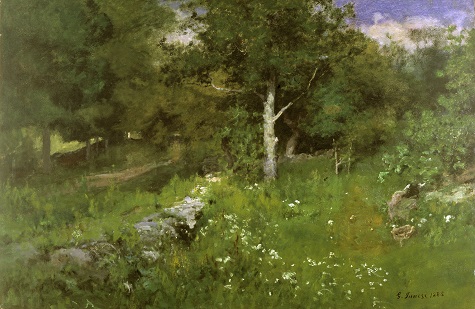
George Inness, Summer Foliage, 1883, oil on canvas, Dallas Museum of Art, bequest of Joel T. Howard

George Inness, Summer Foliage, 1883, oil on canvas, Dallas Museum of Art, bequest of Joel T. Howard

One tour stop is George Inness’s Summer Foliage, which shows the artist’s unique ability to bring to life a traditional landscape scene. After your Museum visit, saunter over to Klyde Warren Park to experience nature firsthand, right in the middle of the Dallas Arts District!Practice capturing your own landscape with a camera or a phone. Don’t forget to tag your photo #DMAParkRanger.

Andrea Vargas Severin is the interpretation specialist at the DMA.

Sensing Sight

It’s Art Beyond Sight Awareness Month, and we have lots of great programs happening at the DMA throughout October that focus on visual awareness, including a number of opportunities to meet and work with artist John Bramblitt. John is a visual artist who lost his vision in 2001. Check out the month’s activities here, and meet John in the video below.

[youtube=http://www.youtube.com/watch?v=k1eRXGgsc3c&w=560&h=315]

Kimberly Daniell is the PR manager and Adam Gingrich is the marketing administrative assistant at the DMA

Open Office: Center for Creative Connections

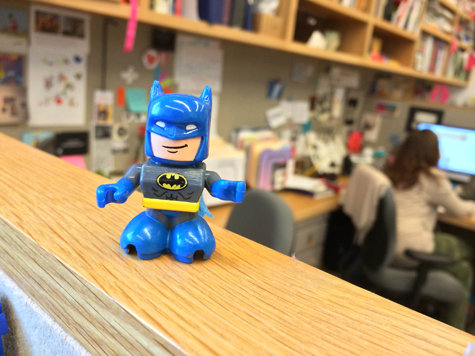
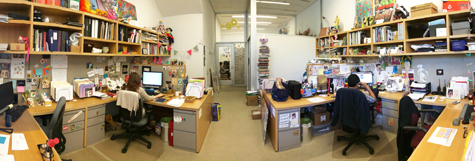
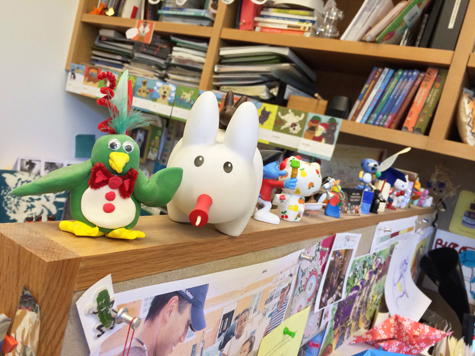
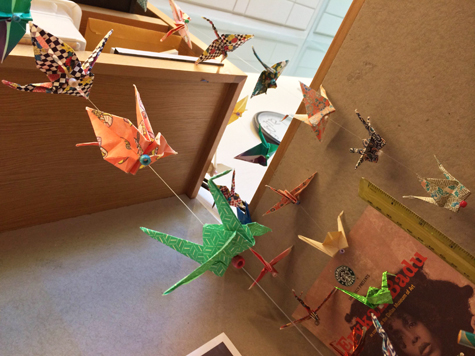
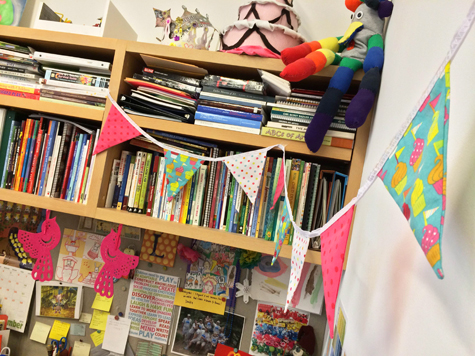
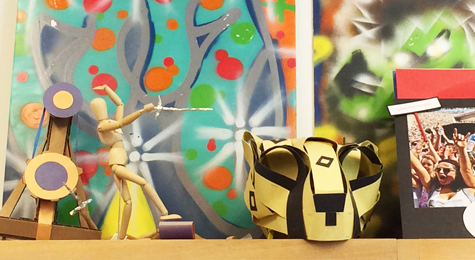
Most people don’t realize how fun having an office on the first floor of the museum can be! The ten of us (plus one intern) in the Center for Creative Connections (C3) office space are especially close, quite literally. We all sit within earshot of each other and are very close to the visitors in C3, which makes it a very lively workplace! Those who live here during the day (and often get locked in because they have stayed too late) are a fabulous group from the DMA’s C3 team; the wonderful ladies from the Family, Access, and School Experiences squad; and the Head of Community Engagement. You can visit Susan, Amanda, Amanda, Leah, Maria Teresa, JC, Danielle, Melissa, Jessica, Amy, and Tyler anytime you want! Just don’t forget which Amanda is which.

1

2

6

5

7

8

Amanda Batson is the C3 program coordinator at the DMA.

A Passion for Pachyderms

Little-known fact: September 22 is Elephant Appreciation Day. I’ll bet you haven’t celebrated it before! Well, here at the DMA, we love elephants. Dumbo, Babar, Horton–they’re all great examples of lovable elephants, but our favorite elephants live on the third floor of the Museum.

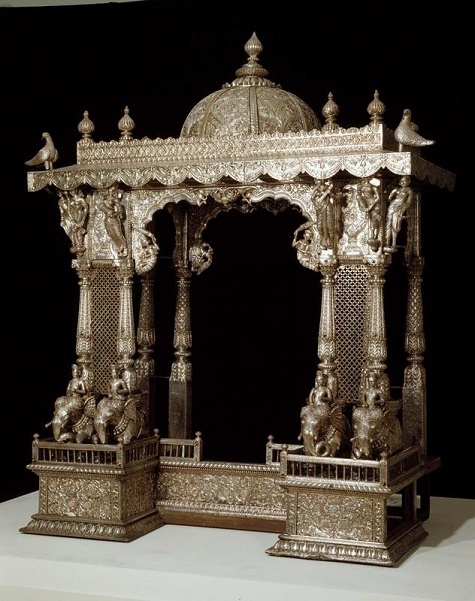
Shrine, late 18th-19th century, silver over wood, Dallas Museum of Art, gift of David T. Owsley via the Alvin and Lucy Owsley Foundation

Shrine, India, Gujarat, late 18th-19th century, silver over wood, Dallas Museum of Art, gift of David T. Owsley via the Alvin and Lucy Owsley Foundation

1
2

This shrine was most likely used in a private home or chapel in India. Notice the intricate details on the elephants and their riders. This particular shrine is made of carved wood and covered with hammered sheet silver using a technique called repoussé. First, designs are created by hammering into the reverse side of a malleable metal. Then, the design is refined by chasing or embossing, to really get those little details to come to life.

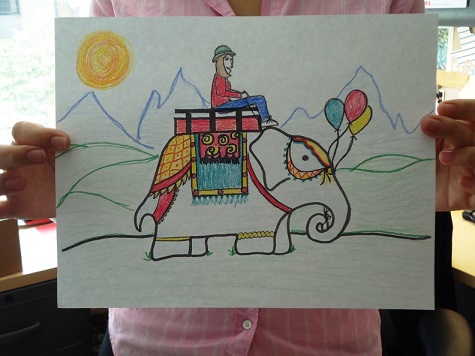
I asked a few DMA staffers to take a good look at the shrine and then imagine what it would be like to be a part of the artwork. This is an activity that anyone can do at the DMA at our Pop-Up Art Spot around the Museum! If you haven’t already dropped by, make sure you do the next time you’re here. There are many different activities that can be done while you are in the galleries. Check out these talented drawings made at the shrine earlier this week!

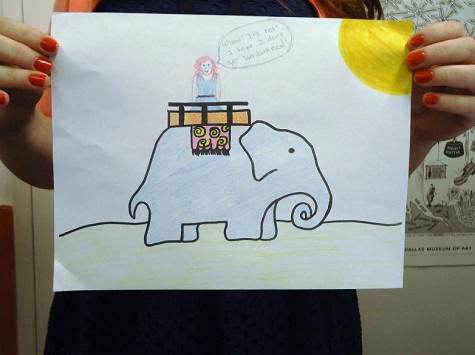
Emma Vernon, Manager of the DMA Partners Program, drew herself traveling through Nepal on a very festive elephant!
4

McDermott Intern Madeleine Fitzgerald drew herself into the picture.
5

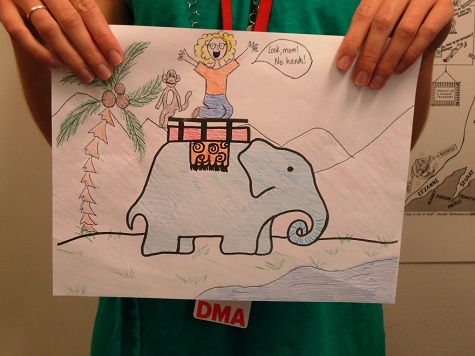
Sitting alongside a monkey is McDermott Intern Amy Elms.
6

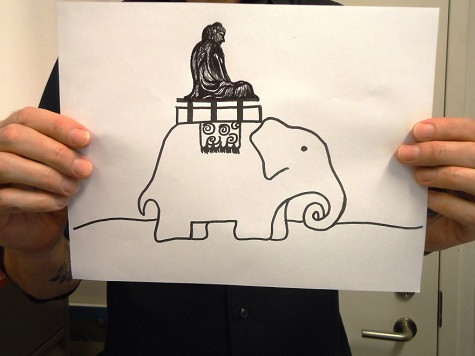
Our Exhibitions Graphic Designer, Kevin Parmer, chose to do his drawing in black and white.
7

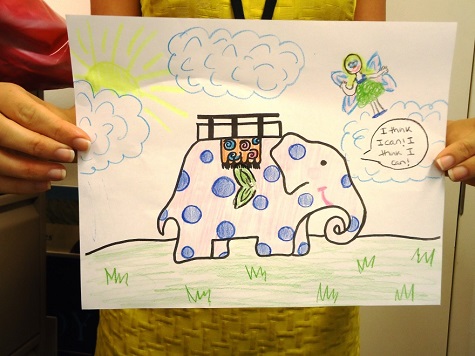
McDermott Intern Hayley Prihoda shows that anything is possible with her whimsical elephant.

8

The next time you’re at the Museum, stop by a Pop-Up Art Spot and have some fun! It is open from noon to 3:00 p.m. Tuesday-Friday and 11:00 a.m. to 4:30 p.m. on the weekends. Also, be sure to come by and show the elephants in the shrine your appreciation!
DMA_PopUp Art Spot_2
Hayley Dyer is the Audience Relations Coordinator for Programming at the DMA.

Go van Gogh, Past to Present

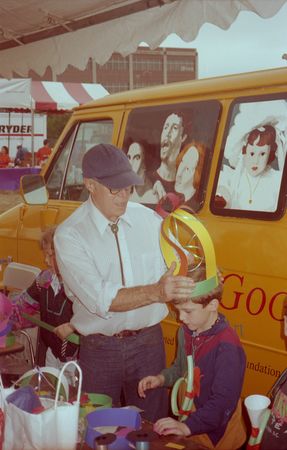
Go van Gogh, the DMA’s elementary school outreach program, is celebrating its 35th anniversary this year. Before we pack up the Go van Gogh van and head out to schools across the city, we thought it would be fun to take a look through all thirty-five years of the program.

Go_Van_Go_1992

1992 Go van Gogh program led by DMA educator Phil Collins

Below are a few fun facts about Go van Gogh through the years.

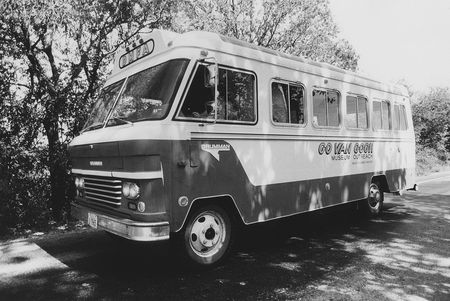
The first Go van Gogh van was actually a bus!

Go_Van_Go_1978

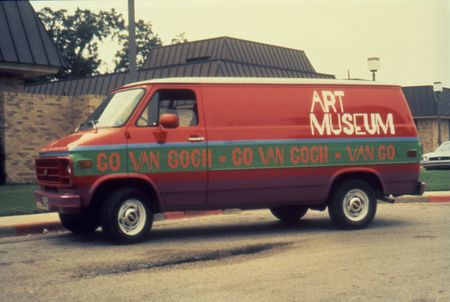
First Go van Gogh vehicle, 1978

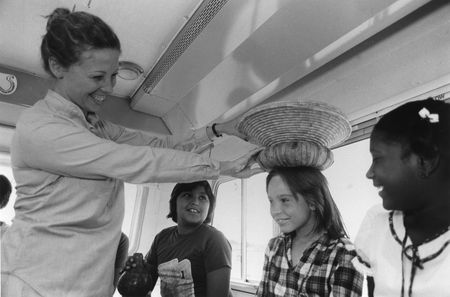
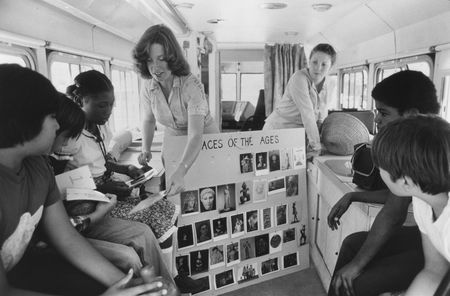
When the program began at the then Dallas Museum of Fine Arts in Fair Park in 1978, school outreach presentations could be given in classrooms or on the Museum Outreach bus itself.

Go_Van_Go_1979_Outreach_002

DMFA teaching staff member Roberta Mathew conducting an outreach program in the Go van Gogh bus in fall 1979

Go_Van_Go_1979_Outreach_001

DMFA education staffers Susan Geyer and Roberta Mathews conducting an outreach program aboard the Go van Gogh bus in fall 1979

Go van Gogh vans (and buses) have always been easy to spot on the freeway.

Go_Van_Go_1981

Go van Gogh van in 1981

Go_Van_Go_c1988_001

Go van Gogh van, c. 1988

Go_Van_Go_c1988_002

Go van Gogh program, c. 1988

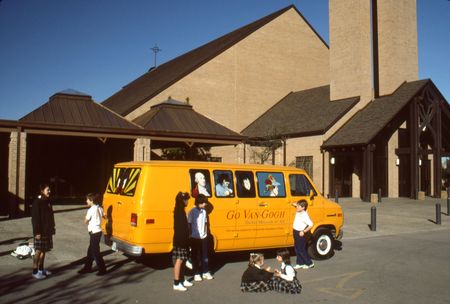
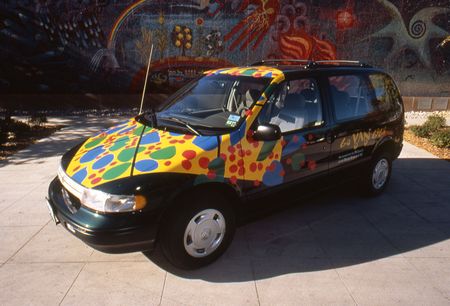
Bright and colorful, Go van Gogh vans often feature artworks from the Museum’s collection in painted or vinyl designs. The Go van Gogh van from the late 1990s included a design from Henri Matisse’s Ivy in Flower.

Go_Van_Go_1990s_002

Go van Gogh van in the 1990s

Go van Gogh van

Today’s Go van Gogh van

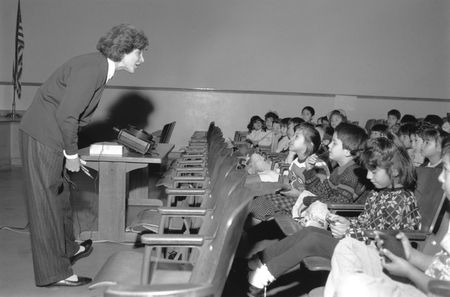
Go van Gogh programs have always included a visual presentation of artworks from the Museum.

Go_Van_Go_Outreach_004

Go van Gogh program using a slide projector, 1980s or 1990s

Through the years, we’ve made many updates in the technology we use to bring these artworks to life. What began with projectors and large printed posters led to overhead transparencies and laminated images.

GvG MT Reilly Elementary, 4th grade

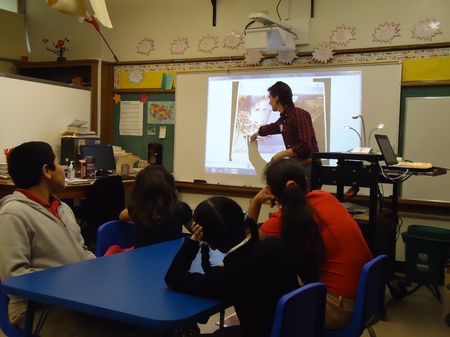
Go van Gogh program with 4th graders at Reilly Elementary School

Later this school year, Go van Gogh will go digital: using iPads and projectors to bring images of artworks to life in the classroom.

Looking ahead to fall, we are excited to unveil a new facet of Go van Gogh outreach–a program designed for Special Education classrooms called Color My World. To learn more about the program, visit our website.

Amy Copeland is the Manager of Go van Gogh and Community Teaching Programs at the DMA.

Audio Tours 21st-Century Style

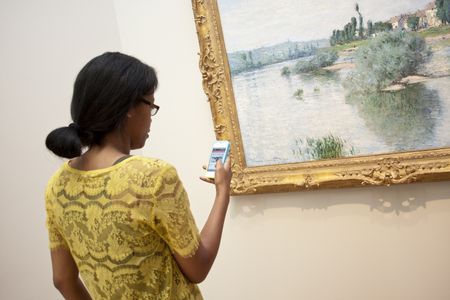
Audio tours have been part of the Museum world for a while, but now you no longer need a shoulder strap when exploring the DMA’s collection. Visitors to the DMA can use their web-enabled devices to access information about the collection, including video interviews, images, geographical information, and responses from the community through the DMA smARTphone tours. Some special exhibitions even have a free smARTphone tour. Right now, discover oral histories tied to Hotel Texas: An Art Exhibition for the President and Mrs. John F. Kennedy (on view through September 15, 2013), and this October you can learn more about the Jim Hodges: Give More Than You Take exhibition from artist Jim Hodges and co-organizing curator Jeffrey Grove, senior curator of special projects & research at the Dallas Museum of Art.

Visitors using audio tour, circa 1960s [Photography by Pat Magruder]

Visitors using audio tour, circa 1960s
[Photography by Pat Magruder]

Visitor using smARTphone tour, 2012

Visitor using smARTphone tour, 2012

Hillary Bober is the Digital Archivist at the Dallas Museum of Art.

Reading, Writing, and Arithmetic

I don’t know about anyone else, but I’m looking forward to the start of a new school year later this month. The DMA’s galleries have been quiet during the “school day” without the sounds of docents, teachers, and students deep in conversation about works of art. I thought it might be fun to celebrate back-to-school time with a DMA tribute to the “three Rs.”

Reading
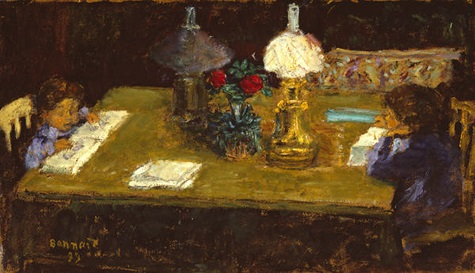
Pierre Bonnard often used his nieces and nephews as models for his paintings. Bonnard was also fascinated by education, and in this painting he shows his nephews Charles and Jean Terrasse reading at a table. It’s easy to imagine that these two children are completing their homework assignments before going to bed. It certainly looks as if one of the boys is more interested in his reading than the other—a scene that is probably familiar to many parents and teachers.

Pierre Bonnard, Interior: The Terrasse Children, 1899, oil on paper board panel, Dallas Museum of Art, The Wendy and Emery Reves Collection

Pierre Bonnard, Interior: The Terrasse Children, 1899, oil on paper board panel, Dallas Museum of Art, The Wendy and Emery Reves Collection

Writing
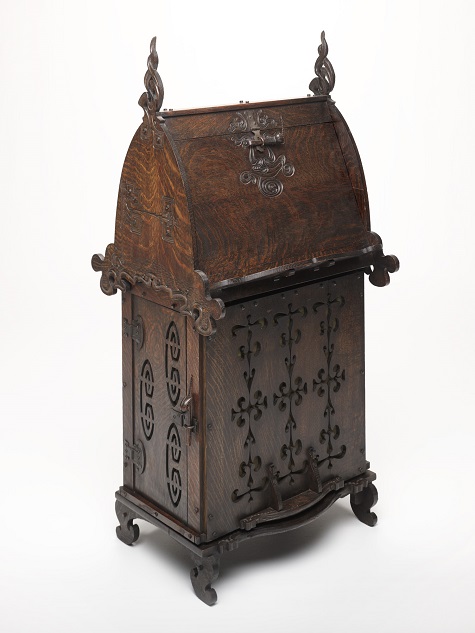
Charles Rohlfs’ Swinging Writing Desk was one of the trademarks of his artistic furniture style. The desk rests on a footed platform and spins on a series of small wheels. The interior of the desk is divided into small compartments—perfect for storing pencils, pens, and any other supplies you might need. I don’t think I would mind doing homework if I had such a beautiful desk to use.

Desk (Model #500), Charles Rohlfs, Charles Rohlfs Workshop, c. 1899-1901, white oak with iron hardware, Dallas Museum of Art, anonymous gift

Desk (Model #500), Charles Rohlfs, Charles Rohlfs Workshop, c. 1899-1901, white oak with iron hardware, Dallas Museum of Art, anonymous gift

Arithmetic
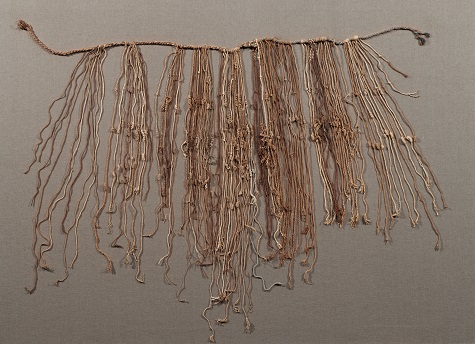
The name khipu comes from a Quechua word meaning “knot,” a fitting name as khipu are made up of many strands of knotted fibers. It is not known what the knots signify, but it is thought that they represent a numerical record. Numbers may be indicated by the size and position of each knot on its cord.

Fragmentary khipu with two main cords and top and subsidiary and tertiary cords, Inca, Late Horizon, c. A.D. 1476-1534, cotton, plant fiber, and indigo dye, Dallas Museum of Art, the Nora and John Wise Collection, bequest of John Wise

Fragmentary khipu with two main cords and top and subsidiary and tertiary cords, Inca, Late Horizon, c. 1476-1534, cotton, plant fiber, and indigo dye, Dallas Museum of Art, the Nora and John Wise Collection, bequest of John Wise

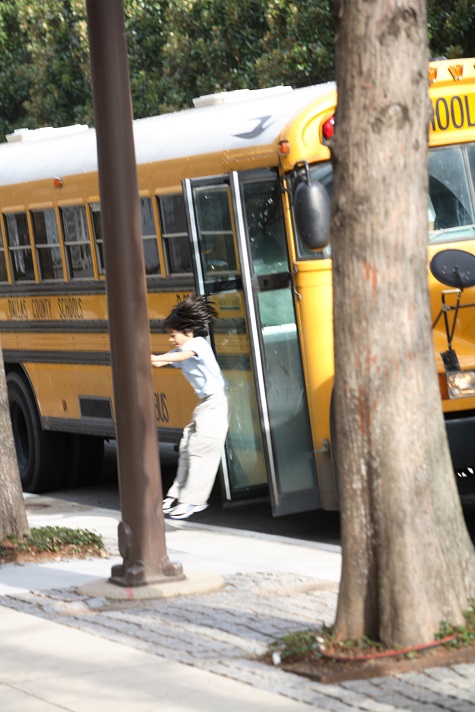
September 16 is the official start date for student programs at the DMA, but we’re currently taking reservations for Museum visits and Go van Gogh outreach programs. Scheduling information can be found online. If you are an educator, we hope you’ll consider bringing your students to the Museum this year. I hope they’ll be as excited as this student was to visit the DMA!

Student jumping off of a school bus at the DMA.

Student jumping off of a school bus at the DMA.

Shannon Karol is Manager of Docent and Teacher Programs at the DMA.

Defining Beauty

Body_Beautiful_Installation_2013_36

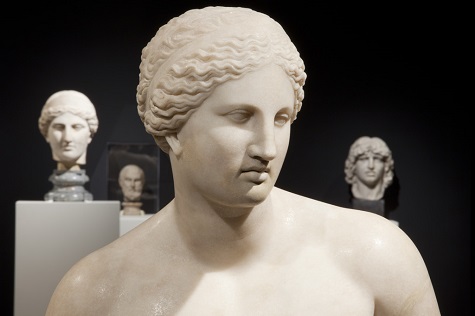
As you may know, The Body Beautiful in Ancient Greece: Masterworks from the British Museum, featuring key works from the collection of Greek and Greco-Roman masterpieces at the British Museum, is currently on display at the DMA. This exhibition, on view through October 6, highlights many representations of the human body and invites us to consider how beauty is defined. Greeks believed that one’s physical, outward appearance was a reflection of one’s inner character—if one was outwardly beautiful, one must also be inwardly virtuous. The body was of utmost importance, and the physical was strongly linked to the moral in Greek minds and culture.

Marble statue of discus thrower (diskobolos), Roman period, second century AD, after a lost Greek original of about 450–440 BC, from the villa of the emperor Hadrian at Tivoli, Italy, GR 1805,0703.43 (Sculpture 250) AN 396999, © The Trustees of the British Museum (2013). All rights reserved.

Marble statue of a discus thrower (diskobolos), Roman period, 2nd century AD, after a lost Greek original of about 450–440 BC, from the villa of the emperor Hadrian at Tivoli, Italy, © The Trustees of the British Museum (2013). All rights reserved.

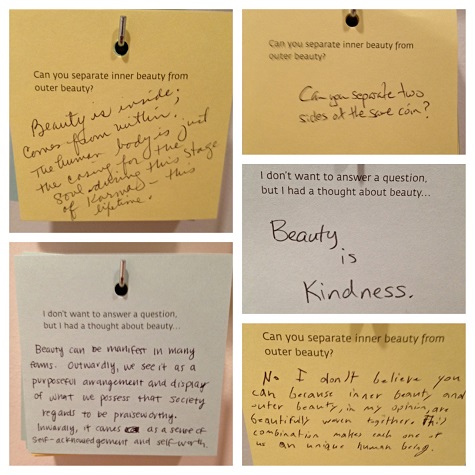
Now, almost two thousand years later, how much have our ideas about beauty changed? Looking at the stunning Diskobolos, do you believe that physical beauty reflects virtue? Or do you think that inner and outer beauty are independent of one another? And how much are your ideas about beauty a product of the culture in which you live? Because the DMA believes that art should spark further thought and discussion, at the end of The Body Beautiful exhibition we created a visitor response wall, where visitors can share their thoughts about beauty after experiencing the exhibition. The response wall consists of two different cards that visitors may choose to fill out—one asks, “Can you separate inner beauty from outer beauty?” and the other reads, “I don’t want to answer a question, but I had a thought about beauty…”

1

As you can see, we’ve gotten some excellent, insightful, and varied comments! We’re keeping track of them, and we’d love for you to respond as well. This month, receive a $4 discount on an exhibition ticket when you purchase online prior to your visit!

Elizabeth Layman is a summer intern at the DMA with Adult Programs and Arts & Letters Live.

Oil and Cotton’s Use of Available Space

SPACE
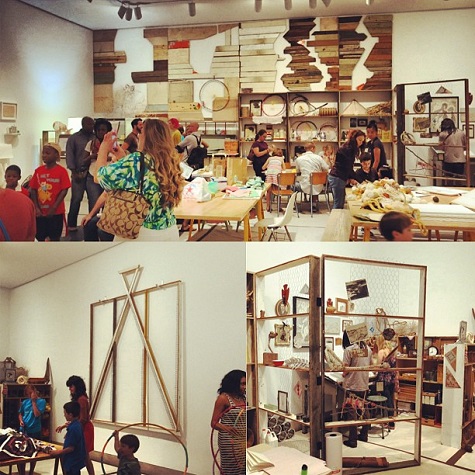
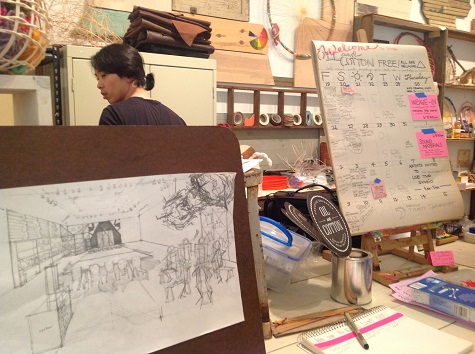
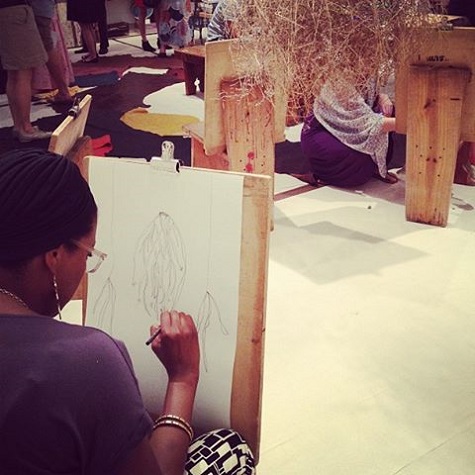
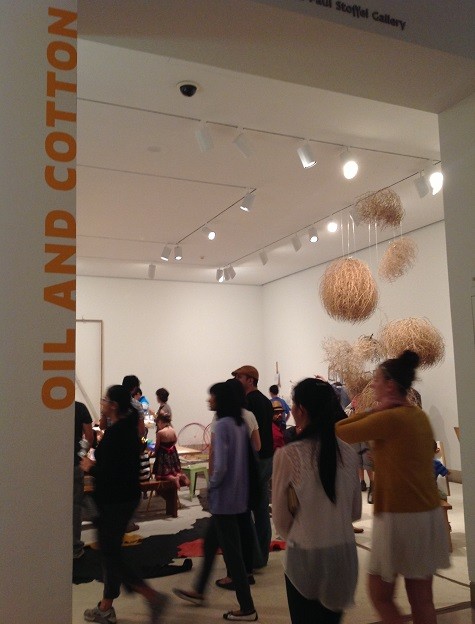
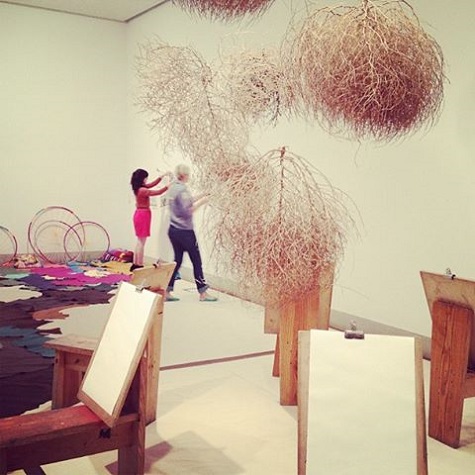
If you’ve stopped by the DMA’s Barrel Vault you have seen the Museum’s first experimental space, DallasSITES: Available Space, with art installations and programming from area artists, collectives, and educators. Oil and Cotton, located in Oak Cliff, has an interactive project room where visitors can participate in free workshops and drop-in activities. We caught up with their co-founders to see how the first week has gone:
photo

DMA: What does it mean to Oil and Cotton to be involved in the DMA’s first experimental space, DallasSITES: Available Space?
Oil and Cotton: It is a huge honor for us to be exhibiting in DallasSITES: Available Space. It feels great to be recognized by our peers, whom we respect so much. And it is validating to be seen for exactly what we are – an artwork that serves through education.
DRW

DMA: What can visitors expect in the Oil and Cotton project room?
O + C: They can expect to use it however they see best. We mean for it to be inviting for all ages at all levels of experience. I had a great conversation with a teenage boy from Oklahoma over the weekend. He was with a tour group who were feeling a bit out of place, insecure, and self-conscious. The other teens were teasing each other about not being able to make art (translation: I don’t belong here.) He leaned towards me and subtly gestured to the open weave bulb baskets that had been made earlier by a class, and whispered that he thought they might be good for catching fish in a river. EXACTLY! We got into a conversation about knotting and netting, using hog gut, and then he made the bold decision to ask me to show him how to weave. In that moment, he belonged. That is the essence of our educational mission.
o+c option

DMA: What was the opening like for your organization last Friday during Late Night? Did you anticipate the crowds?
O + C: Um no. It was utterly insane in a fantastic way. We naively set up drawing activities, thinking for the first night, we’d keep it simple. Before we knew it, the whole place was blowing up with weaving, sculpting, collage, sewing, you name it. All ages, including artists, curators, and toddlers, were working side by side at a huge table covered in donated supplies.  I heard someone comment that he couldn’t tell where the exhibition ended and the education began. Yippee!
TW

DMA: Have you seen anything that may inspire your own practice back at your studio in Oak Cliff?
O + C: Absolutely. More collaboration, more getting out there and serving more people, and more autonomy. It is so exciting to meet people who have never heard of us and hear from them what they might want to contribute.

DMA: What are the DMA visitors’ reactions to DallasSITES: Available Space and the Oil and Cotton area?

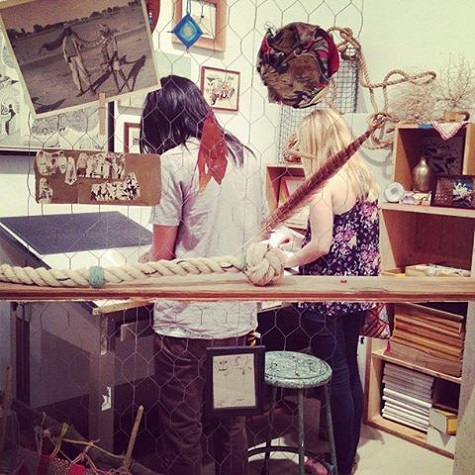
O + C: At first, people engage with the spectacle – thanks to our architect Esther Walker, who captured the feel of our place with her ingenuity and labor of love. Then they wander in and realize it is there for them. They seem to appreciate the options. Parents can make something or just sit and relax, teens can draw with nice materials in a studio, little kids can make forts and roll around in the “park” of leather hides and circle looms made by my daughter. And everyone is invited to hang work on the wall, participate in free classes, ask questions, and use the studio when the Museum is open.
STJEROME
DMA: Have you “met” your neighbors in the exhibition?

O + C: We borrowed a lot of cups of sugar during installation! We enjoyed watching Brandon Kennedy install his book collection and Homecoming! win the hardest working art collective in show business award. My daughter gave a sculpture to Jeffrey Grove (smart move honey!), we got to spend a whole lot of time getting to know the super accommodating DMA staff. It is so special for us all to inhabit the Museum, which has prior to this exhibit a bit of an untouchable space for local artists. Education is of course another story, as they are always reaching out into the community and providing opportunities for Dallas artists. But being in this exhibition, in the same galleries that housed Mark Bradford, Cindy Sherman, and Jim Hodges (!), is a new and exciting opportunity for us. It gives participants a sense of belonging to this city and being recognized for their merits. I hope this leads to more emerging and local artist exhibitions throughout the year. And even more, I hope it emboldens the Dallas art community to launch projects, push for press, and truly making a living as artists here.
TWDRW

We asked visitors to give us a sentence or two describing their personal experiences in the Oil and Cotton Project Room. See below:

“The Oil & Cotton project room was so inspiring and beautiful! I loved being able to bring in my late Gramma’s collection of yarn and contribute in some small way to it all. I know it would have made her absolutely giddy to see some of her supplies used at the DMA! I love how the O + C team created such a wonderful space where the community can come in, create something of their own or contribute to what is already there, and then leave completely inspired to do something at home.” -Jillian Ragsdale

“It’s a rare experience indeed to discover oneself a space that is both as warm and as energetic as the one that Oil and Cotton have crafted at the DMA. (In fact, perhaps its better, to discuss the many spaces within their own space, but that would constitute and essay rather than a few remarks.) I think that the installation works, however, because it is literally at work, engaged in the seriously playful business of supporting creative endeavor. Oil and Cotton’s DMA installation is neither solely gallery nor studio. Public as well as intimate, what Oil and Cotton offers at the DMA is a vital demonstration of how we might imagine not so much what but the combined how and why of what artists do, and what such doing means in terms of simply living, and living well for the sake of everyone.” -Joe Milazzo

“Oil and Cotton created a beautiful, active, yet peaceful space. It is a room I’d like to hang out in. I am so happy and impressed the DMA gave O&C a chance to express themselves freely.” -Kelly Mitchell

“The Oil and Cotton installation at the recent DMA DallasSites exhibition was breath of fresh air. Being able to create and stimulate ideas in a museum context surrounded by a strong artistic community was inspiring. I love the organic well thought out context that O&C provides for people of any age to engage and learn about art practices.” -Ariel Saldivar

“As I’ve come to expect from their continual efforts, Oil and Cotton has once again provided a space for creative exploration, enriched by the affection for detail and caring guidance and by the knowledge and warmth consistently demonstrated by the owners, Kayli and Shannon, as well as by the artists they choose to involve.” -Sally Glass

“I was blown away by the excitement of the Friday night opening of DallasSites. Oil and Cotton has always had a very sincere and authentic atmosphere in their Oak Cliff location, and that same feeling is evident in the DMA gallery space. I felt welcomed and energized by the design of the work space and the presence of everyone attending the Late Night” -Rachel Rushing

Archives

Categories