Archive for the 'Collections' Category


Pet-a-Palooza: A Tail-Wagging Line-Up of Fabulous Felines and Furry Fidos

You have got to be kitten me right meow—is it national Dress Up Your Pet Day already? Indeed it is! If you were having a ruff day, not to worry! Every January 14 the dog-gone crazy DMA staff transform their cuddly critters into a favorite work from our collection (check out the catwalk from 2014 and 2015). It is im-paw-sible not to smile after viewing these purr-fect copycats. Who will be your favorite cat-tenders?
recto

DMA Staffer: Stacey Lizotte, Head of Adult Programming and Multimedia Services
DMA Pet: Parker, English Springer Spaniel, age 2 (he belongs to my parents but I borrowed him when I was home for Christmas)
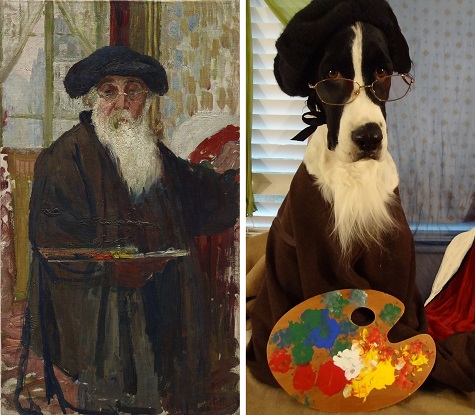
Portrait Inspiration: Camille Pissarro, Self Portrait, c. 1898
I sent my mom several portraits from our collection to pick from and she liked Camille Pissarro’s Self-Portrait best because Parker has the same soulful look. We had a lot of moving parts with this portrait—from props, background, and getting the right angle so that Parker’s chest hair looked like a beard—therefore it took about 120 shots to get one good one of Parker as Pissarro. And a shout out to George Costanza for letting Parker borrow his beret and painter’s palette.
Mexico Jessica
DMA Staffer:
Jessica Fuentes, C3 Gallery Manager
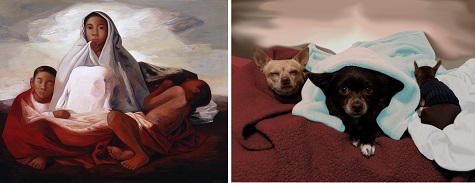
DMA Pet: Fidel (age 4), Nene (age 6), and Cappuccino (age 2 months), Chihuahuas
Portrait Inspiration: Jesús Guerrero Galván, Images of Mexico (Imágenes de México), 1950
New year, new pup! Just a few weeks ago we added a new Chihuahua puppy to our Chihuahua family, so when thinking about this year’s Dress Up Your Pet Day, I had to find a work of art with three figures. I planned to roam the galleries searching for the perfect painting, starting on Level 4 and working my way down. But I didn’t have to go very far. On the Level 4 Landing, overlooking the DMA Cafe, I came across Images of Mexico (Imágenes de México) by Jesús Guerrero Galván. Not only did it contain three figures, but each figure seemed to capture each of my dogs’ traits. The figure in the middle with the piercing eyes had the unmistakable stare of my moody dog, Nene. The figure on the left seemed younger and sweeter, asleep and cuddling up to the older sibling, spot on for my loveable, cuddly Fidel. And the figure at right, lying slightly adrift, illustrated the slight rift between the dogs who’ve grown up together and the newbie, Cappuccino.
george chloe
DMA Staffer: 
Amanda Blake, Head of Family, Access, and School Experiences and Interim Director of Education, and Kimberly Daniell, Senior Manager of Communications, Public Affairs, and Social Media Strategy
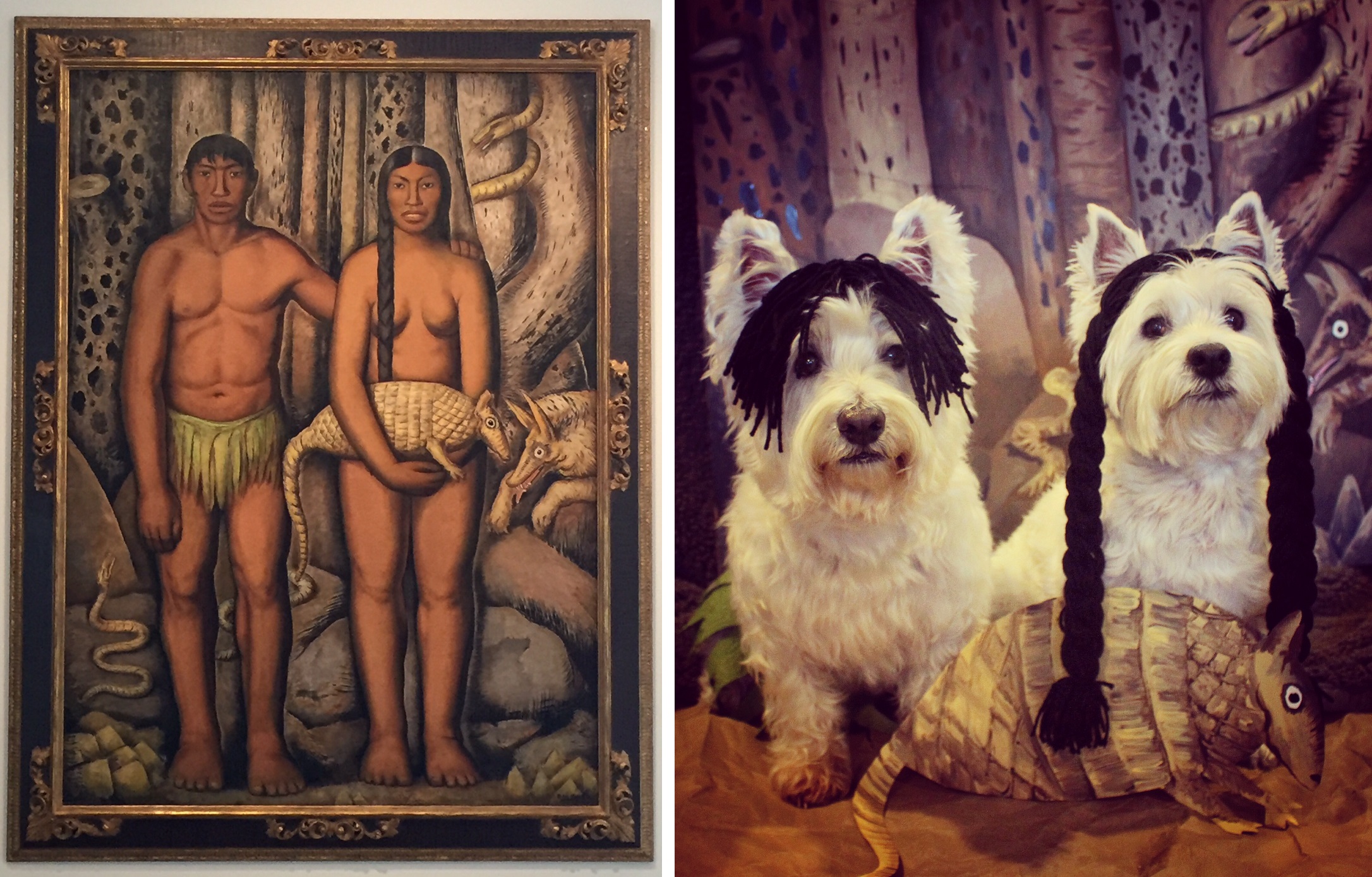
DMA Pet: George Costanza (age 9) and Chloe (age 10), West Highland White Terriers
Portrait Inspiration: Alfredo Ramos Martinez, Mexican Adam & Eve (Adam y Eve Mexicanos), 1933
George and Chloe enjoyed teaming up so much for last year’s blog that they just had to do it again in 2016. Chloe desperately wants to be best friends with George, but becomes a bit shy when he is around because he is such an Insta celebrity. In order to get her out of her bubble and bring these two westies closer together, we decided making them the original couple would help them take their friendship to the next level—could it be puppy love? Both pups enjoyed re-creating this beautiful, large painting by Alfredo Ramos Martinez, and they can’t wait for next year’s art date.
Jessi red hat
DMA Staffer:
Jessie Frazier, Manager of Adult Programming
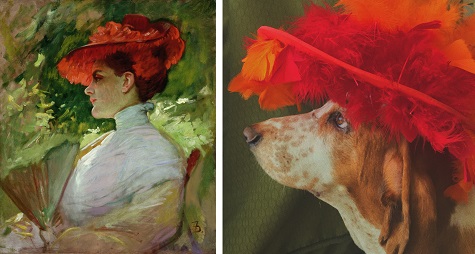
DMA Pet: Jenny, Basset Hound, age 5 1/2
Portrait Inspiration: Frank Duveneck, Lady with a Red Hat (Portrait of Maggie Wilson), c. 1904
This is one of my favorite paintings in the collection, and I thought it was only fitting for one graceful lady to emulate another. Jenny agreed that, like Ms. Maggie Wilson, her delicate features are best captured in profile.
T43118, 3/31/05, 12:37 PM, 8C, 5518x7554 (216+420), 100%, Repro 1.8 v2, 1/8 s, R68.5, G54.1, B79.0

DMA Staffer: Rebekah Boyer, Assistant Manager, DMA Member Groups
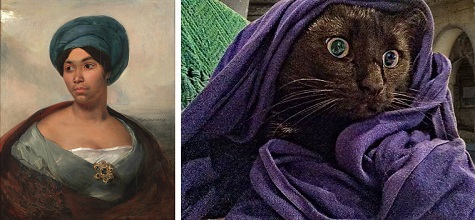
DMA Pet: Stokely Carmichael, Domestic Housecat, suspected Panther, age 4
Portrait Inspiration: Eugène Delacroix, Portrait of a Woman in a Blue Turban, c. 1827
This painting by Eugène Delacroix always catches my eye when I browse our European collection. The model is dressed with studio props intended to persuade the viewer that she is a mysterious and “exotic” foreigner; her “otherization” is further solidified by the use of familiar conventions of Renaissance portraiture. Not only does this send me down memory lane to my undergraduate infatuation with Edward Said but the contemplation of this “Orientalism” piques my interest in the model herself. Was she complicit in this “imperialist oppression,” or was she merely seeking gainful employment to alter her material conditions? I think Stokely’s faraway gaze mirrors and reveals the original work’s secrets: He is ready to help, as long as there is a tuna-laden reward awaiting him.
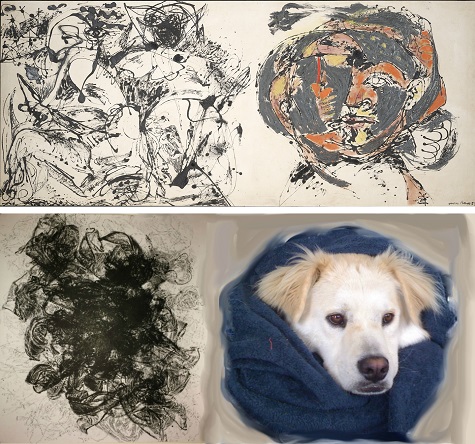
pollock, 7/10/08, 12:29 PM, 8C, 4086x8892 (1584+108), 112%, chrome 7 stops, 1/8 s, R55.4, G34.4, B47.8

DMA Staffer: Chelsea Pierce, Curatorial Administrative Assistant, Contemporary Art
DMA Pet: Helios, Great Pyrenees mix, age 6
Portrait Inspiration: Jackson Pollock, Portrait and a Dream, 1953
Helios is a sensitive dog with many artistic qualities. Most days, he lounges in his armchair as he waits for his mom to return home. Above this chair is a work on paper—made by a DMA colleague—that resembles the black entangled mass in Jackson Pollock’s Portrait and a Dream. After catching Helios curiously examining this work, the idea presented itself to use his precious face as the portrait side of Pollock’s work. Having worked on the current Jackson Pollock: Blind Spots exhibition for over a year, I can say that Pollock has now become ingrained in every aspect of my life.
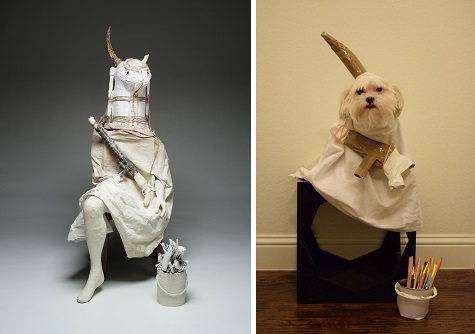
2008_43_2_a_e, 11/18/08, 12:33 PM, 8C, 6000x8000 (0+0), 100%, Custom, 1/15 s, R92.9, G57.6, B60.4

DMA Staffer: Andrea Severin Goins, Interpretation Manager
DMA Pet: Artemisia Gentileschi (“Artie”), Malshi (Maltese-Shihtzu), age 6
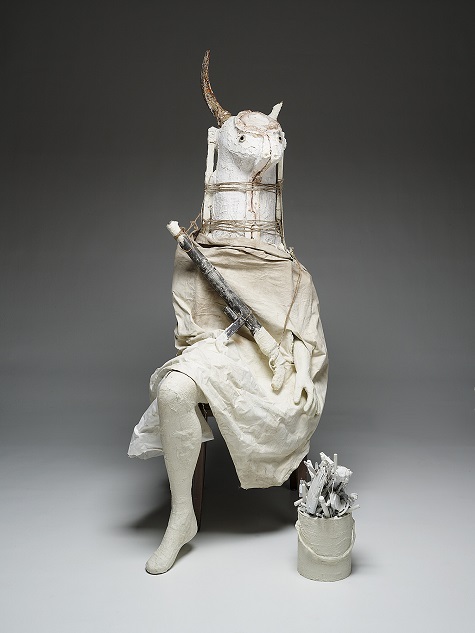
Portrait Inspiration: Marcel Dzama, The Minotaur, 2008
While Artie is named after a 17th-century painter, her favorite kind of art is contemporary. She is particularly drawn to this Dzama sculpture because, like the Minotaur—a hybrid of man and goat—Artie is herself a hybrid (of Maltese and Shihtzu).
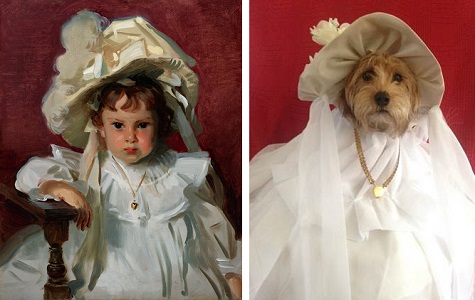
lindsay dorothy
DMA Staffer: 
Lindsay O’Connor, Manager of Docent and Teacher Programs
DMA Pet: Hattie, Dachshund-Terrier mix, age 1
Portrait Inspiration: John Singer Sargent, Dorothy, 1900
Little Miss Dorothy was the natural choice for feisty one-year-old Hattie’s first Dress Up Your Pet Day. While this energetic pup enjoys getting cuddles or tearing around the dog park, Hattie patiently sat for her turn-of-the-century portrait and met the camera with poise beyond her years. She enjoyed chewing on the bonnet when we wrapped up.
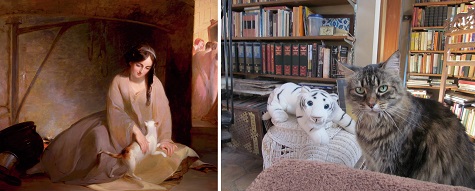
Not DMA Photography

DMA Staffer: Dr. Anne R. Bromberg, The Cecil and Ida Green Curator of Ancient and Asian Art
DMA Pet: Miss Suzl, Maine Coon, age 5
Portrait Inspiration: Thomas Sully, Cinderella at the Kitchen Fire, 1843
Miss Suzl loves posing in her library home and we have a white Snow Leopard toy for her to pose next to as Cinderella and her cat. I named this piece Companion Animals: Miss Suzl and the White Pussy.
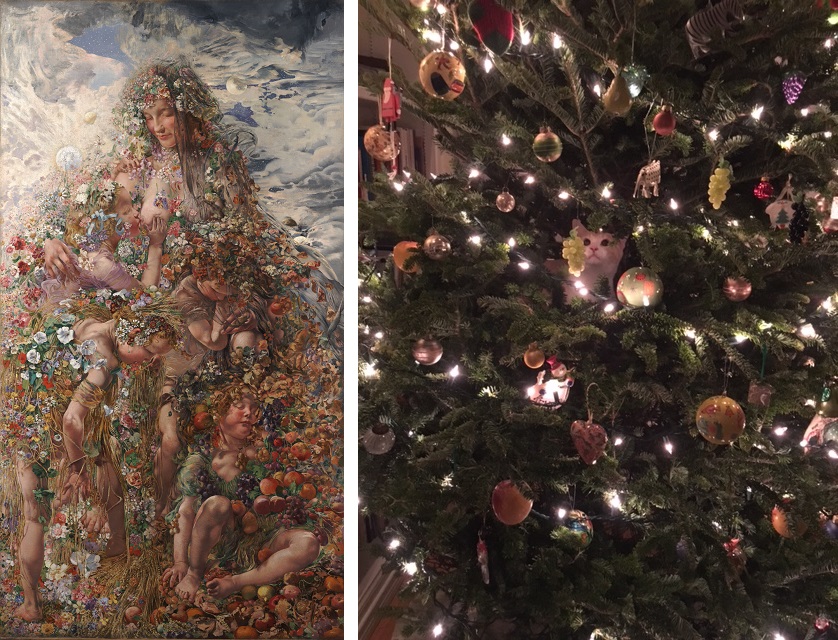
queta
DMA Staffer: Queta Moore Watson, Senior Editor
DMA Pet: Floyd, Tan and White Tabby, age 9 months
Portrait Inspiration: Léon Frédéric, Nature or Abundance (La Nature or Fécondité), 1897
This allegorical depiction of the unity and harmony of nature was painted by Belgian symbolist artist Léon Frédéric. The dual title, Nature or Abundance, is apt here as flora and fauna unite while surrounded by the abundance of the holidays. Perhaps even more apt, however, is the abundance of ornaments Floyd broke as he harmonized with nature.

(Images: Camille Pissarro, Self-Portrait, c. 1898, oil on canvas, Dallas Museum of Art, The Wendy and Emery Reves Collection, 1985.R.44; Jesús Guerrero Galván, Images of Mexico (Imágenes de México), 1950, oil on canvas, Dallas Museum of Art, Dallas Art Association Purchase, 1951.102; Alfredo Ramos Martinez, Mexican Adam & Eve (Adam y Eve Mexicanos), 1933, oil on canvas, Lent by Private Collection, Dallas, TX; Frank Duveneck, Lady with a Red Hat (Portrait of Maggie Wilson), c. 1904, oil on canvas, Dallas Museum of Art, gift of the Pauline Allen Gill Foundation, 1987.368; Eugène Delacroix, Portrait of a Woman in a Blue Turban, c. 1827, oil on canvas, Dallas Museum of Art, The Eugene and Margaret McDermott Art Fund, Inc., in honor of Patricia McBride, 2005.34.McD;  Jackson Pollock, Portrait and a Dream, 1953, oil and enamel on canvas, Dallas Museum of Art, Gift of Mr. and Mrs. Algur H. Meadows and the Meadows Foundation, Incorporated, 1967.8, © 2015 The Pollock-Krasner Foundation/Artists Rights Society (ARS), New York; Marcel Dzama, The Minotaur, 2008, plaster, gauze, rope, fabric, chair, bucket, and paintbrushes, Dallas Museum of Art, DMA/amfAR Benefit Auction Fund, 2008.43.2.a-e, © Marcel Dzama; John Singer Sargent, Dorothy, 1900, oil on canvas, Dallas Museum of Art, gift of the Leland Fikes Foundation, Inc., 1982.35; Thomas Sully, Cinderella at the Kitchen Fire, 1843, oil on canvas, Dallas Museum of Art, gift of the Pauline Allen Gill Foundation, 2005.1; Léon Frédéric, Nature or Abundance (La Nature or Fécondité), 1897, oil on canvas, Dallas Museum of Art, Foundation for the Arts Collection, Mrs. John B. O’Hara Fund, 2007.18.FA

Kimberly Daniell is the Senior Manager of Communications, Public Affairs, and Social Media Strategy, and Julie Henley is the Communications and Marketing Coordinator at the DMA.
A Tip of the Hat

In honor of National Hat Day this Friday, I wanted to tip my hat to a few fascinating finds in our collection.

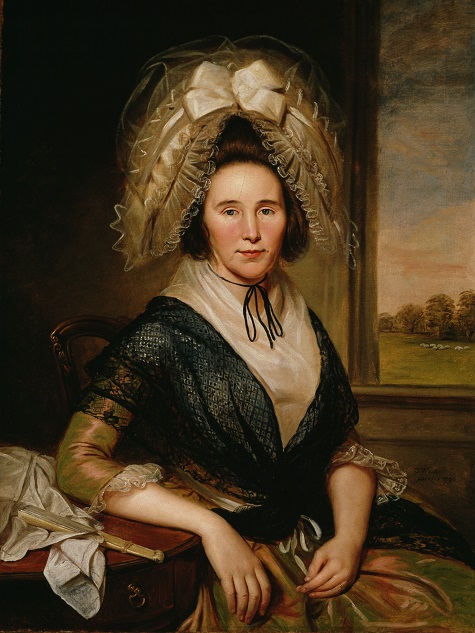
Charles Willson Peale, Rachel Leeds Kerr, 1790, oil on canvas, Dallas Museum of Art, gift of the Pauline Allen Gill Foundation 1989.23

Charles Willson Peale, Rachel Leeds Kerr, 1790, oil on canvas, Dallas Museum of Art, gift of the Pauline Allen Gill Foundation, 1989.23

During the late 18th century, hats were the most important element of your outfit. Formal (read: ridiculously over-dressed) hairstyles had reached such heights that they required proper containment during daytime hours—Mrs. Kerr’s cap does just the trick.

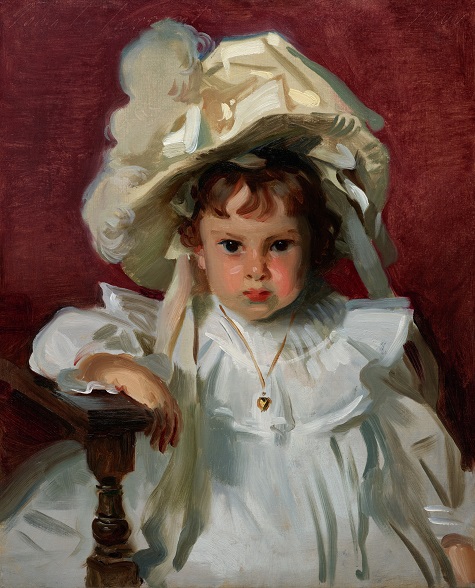
John Singer Sargent, Dorothy, 1900, oil on canvas, Dallas Museum of Art, gift of the Leland Fikes Foundation, Inc. 1982.35

John Singer Sargent, Dorothy, 1900, oil on canvas, Dallas Museum of Art, gift of the Leland Fikes Foundation, Inc., 1982.35

At the turn of the 20th century, children were outfitted like mini-adults. Miss Dorothy’s oversized hat is decked out with such extensive feathers and ribbons that it’s almost too much for her little head to hold!

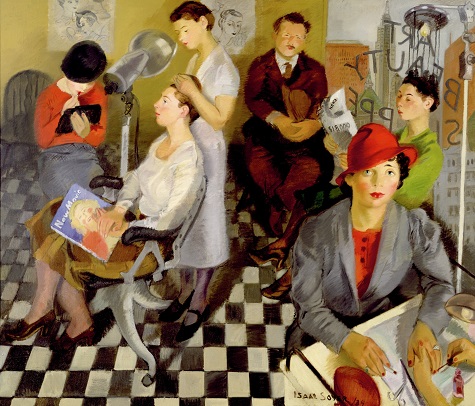
Isaac Soyer, Art Beauty Shoppe, 1934, oil on canvas, Dallas Museum of Art, gift of the Public Works of Art Project 1935.7

Isaac Soyer, Art Beauty Shoppe, 1934, oil on canvas, Dallas Museum of Art, gift of the Public Works of Art Project, 1935.7

A jaunt to the beauty shop wouldn’t have been complete without a favorite piece of millinery. But can you spot all the toppers in this keen scene? Don’t be fooled—the headpiece in back is actually a permanent wave machine!

Visit the DMA’s collection galleries, included in free general admission, and pick out your perfect chapeau.

Sarah Coffey is the Education Coordinator at the DMA.
Uncrating 2015

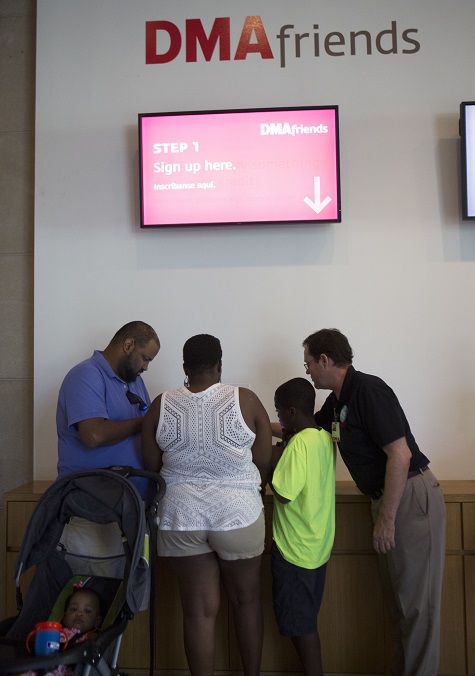
At the DMA, 2015 was a great year full of art, fun, and visitors enjoying an array of exhibitions, programs, and events. Highlights include the fifth anniversary of two of our access programs (Autism Awareness Family Celebrations and Meaningful Moments), the presentation of four DMA-organized exhibitions (Between Action and the Unknown: The Art of Kazuo Shiraga and Sadamasa Motonaga, Michaël Borremans: As sweet as it gets, Spirit and Matter: Masterpieces from the Keir Collection of Islamic Art, and Jackson Pollock: Blind Spots), eleven Late Nights, an active year of paintings and object conservation, dozens of classes and art camps for kids, the hosting of our third naturalization ceremony, the topping out of the Museum’s new Eagle Family Plaza and north entrance, and more than 700,000 visitors in 2015. We can’t wait to see what 2016 brings!


The Best Way to Spread Artsy Cheer

. . . is singing loud for all to hear!

With the holiday season in full swing, I’ve taken some liberties with a handful of my favorite yuletide melodies. If you know any Claymation experts who’d be willing to work their magic on a DMA-inspired stop-motion musical, please give me a call. Until then, here are a few remixed holiday songs to celebrate some of the works from our collection.

The Minotaur at C3
(to the tune of “Rudolph the Red-Nosed Reindeer”)

You know Jasper Johns, Donald Judd, and Robert Smithson’s
Works in the contemporary collection,
But do you recall
Marcel Dzama’s white minotaur?

The Minotaur at C3
Has a rough and stubby nose.
His face is made of plaster
And it’s covered up with gauze.

Some say he’s funny-looking
‘Cause he only has one arm,
But all the limbs he’s missing
Minotaur makes up with charm.

Half a person and half bull,
Sitting in his chair—
Minotaur, you’re quite a sight!
Drawing you is a delight.

Now you’re our favorite figure
Found in Greek mythology.
How did you leave your labyrinth?
It’ll stay a mystery.

Marcel Dzama, The Minotaur, 2008, Dallas Museum of Art, DMA/amfAR Benefit Auction Fund © Marcel Dzama, 2008.43.2.A-E

Marcel Dzama, The Minotaur, 2008, Dallas Museum of Art, DMA/amfAR Benefit Auction Fund, 2008.43.2.a-e, © Marcel Dzama

DMA Clocks
(to the tune of “Jingle Bell Rock”)

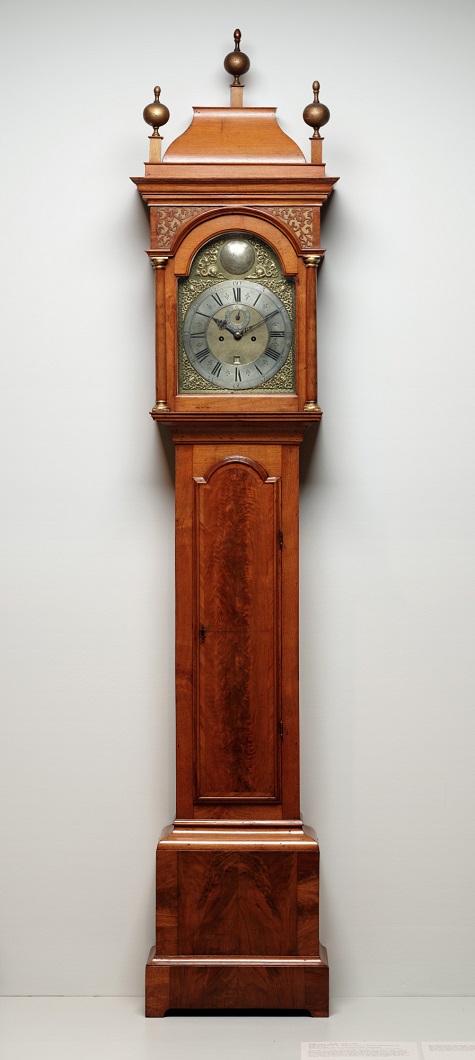
Tiny clocks, modern clocks, freestanding clocks,
19th- and 17th-century clocks,
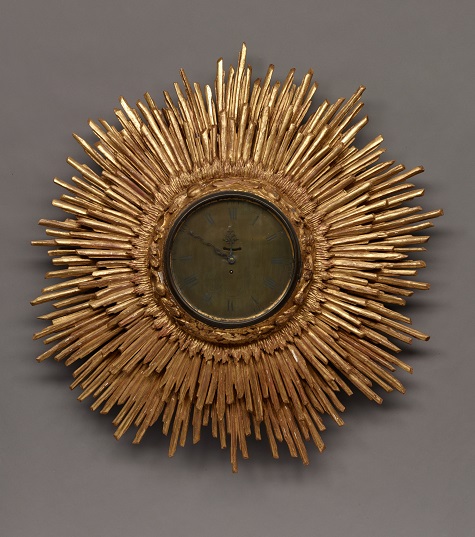
Up on the 3rd floor at the Reves Salon
Is William Moore’s clock shaped like a sun.

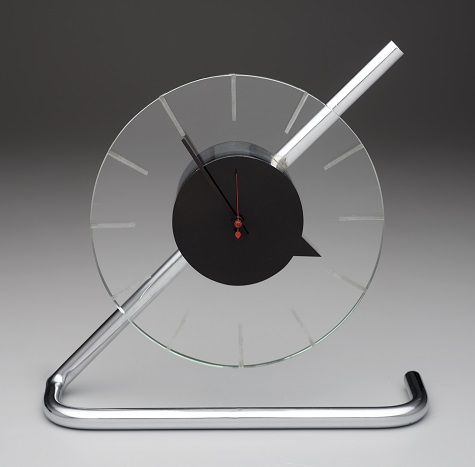
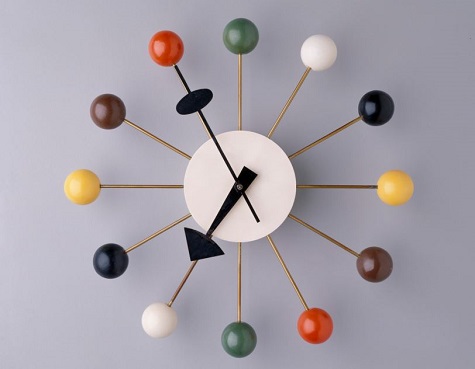
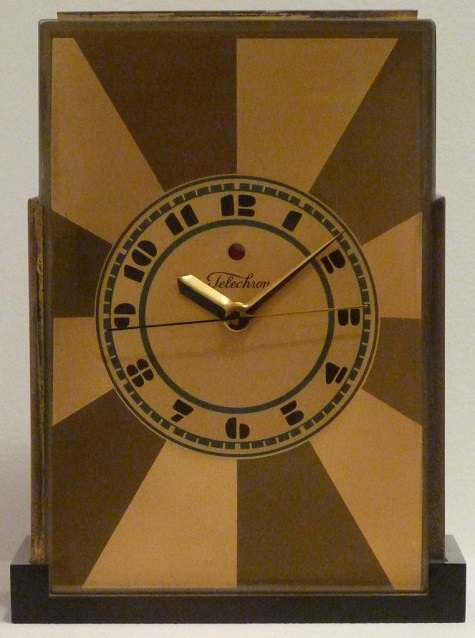
Ball Wall Clock, Tall Case Clock, Gilbert Rohde’s Clock,
Paul Frankl’s stylish “Telechron” clock,
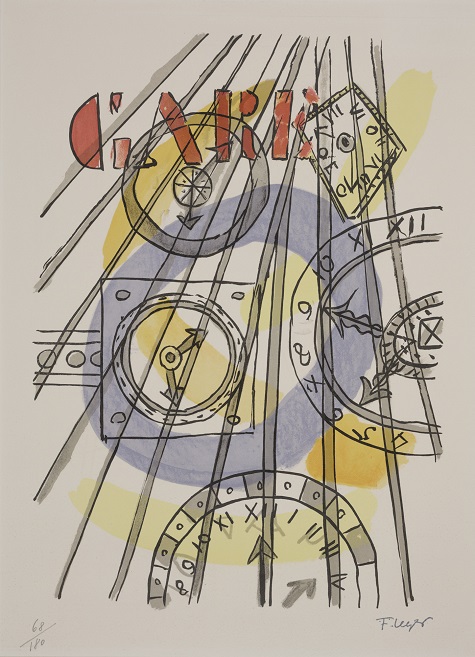
Check out a print with clock faces to spare
By Fernand Legér.

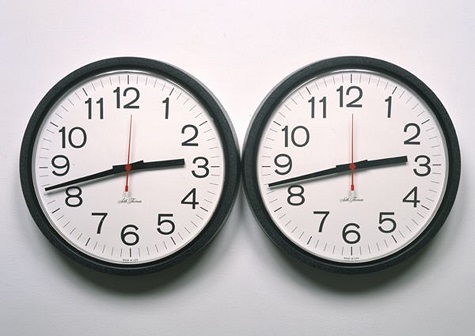
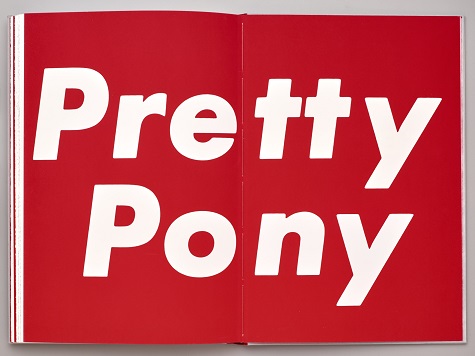
There’s Untitled (Perfect Lovers)
Tick-tocking side by side.
Stephen King and Barbara Kruger
Placed a clock on their book’s front side.

If you ever hope to hear the clocks chime,
You may be out of luck—
So many hands, but so few that tell time
On the DMA’s clocks.


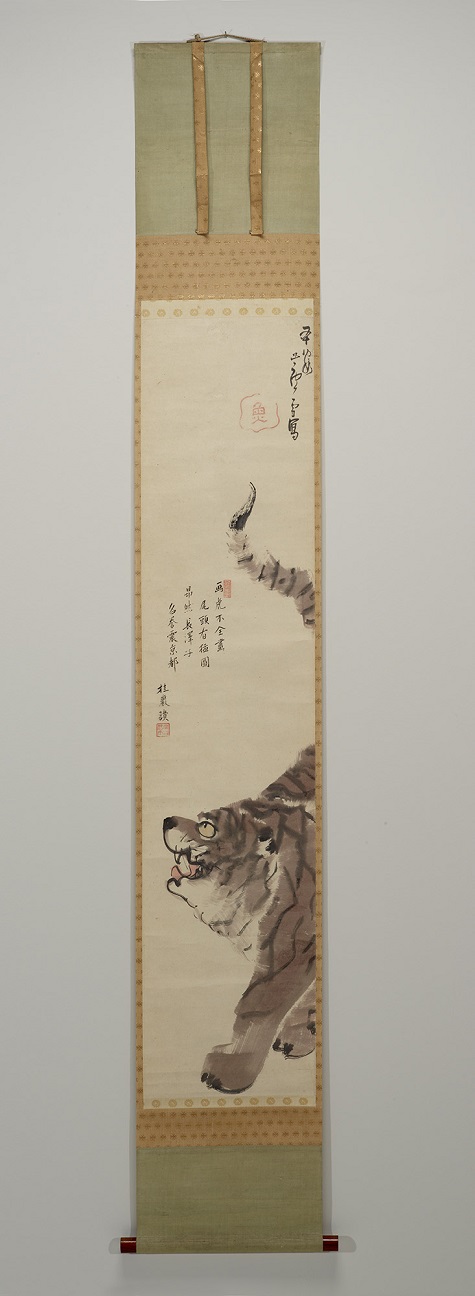
I Saw A Tiger Licking Its Paws
(to the tune of “I Saw Mommy Kissing Santa Claus”)

I saw a tiger licking its paws
After the Museum closed last night.
It didn’t see me peek
Down the Japanese gallery.
It jumped off of its scroll
Into the hall in front of me.

Then, I saw the tiger stretch out its paws,
And let out a roar with all its might.
Oh, I’ve warned everyone I see
But no one else will believe
That the tiger comes alive at night.

Nagasawa Rosetsu, Tiger, after 1792, Dallas Museum of Art, General Acquisitions Fund, Image courtesy Dallas Museum of Art, 1972.13

Nagasawa Rosetsu, Tiger, after 1792, Dallas Museum of Art, General Acquisitions Fund, 1972.13

Happy holidays!

Paulina Lopez is the McDermott Graduate Intern for Visitor Engagement at the DMA.

A Staff Selection in C3

As part of our mission in the Center for Creative Connections (C3), we highlight voices from our community. We achieve this in several ways: by offering visitors the opportunity to publicly respond to works of art, by commissioning local artists to create interactive installations, and by collaborating with local artists to offer special programming. In addition, each year we work with DMA staff, those who wouldn’t ordinarily have the opportunity to select which works of art go on view, to pick a work of art to be installed in C3 and write about it. We call it “C3 Staff Point of View.”

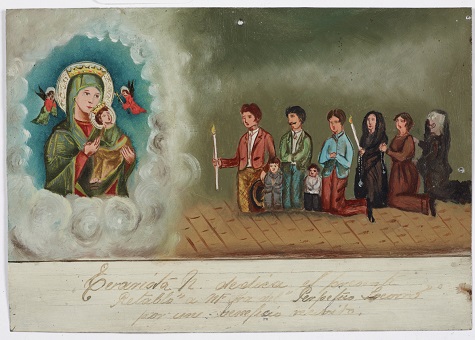
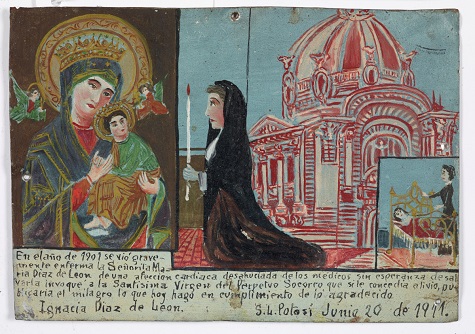
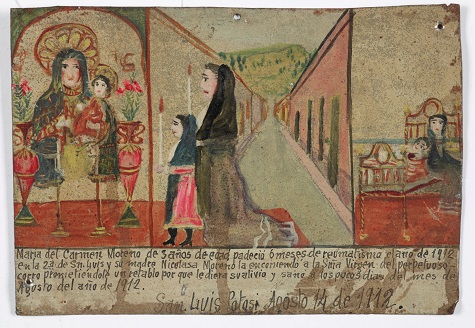
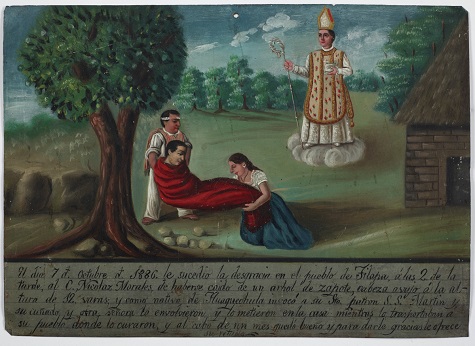
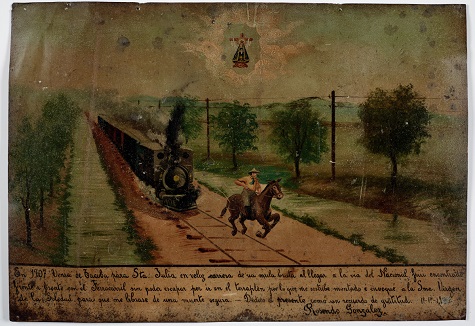
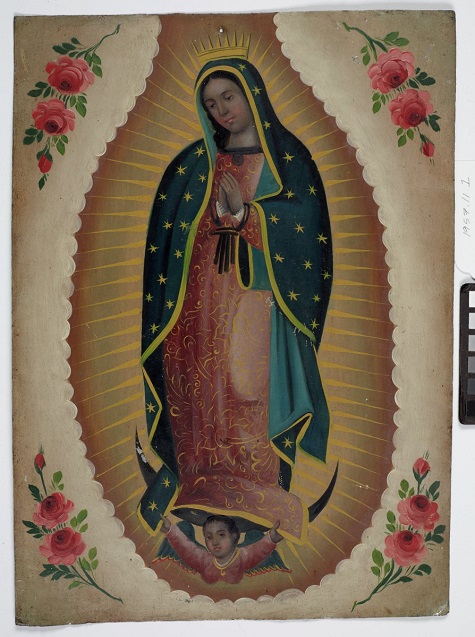
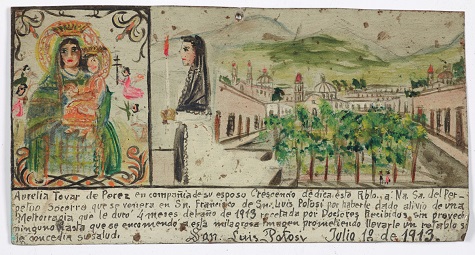
This year, Maria Teresa Garcia Pedroche, Head of Community Engagement, has chosen an assortment of nine retablos, which were installed December 14 and can be seen on your next visit to C3.


Describe your job in fifty words or less.
I create experiences and programs both at the Museum and off-site that promote conversation and engagement by inviting community partners to share their unique perspectives on the Museum’s collection. My job also  includes organizing the annual “Young Masters” exhibition, which features works created by Advanced Placement students participating in the O’Donnell Foundation’s AP Fine Arts Incentive Program.

23812578305_52a7d30333_z

All of these works are titled Retablo. For our readers who may not know, what is a retablo?
Although these works are titled “retablos,” Spanish for “devotional paintings,” many of them are also considered “exvotos,” paintings that serve as offerings of gratitude. “Exvotos” are created on tin or sheet metal by local artists or artisans using inexpensive materials. Many “exvotos” include a painting of a saint with the name and image of a patron.

What factors led to your decision to choose these works of art to go on view in C3?
Often I work with communities outside the walls of the Museum. We have a proud history of serving North Texas, connecting art and people. Over the years, the communities we serve that collect “exvotos” and “retablos” have asked if these types of works are part of the DMA’s collection. I chose these works of art because some of our communities are specifically interested in them, and showcasing global works helps visitors appreciate and understand the importance of art created by everyone. Personally, I have created “retablos” inspired by strong women in my family.

Also, I love the art and stories with answered prayers. Growing up in Brownsville, Texas, my family traveled to the Basilica of Guadalupe, DF, San Juan de los Lagos, Jalisco, Shrine of St. Francis of Assisi, Real de Catorce, SLP, and other churches. We participated in pilgrimages where visitors would pray for their loved ones and leave their votive offerings at the altar and outside the place of worship. It was wonderful to see and hear visitors share blessings and miracles.

What do you hope visitors will gain from seeing these works of art?
The demographics show that Dallas is multicultural; we can bridge the cultural differences and find common language through the arts.  The arts are the soul of our community, helping reflect and promote the city’s history and cultural diversity: past, present, and evolving. I hope visitors will be open when viewing these works and consider how these “exvotos”—these hopes, dreams, and prayers—are similar to their own.

When you stop by the Center for Creative Connections to see these newly installed retablos and exvotos, take a moment to create your own exvoto illustrating a personal experience or prayer.

Jessica Fuentes is the Center for Creative Connections Gallery Manager at the DMA.
Pollock for all Ages

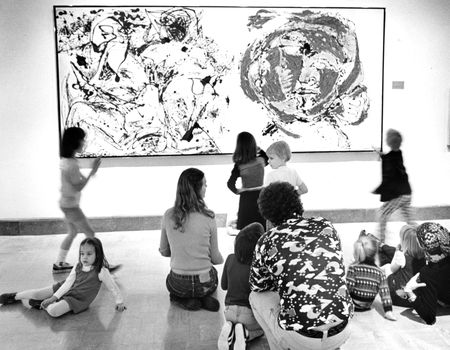
Jackson Pollock tends to bring out art enthusiasts of all ages, and his two iconic works in the Museum’s collection have always been an important stop for visitors. The Dallas Museum of Art has a long history with Pollock; we were the first museum in the world to acquire one of his “classic period” works (Cathedral), and the DMA’s Portrait and a Dream is widely considered to be his last major art statement. Since both of these iconic works are on view in the current exhibition Jackson Pollock: Blind Spots, we began exploring the archives and stumbled upon photos from a 1970s art tour focused on our impressive Pollock piece:

Preschoolers visit the DMFA and learn about Jackson Pollock in 1976.

Preschoolers visit the DMFA and learn about Jackson Pollock. Photo by Clint Grant, Dallas Morning News, October 29, 1976

Photo by Clint Grant, Dallas Morning News, October 29, 1976

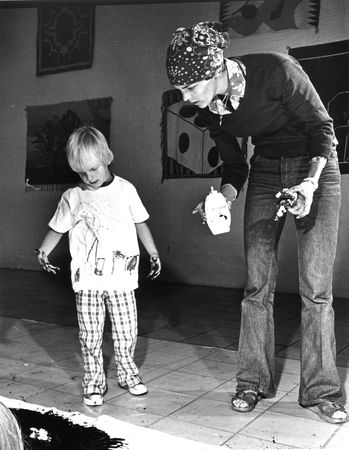
And then get to try their hand at drip paintings.

Photo by Clint Grant, Dallas Morning News, October 29, 1976

Photo by Clint Grant, Dallas Morning News, October 29, 1976

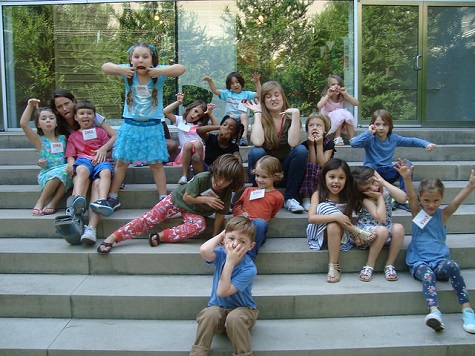
Ten 3-5 year olds, who were participating in the Young Artists program started by Southern Methodist University’s fine arts education department, joined DMFA education staff at the Museum for an afternoon all about Pollock . . . and cookies.

See more photos in the November 21, 1976, article “What is Art?” by Clint Grant.

Hillary Bober is the Archivist at the Dallas Museum of Art.

Pen Pals

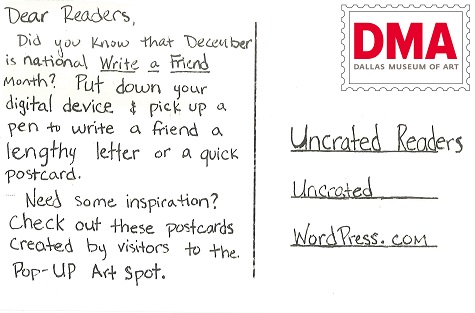
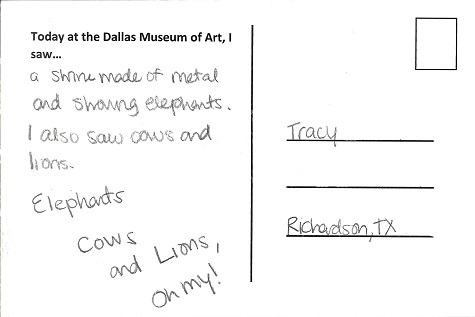
Write a Friend Post

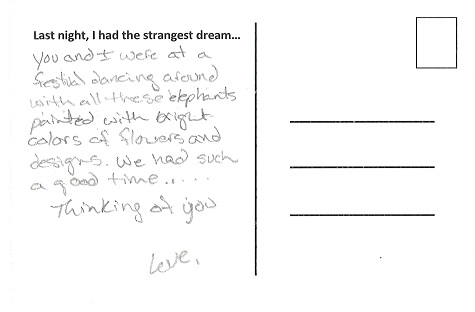
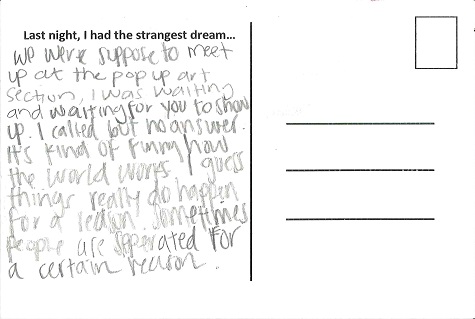
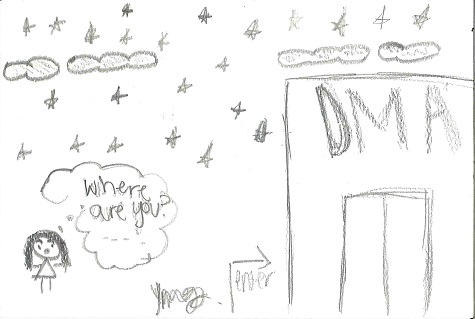
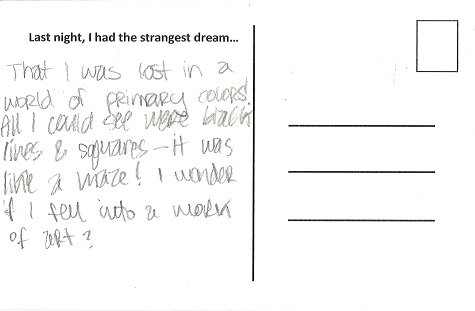
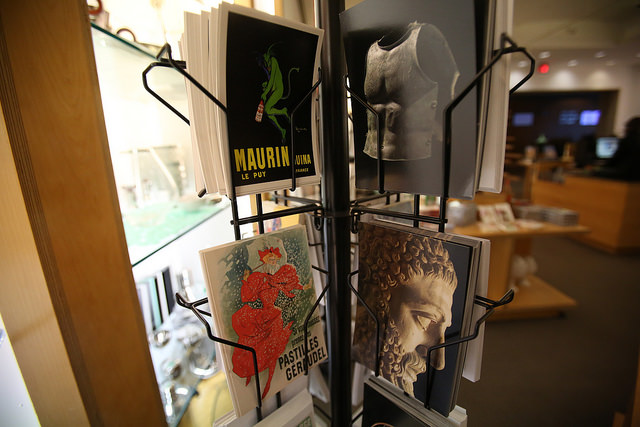
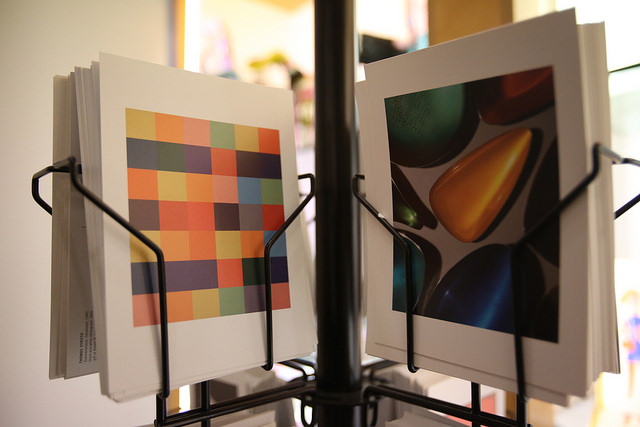
Stop by the DMA Store to stock up on supplies! Pick a postcard of your favorite work of art from the DMA’s collection and send it to a friend with a thoughtful message.

Jessica Fuentes is the Center for Creative Connections Gallery Manager at the DMA.
30 Minute Dash – Jessica Fuentes

Many visitors, especially those coming with families, often start their visit to the DMA in the Center for Creative Connections (C3), a great starting point because it is located on the first floor, in the heart of the museum, and displays works of art from across the Museum’s diverse collection. However, after starting in C3, visitors tend to ask, “What else should we see while we’re here?” Of course, there could be a multitude of answers to that question, but I think I’ve laid out a nice action plan, using one of my favorite artworks currently on view in C3 as a starting point.

2008_43_2_a_e, 11/18/08, 12:33 PM, 8C, 6000x8000 (0+0), 100%, Custom, 1/15 s, R92.9, G57.6, B60.4

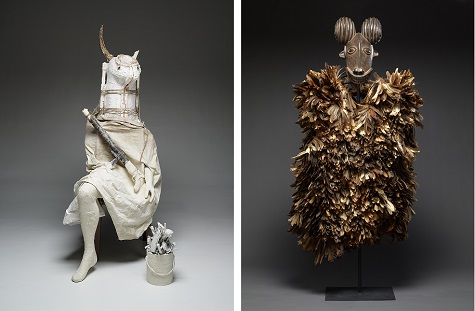
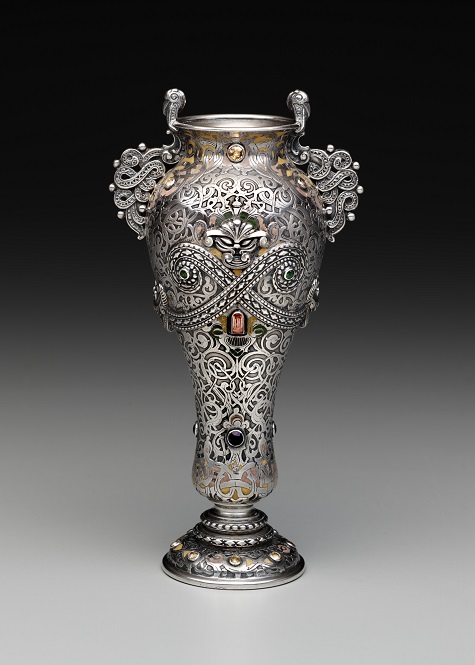
In the main C3 Gallery, notice the similarities between The Minotaur by Marcel Dzama and Ram Mask with Feather Cape created by the Kom people of Cameroon. They both depict features of two beings, The Minotaur with the head of a bull and the body of a human, and Ram Mask with Feather Cape with a stylized mask representative of a ram and a cape made of chicken feathers. Taking this idea as a starting point for works to see throughout the Museum, exit C3 and turn right down the main concourse. Headdown the concourse and take the Red Elevator up to the 4th Floor. Upon exiting, turn left and walk through the Native American Art gallery, taking a left into American Art. Then stay to the right and walk to the back corner where the American Silver Gallery is located. In a small case in the center of this gallery you will encounter the beautifully intricate silver Vase (for the Pan-American Exposition, Buffalo, New York.

2009_40

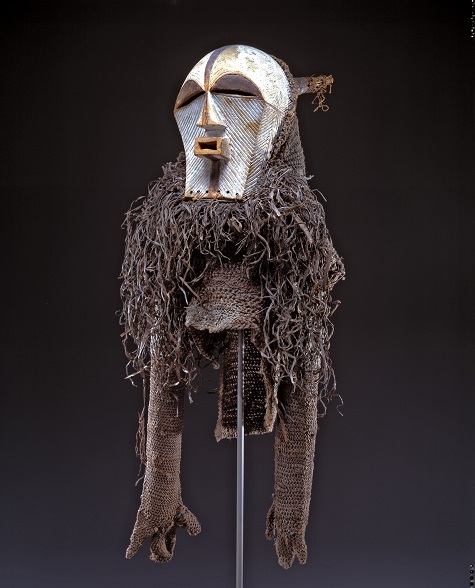
Notice the serpentine handles culminating in bird heads and the etched patterns of scrolls and masks. Next, continue to walk around and through the American Gallery and take the small staircase that leads to the African Gallery. At the bottom of the staircase, walk to the far end of the gallery and take a right to find the Helmet mask (kifwebe) and costume.

1974.SC.42

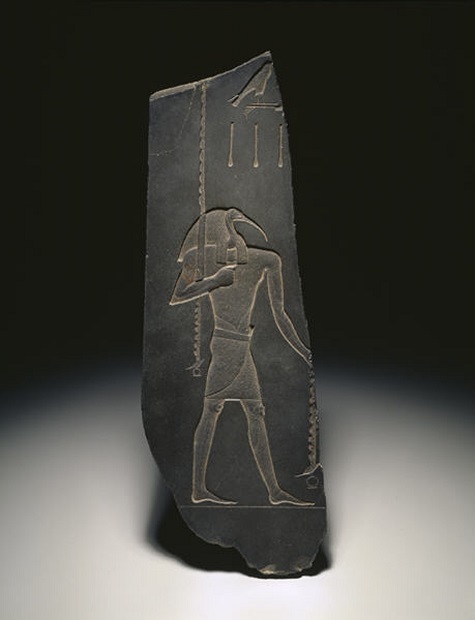
Kifwebe masks are “composite beings,” compiled of human and animal elements. The striated designs on them derive from the markings and patterns of wild or dangerous animals such as antelopes, zebras, and okapi. The central crest may represent that of an ape or rooster. When you view this work of art in the galleries, it is accompanied by a short video which shows the mask in use, truly bringing it to life. Finally, continue through the African Gallery and take a left into the Egyptian section. To your immediate left you will find a collection of small works including a slate remnants depicting Thoth, God of Learning and Patron of Scribes a human figure with the head of an ibis.
1979_1

Visit all of these works, for free, during your Thanksgiving break.

Jessica Fuentes is The Center for Creative Connections Gallery Manager at the DMA


images: Marcel Dzama, The Minotaur, 2008, plaster, gauze, rope, fabric, chair, bucket, and paintbrushes, Dallas Museum of Art, DMA/amfAR Benefit Auction Fund © Marcel Dzama 2008.43.2.A-E; Helmet mask with feather costume, Kom peoples, Cameroon, Africa, Early to mid-20th century, wood, fibers, and feathers, Dallas Museum of Art, African Collection Fund 2011.18.A-B; George Paulding Farnham, Tiffany and Company, Vase (for the Pan-American Exposition, Buffalo, New York), 1901, silver, enamel, citrines, and garnets, Dallas Museum of Art, Discretionary Decorative Arts Fund 2009.40; Helmet mask (kifwebe) and costume, Songye or Luba peoples, Democratic Republic of the Congo, Africa, late 19th to early 20th century, wood, paint, fiber, cane, and gut, Dallas Museum of Art, The Gustave and Franyo Schindler Collection of African Sculpture, gift of the McDermott Foundation in honor of Eugene McDermott 1974.SC.42; Thoth, God of Learning and Patron of Scribes, Late Period, 663-525 B.C., Egypt, Africa, slate, Dallas Museum of Art, gift of Elsa von Seggern 1979.1

A Thanksgiving Trifecta

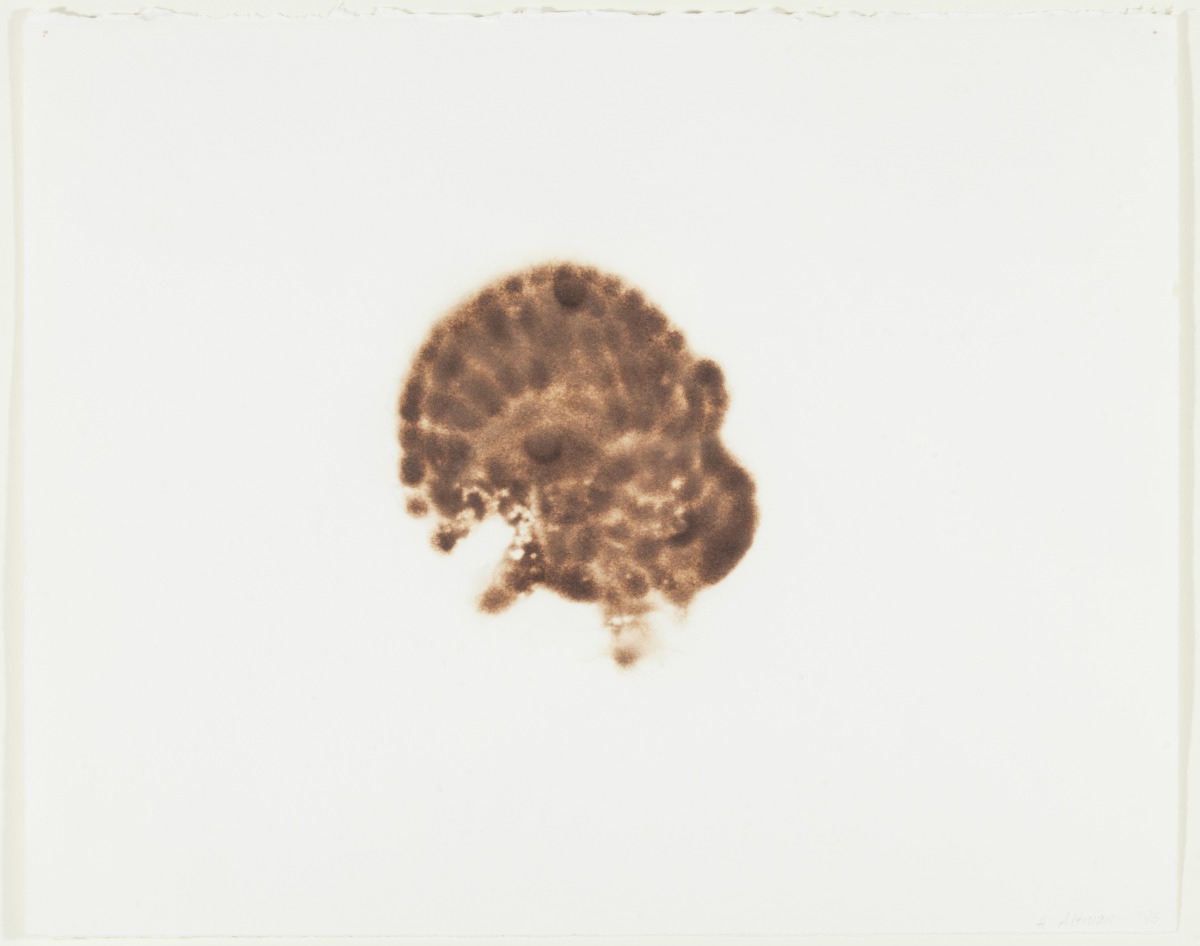
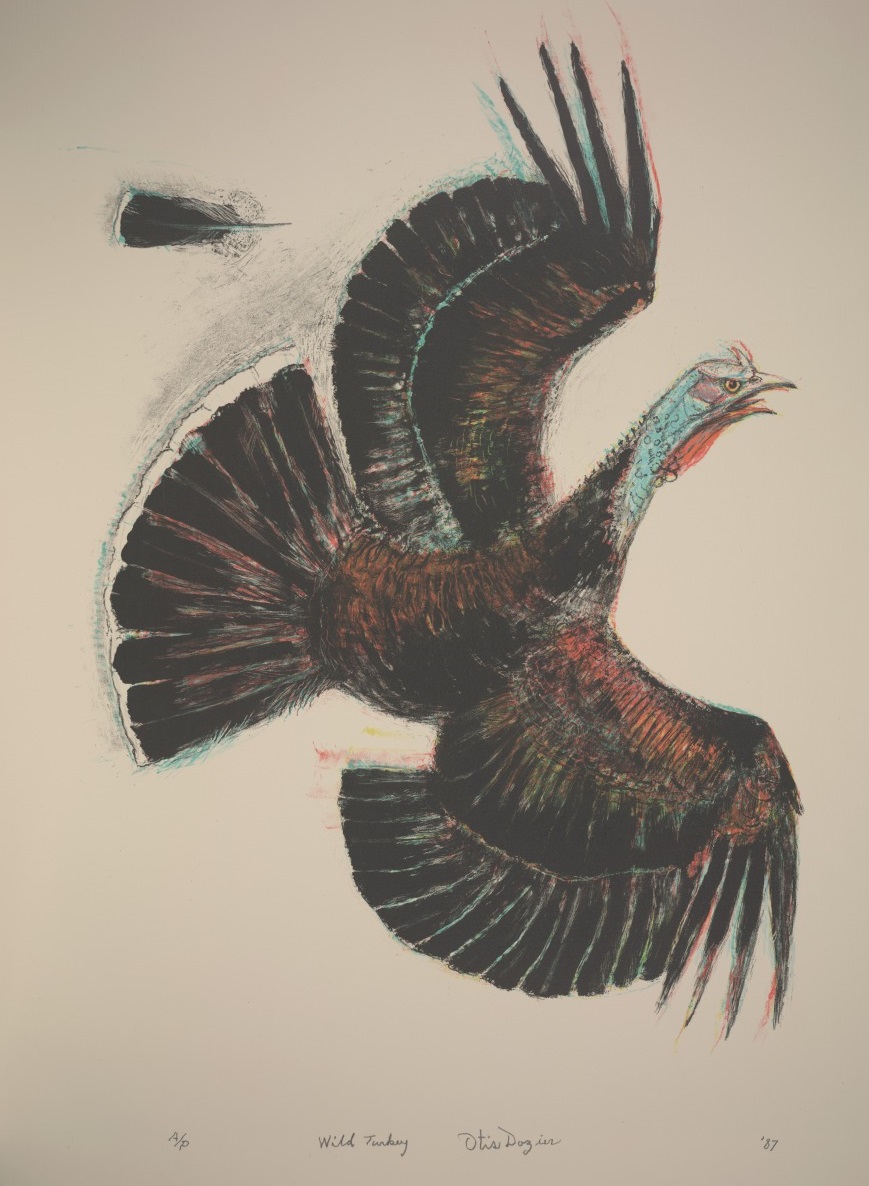
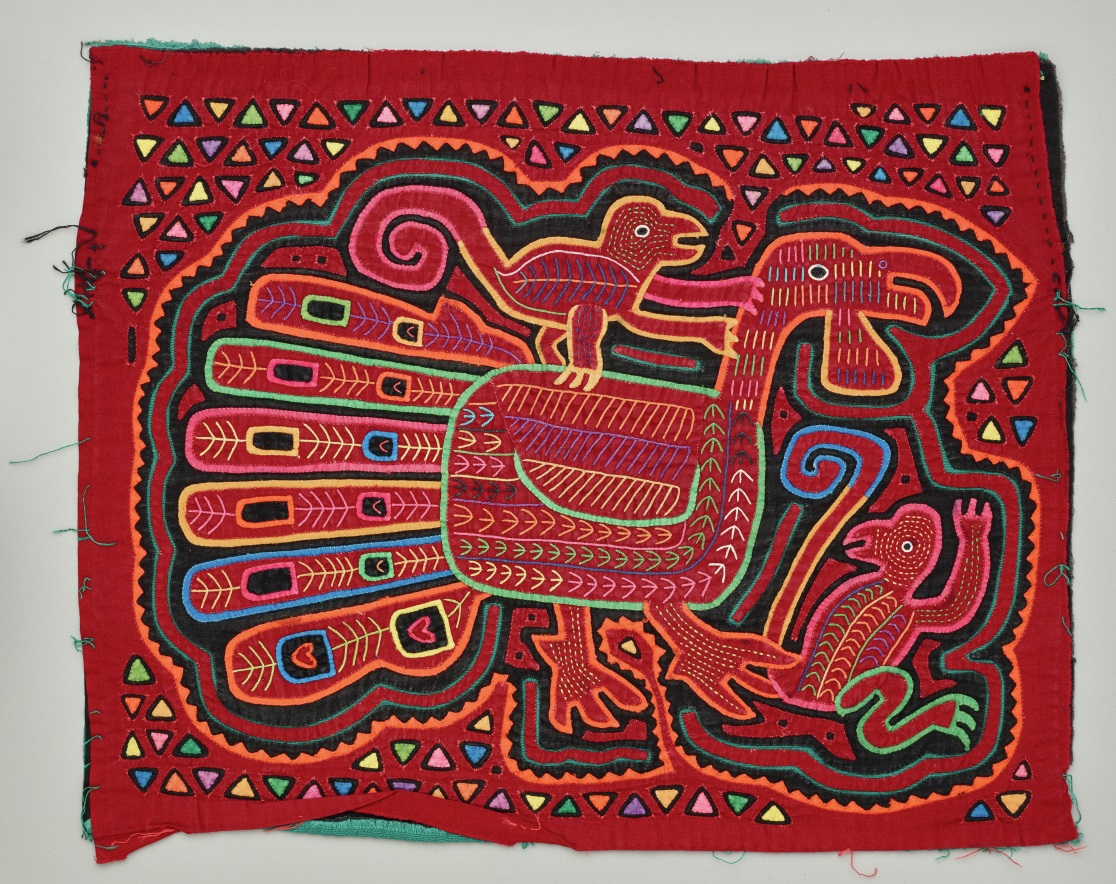
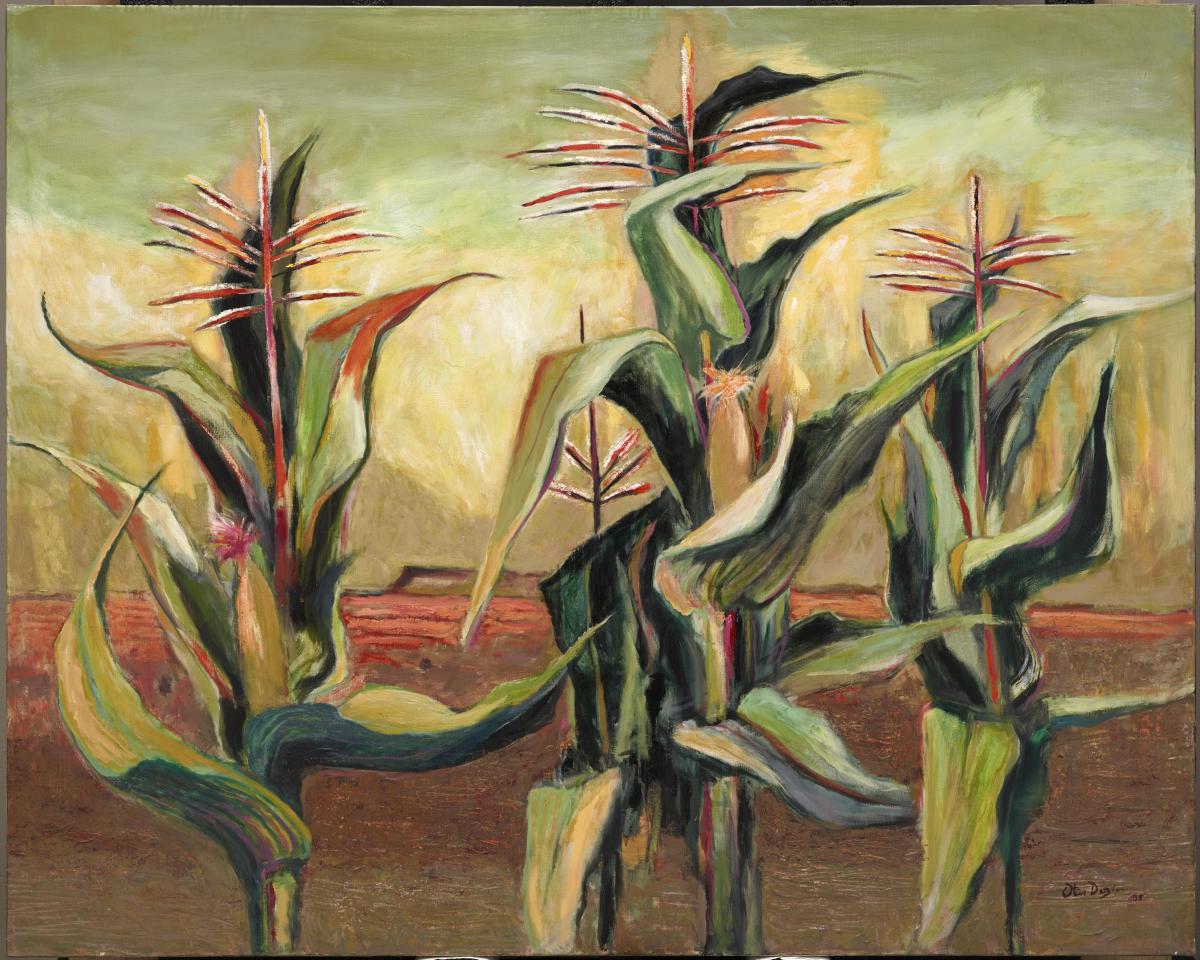
It is well known in my family that the only foods I need on my plate for Thanksgiving dinner are turkey, corn, and mashed potatoes. No other food needs to pass my way at the table.

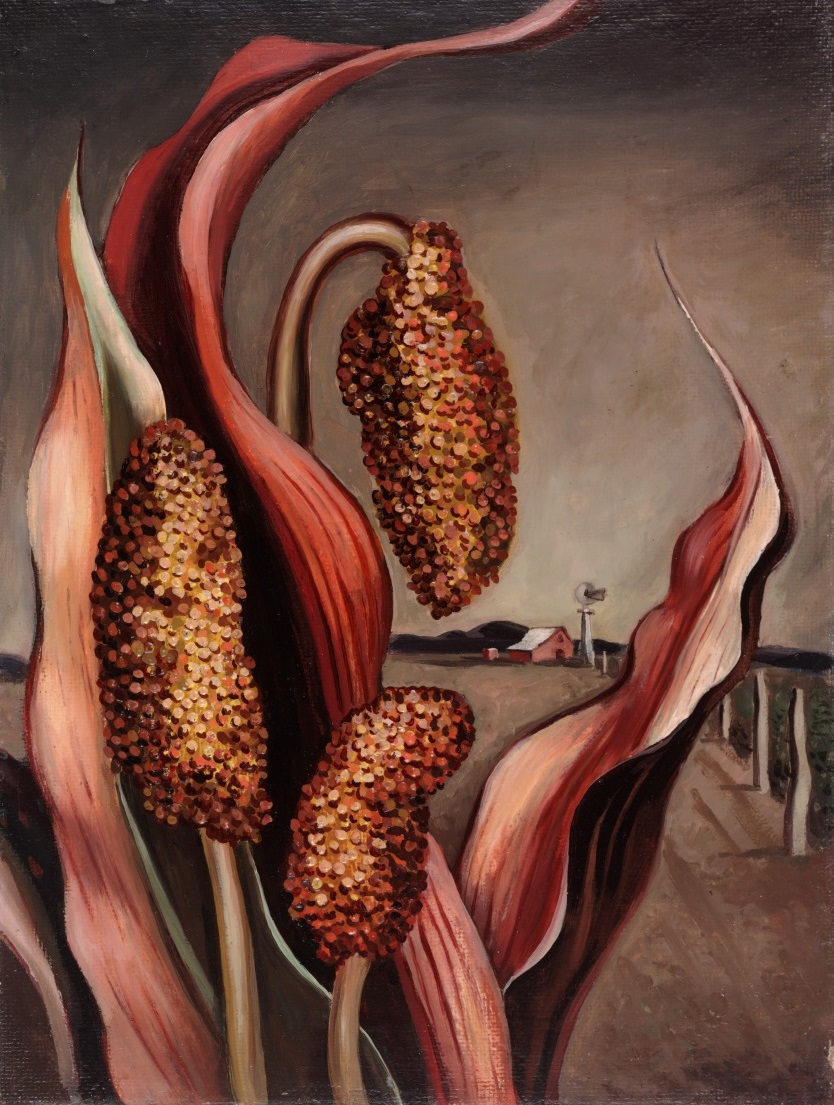
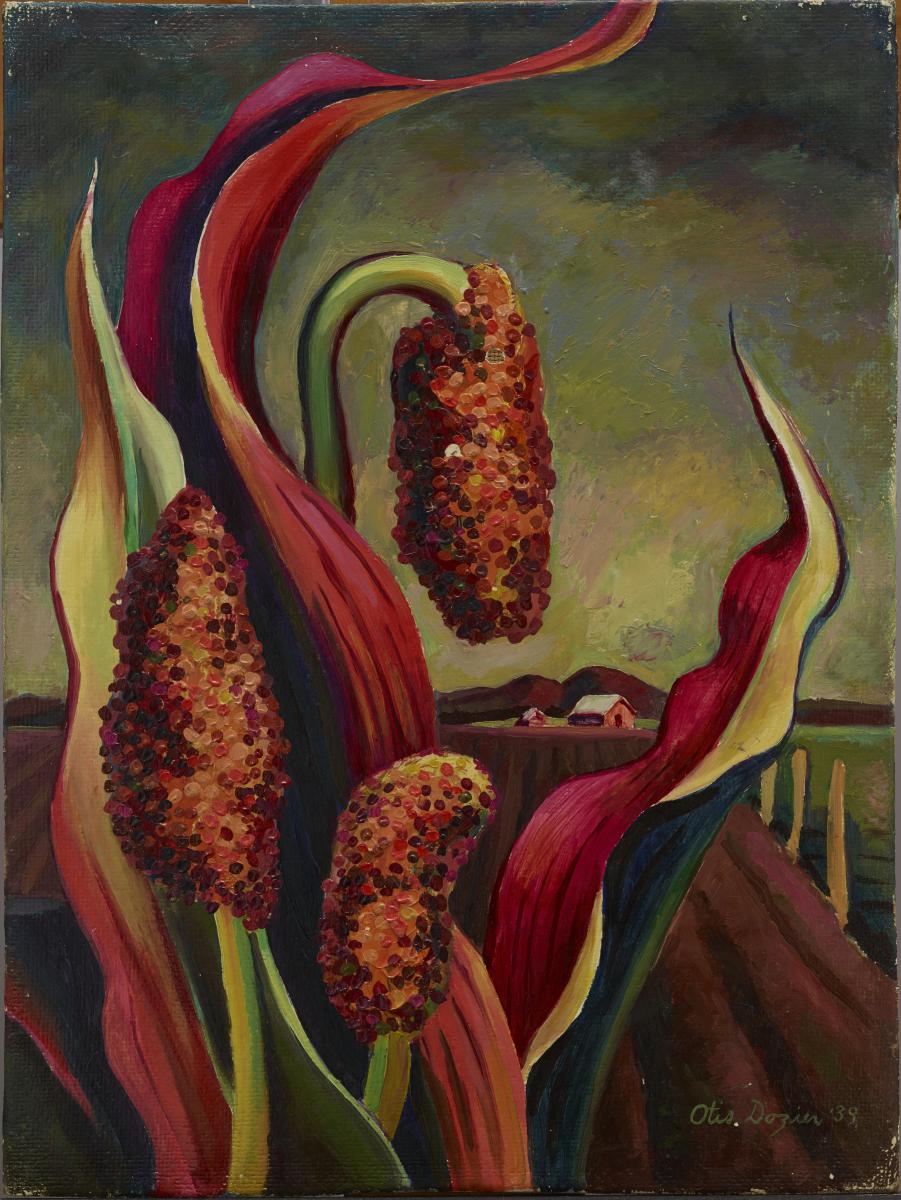
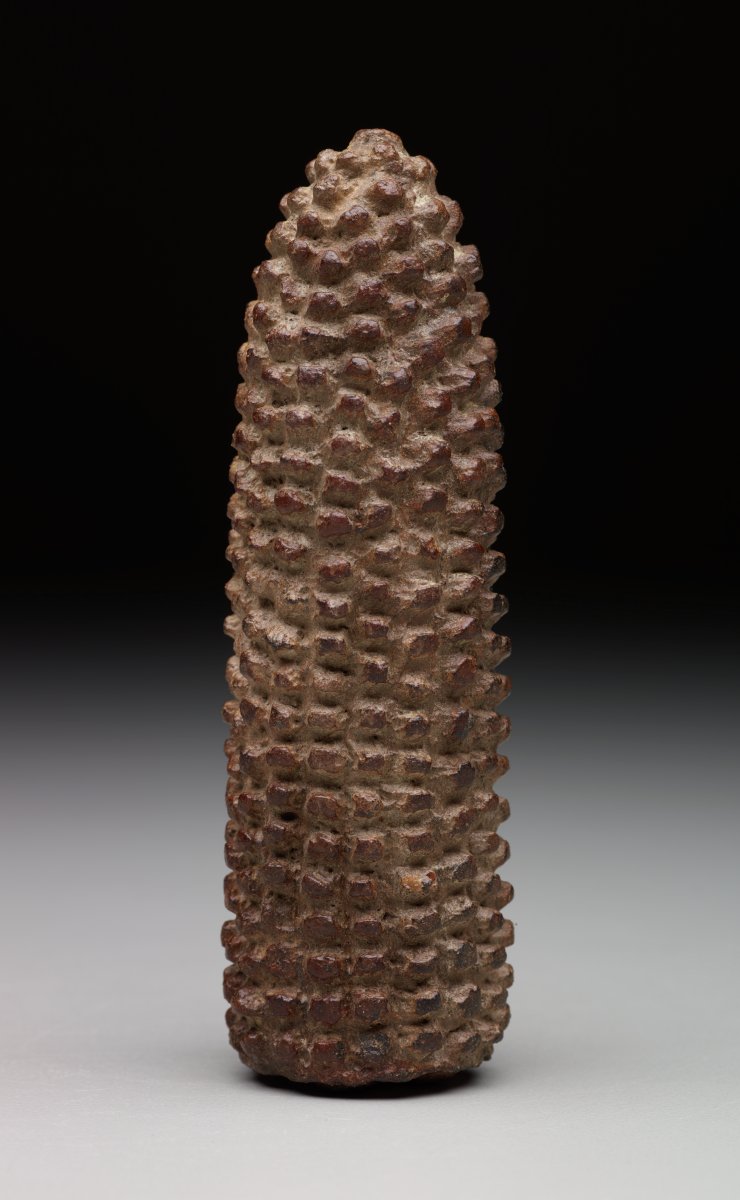
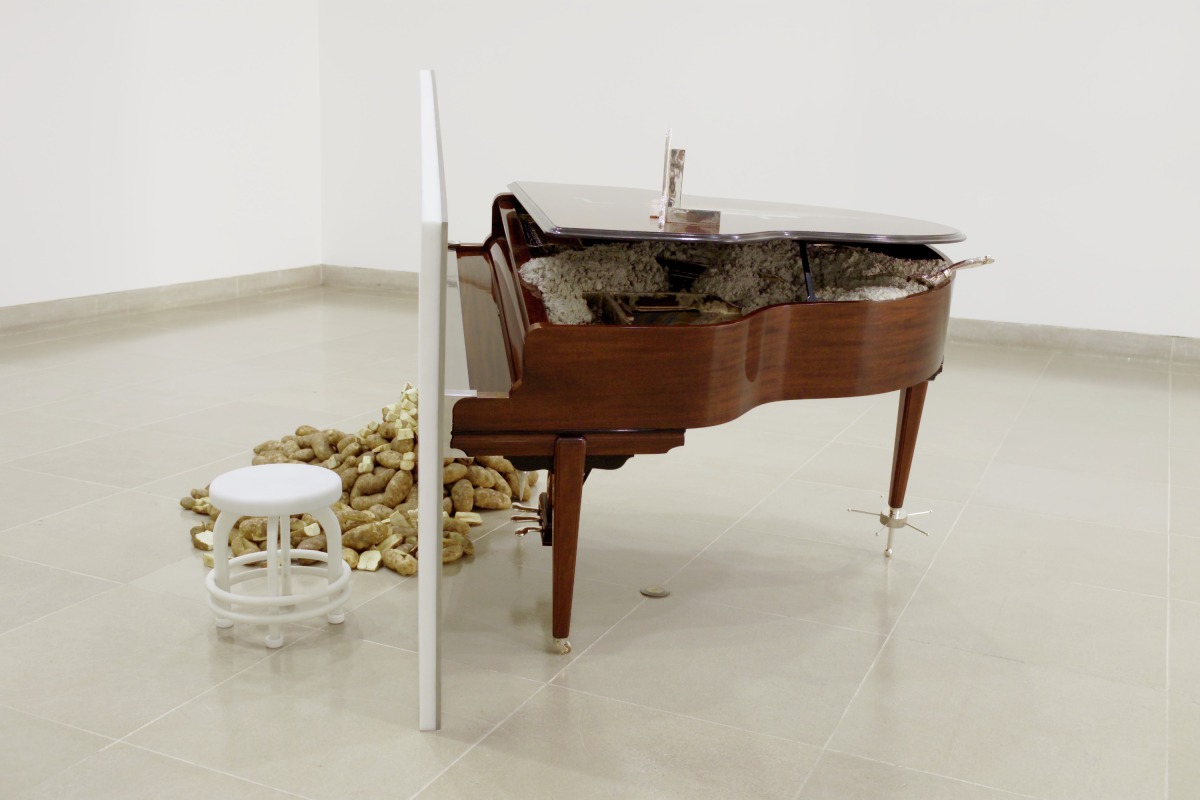
In honor of my favorite holiday meal, I share with you images of turkeys and corn from our collection. And while we don’t have any works of art featuring mashed potatoes, Matthew Barney’s The Cloud Club does feature whole potatoes…and a piano.

Helen Altman, Turkey, 1995, scorch on paper, Dallas Museum of Art, The Texas Artists Fund and gift of Karol Howard and George Morton, © Helen Altman, 1997.152.4

Helen Altman, Turkey, 1995, scorch on paper, Dallas Museum of Art, The Texas Artists Fund and gift of Karol Howard and George Morton, © Helen Altman, 1997.152.4

Otis Dozier, Wild Turkey, 1987, lithograph, Dallas Museum of Art, gift of The Dozier Foundation, ©Denni Davis Washburn, William Robert Miegel Jr, and Elizabeth Marie Miegel, 1990.63

Otis Dozier, Wild Turkey, 1987, lithograph, Dallas Museum of Art, gift of The Dozier Foundation, ©Denni Davis Washburn, William Robert Miegel Jr, and Elizabeth Marie Miegel, 1990.63

Untitled (mola: turkey with two monkeys), Latin America, 20th Century, cotton, applique, Dallas Museum of Art, gift of The Dozier Foundation, DS.1990.300

Untitled (mola: turkey with two monkeys), Latin America, 20th Century, cotton, applique, Dallas Museum of Art, gift of The Dozier Foundation, DS.1990.300

Otis Dozier, Indian Corn, 1965, oil on canvas, Dallas Museum of Art, gift of The Dozier Foundation, ©Denni Davis Washburn, William Robert Miegel Jr, and Elizabeth Marie Miegel, 1990.47

Otis Dozier, Indian Corn, 1965, oil on canvas, Dallas Museum of Art, gift of The Dozier Foundation, ©Denni Davis Washburn, William Robert Miegel Jr, and Elizabeth Marie Miegel, 1990.47

Otis Dozier, Maize and Windmill, 1937, oil on Masonite, Dallas Museum of Art, The Barrett Collection, Dallas, Texas, ©Denni Davis Washburn, William Robert Miegel Jr, and Elizabeth Marie Miegel, 2007.15.20

Otis Dozier, Maize and Windmill, 1937, oil on Masonite, Dallas Museum of Art, The Barrett Collection, Dallas, Texas, ©Denni Davis Washburn, William Robert Miegel Jr, and Elizabeth Marie Miegel, 2007.15.20

Otis Dozier, Maize and Farmhouse, 1939, oil on Masonite, Dallas Museum of Art, gift of The Dozier Foundation, ©Denni Davis Washburn, William Robert Miegel Jr, and Elizabeth Marie Miegel, 1990.40

Otis Dozier, Maize and Farmhouse, 1939, oil on Masonite, Dallas Museum of Art, gift of The Dozier Foundation, ©Denni Davis Washburn, William Robert Miegel Jr, and Elizabeth Marie Miegel, 1990.40

Corn Cob Effigy, Pre-Columbian, 900-1500 A.D.?, ceramic, Dallas Museum of Art, gift of Mrs. Nancy G. Sayles, 1987.377

Corn Cob Effigy, Pre-Columbian, 900-1500 A.D.?, ceramic, Dallas Museum of Art, gift of Mrs. Nancy G. Sayles, 1987.377

Matthew Barney, The Cloud Club, 2002, mixed media, Dallas Museum of Art, Contemporary Art Fund: Gift of Arlene and John Dayton, Mr. and Mrs. Vernon E. Faulconer, Mr. and Mrs. Bryant M. Hanley, Jr., Marguerite and Robert K. Hoffman, Cindy and Howard Rachofsky, Deedie and Rusty Rose, Gayle and Paul Stoffel, and three anonymous donors; DMA/amfAR Benefit Auction Fund; and Roberta Coke Camp Fund, © 2002 Matthew Barney, courtesy Barbara Gladstone, 2003.24.1.A-D

Matthew Barney, The Cloud Club, 2002, mixed media, Dallas Museum of Art, Contemporary Art Fund: Gift of Arlene and John Dayton, Mr. and Mrs. Vernon E. Faulconer, Mr. and Mrs. Bryant M. Hanley, Jr., Marguerite and Robert K. Hoffman, Cindy and Howard Rachofsky, Deedie and Rusty Rose, Gayle and Paul Stoffel, and three anonymous donors; DMA/amfAR Benefit Auction Fund; and Roberta Coke Camp Fund, © 2002 Matthew Barney, courtesy Barbara Gladstone, 2003.24.1.A-D


Happy Thanksgiving!

Stacey Lizotte is Head of Adult Programming and Multimedia Services

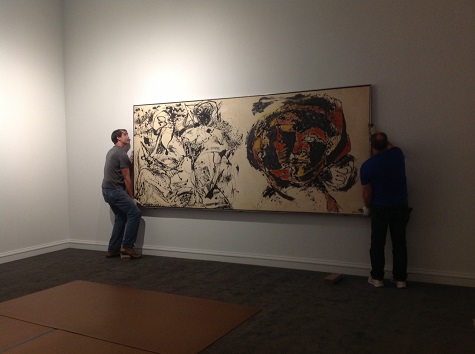
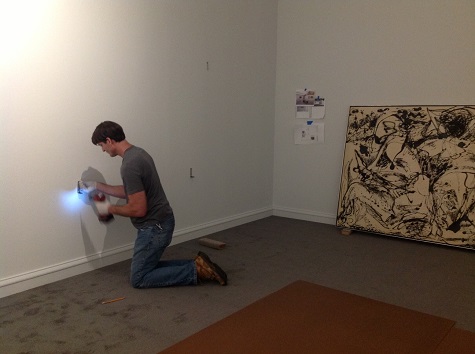
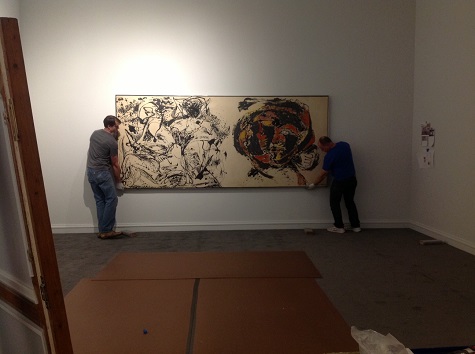
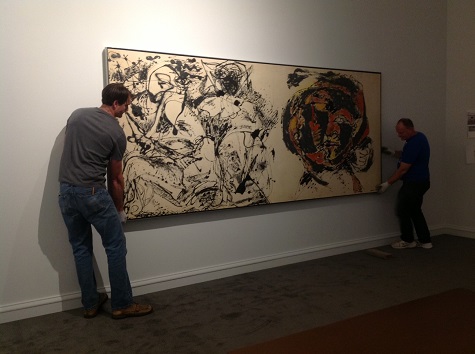
A Pollock Comes Home

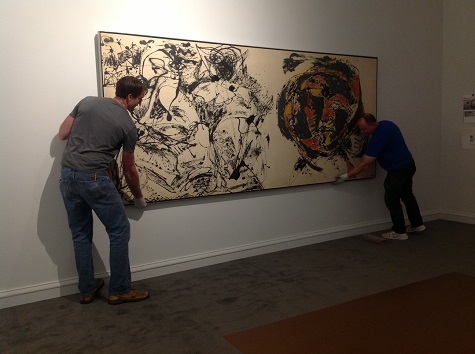
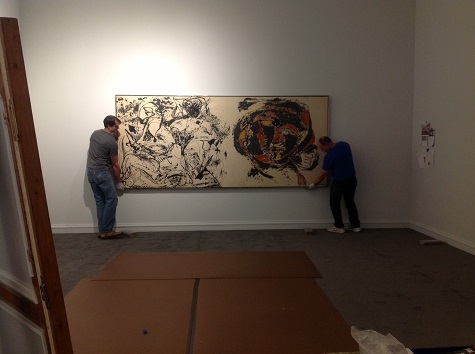
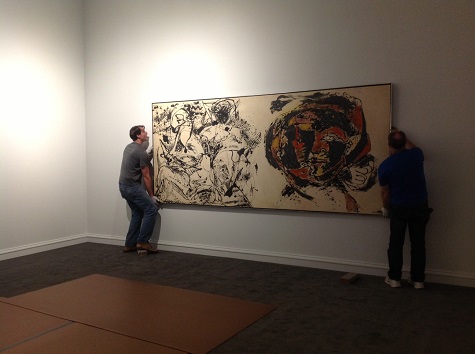
You may have heard about an exhibition that we are just a little bit excited about here at the DMA. Since we cannot wait for you to experience Jackson Pollock: Blind Spots, which opens this Friday during Late Night, we thought we would share the homecoming of the DMA’s Portrait and a Dream, which was recently installed inside the exhibition. Jackson Pollock: Blind Spots will be on view November 20, 2015, through March 20, 2016.
Kimberly Daniell is the Manager of Communications and Public Affairs at the DMA.


Archives

Categories