Archive for the 'Art & Teaching' Category


Tour and Outreach Scheduling Begins Today

Teachers, grab your calendars: tour and Go van Gogh outreach scheduling for the 2012-2013 school year begins today.

As always, all outreach programs and tours booked in advance are free of charge.  Go van Gogh outreach is offered to grades 1-6 in the Dallas area.  Programs include conversations about artworks and an art-making activity, and are designed to dovetail with school curricula, per grade level.  Visit our web site to learn more about the Go van Gogh programs offered this year.

Self-guided or docent-led tours of the Museum’s collection and special exhibitions are available to K-12 students and higher education audiences.  Of special note this fall is our Legacy of the Plumed Serpent in Ancient Mexico docent-guided tour, which will feature outstanding works of Mesoamerican art.  Visit our web site for a full list of tours offered this year.

To submit on online request form, visit the tour and Go van Gogh sections of our web site.

We look forward to seeing you and your students this Fall!

Amy Copeland
Coordinator of Go van Gogh Outreach

Texas Late Night

Howdy, y’all! This past Friday, the DMA showed folks a rootin’ tootin’ good time at our Late Night celebration of the Flower of the Prairie: George Grosz in Dallas exhibition. With a theme as big as Texas, you can bet that there was lots to do here at the Museum. With live folk bands playing in the Atrium Cafe and in the galleries, visitors could hear old-time, toe-tapping, traditional Texas music almost anywhere they went. Adult crowds could be seen gathering for tours of the exhibition and  surrounding the watercolor demonstrations led by artist Scott Winterrowd. Lectures, talks, and films throughout the night also kept the adults scurrying from one program to the next. Families had a rip-roaring time in the Center for Creative Connections studio constructing their own Dallas building to contribute to a three-dimensional city skyline. Also in C3, kids created Texas-inspired bandanas and participated in Yoga for Kids. To get a peek at all the festivities, check out the slide show below.
.

[slideshow]

.
One of my favorite moments from the night was bumping into a family I had taught during a Go van Gogh Summer Library Program. When I stumbled upon them, they were in C3 doing yoga and discussing what kind of building they would create in the studio. They excitedly told me all about going into the Flower of the Prairie: George Grosz in Dallas exhibition to see all of the works of art we had talked about during the Impressions of Dallas library program. “They know everything!” the kid’s impressed dad exclaimed. It is always a joy to see familiar faces in the Museum. To learn a little more about the Go van Gogh Library Program, check out Amy’s blog post from last week. Every participant receives a free family pass, which you could use at the next Late Night on August 17.

What was your favorite moment from the Late Night?

Hannah Burney
Go van Gogh Programs Assistant

Free Summer Fun at Dallas Public Libraries

[slideshow]If you’re looking for a way to entertain the kiddos this summer free of charge, we’ve got just the thing!

For the next few weeks, the Go van Gogh team will be heading out to local Dallas libraries to present free art programs for kids ages 5-12.  The hour-long programs include interactive conversations about artworks and lots of time to dig into a fun art-making project.  Best of all, participants receive a free family pass to the Museum.

This summer, we are offering two different programs—Searching for Faces and Impressions of Dallas—and we’re criss-crossing the metroplex, visiting most of Dallas’s public libraries.  Below are descriptions of the programs, and below that, a schedule of our upcoming programs.  You can also find the programs here on our website.  Be sure to contact the library in advance; to confirm space availabilty.

Searching for Faces
Look for clues—including faces, clothing, and gestures—that tell us about figures in works of art. Then, create your own self-portrait that tells us about you. For children ages 5–12, recommended for ages 5-9.

Impressions of Dallas
Explore Dallas’s past through the watercolor paintings of German artist, George Grosz. Then use watercolor pencils to create your own artwork! For children ages 5–12, recommended for ages 9-12.
This presentation highlights artworks in the Dallas Museum of Art’s special exhibition Flower of the Prairie: George Grosz in Dallas, on view now through August 19.

JULY
Tuesday, July 17, 2:00 p.m.
Prairie Creek, 9609 Lake June Road, 75217
214-671-0410
Searching for Faces

Wednesday, July 18, 2:30 p.m.
Audelia, 10045 Audelia Road, 75238
214-670-1350
Impressions of Dallas

Thursday, July 19, 2:00 p.m.
Lochwood, 11221 Lochwood Boulevard, 75218
214-670-8403
Searching for Faces

Friday, July 20, 2:00 p.m.
Kleberg-Rylie, 1301 Edd Road, 75253
214-670-8471
Searching for Faces

Tuesday, July 24, 2:00 p.m.
Timberglen, 18505 Midway Road, 75287
214-671-1365
Impressions of Dallas

Wednesday, July 25, 2:00 p.m.
Dallas West, 2332 Singleton Boulevard, 75212
214-670-6445
Impressions of Dallas

Thursday, July 26, 2:00 p.m.
Park Forest, 3421 Forest Lane, 75234
214-670-6333
Searching for Faces

Friday, July 27, 2:00 p.m.
Oak Lawn, 4100 Cedar Springs Road, 75219
214-670-1359
Searching for Faces

Tuesday, July 31, 10:30 a.m.
Children’s Center at the J. Erik Jonsson Central Branch, 1515 Young Street, 75201
214-670-1400
Impressions of Dallas

AUGUST
Wednesday, August 1, 2:00 p.m.
Highland Hills, 3624 Simpson Stuart Road, 75241
214-670-0987
Impressions of Dallas

Thursday, August 2, 2:30 p.m.
Skillman Souwestern, 5707 Skillman Street, 75206
214-670-6078
Searching for Faces

Friday, August 3, 2:00 p.m.
Fretz Park, 6990 Belt Line Road, 75254
214-670-6421
Searching for Faces

Tuesday, August 7, 10:30 a.m.
Preston Royal, 5626 Royal Lane, 75229
214-670-7128
Searching for Faces

Wednesday, August 8, 2:00 p.m.
Highland Hills, 3624 Simpson Stuart Road, 75241
214-670-0987
Searching for Faces

Thursday, August 9, 10:30 a.m.
Hampton-Illinois, 2951 South Hampton Road, 75224
214-670-7646
Impressions of Dallas

Friday, August 9, 2:00 p.m.
White Rock Hills, 9150 Ferguson Road, 75228
Impressions of Dallas

Friday, August 10, 2:00 p.m.
Kleberg-Rylie, 1301 Edd Road, 75253
214-670-8471
Impressions of Dallas

Amy Copeland
Coordinator of Go van Gogh Outreach
Teaching for Creativity: Scribble Characters

Consider testing out this entertaining creativity exercise with your students or even with friends. (It’s THAT fun.) When Summer Seminar instructor, Magdalenda Grohman facilitated this exercise with this year’s participants, they had a blast with it.

  1. Every person should have a piece of paper and a writing utensil.
  2. Close your eyes. Keeping your pen or pencil on the paper, scribble for about forty-five seconds. Think about the mood you are in, and try to reflect that mood through your scribbles.
  3. Once everyone is finished drawing, open your eyes, and gather together all the scribbles. Shuffle the scribbles.
  4. Choose one scribble. As a group, think about and describe the scribble. What adjectives come to mind?
  5. Imagine that this scribble is a person. Who is it? What is his/her name? How old is he/she? What does he/she do for a living and/or for fun? What is his/her relationship with his family? What interesting events have occurred in his/her life? What is his/her biggest wish and/or greatest fear?
  6. Jot down the most important aspects of this person, and continue personifying the rest of the scribbles as a group.
  7. Once you have a set of scribble-characters, then randomly distribute one to each participant. Ask one participant to create a sentence to begin a narrative. The scribble-character in his/her hand must be involved in the narrative.
  8. The next person adds another sentence and another character to the narrative, until you have a funny, collaborative story that incorporates all of the scribble-characters.

Here are some of our scribble characters:

[slideshow]

In what ways are you encouraging open-minded, creative attitudes and training transformative thinking in your classroom?

Andrea V. Severin
Coordinator for Teaching Programs

Friday Photos: Summer Seminar 2012

Last Friday marked the end of Summer Seminar 2012: Teaching for Creativity, a week-long, immersive workshop for teachers of all grades and subjects to explore ways to foster creative thinking skills in their students. As a relatively fresh DMA employee, this Summer Seminar was my first. I was joined by eight educators from near and far (from Texas to Nebraska to Monterrey, Mexico!). Participants spent the week with the Museum’s resident creativity expert, Dr. Magdalena Grohman, engaging in group and independent creativity exercises, exploring creativity through art in the galleries, discussing current scholarship on creativity, and developing lesson plans to be tested in their classrooms next school year.

Thank you to this year’s participants for your insight, enthusiasm, and open-minds. Check out some of the photos from our idea-filled week.

[slideshow]

Andrea V. Severin
Coordinator of Teaching Programs

An Artistic Aegean Anniversary

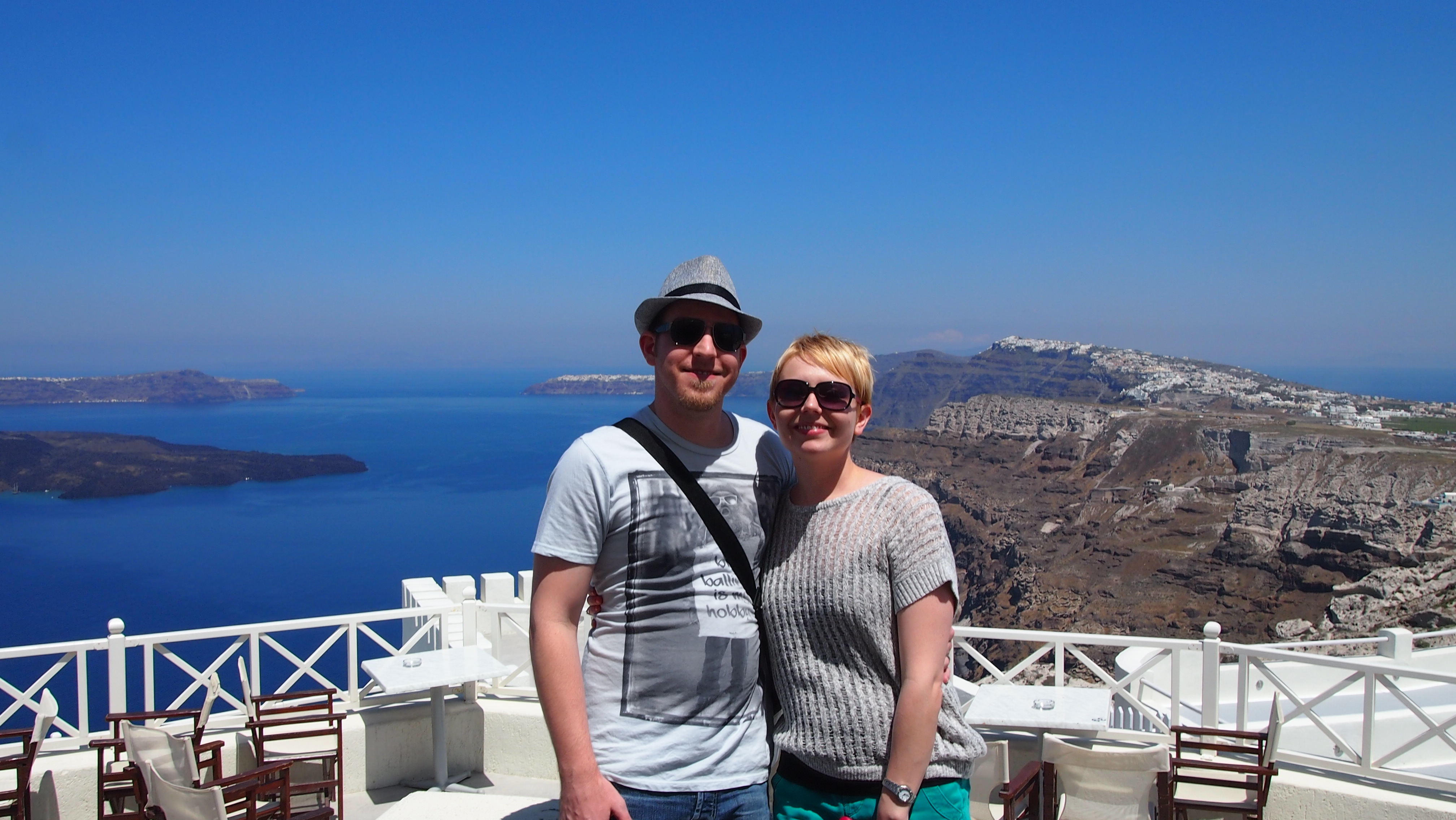
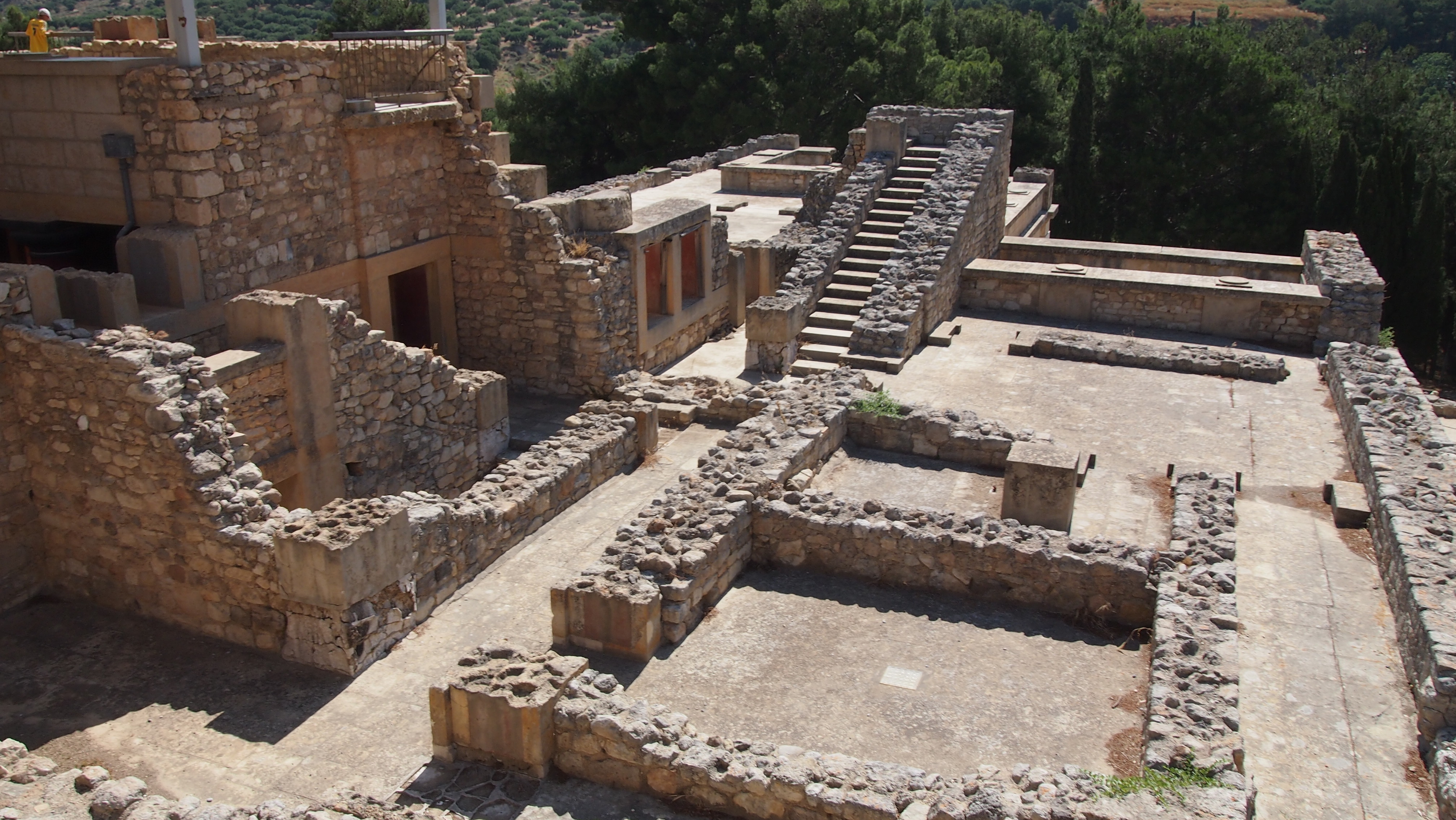
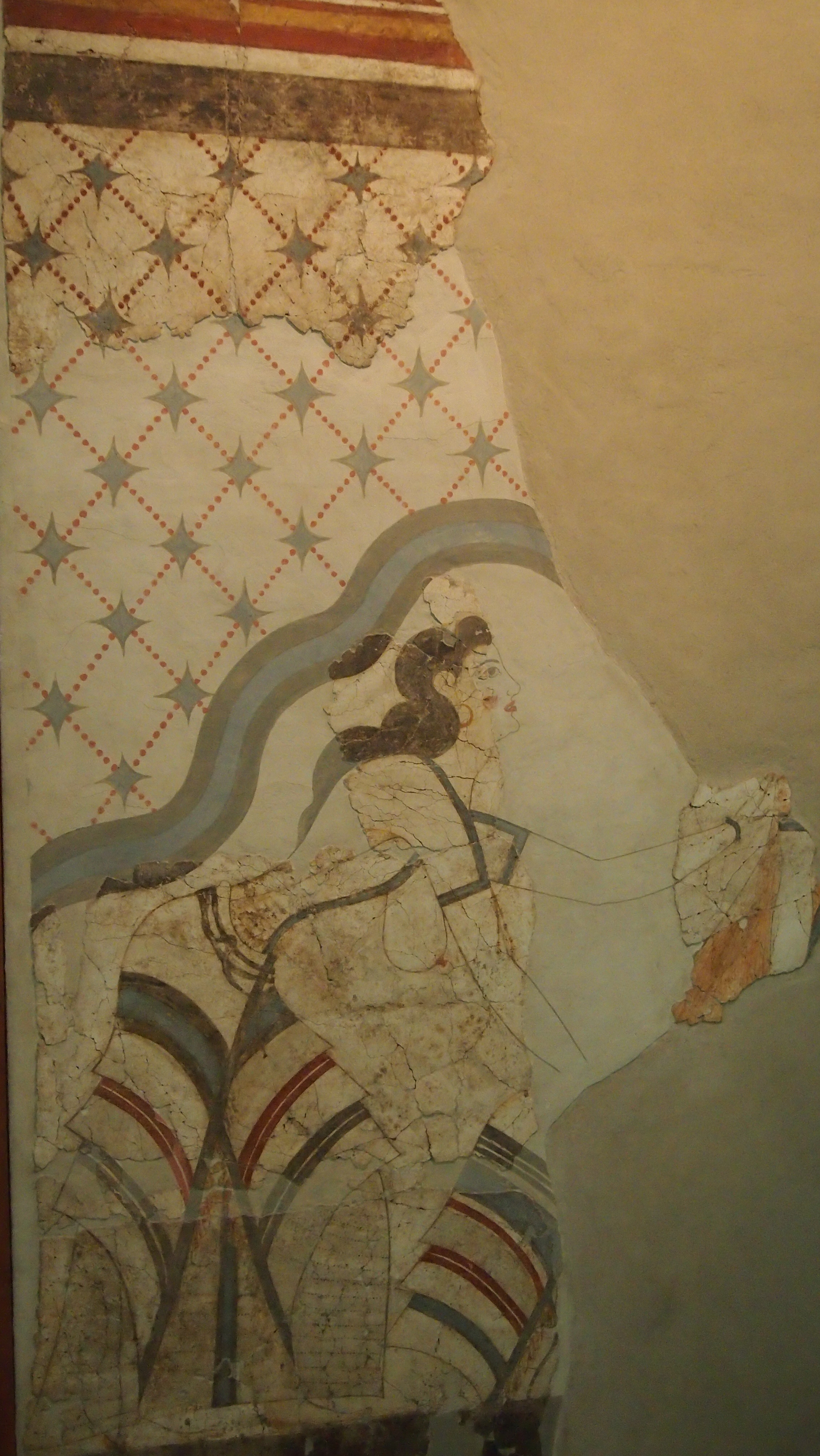
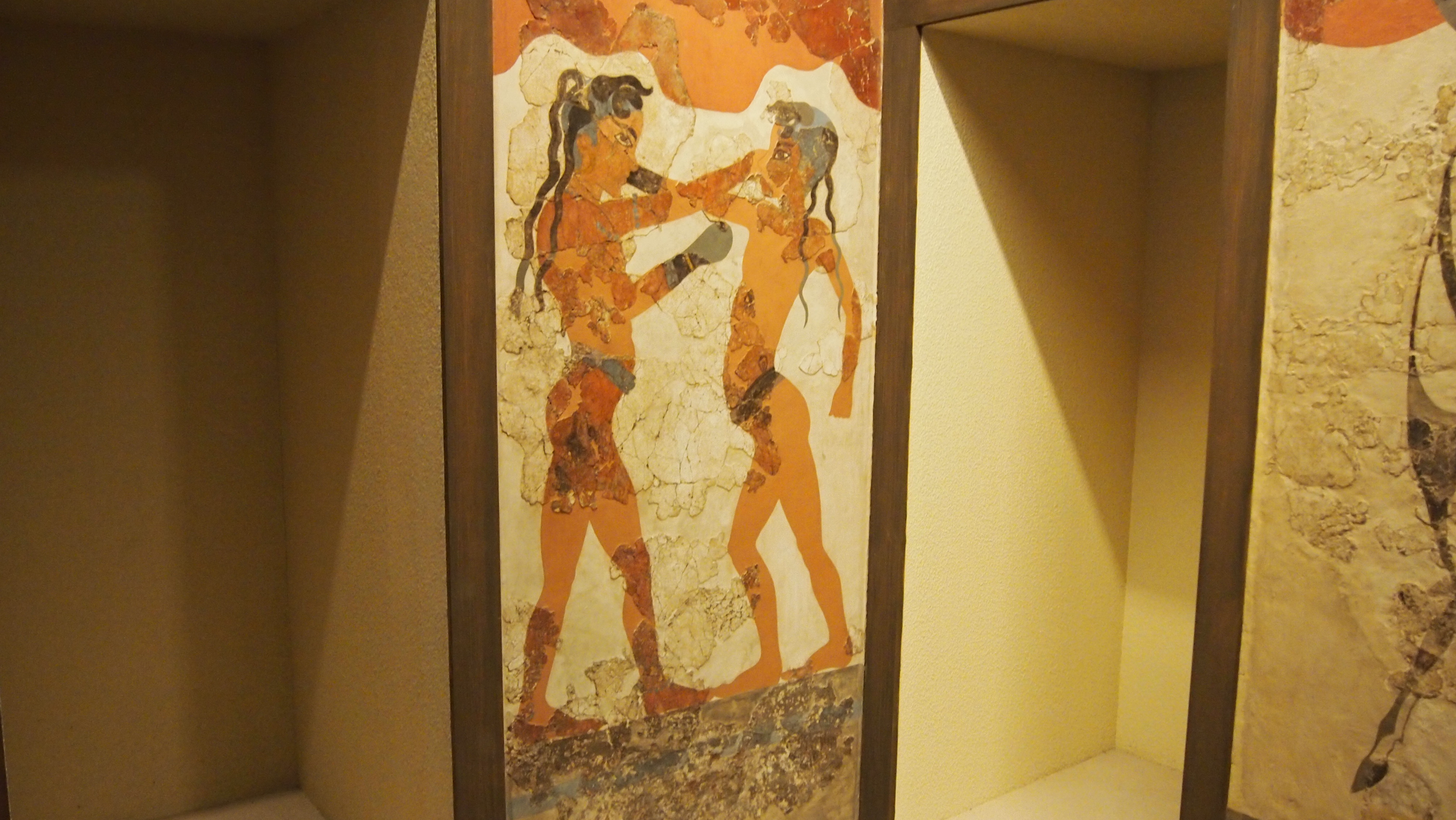
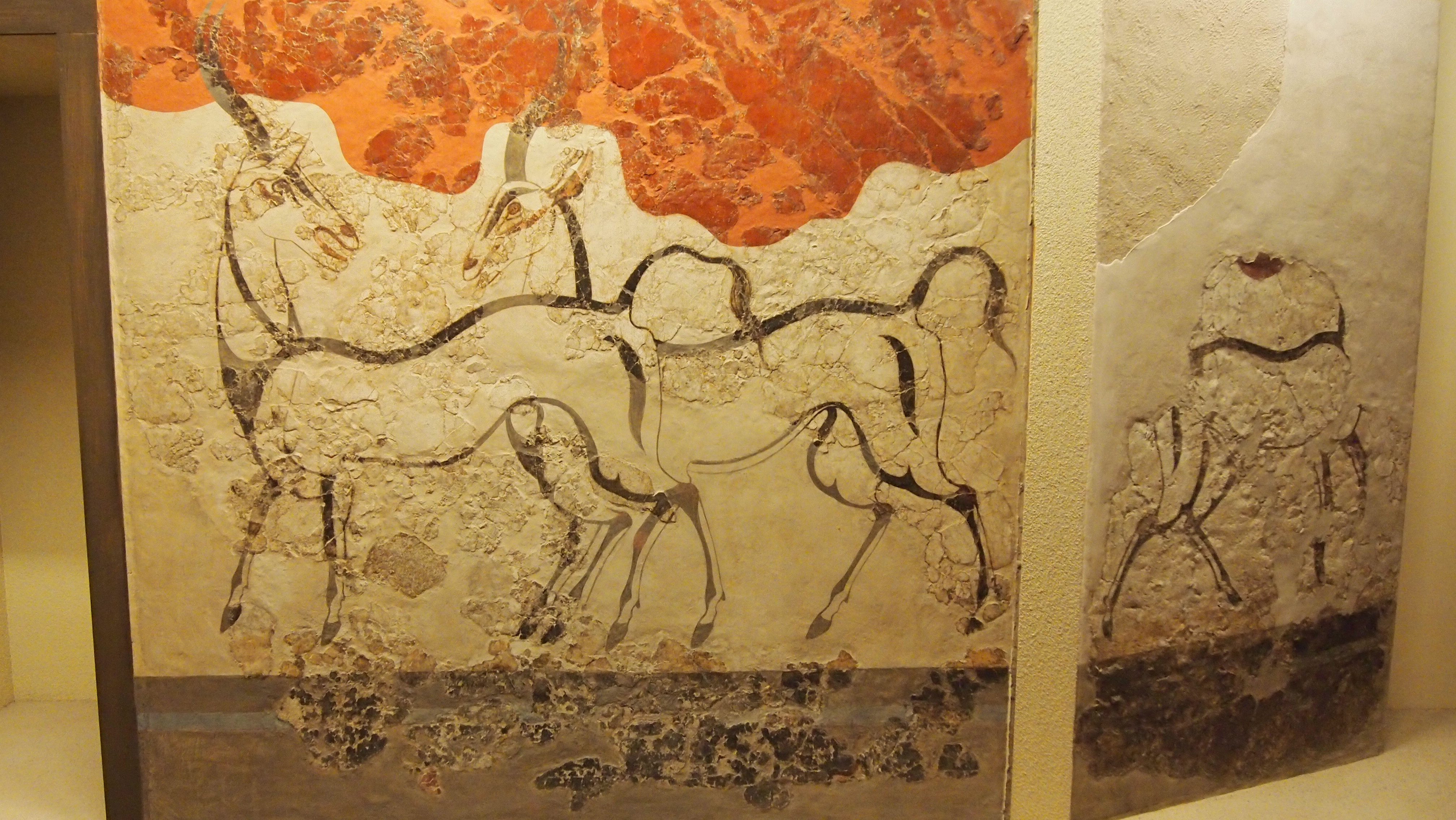
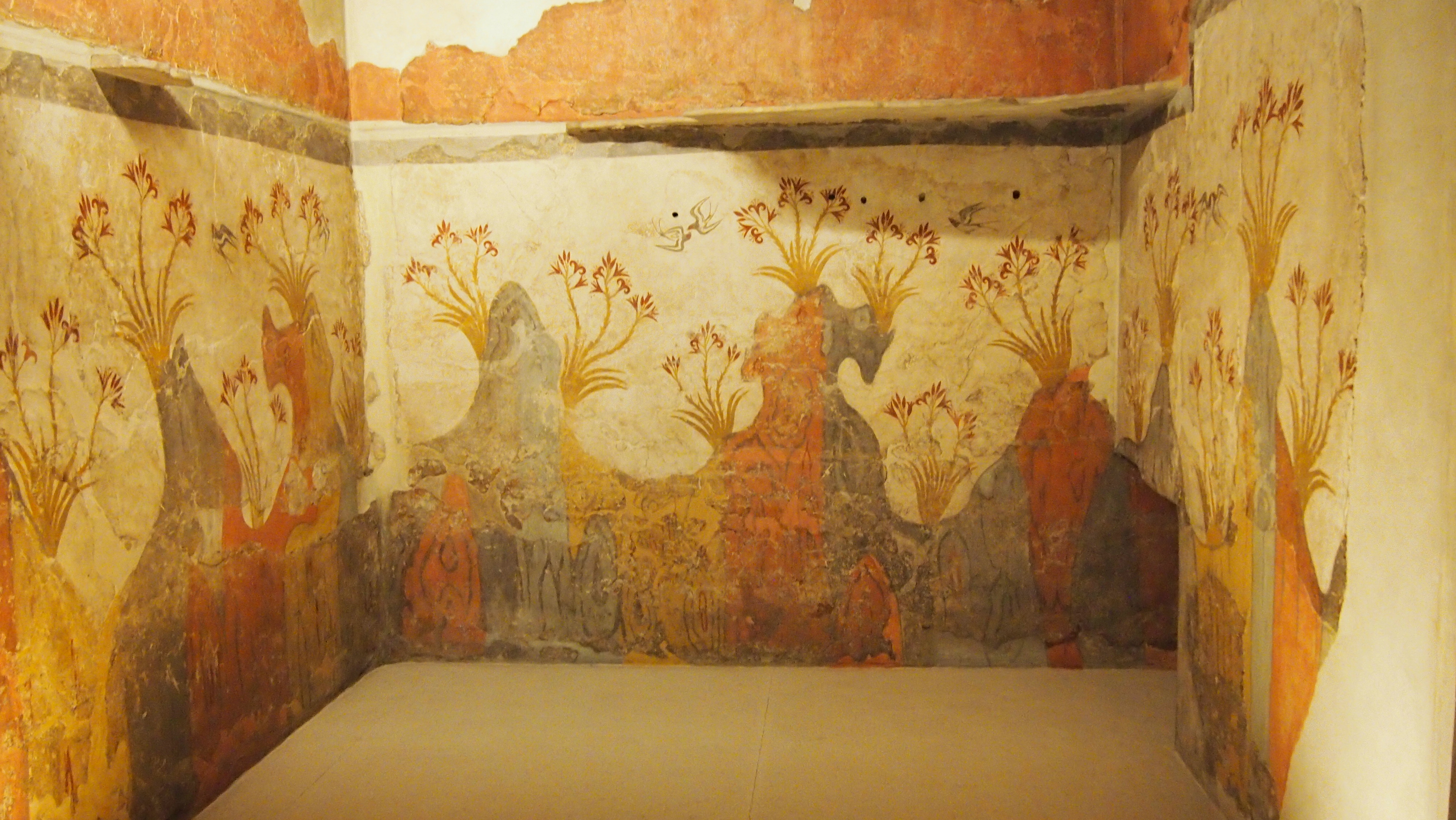
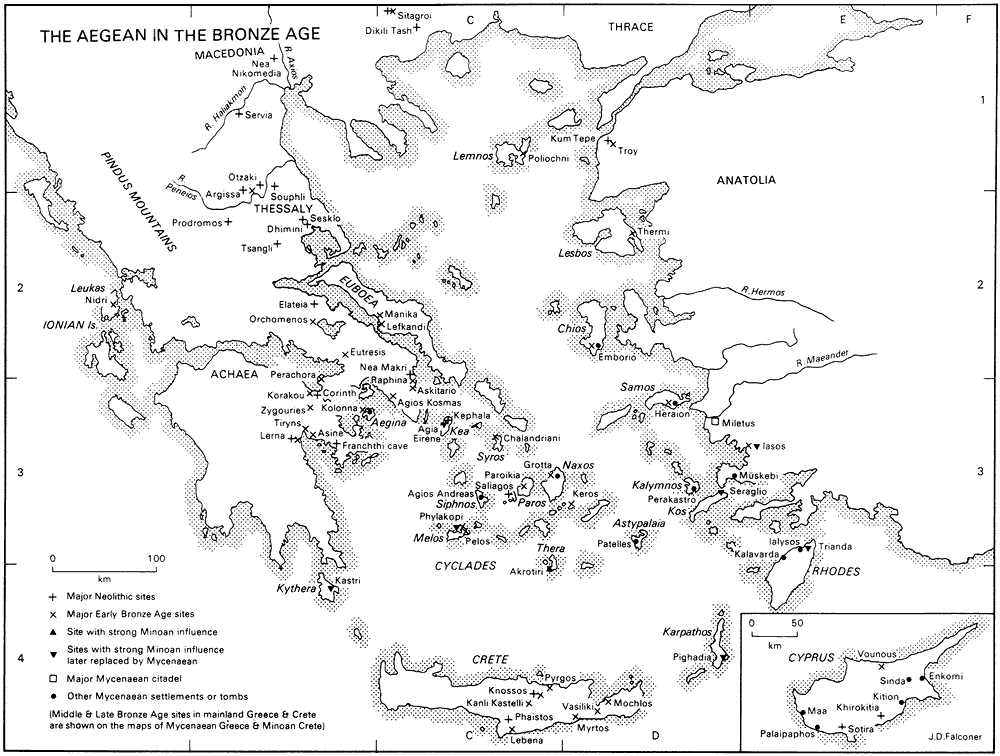
A few weeks ago, my husband and I celebrated our first anniversary on an amazing cruise through the Aegean Sea. I majored in Ancient History at the University of Texas, so you can imagine my excitement at getting to experience numerous ancient sites in person. In particular, I have always been fascinated with prehistoric Aegean cultures, so the stops on both Crete and Thera (Santorini) were definitely a highlight.

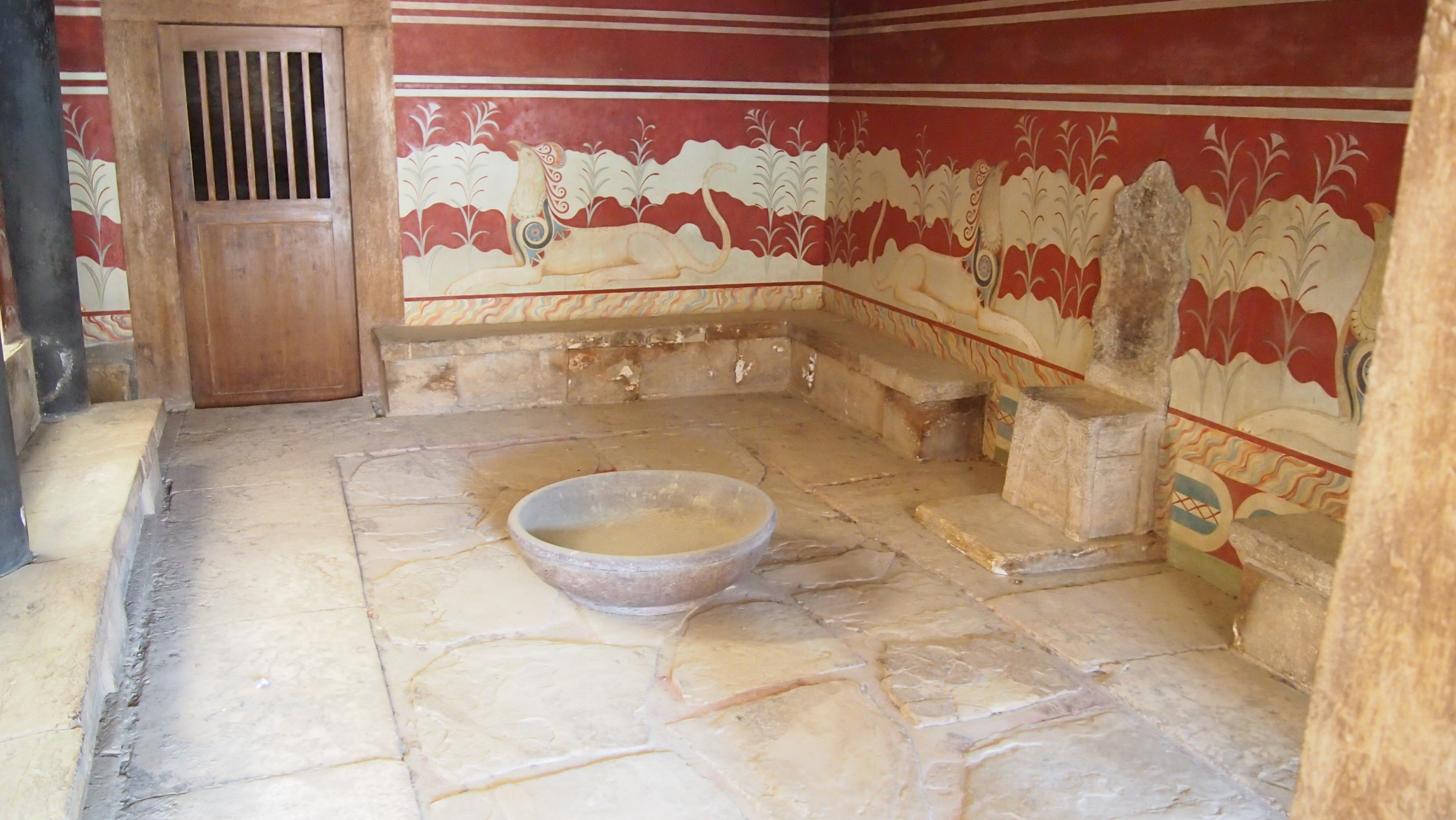
One of the most interesting cultures is the Minoan civilization, which thrived during the Bronze Age from 2100-1500 B.C. on the island of Crete. Named for the mythical King Minos, the Minoans developed a centralized political system ruling from urbanized palace centers, the largest of which was located at Knossos on the north central coast of Crete. As prosperous sea-farers, the Minoans established extensive contact and trade with the contemporary cultures of Egypt and the Near East. Ancient writers even asserted that King Minos ruled over a maritime empire which included many Aegean islands. Although the extent of the Minoan political sphere is unclear, the Minoans were certainly in contact and influencing the culture of nearby islands like Thera, as attested by the surviving art.

Looking into the caldera on Thera, with the active volcano at left

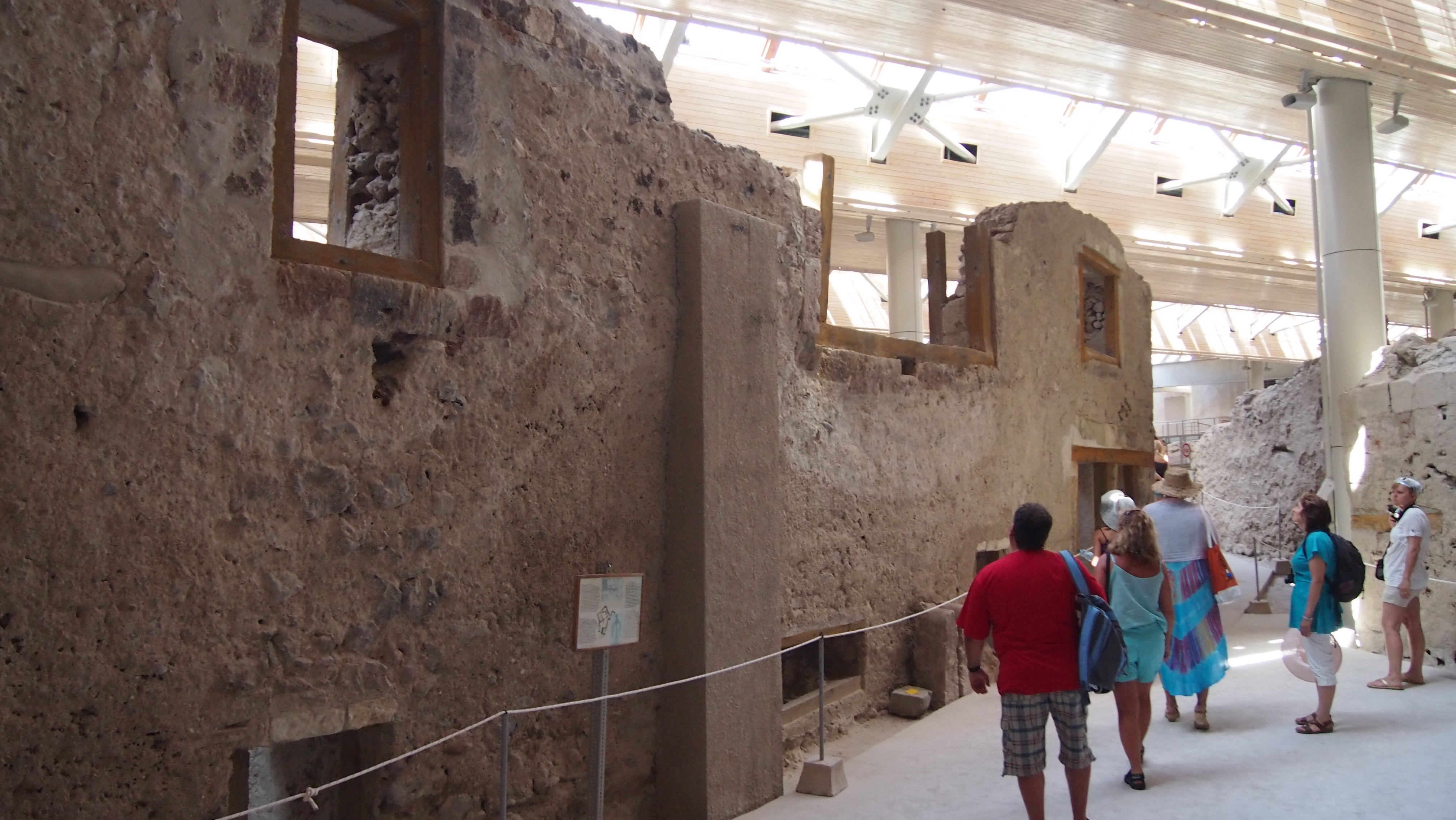
Thera is a unique island whose history has been shaped by the active volcano at its center. During the period of Late Minoan 1A (c. 1625 B.C. or c. 1550 B.C.—dating is disputed by different scholars), the volcano erupted with such extreme force that it spread ash across the entire eastern Mediterranean and likely created a global cooling event. This eruption not only formed the distinctive caldera and picturesque cliffs seen on the island today, it also covered an entire ancient site in ash and pumice, perfectly preserving it like a prehistoric Greek Pompeii. Because of this eruption, the archaeological site of Akrotiri has yielded frescoes that are much more complete than those found elsewhere in the Aegean.

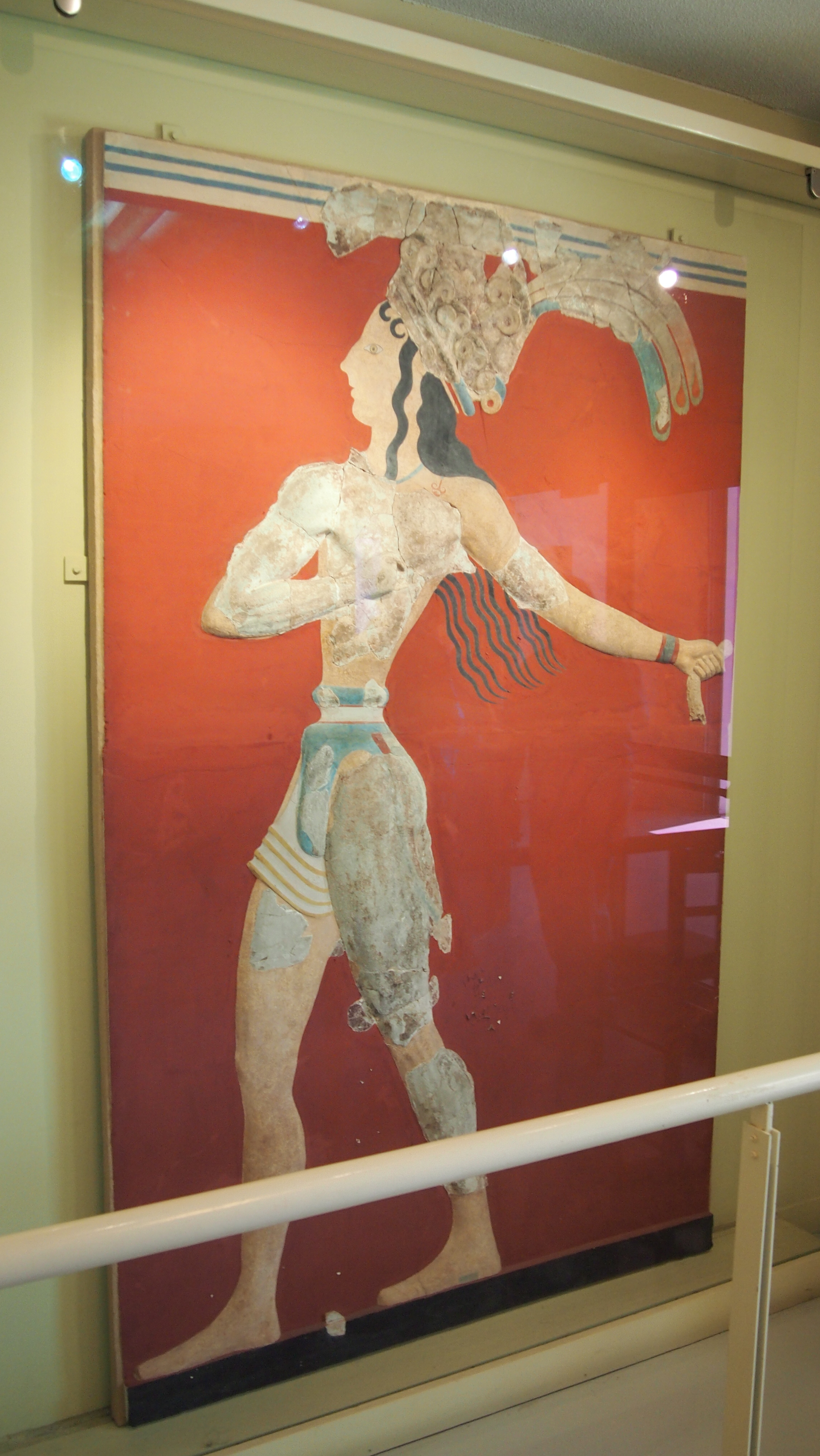
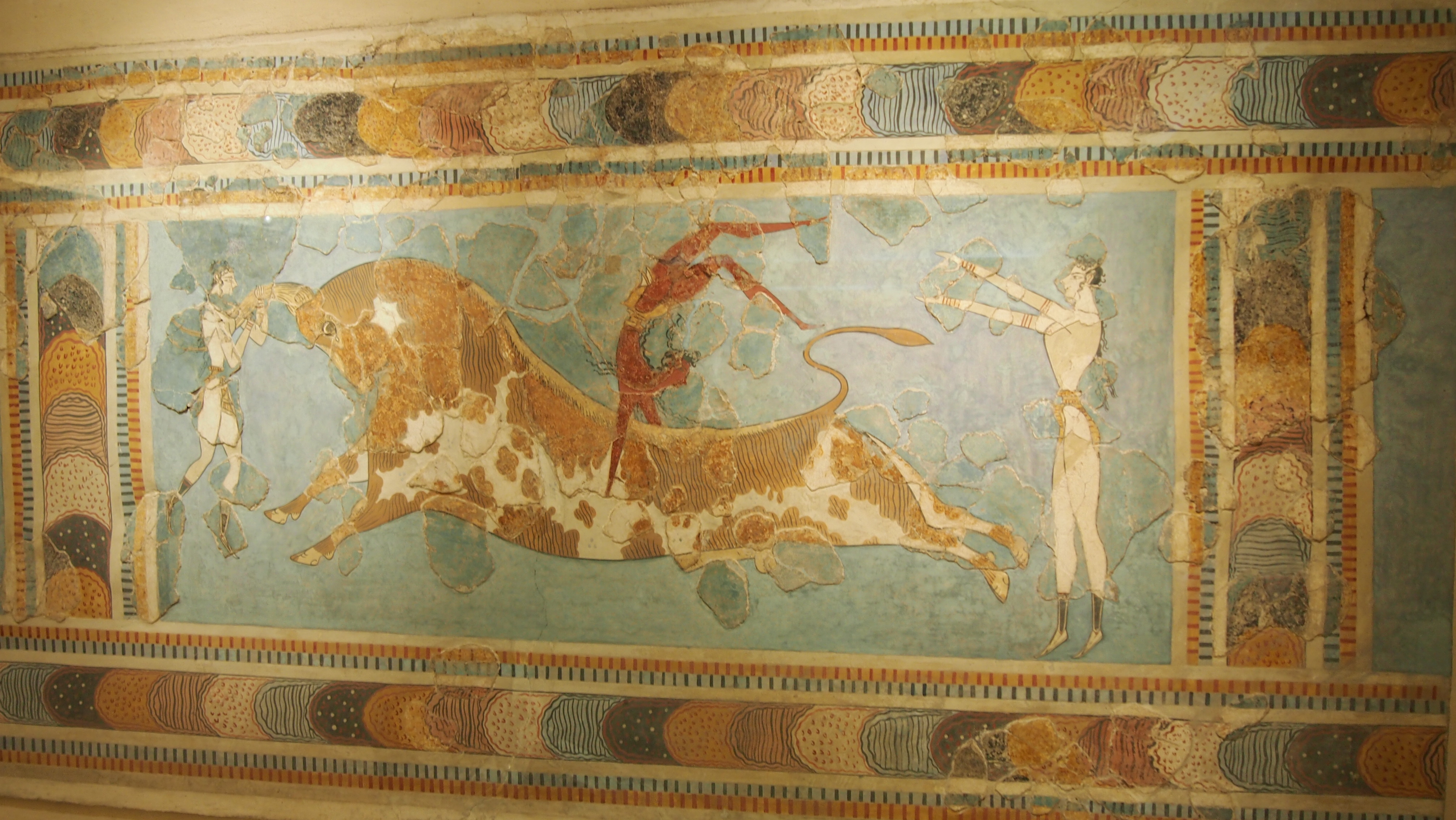
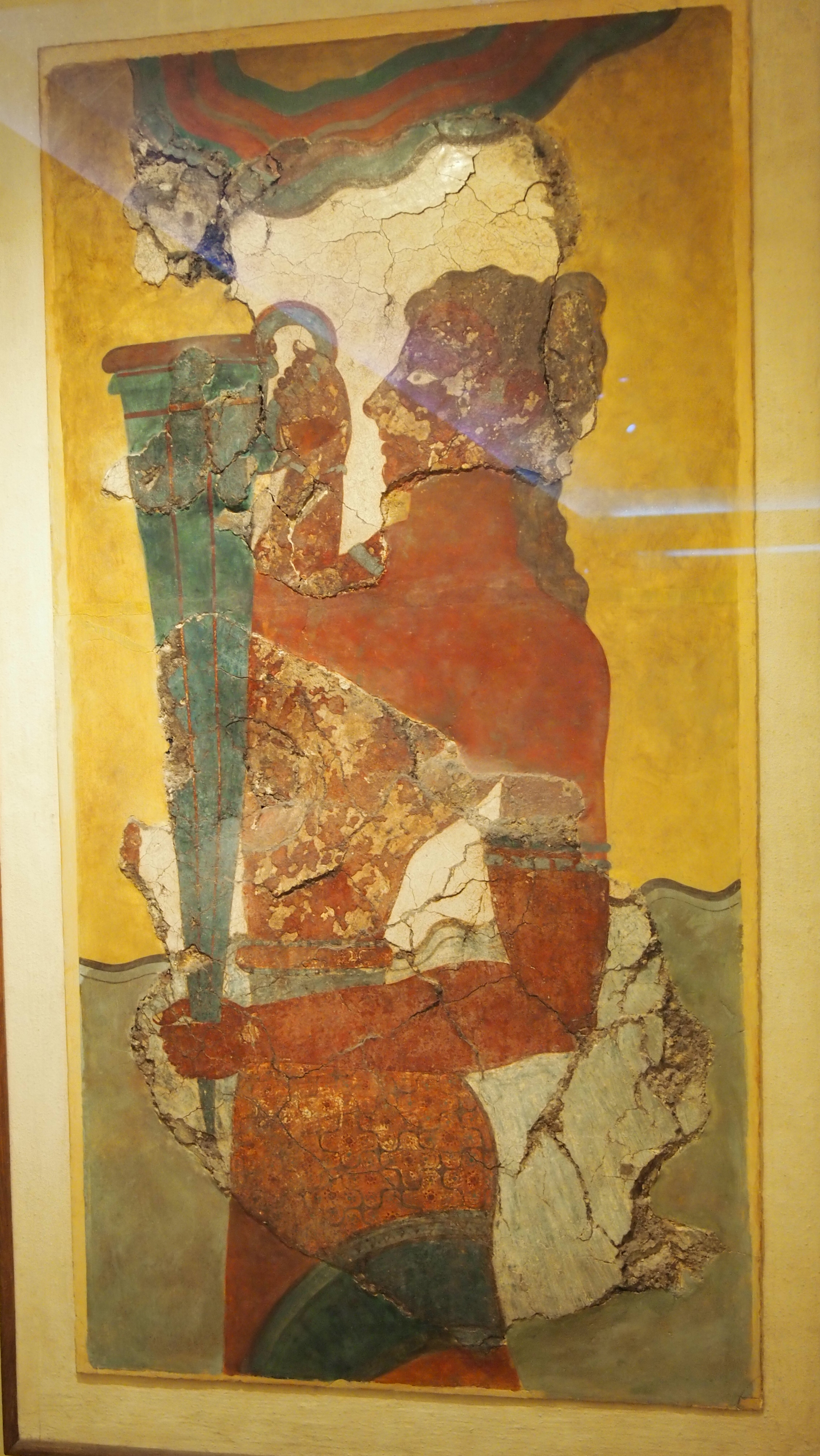
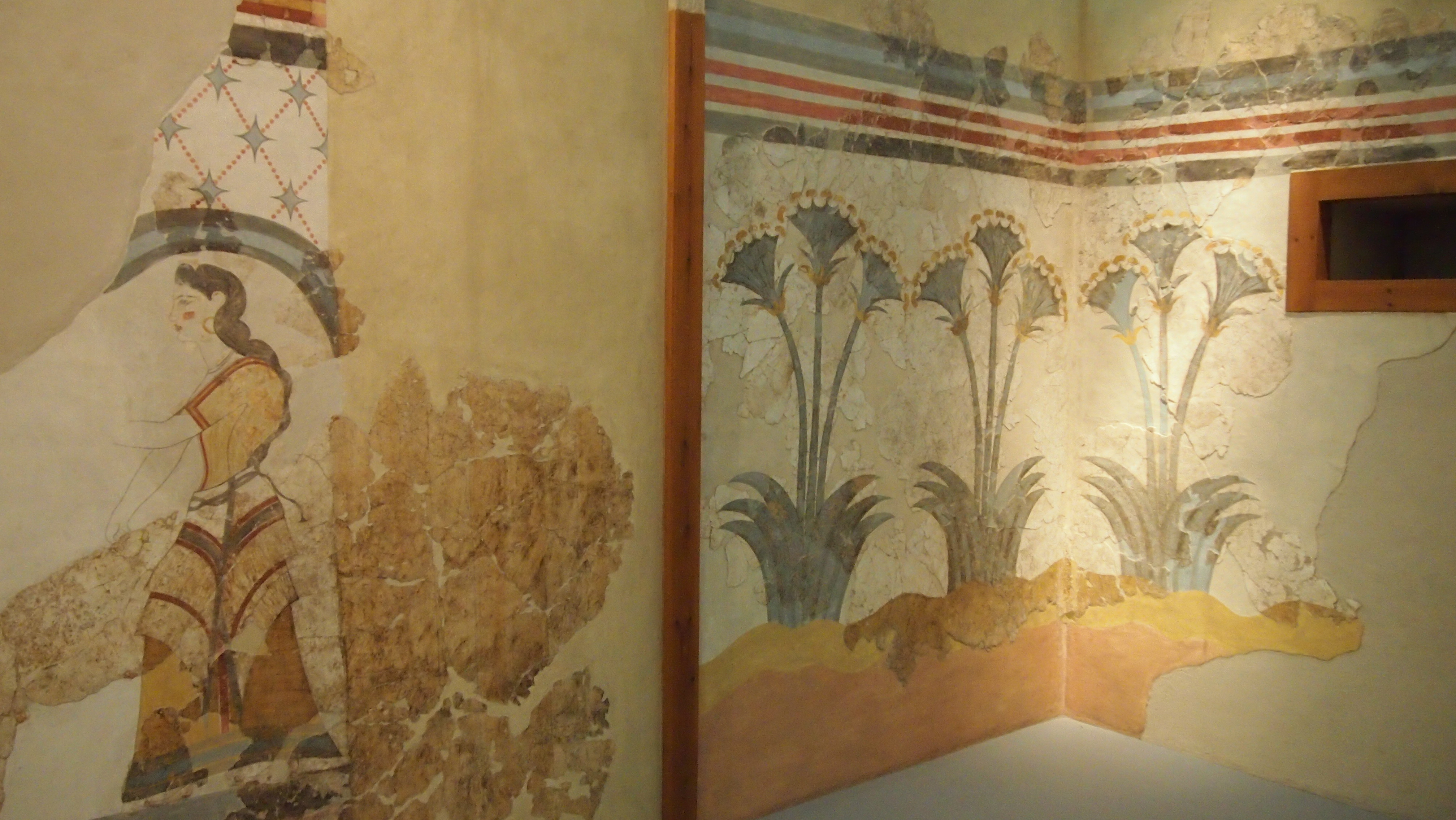
To execute their frescoes, Minoan artists used mineral pigments in white, red, brown, yellow, black, and blue. The wall surfaces were divided into three zones: the upper zone, above windows and doors, contained miniature friezes or decorative patterns; the middle zone included the large main subject; and the lower zone served as the base, sometimes using patterns to imitate stonework. The basic composition was painted in buon fresco technique, on the wet lime plaster surface. Additional colors and details were added after the plaster dried (fresco secco), using an organic fixative like egg white. The scenes include themes from nature (landscapes with plants and animals), daily life (fishing, sea-faring), and ritual (offerings to a goddess). The Theran fresco style is similar to the style found in Knossos and other palace centers on Crete, but utilizes a livelier, though less refined, hand.

A visit to Thera is certainly not complete without a trip to the Museum of Prehistoric Thera, where you can see examples of these beautiful frescoes, along with other objects found at Akrotiri. But visiting the extensive ancient sites of both Knossos and Akrotiri really allows for a more complete understanding of the Minoan culture that flourished thousands of years ago. That such beautiful art could be created so long ago—simply amazing!

Click on the thumbnails below for larger images.

Further Reading:

  • Chapin, A. (2010). Frescoes. In E. H. Cline (Ed.), The Oxford handbook of the Bronze Age Aegean (ca. 3000-1000 BC) (pp. 223-236). New York: Oxford University Press.
  • Doumas, C. (1992). The wall-paintings of Thera. Athens: Thera Foundation.
  • Rutter, J. (n.d.).  Lesson 17: Akrotiri on Thera, the Santorini Volcano and the Middle and Late Cycladic Periods in the Central Aegean Islands. Retrieved from Dartmouth.edu.
  • Shelmerdine, C. W. (2008). The Cambridge companion to the Aegean Bronze Age. Cambridge: Cambridge University Press.

Sarah Coffey
Assistant to the Chair of Learning Initiatives

Friday Photos: Peaceful Space

Imagine you are in a peaceful place.  What does that place look like?  Is it a serene hillside, a secluded beach, or even just the comfort of your home?  Images on the Center for Creative Connection’s Monitor Wall explore the idea of peacefulness through photos in the latest installation: Peaceful Space.  To find out more about the Monitor Wall in the Center for Creative Connections or C3, I’ve asked C3 Specialist Jessica Nelson about the project.

The Monitor Wall in the Center for Creative Connections

Who are the artists behind the artwork?

The images on the Monitor Wall fall into three different categories.  We have images submitted by our visitors, images from the DMA’s collection, and images from around the DMA.  Knowing the “artists behind the artwork” can be a little tricky because our visitors submit their entries on our Flickr page.  However, I do know that we have some DMA employees who contribute regularly such as Amanda Blake, Jonathan Toles, and myself.

What was the inspiration for the C3 Monitor Wall?

So, in relation to those three different categories of images, there were a few different things that inspired the creation of the Monitor Wall.  First, we wanted to have the ability to show more works of art from the DMA’s collection, and in doing so create a connection between the C3 theme Encountering Space and the rest of the collection.  Also, we wanted to provide an opportunity for visitors to participate in the content of the exhibition.  We see the Monitor Wall as an opportunity to take the idea of “programming” and move it beyond the museum walls, in the sense that our visitors are participating in the exhibition by contributing their photographs, and this participation happens after they have left the physical space of the museum.

How often do you change the images?

The theme for the Monitor Wall changes every six months.  Previous themes include: Texas Space, Filled Space, and Designed Space.  Throughout those six months, we add images that our visitors submit every month.

[slideshow]

Capture your peaceful place and submit your photograph to the Dallas Museum of Art’s Flickr page! 

Wishing you all a peaceful weekend,

Loryn Leonard
Coordinator of Museum Visits

Presenting…CONNECT! A New Teacher Resource

Since 2009, DMA educators and area K-12 teachers have collaborated and developed CONNECT Teaching Materials, accessible at dmaconnect.org, the DMA’s new and improved online teaching materials. Funded by a grant from the Institute of Museum and Library Services, this new resource builds bridges between your students and cultures around the world through an exploration of works of art in the DMA’s collection and special exhibitions. The ultimate goal of these resources is facilitating a relevant, meaningful, and culturally literate understanding of those works for students and teachers.

CONNECT is designed to be accessible via a variety of learning styles. The ideas and information about each work of art are organized into various levels. Levels of access include First Glance material, which provides a brief but thorough introduction to the work of art. Extended Information is an in-depth exploration of an artwork’s content and information related to its visual, artistic, cultural, and historical contexts. Teaching Ideas are also included with each work, encouraging close looking, meaningful dialogue, and offering multidisciplinary ways to connect with a work of art, such as exercises in art making, writing, and research. Additionally, contextual images, audio and video clips featuring curators, artists, and other content experts, links to relevant websites, and a bibliography of reference books are offered for each work.

In short, CONNECT Teaching Materials provide teachers:

  • Accurate information about works of art in the Dallas Museum of Art’s collection and select temporary exhibitions.
  • Choices and levels of information for accessing and experiencing works of art.
  • Multiple perspectives on works of art through audio and video clips featuring curators, artists, and other content experts.
  • Teaching ideas that encourage close looking, dialogue among students, and personal connections with works of art.
  • Teaching ideas that emphasize multiple learning styles and connections across disciplines.
  • Support for teaching cultural literacy.
  • Extensions for learning through bibliography and website links.

Consider this neat interdisciplinary scenario: Ms. Lammers’ fifth-grade math classroom at Nathan Adams Elementary School in Dallas uses CONNECT to explore an Egungun costume made by the Yoruba people in Nigeria. They investigate the patterns and symmetry of the costume as a tool to refine their measurement skills and learn divisibility rules. Before delving into the math, however, the students explore the ritual context of the costume and consider rituals in their own families, and they begin to make meaning of this costume to the Yoruba.

We hope that you check out this new resource, and we would love to hear your thoughts about how you could connect with CONNECT in your classroom!

Andrea V. Severin
Coordinator of Teaching Programs

How It's Made: Sacred Bronzes of India

When you enter the Southeastern Asian galleries located on the third floor of the Museum, an instant calm envelops you.  The gallery is full of stone and bronze figures choreographed in slow and quiet poses.  It’s almost like stumbling upon a yoga class, where each figure is in a tranquil pose and reaching for spiritual awareness. 

Image of the Southeastern Asian Galleries at the Dallas Museum of Art

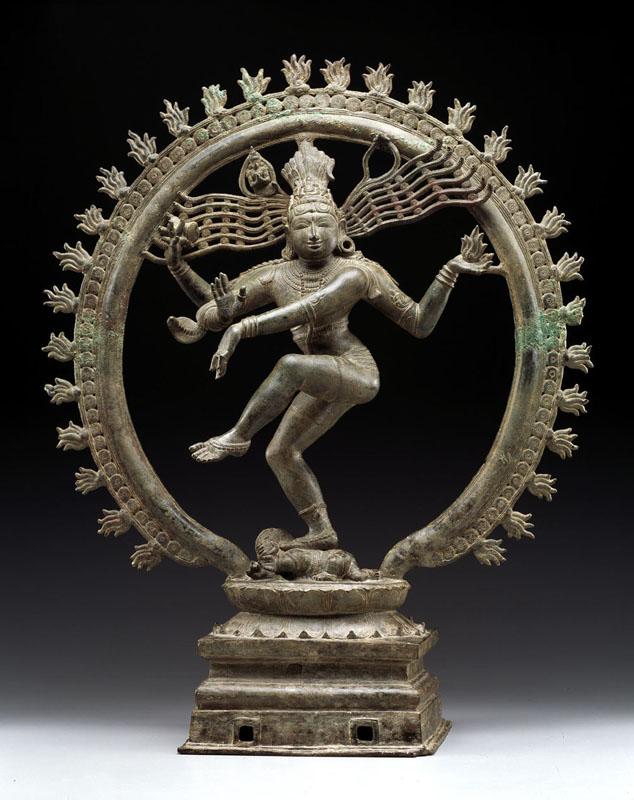
I am most drawn to the bronze sculptures of the collection, and I’d like to share how they were made.  As with most metal sculptures throughout history, the sacred bronzes of India were made with the ancient technique of the lost-wax process.  The lost-wax process served as an integral part of the Hindu religion during the Chola dynasty, which reigned between the ninth and thirteenth centuries, due to the desire for portable images of deities.

These bronze figures were created for worship and were housed in stone temples.  Oftentimes, they were removed from the temples for use in ceremonies, acting as processional gods to the people of India.  Our very own Shiva Nataraja is a perfect example of a processional bronze.   For more information on how these bronze objects were used in ceremonies, read Hannah’s blog post on Thursday.

Shiva Nataraja, Dallas Museum of Art

Shiva Nataraja, India, c. 1100, Dallas Museum of Art, gift of Mrs. Eugene McDermott, the Hamon Charitable Foundation, and an anonymous donor in honor of David T. Owsley, with additional funding from The Cecil and Ida Green Foundation and the Cecil and Ida Green Acquisition Fund

Lost-wax Process

The lost-wax process is a technique that seems to be as old as time.  It’s estimated that the earliest work created in this technique dates back to around 3500 B.C. in modern day Pakistan, and it is a common application for sculptors today.  One of the oldest works we have in the Museum dates back to 2000 B.C. and can be found in Silk Road installation on the third floor. 

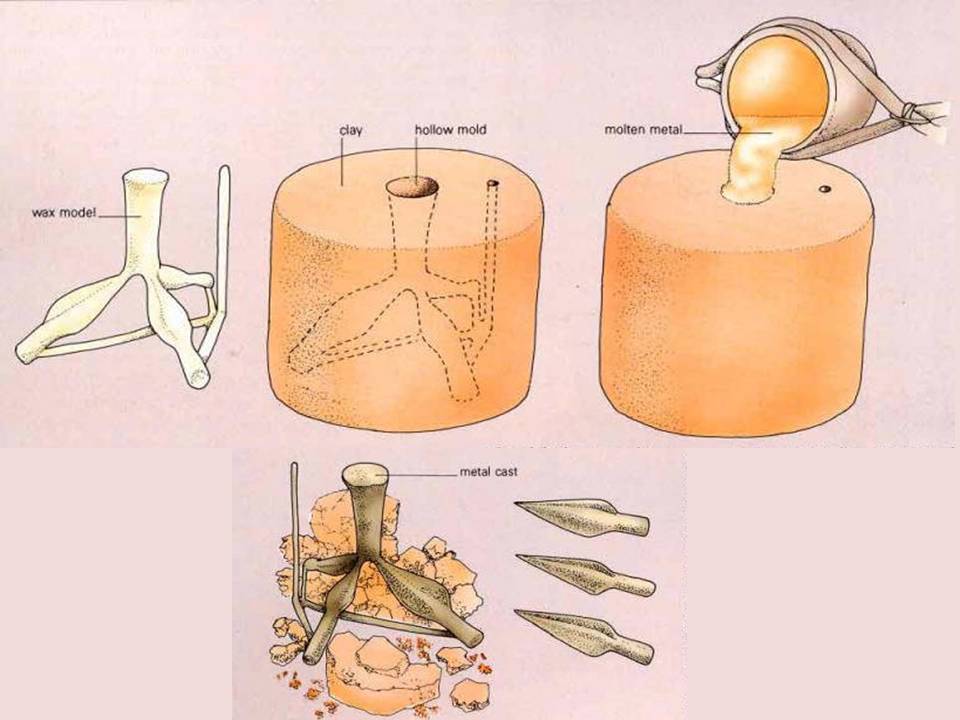
The process begins with “prepared wax,” a mixture of hard beeswax and resin.  The sculptor gently heats the wax to create a malleable material for molding.  After an area of the object is finished, it is dipped into a cold basin of water to harden the wax.  This alternation of heating and cooling continues until the entire figure is assembled.   The sculptor will then go back and add details with wooden tools to finalize the figure. 

Once the object is ready for the mold, sprues (which are tubular forms of wax that allows liquid metal to flow from one end to another) are applied to the figure to ensure that the molten metal will reach all parts of the figure.  The sculptor then meticulously applies several layers of clay to build up a mold, leaving a small hole to allow for the burn-out process.  When the clay is bone-dry, the mold is fired to harden the clay and to burn-out the wax.  This method allows the wax to flow out, leaving a hollowed clay mold. 

Next, metalworkers melt a mixture of copper, lead, and tin (and in some cases, gold and silver too) in a crucible and then carefully pour the molten metal into the same hole the wax was released from.  Metal cools relatively fast, so if you have a large object, you have to make sure you have enough melted metal!  Once the metal is cooled, the clay shell is broken and the sculpture is revealed.  Every bronze sculpture is unique, as the clay molds cannot be reused.  To complete the work, the sculptor must cut off the sprues and sand the surface smooth, readying the object for the final application of polishing and wax.

Diagram of molds, courtesy of www.lost-waxprocess.com

I encourage you to stop by the Museum and observe these sacred bronzes of India.  You might find yourself appreciating the tranquil rhythm and balance of these forms, as well as how they were made!

Best regards,

Loryn Leonard
Coordinator of Museum Visits

Ivory Tusks and Cultural Hybridity

During the 19th century, carved ivory tusks were commissioned for export to countries such as Portugal, Britain, France, Spain, Holland, India, and America. These “souvenirs,” often mementos of an African adventure, exhibited a combination of indigenous and foreign subjects and styles.

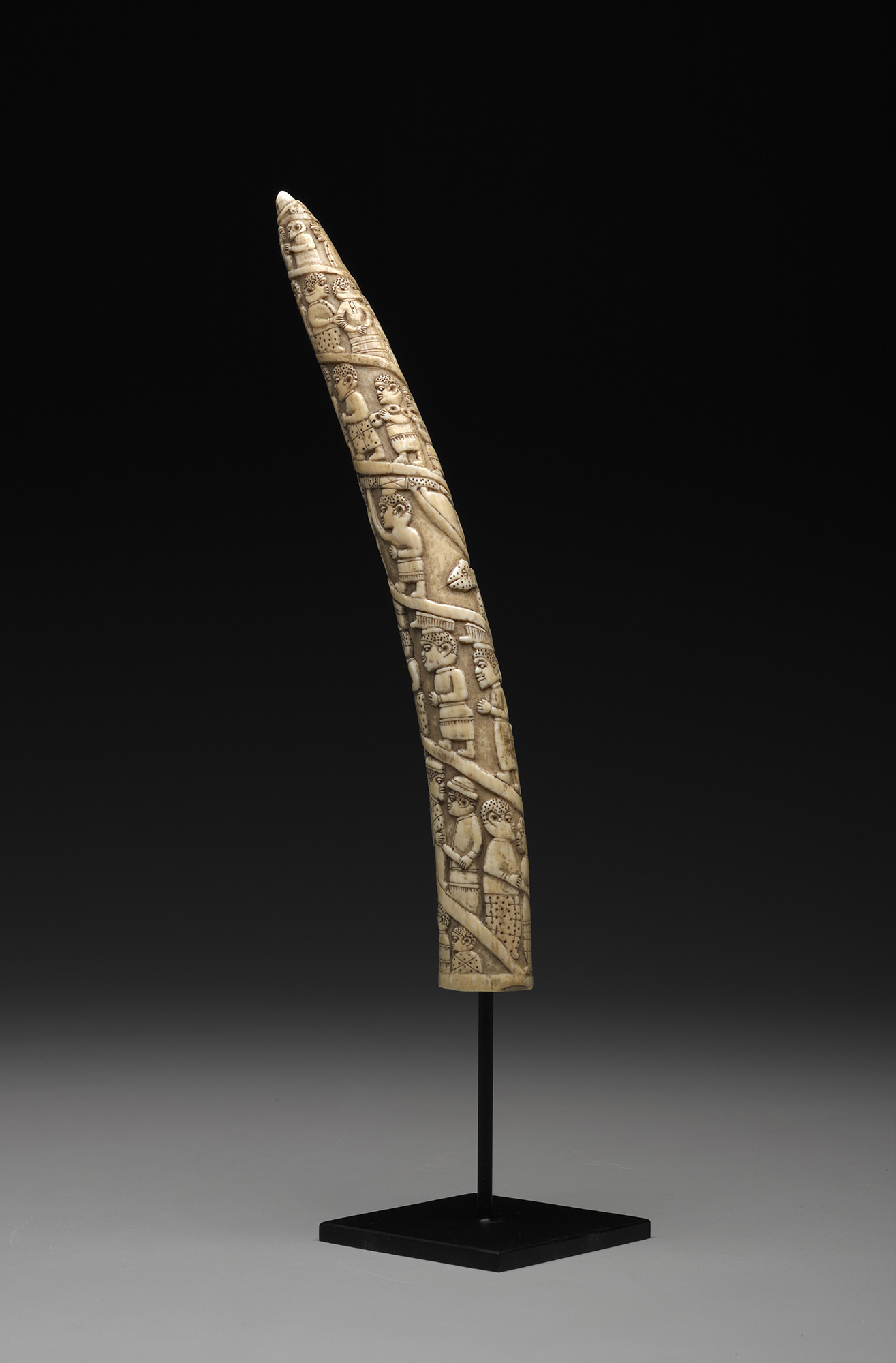
This Saturday, an interesting exhibit opens in the Museum concourse, Souvenir: A 19th Century Carved Tusk from the Loango Coast of Africa.  While the exhibition explores African souvenir art in the 19th and 20th centuries, the highlighted work is a carved ivory tusk the Museum acquired in 1969. This is the first time the tusk has been on view since its acquisition.

Tusk with multiple scenes in relief, 19th-20th century, Dallas Museum of Art, The Clark and Frances Stillman Collection of Congo Sculpture, gift of Eugene and Margaret McDermott

Six hundred to one thousand of these tusks are estimated to exist in private collections and museums. An article in Smithsonian magazine refers to these tusks as “spirals of history,” as the images carved in relief often tell stories of transatlantic  trade, manual laborers, rituals, and interactions with foreigners.

The spiral motif as well as the concept of conveying narrative through a spiral recall indigenous artistic traditions, while the subject matter of these tusks often incorporate foreign objects, subjects, or figures. Ultimately, these carved tusks are cultural hybrids.

I’m thinking of all the teaching possibilities related to cultural hybridity. In a recent discussion with colleagues about the very personal and complex implications of defining one’s own “culture,” I am confident that many students could relate to this notion of cultural hybridity. It would be interesting to ask your students to consider their “culture.” Often we associate culture with ethnicity, but culture could also include age, gender, geographic location, religion, or political status.  What could an exercise about exploring and defining the various elements of one’s culture look like? For example, you might ask students to design a souvenir about the various cultures that affect their day to day actions and decision-making. What would their souvenir look like? How would they represent various cultures?

For teaching ideas and information about other works in our African collection, visit our our new online teaching materials related to our standing power figure (nkisi nkondi), helmet mask (mukenga), or rhythm pounder. Please comment and share with us the ways that you and your colleagues are incorporating ideas about cultural hybridity (and the fluid nature of culture) in your classrooms, and come check out Souvenir, on view until September.

Andrea V. Severin
Coordinator of Teaching Programs

References:


Archives

Categories