Archive Page 168

Elephants, Buffalo, and Giraffes…Oh My!

Take a moment and imagine an African elephant at the Dallas Zoo.  Now imagine an elephant at the Dallas Museum of Art.    Were the images of the elephants the same?    It would definitely make an interesting story (with a strong potential of damaging artworks) to see a live elephant  in the Museum galleries!    Although elephants are not allowed in the Museum, images and representations of elephants and other animals by living African cultures are.

On Saturday, January 29, twelve teachers from a variety of disciplines and grade levels joined the DMA and the Dallas Zoo for a full-day teacher workshop.   Teachers spent the morning exploring animals from Africa in the DMA exhibition African Masks: The Art of Disguise and in the afternoon engaged with live animals in the Dallas Zoo’s Giants of the Savanna exhibition.

[slideshow]

At the Museum, teachers considered the connections between the animals represented in masks and the living cultures that created the masks in response to their beliefs and surrounding environment.  With a focus on antelope, elephants, and buffalo, Museum staff encouraged teachers to think about descriptive words that relate to each, observe the realistic and abstract qualities of the animal masks, and think about the context of each mask in relationship to the ceremonies performed by the different cultures.

The conversation continued at the Dallas Zoo as teachers discussed  the  location of the African Savanna, the animal habitats within, and the challenges facing animals in the different African countries.  Luckily, the weather outside was extraordinary (the workshop occurred the weekend before the snow and ice), and the teachers were able to ride the monorail around the Zoo, participate in elephant observation studies, and feed the giraffes.

By the end of the day, teachers commented on their experiences with looking at patterns on the African masks and on the animals and made connections to the  significance of animals within the cultures and countries in Africa.

We all had a great time and are looking forward to another collaborative teacher workshop with the Dallas Zoo soon!  This workshop is one example of what the DMA offers to teachers of all grade levels and disciplines.   Be sure to check the Teacher Programs website for new workshops later this spring.

Until next time….

Jenny Marvel
Manager of Programs and Resources for Teachers

The Night Owl and the Pussycats: Adventures in Igniting the Power of Art

From the very beginning in February 2009, this exciting book project inspired by the DMA’s director, Bonnie Pitman, was a collaborative effort. And my responsibility was to serve as the publication’s gatekeeper, charged with trafficking the manuscript, compiling and incorporating the numerous edits and comments, and keeping track of all the details and loose ends. There were “those days” when I imagined masses and masses of rapidly proliferating Hydra heads—and, like a metaphorical Hercules, the faster I lopped them off (i.e., completed a task), the faster they seemed to regenerate.

To keep track of all the edits to the digital manuscript, we used the Microsoft Word feature known as Track Changes, where, like a board game, everyone gets a different color. With five or six people making rainbow-colored edits, the manuscript became a vivid, almost psychedelic, dazzle of clashing colors, from bright pink to pale brown. Since large chunks of text were moved around, Word could only track this by keeping the old, lined-out passages on the page, so I found myself on “fast forward” through whole paragraphs on occasion. Then when comments were added to the screen, a running series of squashed balloons of text crowded in along the right-hand margin. Pretty soon we were laughing about eye strain.

Our quest for a perfect set of images became the next challenge. We pored through hundreds of DMA images—sorting, juxtaposing, weighing, and discarding—for each of the 141 photographs finally chosen. So it was definitely an exciting moment when the book went to the printer in early October 2010. As I write this blog two years later, we have distributed the printed copies. While this project “had its moments,” it’s also been enormously rewarding. I’ve learned a lot about data analysis, the design and packaging of information, and the challenges and pitfalls of fact checking. Even at moments of relatively frazzled morale, our spirits were always kept up by the knowledge that we were presenting something new and important. This book was a labor of love for a large group of people, especially for the two authors.

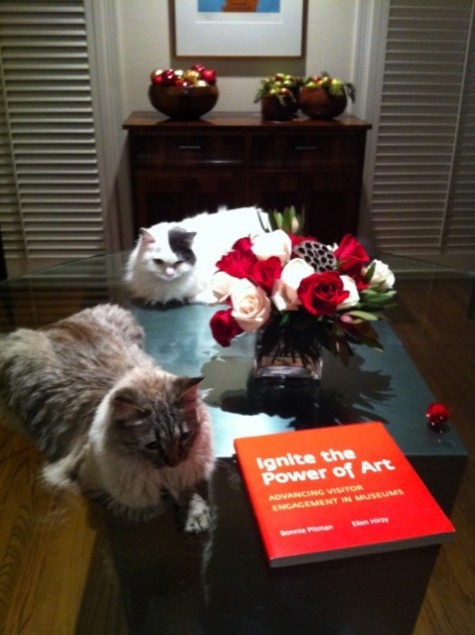
Ending on a light note, Bonnie kept us entertained throughout the editing and production process by sending digital pictures of her two cats, Leda and Perseus. Owing to the late hours she usually keeps, Bonnie was frequently hard at work on this book at one or two o’clock in the morning, seated at her glass work-table, with Leda and Perseus lying on—or playing with—stacks of galleys, photo contact sheets, charts, layouts, and reports—all of which offered the cats an ideal playground. I still have the early photographs showing them stretched out on a hoard of papers and folders. The later pictures depict their puzzlement as the glass tabletop finally resurfaced and the papers receded. And there’s a final shot of the cats sitting wistful, but perhaps also slightly triumphant, on a table cleared of everything but a vase of flowers and a single copy of the printed book. I’m sure Leda and Perseus look forward to a sequel.

Eric Zeidler is Publications Coordinator at the Dallas Museum of Art.

Reader Pick: Love in the DMA's Collection

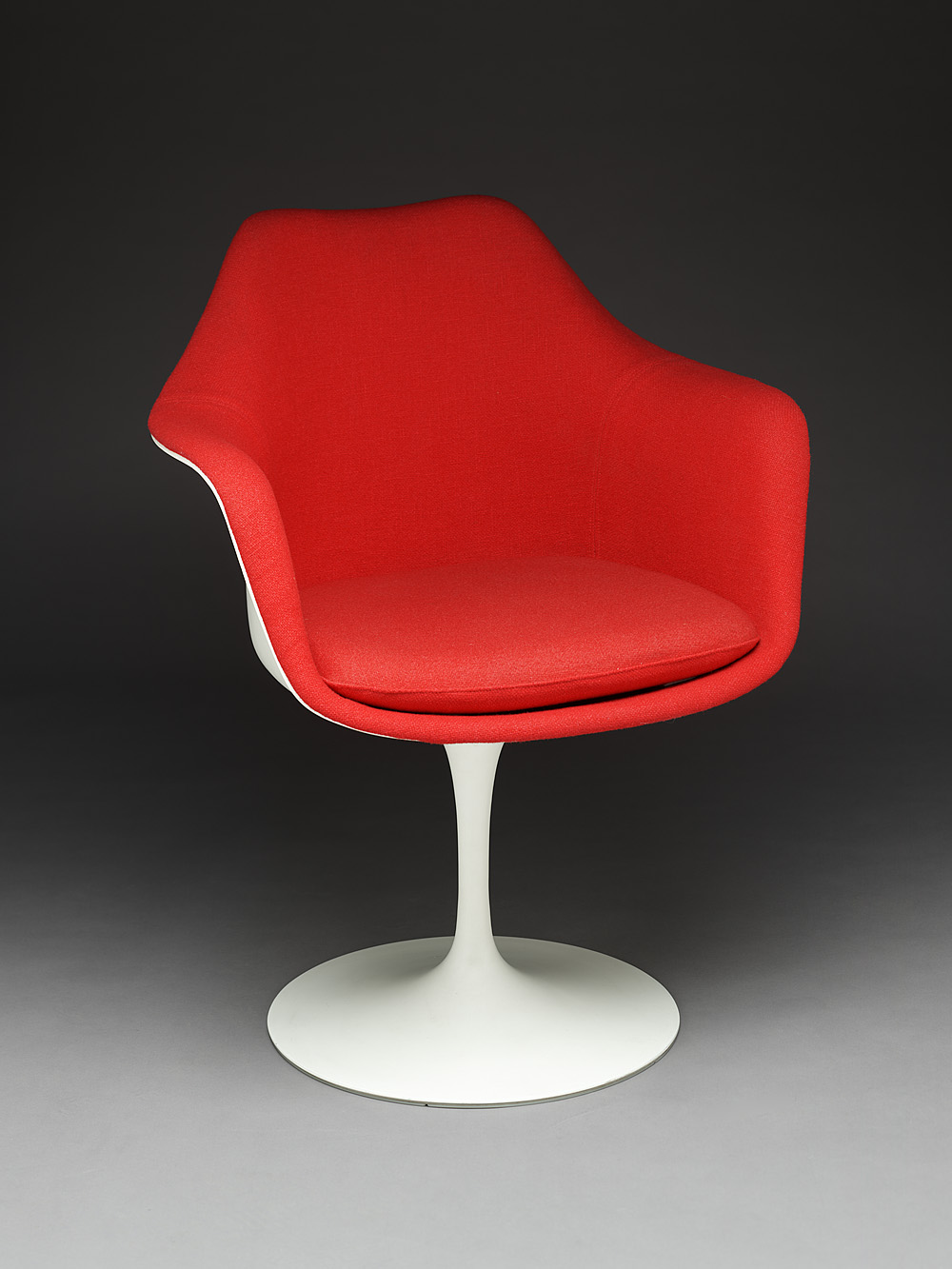
Eero Saarinen, Tulip Chair, c. 1980, Gift of Knoll International

The time has come to announce the winner of the Reader Pick from February 14. Drum roll please! The work of art with the most votes is The Tulip Chair, by Eero Saarinen. Thank you to all who voted. We hope next time to have even more votes for the reader pick!

Amy Wolf
Coordinator of Gallery Teaching

Seldom Scene: Presidents at the DMA

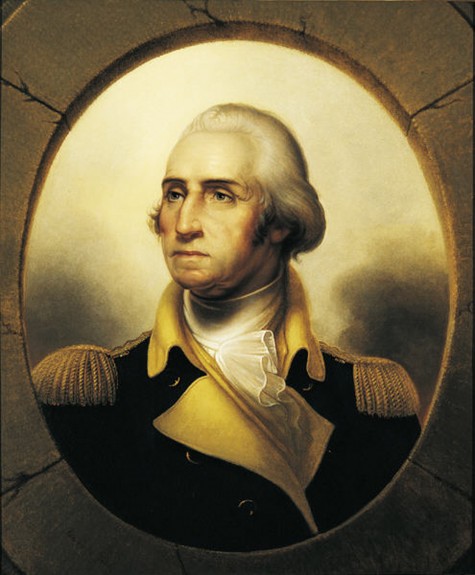
In honor of Presidents’ Day we wanted to share a few images of U.S. Presidents that are in our collection.

George Washington, Rembrandt Peale, c. 1850

George Washington, Jean-Antoine Houdon, c. 1786

Lincoln, Boardman Robinson, 1937

The Washington Family, Edward Savage, c. 1780

Insomniac Tours: A History

Roslyn Walker, DMA curator, leading a Late Night tour.

Have you ever wondered what happens in the Dallas Museum of Art after the sun goes down? Do the paintings look different at night? Does the Museum have a different feel to it? Well, there’s one way to find out.

Late Nights at the Museum feature a variety of programs and activities, including the Insomniac Tour. The Insomniac Tours started informally in 2004, thanks to our Director, Bonnie Pitman, and her night-owl disposition. When the DMA turned 100 we stayed open for 31 hours, and Bonnie led tours into the wee hours of the morning for anyone who wanted a more personalized Museum tour. With the launch of Late Nights, the tours continued, and their name was coined.

Bonnie is not the only one who gives the Insomniac Tour, although she tries to attend as many Late Nights as possible. Other guest tour guides have included artists Krystal Read and Jim Lambie, DMA curators Heather MacDonald, Roslyn Walker, and Jeffrey Grove, and local art critics such as Christina Rees. When Director of Collections Management Gabriela Truly gives the tour, she talks about the art that’s not displayed, and where it is stored. These different speakers give visitors a chance to learn new things about the works of art through multiple perspectives.

The best part about Insomniac Tours is that no two tours are the same. The tour guide will take a poll every Late Night to see how many people have taken an Insomniac Tour before, and will ask for input on what members of the group want to see. If the group is full of newcomers, the tour guide will give a “best of” tour, highlighting some of the most unique parts of the DMA’s collections. Repeat visitors can get a tour of more obscure works, or focus on a certain exhibition or movement.

Since the DMA is such an expansive museum, it can be intimidating for visitors to know where to begin. Joining an Insomniac Tour allows visitors to receive a customized tour with some of the leading art experts. So check it out the next time you’re looking for something to do on a Friday night, and see how art can come alive after dark!

Join Olivier Meslay, Senior Curator of European and American Art and The Barbara Thomas Lemmon Curator of European Art, when he leads his first Insomniac Tour during the February Late Night.

Friday Photos: Mystery Artwork

Last Friday, I presented clues to the first mystery artwork. I hope you enjoyed searching online or visiting the museum to find the answer.
 
The mystery artwork is…….
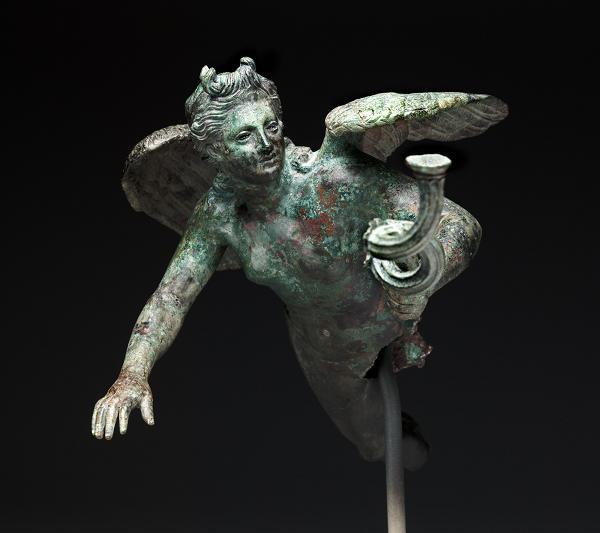
Eros lamp holder

Date: early 1st century B.C.
Dimensions: Height: 22 1/4 in. (56.515 cm)
Medium: Bronze
Dallas Museum of Art, The Eugene and Margaret McDermott Art Fund, Inc., in honor of Anne Bromberg’s 30th anniversary with the Dallas Museum of Art.  

Click here to learn more about the Eros lamp holder.

I present to you the second mystery artwork.

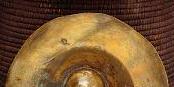
Take a closer look and you will see coils of fiber and metal hooked together.

Mystery Artwork #2

  1. I increase in size from top to bottom.
  2. I can only be worn by chiefs.
  3. I can also be seen with a wavy-edged scepter.
  4. My name means to sing.
  5. The presence of metal disks signifies wealth and prestige.

What am I?

You have one week to guess! Click on collections and begin your search. We also invite you to join us tonight as we celebrate our romance-inspired Late Night event.

Best Wishes,
Karen A. Colbert
Teaching Programs Intern

Staff Reading Group Update

It’s been a while since we blogged about our Staff Reading Group

January’s reading group featured several special guests.  We were joined by colleagues from the Crow Collection of Asian Art, the Nasher Sculpture Center, and the Rachofsky House for a conversation led by Nina Simon.  Nina is an independent experience designer, author of The Participatory Museum, and author of the Museum 2.0 blog which also appears as a column in Museum magazine. 

Nina selected our reading: a keynote address from the 2008 Australia Council Arts Marketing Summit, given by US philanthropy expert Diane Ragsdale, and titled: “Surviving the culture change.”   Ragsdale’s address (to greatly simplify) challenges arts organizations to adapt and to rethink their audience—what they need (and what they might not know they need), and how we can engage them in order to stay relevant.

The reading was provocative and timely, and led our group to consider behaviors and attitudes of museum visitors and to reflect on our own tendencies as museum-goers.  Why is it that we only go to concerts, museums, or the zoo once in a while if we really enjoyed the experience?  How can we make museum-going a habit—something we integrate in our lives, like an exercise class?  One of the great ideas that came from our session was that we think of going to museums/concerts/etc. like we do going to yoga—an activity that’s regularly on our calendars and prioritized in our lives. 

Ragsdale, in suggesting ways arts organizations can change in response to questions like these, shares truly inspiring examples of progressive, visitor-centered programming already in place in museums around the world.  Here at the DMA, we are pushing on our own ideas of ways to adapt programs to further visitor involvement.  We are currently in the process of refreshing Late Nights with the help of visitor voices and museum-world consultants—Nina, among them.  So look for new and exciting things to come!

And in the meantime, check out Nina’s blog to read more about great programs and experiences happening in museums.

Amy Copeland
Coordinator of Go van Gogh Outreach

Exit Through the (Stickley) Gift Shop

Take home a bit of Americana inspired by the age of Gustav Stickley in the exhibition store.   


Artist Spotlight: Emile Bernard

I recently had the pleasure of speaking with our docents about two paintings within the collection by 19th-century, French artist Emile Bernard (1868-1941).  Both of these works feature Breton women (from the region of Brittany in France) in traditional festival attire.  In the late-19th century, the villages of Brittany, like many other rural sites outside Paris, had become the center of various artist colonies.  The most well-documented of these sites is the city of Pont-Aven, which between 1886 and 1894 became the stomping ground of notable artists such as Paul Gauguin, Paul Serusier, and Emile Bernard.  This cast of characters, along with an international array of artists from countries such as Holland, Belgium, Switzerland, became known as the Pont-Aven School and triumphed a pared-down aesthetic that departed from the naturalism of Impressionism and emphasized a synthesis of the impressions of nature and abstract forms that underlined emotional experience. 

[slideshow]

Brittany was fertile ground for the Pont-Aven School artists because of its association with an exotic aesthetic that played up the primitivism of the picturesque peasants and overlooked the industrial developments and spread of Parisian taste and sophistication to the not-so-remote villages.  In this sense, what the artists left out–factories, commericalism, and modern advancements–become just as much the subject of the work as what they included.

Bernard first visited Brittany in 1886 and would return to the region the next four summers.  In 1888, he worked closely with Paul Gauguin, and together they launched the Synthesist style that characterized much of the work coming out of Pont-Aven.  Bernard was inspired by Medieval cloisonne, or the technique of applying enamel partitions within stained glass.  He and Gauguin, like many artists of the period, also looked to Japanese prints for inspiration and a means to rejuvenate the European style. 

The two DMA paintings by Bernard are dated 1891 and 1892 by the artist in the lower right-hand corner of the canvases next to his signature.  In 1893, he left for a ten-year soujourn in Egypt and would not return to Brittany until 1910 for a brief stay and 1939-1940 for an extended stay the year before his death.

“Othering” is the act of creating an uneven power hierarchy through the myth of a binary of “us” and “them.”  This serves tp emphasize the percieved weaknesses of “them,” or the marginalized society, as a means of underlining the superiority and right to power of “us.”

These works of art can be used with students at the Museum or in the classroom.  They are a great jumping off point to think about exoticism and its role in art.  Exoticism is typically associated with well-known works by Orientalist painters such as Jean-Auguste Dominique Ingres and primitivists like Paul Gauguin.  The Pont-Aven School works embody similar ideas of “othering,” except that the exotic projections take place within France and become a sort of internal othering.   What other examples of othering, based on gender, race, ethnicity, religion, etc. can you think of in art and popular visual culture?

Ashley Bruckbauer
McDermott Intern for Teacher Programs and Resources

Seldom Scene: Love Designed

A Date to the DMA:

[youtube=http://www.youtube.com/watch?v=uIvIjRXPcTU&w=480&h=390]

The Center for Creative Connections invites you this spring to explore the Encountering Space exhibition with a fresh perspective inspired by designed spaces. Experience changes on view March 12 – September 30, 2011 throughout the Center including two additional works from our Decorative Arts collection shown below. Get involved and share your own photographs of designed spaces on Flickr, www.flickr.com/groups/dmadesigned.

Chair, Frank Lloyd Wright, 1956

Hall chair, c. 1850-1860


Archives

Categories