Archive for the 'Behind-the-Scenes' Category


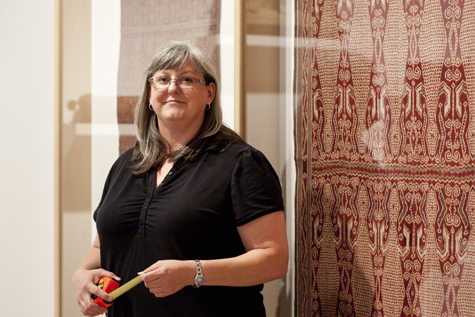
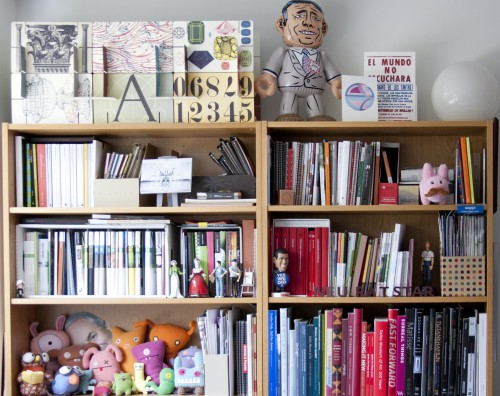
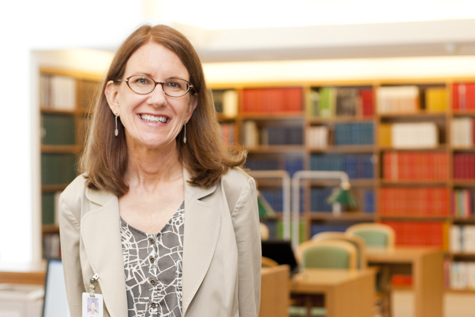
Behind the Books: An Interview With Our DMA Librarian

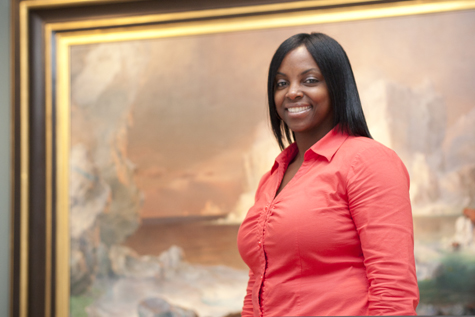
Uncrated tracked down Librarian Mary Leonard to talk about her job at the Museum. Mary is the friendly face that greets you when you enter the Mayer Library here at the DMA. Her knowledge is invaluable to researchers of art—and probably a few of us trivia buffs.

Describe your job in fifty words or less.
I handle reference questions and acquisitions for the library. We are open to the public during certain hours and I help visitors during those times and also assist people on the phone and via e-mail. The Mayer Library is a research library—the stacks are closed—so appointments are recommended. But walk-ins are welcome too!

What might an average day entail?
Sometimes I’m going over new books lists—my favorite job! During public hours, I’m at the reference desk and I might be helping a student with a paper or an appraiser with auction results. I check out books to staff and give orientations to new staff and docents. Every day can be different.

How would you describe the best part of your job and its biggest challenges?
The best part of my job is actually getting to look at all the beautiful books we have in our collection. One of the biggest challenges is keeping up with what’s actually going on out in the Museum—seeing new acquisitions and exhibitions. I can get stuck at my desk pretty easily.

Growing up, what type of career did you envision yourself in? Did you think you’d work in an art museum?
I had no idea when I was a kid out in West Texas that these kinds of jobs even existed! But I’ve always loved libraries and art, so I’m really fortunate my career led me here.

What is your favorite work in the DMA collection?
The Fantin-Latour Still Life with Vase of Hawthorne. Or the Matisse Still Life: Bouquet and Compotier. There’s a pattern here. . . . I also love the Fleischner Courtyard, right outside the library windows. I’ve seen it in every season and I never get tired of looking out the window. See, I’m not daydreaming, I’m looking at art!

Is there a past exhibition that stands out in your mind as a favorite or is there a particular upcoming show you’re looking forward to seeing?
Everyone is excited about Jean Paul Gaultier—we have the catalog here already and it’s massive. I can’t wait to get down and see the African Headwear exhibition. In the past, I loved the J. M. W. Turner show and the Anne Vallayer-Coster exhibition. Beautiful paintings—what’s not to love?

Seldom Scene: Shipyard

Mark Bradford opens on October 16 but the installation began a few weeks ago. Below are images of the Barrel Vault installation of Detail, a monumental section of the ark Mithra, which the artist built for Prospect 1, the 2008 New Orleans Biennale, one of the first international art events devised to bring visitors back to that city following Hurricane Katrina.

[slideshow]

Guiding Us Along

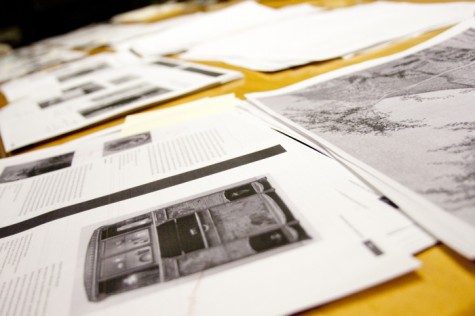
The existing Dallas Museum of Art collections handbook was published in 1997. Considering all of the stellar acquisitions that have taken place in the last fifteen years, we felt the time was right to publish a new one. The process took months of preparation and many meetings to create the new guide, which will be available in the Museum Store early next year.

In a series of conversations, DMA curators and former DMA Director Bonnie Pitman came up with a timeline, and  agonized over the book’s structure (for example, does Romare Bearden’s Soul Three belong in the Contemporary or the Modern section? Should European and American art be combined?). The group also came up with an “A” and a “B” list of objects to be considered for inclusion in each of the sections.

The process for paring these lists down was grueling for all concerned. Sacrifices and compromises were made. As a biased participant, I had my own favorite objects, and anxiously awaited the outcome of each meeting. My beloved College of Animals by Cornelis Saftleven was out of the running early on, owing to urgent conservation needs, but I had the pleasure of seeing this work restored to the European and American section late in the process.

Cornelius Saftleven, "College of Animals," n.d., oil on canvas, Dallas Museum of Art, The Karl and Esther Hoblitzelle Collection, gift of the Hoblitzelle Foundation, 1987.32

I worked on the entries with the curators, interns, and freelance contributors. This catalogue has given me a newfound appreciation for the many works of art I had always admired in passing but never really focused on. Immersing myself in object files or staring at the objects in the galleries, I added many new discoveries to my list of personal favorites.

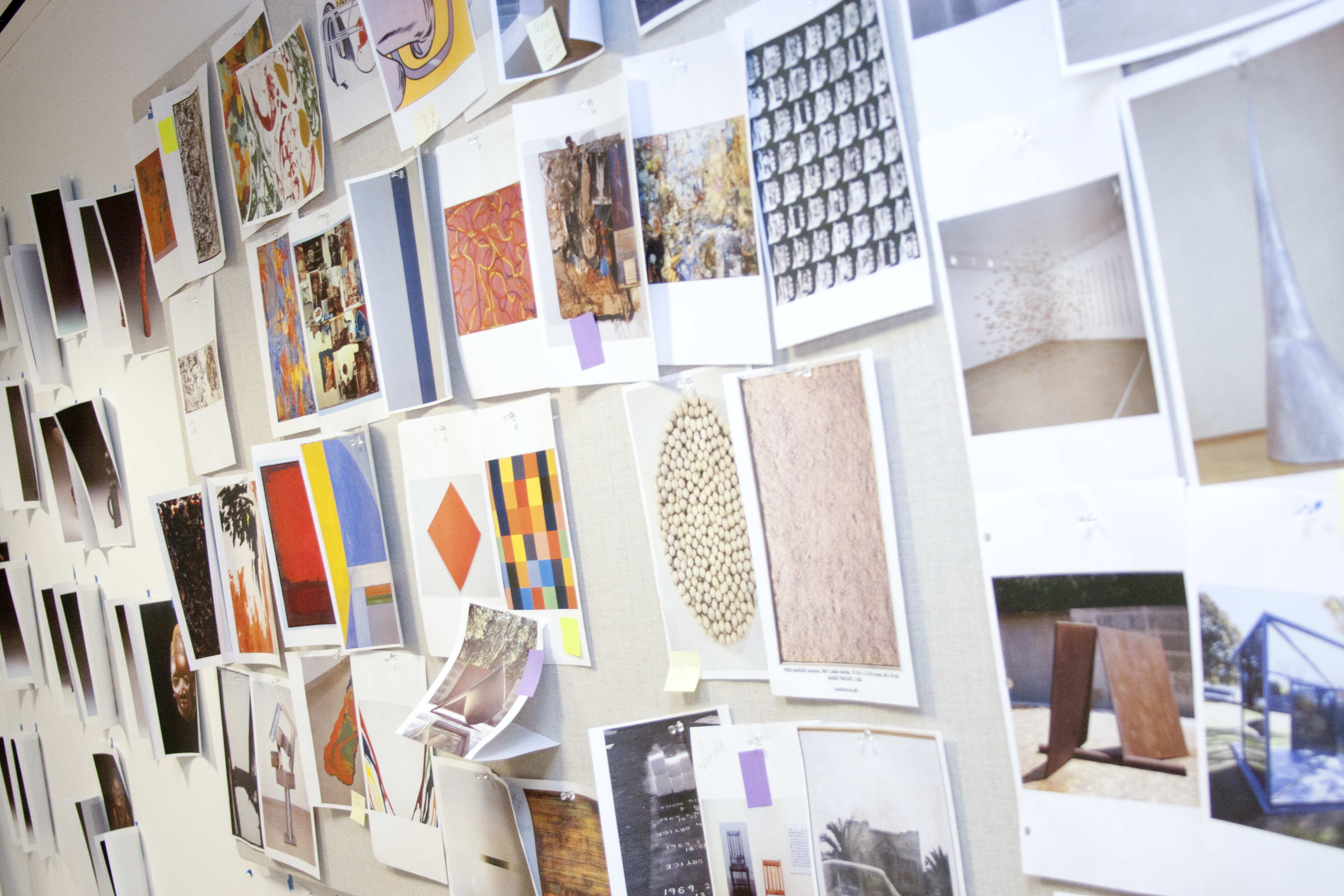
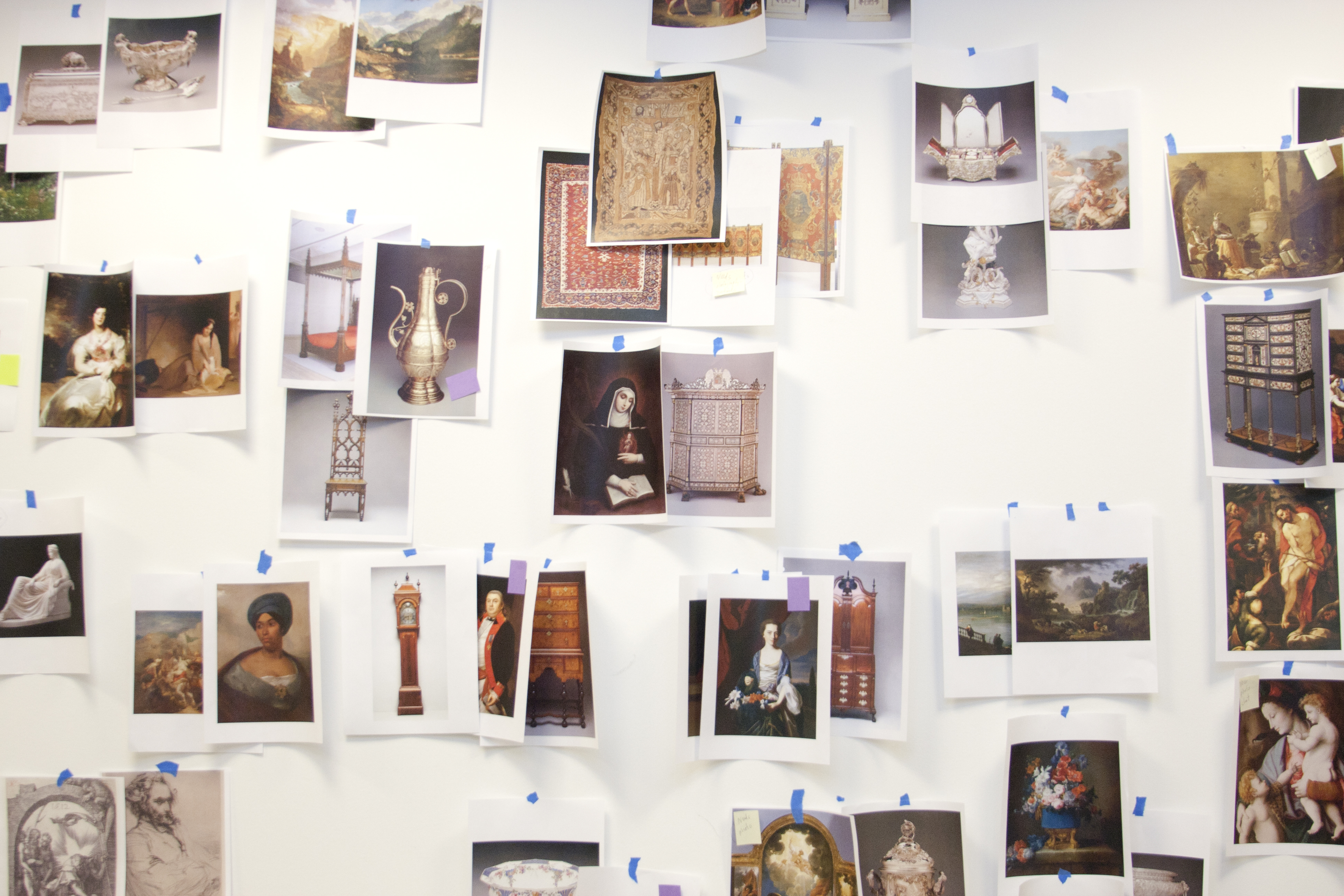
Perhaps the most fascinating part of the process was the ordering and grouping of objects within their sections. We plastered the walls of our “Classroom B” conference room with color printouts of all four hundred-plus objects, taped or pinned in constantly migrating clusters. It was ultimately quite satisfying to see the groupings crystallize; every invidious or inept grouping eventually led us to the final fortuitous solution. This was a creative process, appealing to the artist in me.

Eric Zeidler is the Publications Manager at the Dallas Museum of Art.

Opening Up: A Staff Profile of Our Operations Manager

Uncrated tracked down Tara Eaden, the DMA’s Operations Manager, to talk about her job at the Museum.

Describe your job in fifty words or less.
As Operations Manager, my basic duties are to manage the Museum’s daily operations. These duties include, but are not limited to, coordinating with the operations supervisors to organize office moves, set up/break down special events, and to make sure that the museum remains pristine.

What might an average day entail?
There really is no average day for anyone in operations, however the basic portion of my day may consist of various meetings, scheduling for different activities/projects, problem solving and/or fulfilling certain needs of staff, visitors and vendors that fall within my jurisdiction.

How would you describe the best part of your job and its biggest challenges?
The best part of my job is the daily knowledge I gain through departmental and peer interactions, as well as meeting the most influential and unique people—colleagues and visitors. I am very fortunate to work with a team of people who make the most challenging days seem effortless. I am doubly fortunate to work in an environment who embraces and caters to all cultures from all demographics.

One of the biggest challenges I might face would be the overlapping of events on the same day. There have been some days where the operations crew is spread thin because of the need to take care of their daily housekeeping needs, as well as multiple events scheduled for the same day at either the same time, or overlapping times. This puts a strain on the crew, thus placing me in the position to be creative with scheduling and employee placement so that the needs are met for not only the client, but for the best interest of the employee.

Growing up, what type of career did you envision yourself in? Did you think you’d work in an art museum?
I always thought I would be a teacher growing up. Even though I do have the opportunity to teach now from time to time in other capacities, I always thought I’d be in a classroom filled with a group of tots eager to learn. I never thought I would work in an art museum. But now that I’m here, it has been one of the most gratifying experiences I’ve ever encountered.

What is your favorite work in the Museum’s collections?
While I have several favorite works in the museum, my favorite is by far the Untitled (big/small figure) by Tom Friedman. Works of art may say different things to different people, but this work speaks to me in a manner of symbolism. The big blue man (I’ll call him the blues) for me represents problems that we all face sometimes that seem so much bigger than we are. The small figure represents us. The big blue man is looking down on the small man as if he can defeat him or get the best of him. It is in that moment that we could either decide to allow our problems to give us the blues, or we can overtake them. Or simply stated, sometimes our problems seem bigger to us than they really are. My second favorite is The Icebergs by Frederic Edwin Church.

Is there a past exhibition that stands out in your mind as a favorite, or is there a particular upcoming show you’re looking forward to seeing?
While we have had a number of beautiful and intriguing exhibits, such as Dale Chihuly (1994), Animals in African Art: From the Familiar to the Marvelous (1997), Splendors of China’s Forbidden City: The Glorious Reign of Emperor Qianlong (2004), Gordon Parks- Half Past Autumn (2005), my favorite by far is the Across Continents and Cultures: The Art of Henry Ossawa Tanner exhibition from 1995.

60 Minutes in the Dallas Museum of Art

As a child, my first museum visits were orchestrated by my parents. These all-day excursions began the moment the museum opened its doors and ended sometime after five o’clock, when a security guard shuffled us to the nearest exit. Before the day was through, we’d make it a point to see everyone’s favorite area of the museum, eventually charting its every offering.

Today trips like this are harder and harder to come by and actually, now that I work for the Dallas Museum of Art, one of the hardest parts of my job is finding the time to experience the artwork! For me, shorter more frequent trips to the Museum have helped me get to know the DMA one gallery or even one artwork at a time.

Thanks largely to the DMA’s great variety of lunchtime tours, after-hours programs, and lectures, you can broaden your knowledge of the collection nearly every week. These guided experiences are the perfect way to spend a short visit to the DMA, and hopefully they’ll encourage and equip you to do more focused exploring on your own!

With just sixty minutes to work with, you’d be surprised at the great multitude of experiences that await you. Here are some of my favorite works to get you started. They’re just a small sampling of the amazing works that will inspire you to take your time and get a closer look.
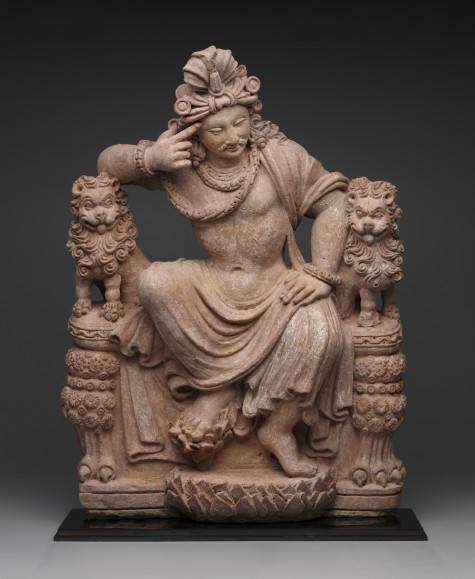
Gandharan culture, Hadda region, "Thinking Bodhisattva", 4th to 6th century A.D., Terracotta, Dallas Museum of Art, Wendover Fund, gift of David T. Owsley via the Alvin and Lucy Owsley Foundation, Cecil and Ida Green Acquisition Fund, and General Acquisitions Fund

This Buddhist sculpture, located on Level 3, represents a bodhisattva, or someone who has achieved enlightenment but delays Nirvana to help others achieve transcendence. In fact, he’s not just any bodhisattva, but the one destined to become the historic Buddha, the founder of Buddhism.

I enjoy this sculpture mostly because of its rich detail and lively gestures. When I stand before him, he seems to be not only reflecting upon his impending destiny but truly at the heels of it. At any moment he seems ready to step off his throne and into his next life as the Buddha.
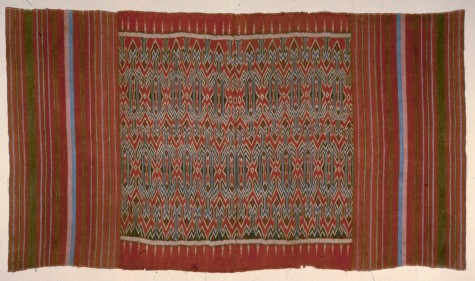
Toraja, Sulawesi, Galumpang area, Indonesia, Shroud or ceremonial hanging (sekomandi), probably late 19th century, Cotton, Dallas Museum of Art, the Steven G. Alpert Collection of Indonesian Textiles, gift of the McDermott Foundation

Of all media, I am least familiar with and most intrigued by the textiles. You can get fairly close to these objects in the galleries, and attempting to deconstruct their striking complexities by doing so can be nothing short of mesmerizing.

This example, located on Level 3, was woven by the Toraja peoples of Indonesia and exquisitely combines bold arrangements in color, pattern, and texture to reveal in its central quadrant a series of geometric and interlocking human figures believed to represent generations of beloved ancestors.
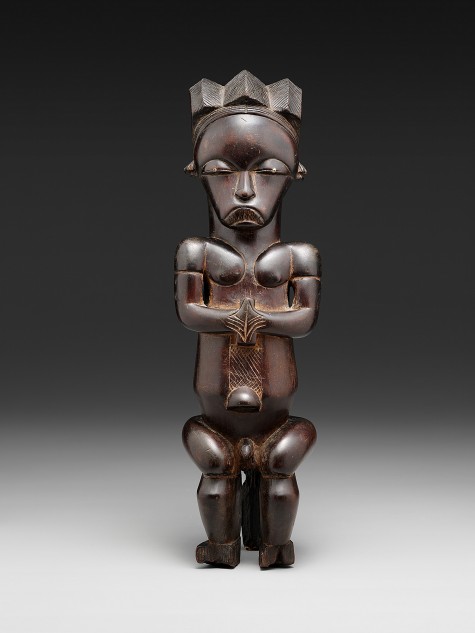
Mvaï group, Fang peoples, Ntem region, Gabon, Africa, Reliquary guardian figure, 1800-1860, wood, Dallas Museum of Art, The Eugene and Margaret McDermott Art Fund, Inc.

Predating Western notions of cubism by nearly half a century, this rare sculpture from the Fang peoples of sub-Saharan Africa is sure to stun you in your tracks. Composed of beautifully carved abstract and voluminous forms, the shining figure was probably modeled in the likeness of an ancestor and positioned protectively atop a reliquary box containing familial remains. Now I like to think of him as standing guard over the African galleries on Level 3 at the DMA, humbling our viewers and summoning their attention.
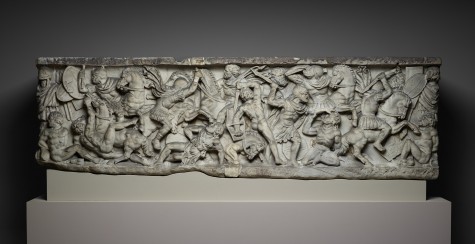
Roman, Battle sarcophagus, c. 190 A.D., marble, Dallas Museum of Art, Cecil and Ida Green Acquisition Fund and gift of anonymous donor

This sarcophagus, located on Level 2, was probably made to commemorate the military victories of a Roman general whose corpse it was intended to house. Its battle scene is deeply carved in a complex relief that reveals warriors, horses, and captives, each densely intertwined and submerged in the real chaos of war.

Every time I visit this work, I’m fascinated by the great number of unique figures and gestures captured against its surface. Every few inches reveals a new layer of intense drama.
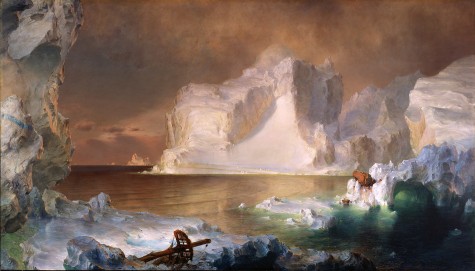
Frederic Edwin Church, The Icebergs, 1861, oil on canvas, Dallas Museum of Art, gift of Norma and Lamar Hunt

During my first visit to the DMA, The Icebergs, located on Level 4, was the first masterpiece to truly floor me. Based on sketches made during a monthlong boat trip in the North Atlantic, it is an enthralling triumph by Frederic Edwin Church.

Its exquisite palette and sharp glow entice any viewer. I have to visit the painting time and time again, simply because each time I do, I swear, it changes. No matter how hard I try, I can never fully recall its subtle warmth and reflection of light.
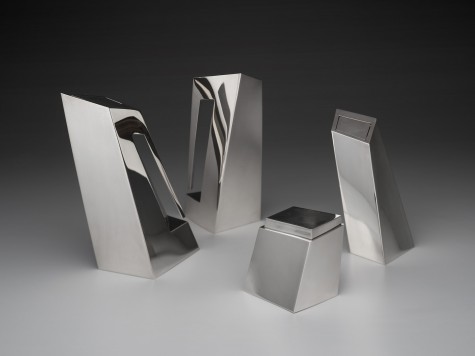
Zaha Hadid (British born Iraq, 1950), designer; Sawaya & Moroni (Italian, est. 1984), maker, Tea and coffee service, designed 1996, executed 2002, silver, Dallas Museum of Art, anonymous gift of in honor of Lela Rose and Catherine Rose

This puzzle-like tea and coffee service, located on Level 4, represents a first foray into silverware for renowned architect Zaha Hadid. When not in use, the lustrous components gather into a single architectural form that defies symmetry and cleverly disguises its function.

How cool is that?! I challenge you to stand in front of this service and try to piece it together in your head. It’s no easy feat, I assure you, but in the meantime you’ll definitely enjoy getting lost in its abundance of reflective surfaces and voids.

Auriel Garza is the Curatorial Administrative Assistant to Non-Western and Decorative Arts at the DMA.
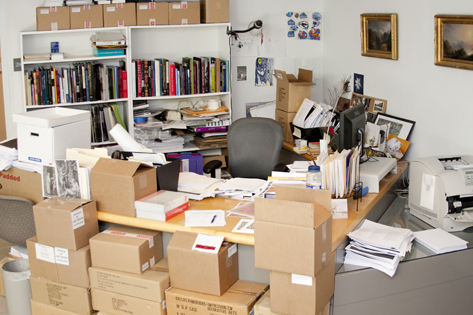
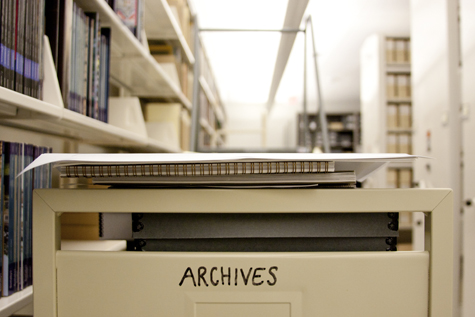
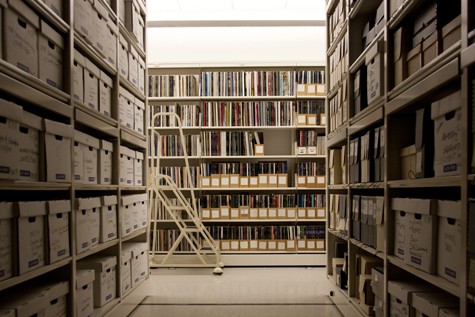
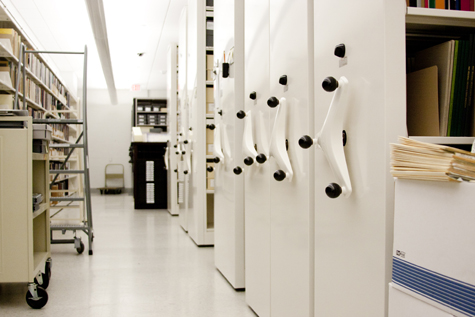
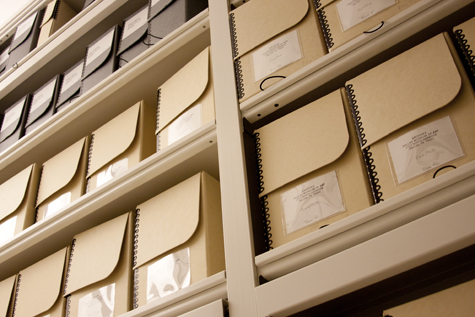
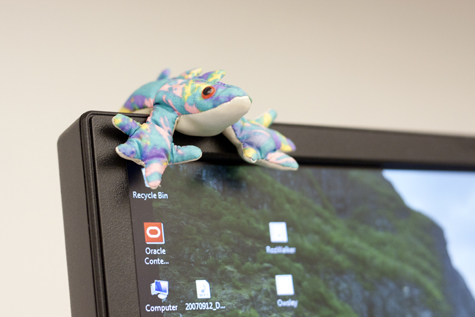
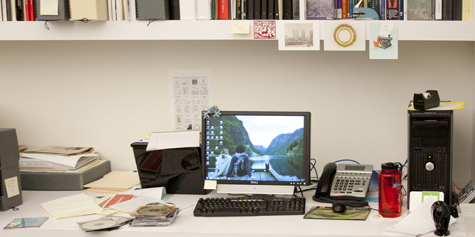
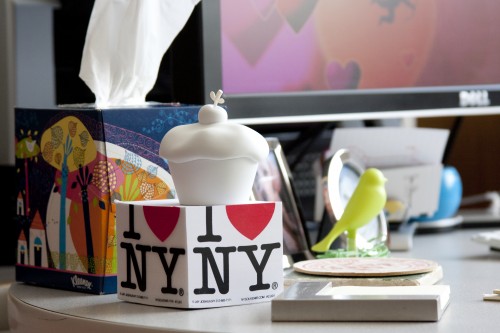
Behind Closed Doors: Archives

Go behind the Museum office doors and discover the various work spaces in the DMA. Each month we will share insight into a different department.

This month, Hillary Bober, Digital Archivist, shares her space with us.

Photography by Adam Gingrich, Marketing Assistant at the Dallas Museum of Art

Staff Profile: Prepping Up

Uncrated tracked down Preparator, Mary Nicolett, to talk about her job at the Museum. Mary is a key member of the installation team and is known for her keen eye and attention to detail.

Describe your job in 50 words or less.
My official title is “Preparator, Logistics Facilitator,” which is a fancy way of saying that when I am not busy as a preparator moving, installing or taking care of the art, that I am ordering supplies or tools in preparation for the teams’ upcoming tasks.

What might an average day entail?
My days and weeks vary, depending upon what installation we are working on.  I may be moving works in storage, building archival boxes for delicate items, researching the newest drills, touch-up painting the walls, or installing an intricate or obsessive artwork.  There are always the deliveries and pick-ups that interrupt the flow of the day, but I am lucky that I get to uncrate works of art, which sometimes makes me the first person in the building that gets to see something new! Only one thing is consistent in my day: the coffee during our afternoon break.

How would you describe the best part of your job and its biggest challenges?
I am continually learning. My coworkers have a wide variety of talents, and both the exhibitions and collections departments work wonderfully together as a team. I learn something new during most installations. The variety of artworks that enter the building vary in age, material and construction and thus their needs differ. This diversity continually specifies what techniques or care are needed in order to preserve the works, keeping us on our toes.

Growing up, what type of career did you envision yourself in? Did you think you’d work in an art museum?
I was too busy being a kid to think about a career, but I was very influenced by my father who worked as an architectural draftsman and took some evening terracotta studio courses from Octavio Medellin. My ease in math, geometry and spatial relationships steered me towards a degree in sculpture, but even then I did not think about working at a museum.

What is your favorite work in the DMA collection?
That is a tough question, as the answer probably changes with my moods!  The lovely Indonesian textiles from the Sarawak area, with their wealth of history, intricacy of detail, and process of dying the wefts prior to weaving are inspirational to me. I have continual fondness for the graceful serenity of the Henry Moore maquettes. But, I have to admit, my first week at the museum I just HAD to see Tom Wesselmann’s Mouth #11, as I remember it from an elementary school tour, when the DMA was at Fair Park.

Is there a past exhibition that stands out in your mind as a favorite or is there a particular upcoming show you’re looking forward to seeing?
The J. M. W. Turner exhibition was fantastic! The layout and gallery design with the moldings created a perfect environment for his works. I like contemporary art more than landscapes and port scenes, but his paintings continually stopped me in my tracks while doing my duties. The upcoming Jean Paul Gaultier exhibit has many challenges for us ahead, and our designer, curator and exhibition team are still in the process of deciding all the intricate details that go into such a show. With this being our first big “fashion” exhibition, I look forward to dressing the mannequins and getting an up-close view of the pieces, some of which are more like strange sculptural forms than clothing.

Seldom Scene: A Tip of the Hat

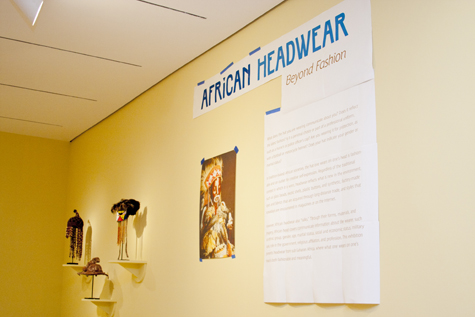
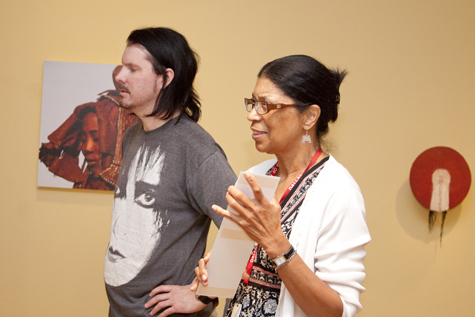
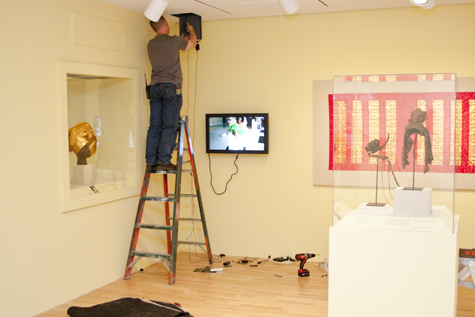
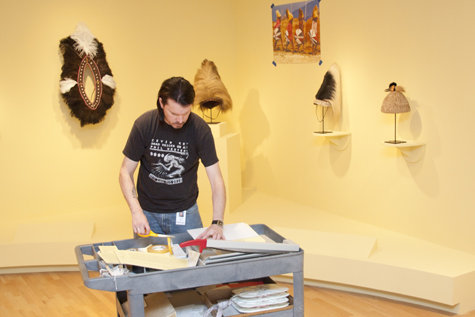
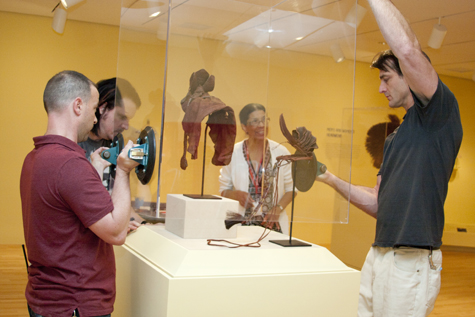
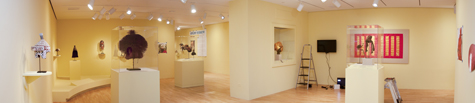
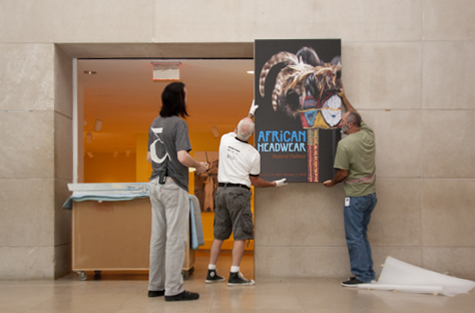
African Headwear: Beyond Fashion opened yesterday and will be on view through January 1, 2012. The exhibition celebrates the artistry of African decorative design and initiates us into the world of fashion a few months before we host Jean Paul Gaultier: From the Sidewalk to the Catwalk. Below are a few images showing the preparation that went into creating the African Headwear exhibition.

Staff Profile: In the Sound Booth

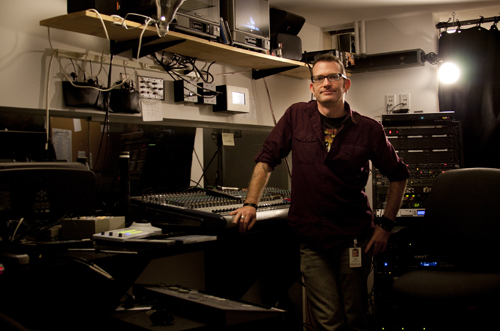
Uncrated tracked down Corbett Sparks, one of the DMA’s multimedia technicians, to talk about his job at the Museum. Corbett can frequently be spotted behind the sound board during Thursday Night Live and Late Nights in the Atrium and is also the “great Oz” in the Horchow Auditorium control booth.

Describe your job in fifty words or less.
I am a multimedia technician, which means I take care of any audio/video needs that come up at the Museum. I am also in charge of editing and cataloguing all recorded audio.

What might an average day entail?
I really don’t have average days—I don’t even have a regular schedule! The only consistent part of my week is Thursday night, where I run sound for jazz (Thursday Night Live). I also take care of all the atrium performances for Late Nights on the third Friday of every month. Other days I might be setting up a laptop and projector for a meeting or running the sound and light boards for a lecture in the Horchow Auditorium.

How would you describe the best part of your job and its biggest challenges?
Meeting the artists and performers that come through here and making sure their lecture/show goes off the way they want is my favorite part of this job. I am a people-pleaser and enjoy exceeding their expectations. My biggest challenge might be dealing with all the people that get me confused with the other tech, JD. We kind of look alike.

Growing up, what type of career did you envision yourself in? Did you think you’d work in an art museum?
I always knew I would work in a creative field. When I was younger, I wanted to either be a fine artist or movie director. That being said, I still don’t know if I am grown up yet.

What is your favorite work in the Museum’s collections?
Bill Viola’s, The Crossing. He was an early inspiration for me as an artist. My first introduction to his work was actually at the DMA. That piece was called The Sleep of Reason:
“A black-and-white monitor on a wooden chest shows a close-up view of a person sleeping. At random intervals, the lights cut out and the room is plunged into total darkness. Large color moving images momentarily appear on three walls and a loud disturbing sound of moaning and roaring fills the space — fires burn out of control through city buildings, fierce attack dogs lunge at the camera, violent ocean waves crash into shore, a provoked owl flies into a bright light. Just as suddenly, the images vanish, the lights come back on, and the room returns to normal.

This piece opened my high school eyes to what art could be—not just paintings and sculpture, but concepts and the use of technology to get those ideas across.

Is there a past exhibition that stands out in your mind as a favorite, or is there a particular upcoming show you’re looking forward to seeing?
I really enjoyed Fast Forward. I am also definitely looking forward to the Jean Paul Gaultier exhibition. I am intrigued by the use of the “Tony Ousler”-ish  projections on the mannequins and the general atmosphere surrounding them. Looks like fun!

Behind Closed Doors

Go behind the Museum office doors and discover the various work spaces in the DMA. Each month we will share insight into a different department.
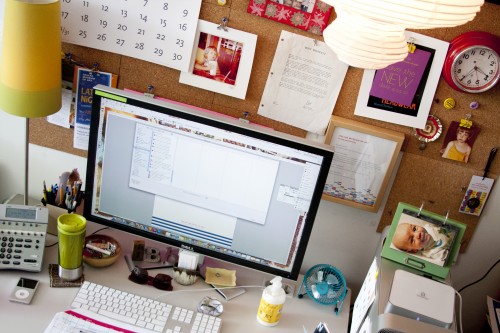
This month, our in-house design team shares their space with us.

Photography by Adam Gingrich, Marketing Assistant at the Dallas Museum of Art


Archives

Categories