Archive for the 'Art & Teaching' Category


Thematic Connections with Contemporary Art: Systems and Process

We constantly encounter and use systems in our everyday lives – roadways, electricity, mathematics, language, and so much more.   Although there are multiple definitions of a system, the one that seems to be the most universal is a grouping of interacting, interrelated, or interdependent items forming a unified whole.

An artist may employ a system in his or her creative process, in subject matter, or in concept.   During the first part of the Contemporary Teacher Workshop (at the Dallas Museum of Art) on Saturday, February 19, participants will explore the theme of systems in select artworks from the 1960s through today in the exhibitions Re-Seeing the Contemporary:  Selected from the Collection and Big New Field:  Artists in the Cowboys Stadium Art Program. With a focus on language and systems within an artist’s process, educators will engage in interactive and interdisciplinary experiences that are applicable and translatable for the classroom.  On Saturday, February 26, our conversation about the artist’s process will continue at The Rachofsky House as we view the current installation Process Imperfect.

There are a few spaces available for this two-part teacher workshop.  If interested, please register online.

Here are a few artworks that may be a part of the conversation on Saturday, February 19:

[slideshow]

We look forward to seeing you at the workshop!

Until next time….

Jenny Marvel
Manager of Programs and Resources for Teachers

Images in slide show:
Richard Diebenkorn, Ocean Park No. 29, 1970, Dallas Museum of Art, gift of the Meadows Foundation, Inc.

Christopher Wool, Untitled, 1990, Dallas Museum of Art, gift of the Friends of Contemporary Art

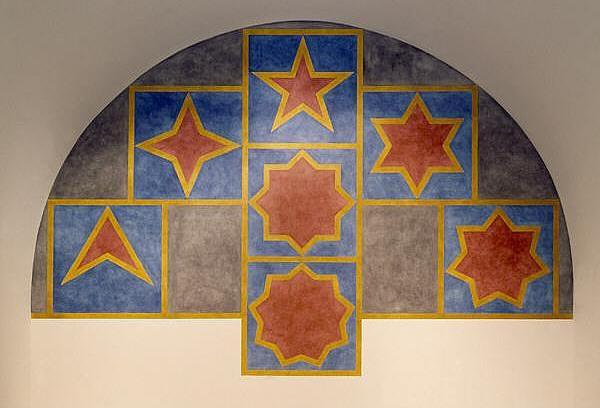
Sol Lewitt, Wall Drawing #398, 1983 (drawn 1985), Dallas Museum of Art, gift of The 500, Inc., Mr. and Mrs. Michael J. Collins and Mr. and Mrs. James L. Stephenson, Jr.

Carl Andre, Pyramid (Square Plan), 1959 (destroyed) 1970 (remade), Dallas Museum of Art, General Acquisitions Fund and matching funds from The 500, Inc.

Staff Spotlight: Shannon Karol

Usually, I interview artists, educators, and community partners with whom we partner in various programs.  This month, I’m turning the spotlight on our own Shannon Karol.  Shannon has worked at the DMA since 2005, with the exception of a short stint back in her home state of Michigan.

Tell us about your history with the DMA.

I first came to the Museum in 2005 as a McDermott Graduate Curatorial Intern, and I worked with Dr. Roslyn Walker, our Curator of African art.  A big part of my intern responsibilities was working with scholars to gain permission to use their contextual photos in our catalog of the African collection.  I did a bit of background research for the catalog, too.

I went away for a year to work at the Kresge Art Museum at Michigan State University, and returned to the DMA in August 2007 as Tour Coordinator.

Just last month, I was promoted to Manager of Docent Teaching and Gallery Interpretation.  I’m now responsible for the Museum’s 108 docents, which includes training and helping them learn best practices for teaching in the galleries.  I’ll also continue to work with some of our partner schools and school districts on their annual museum visits.

To what part of your new position are you most looking forward?

The most immediate thing I’m looking forward to is representing the Museum at the Super Bowl on Sunday.  I’ll be there to talk about connections between the Cowboys Stadium Art Program and our Big New Field exhibition.

I’m also looking forward to training a new docent class and helping them get excited and prepared to be in the galleries with our student visitors.

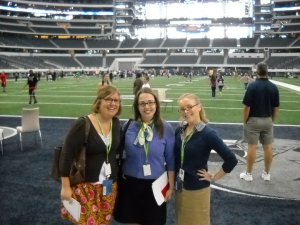
On the field at Cowboys Stadium last fall with Molly and Amy

What do you miss most about Michigan?  What do you like most about Texas?

I miss my family the most.  But I do not miss the snow.

What I like most about Texas is having a part of my family here and spending time with my three  teenage cousins, two of whom are teen docents.  I also love the Texas weather when it’s seventy degrees and sunny in January.

What do you do in your free time?

I sew.  I enjoy making purses and skirts, and I’m currently working on a dress that I plan to wear in Paris when I visit for the first time this summer.

How does your love for teaching with works of art extend outside the DMA?

Once a year, when I go home to visit my family in Michigan, I go to school with my sister to talk with her third-grade students about art.  We look at images of famous works of art, including paintings from the DMA collection.  I have them make up stories, write poems and tell me about what they see.  We end the day with a “Pollock-ing” activity, which involves dipping marbles in paint and rolling them around in a baking tray lined with paper.  Then, the kids make their own Andy Warhol-inspired self portraits.  My sister takes black and white photographs of the students, and we give them highlighters to color in their portraits.

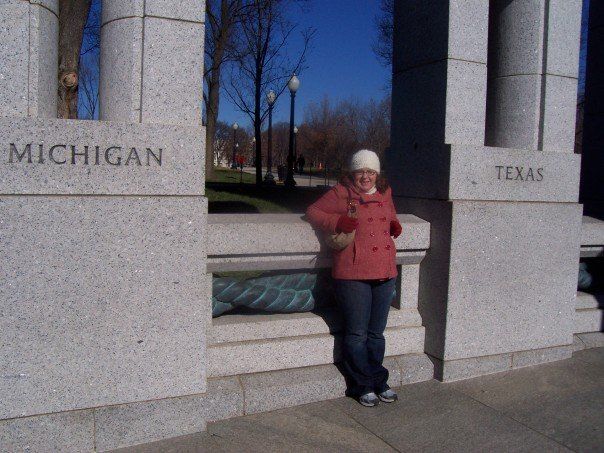
Shannon stands between the pillars of her two “home states” at the World War II Memorial in D.C.

Melissa Nelson
Manager of Teaching in the Community

Engaging Opportunities with Art, Artists, and Animals

As the new year begins, I encourage you to think about ways you can connect with with artists, artworks, and other K-12 colleagues  at the Dallas Museum of Art.  Here are two events that might prove to be inspirational, relaxing, or simply rejuvenating.

  • Join us for our annual Late Night Birthday Celebration as the Museum turns 108 on Friday, January 21 from 6:00 p.m. to midnight!   To celebrate the beginning of the Spring Semester, we invite you to bring your educator ID to receive FREE Museum admission.  Come with your colleagues, family, and friends to experience traditional African music, polka with Brave Combo, participate in Twitter Treasure Hunts, and engage in conversations with artists in the Center for Creative Connections.  In addition, visit the Educator Resource Table from 7:00 to 10:00 p.m. to meet DMA education staff, register for door prizes, and sign up for upcoming teacher programs.     


  • Join us for an exciting teacher workshop Animals from Africa at the Dallas Zoo and the Dallas Museum of Art on Saturday, January 29!  Spend the morning at the Dallas Museum of Art, experiencing African Masks: The Art of Disguise and then journey to the Dallas Zoo for an afternoon of exploration in the Giants of the Savanna!  This special workshop includes a gallery tour, a special behind-the-scenes experience at the zoo, and lessons from experienced art and zoo educators that you can take back to your classroom.  Participants will also receive six CPE hours.  Cost is $50 for this workshop and includes admission and parking at both institutions.  To register, please complete the registration form and return to the Dallas Zoo Education Department via fax, email, or mail.

We look forward to seeing you at one or more of these events!   Don’t forget, bring your educator ID on  Thursday evenings to receive FREE admission to the Museum.

Until next time….

Jenny Marvel
Manager of Programs and Resources for Teachers   

The Art of Appropriation, a Wednesday Gallery Talk

Every Wednesday at 12:15 p.m., visitors can meet at the Visitor Services Desk for the Museum’s weekly Gallery Talk.   Gallery talks are 45-minute long intimate lectures and discussions that take place in the Museum galleries.  These talks are very different from a tour in that they typically focus on a narrow group of objects with a unifying theme within the Museum’s collections or special exhibitions.  They are often led by Museum curators, visiting scholars, and Museum staff.  Each year, every McDermott Intern leads a gallery talk as part of their internship experience. 

I was the first intern up to bat in leading a Gallery Talk titled The Art of Appropriation: “Exotic” Motifs in European Art.

Below are images of several of the objects I discussed during the talk.

[slideshow]

I decided to focus on appropriation art, a topic taken from my honors thesis as an undergraduate at SMU.  I’ve done extensive research on chinoiserie, an 18th-century European decorative arts movement inspired by Asian motifs, and this served as the starting point for my investigation of Asian-influenced objects in the DMA’s collections.  The talk emphasized four main topics in the discussion of these objects.

1. The definition and different types of appropriation art or art that crosses cultural boundaries.  For example, the colonial Mexican screen pictured in the slideshow appropriates styles, motifs, and subjects from Japan, China, the Netherlands, and ancient Rome.  See if you can determine which element can be attributed to which country!

2. Early (13th to 17th century) travel, trade, and other forms of contact between Europe and Asia.  Cosmopolitan objects, such as the Mexican screen, would not have been possible without cross-cultural exchange of information and goods between the two continents.  This exchange manifested in the early accounts of travelers like Marco Polo, the trade of goods and publication of scientific surveys through the various East India Companies, and missionary publications.

3. 17th- and 18th-century Chinese and Japanese exports and subsequent European “copies.”  Objects such as the Charger seen above represent early porcelain exports from China (made at the Jingdezhen imperial kiln) and the influence of European taste on their decorative elements.  Due to the relatively high cost of these imports, Europeans began making faience, and later porcelain, copies of Asian-produced objects.

4. The contradictory pairing of exoticism and ethnography in the 19th-century.  The 19th-century saw the emergence of the field of ethnography, fueled by the World’s Fairs and a growing body of “scientific” literature.  However, the notion of the East as a mysterious and exotic land persisted as seen in the painting above by Alfred Stevens that showcases the artist’s collection of Japanese screens, Chinese porcelain, and Kashmir textiles within the quintessentially French context of the salon.

Leading a gallery talk is a unique experience for an intern, and all in all it was very enriching, though a bit nerve-racking.  This topic was especially rich to share with museum visitors, as most everyone has experience with some type of appropriation!  It is a ubiquitous presence in our lives from advertisements that include famous works of art to the millions of souvenir stands selling Mona Lisa key chains or Mao Zedong t-shirts.  Post your example of appropriation to the comments section!

Upcoming Gallery Talks for the month of January include:

January 5th: Must be Willing to Travel: Early American Portraitists and the Transatlantic Exchange, led by Sara Woodbury (McDermott Graduate Curatorial Intern for European and American Art)

January 12th: Form/Unformed: Design from 1960 to the Present, led by Kevin W. Tucker (The Margot B. Perot Curator of Decorative Arts and Design, DMA)

January 19th: Topping It Off: Portraits of Women in Fashionable Hats, led by Sarah Vitek (McDermott Education Intern for Adult Programming)

January 26th: European Art and the Rosenberg Collection, led by Heather MacDonald (The Lillian and James H. Clark Associate Curator of European Art, DMA)

Ashley Bruckbauer
McDermott Education Intern for Resources and Programs for Teachers
Community Connection: Thriving Minds

The DMA partners with Thriving Minds, a city-wide initiative to provide arts and cultural experiences for Dallas students, in the offering of an extended arts program during after school hours.  We have partnered with Thriving Minds and their umbrella organization Big Thought in several ways over many years.  The after school program is our newest partnership, which has become my focus during the past two years.  I am fortunate to work closely with Creative Specialist Laura Orange on this program: we share an excitement and enthusiasm for serving students during after school hours with programs that are educational, meaningful, and most importantly, fun.

Tell us a bit about your background and how you came to your position at Big Thought.

When I was in my early twenties, I studied with a professional company that had connections with the Paris school of Marcel Marceau.  We became the United States version of that company.  The man I studied with supported himself by being a resident artist for the state of Ohio, and he trained me on how to make a living by putting together a show and getting involved with various state arts commissions.  I ended up here in Texas in the early 80’s when Young Audiences was forming.  Young Audiences wanted a mime company, and they asked me to create one their second year.  I spent years performing through schools, doing residences and other work through Junior Players and Dallas Children’s Theater, and along the way I learned about arts administration.  As Young Audiences developed, they realized they needed in-house arts administration staff and brought me on board – that was probably ten years ago.  Young Audiences grew into Big Thought and extended into afterschool programming.  I was the representative here for 21st Century programming and was able to connect organizations with afterschool programs.  Now we staff programs at schools, and I realize I’ve almost come full circle.

What advice would you give to artists who are interested in teaching school children?

Don’t take yourself too seriously.  You’ve got to enjoy children and enjoy the journey they’ll take you.  Sometimes, something will happen that can be a really brilliant idea if you’re not stuck on what you want to do.  Some of my best adventures happened when something didn’t work right, and I decided let’s try this and see what happens?  It became a lot more fun.   

You have a performance background.  How do works of art connect with your approach toward teaching?

Works of art can be very inspirational.  From the mime background, every picture tells  a story, and there’s movement and everything.  We’ve physically recreated works of art in performances with our bodies.  You can also do a movement exercise where you take a still picture, and ask students what do you want to be in it?  A blade of glass, a tree, birds flying, part of a hill…if we were to unfreeze it, what are the little movements that would happen?   What sounds would it make?  Students can use these things to understand line, form, and shape of physical bodies.  Since mime is abstract, there is a lot to connect with abstract paintings, too.

If you could be doing anything else, what would it be?

Probably sitting on the beach and watching the ocean.

What is your favorite holiday tradition?

Our annual drive home to my parents’ house is usually pretty funny.  We rent a minivan and I call it “Operation Little Miss Sunshine”.  Me, my brother, my husband, my dogs, and whatever we can stuff in the van drive to Mississippi and back together.

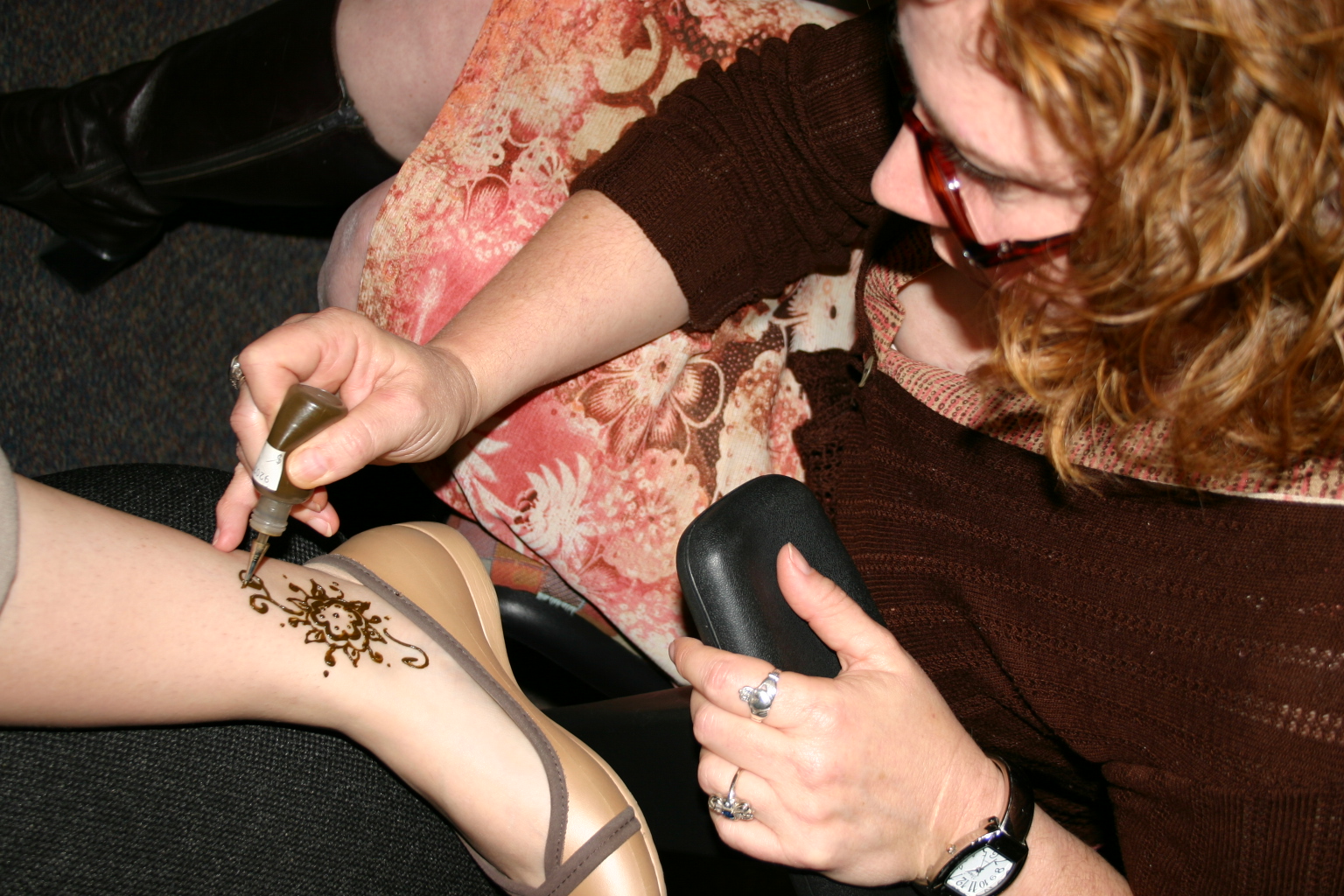
Laura paints a henna tattoo on a colleague.

TAEA 2010

This past weekend, my colleague Shannon Karol and I took a trip down I-35 to Austin for the annual Texas Art Education Association (TAEA) conference.   TAEA brings together art educators in K-12 classrooms, universities, and museums.

My favorite part of TAEA has been getting to hear what other museums in the state are doing.  This year, I learned how ArtPace works with community partners in a program called ¿Como Vives?, how the Meadows Museum structures a multiple-visit program with area 6th graders, and how the Museum of Fine Arts, Houston engages audiences with contemporary art.  There was a lot to take in! 

Shannon and I also got a chance to talk about the DMA in presentations we gave.  Shannon shared her expertise in African art with conference-goers in her session, Themes for Teaching with African Art.  The session included themes (including family, proverbs, and royalty) that can be used to engage students of all ages with African art.  If you are interested in integrating African artworks into your classroom, I hope you’ll check out Shannon’s African Art Resources

In my session, Close-Looking, Collaboration, and Creative Response: Interactive Experience with Works of Art, I shared three activities that allow for my favorite kinds of gallery experiences: ones that are open-ended, involve groupwork, and art-making or writing in response to a work of art.  My favorite of the three is Post-It poetry.  I like poetry exercises; I think they’re a great way to get students to distill their ideas about an artwork into brief, meaty responses.  With Post-It poetry, students write words that describe an artwork on individual Post-Its and stick them to a board that serves as a group word bank.  After all group members have contributed responses, the group works together to rearrange Post-Its to create phrases or sentences.  Click here for more detailed Post-It poetry instructions.

What I like most about this activity are the unexpected resonances that happen when students read poems.  Hearing different, fresh combinations of words always enriches the experience of looking at an artwork for me.  Below are some Post-It poetry pictures, and a Post-It poem participants made during my TAEA session.

[slideshow]

The two of us also took in the sights in Austin.  We checked out the Blanton Museum of Art, stopped by the capitol, shopped funky stores on South Congress, and had a blast eating out of trucks!  (Not the F-150 kind, but the street-food-vending kind).   All in all, it was quite the weekend.

Amy Copeland
Coordinator of Go van Gogh Outreach

Community Connection: Eye-opening, Enlightening, and Fabulous

Some of our devoted Go van Gogh volunteers have participated for many years, so we design special workshops for them with the goal of making connections – with works of art, with fellow volunteers, and with personal teaching experiences – in fun and fresh ways.  These themed workshops often feature guest speakers, such as local artists or our colleagues in the education department.   

Our last workshop focused on the theme “PLAY”; you can view pictures from the workshop in our intern Karen’s photo post.  We invited Leticia Salinas, the 2009-2010 McDermott Intern for Family Experiences, to lead conversations and activities with volunteers in front of works of art entirely in Spanish.  Volunteers commented after the workshop that their experience with Leticia was “eye-opening”, “very valuable”, “helpful”, “enlightening”, and “fabulous”.

Leticia leads the Paint the Town DMA Summer Art Camp.

Tell us about your connection with the DMA.

I’ve been in Dallas for about ten years, and during college I visited the DMA every now and then and attended Late Nights.  Last year, I was the McDermott Intern in the Family Experiences department.  I continue to help during Late Nights and other special Family Experiences programs. 

What are you doing now?

I am a Special Education Bilingual Teaching Assistant at Thomas Elementary in Plano ISD.  I help teachers in classrooms with special education and/or bilingual students, primarily kindergarten through second grade. 

Describe your session with Go van Gogh volunteers.

I gave two tours in Spanish focusing on Jackson Pollock’s Cathedral and three hats in the African collection.  This helped volunteers put themselves in the position of ESL students and also showed them effective ways of teaching these learners.  Hopefully, the volunteers were able to gauge how these students feel and will be able to use that knowledge as a tool when they teach.  It was a really great experience, and I enjoyed it.  The volunteers were all very willing to participate even though it was a different language and they may have felt uncomfortable.

What do you consider important when working with ESL students, and how does this apply to teaching with works of art?

When working with ESL students, there has to be something more than language.  You have to be really creative and think of different ways to teach a subject.  This applies to all subjects.  I think art is a great way to teach ESL learners because they have a visual picture of what you’re talking about.  You can get creative and lead activities that are more hands-on and fun, playing with color and lines and movement.  All of those concepts are easy to teach to students who don’t speak English fluently.

Finish this sentence: In ten years, I’d like to be…

I hope to be at a place where I’m happy with my job and I love what I do, whether it be working in a museum or with kids or doing something totally different that I never thought I would do.  Hopefully, in ten years I’ll have it all figured out.

Go van Gogh Stays to Play

Last Friday, Go van Gogh staff  led a “play” workshop for our volunteers. This session led volunteers into the galleries to discuss and interact with works of art in a creative and fun way. Volunteers  posed as the objects, created a yarn painting similar to Jackson Pollock’s Cathedral, as well as experience several discussions led in Spanish. A former McDermott Intern, Leticia Salinas, who facilitated the discussions, demonstrated various hand gestures and other techniques that could be utilized when facilitating programs with students who speak languages other than English.

The fun did not stop there! Volunteers used materials from the space bar in the Center for Creative Connections to create art, then continued their play session in the Tech Lab. Go van Gogh is an outreach program that brings the Dallas Museum of Art to 1st through 6th grade students in schools throughout North Texas.   Allowing the volunteers to play was a unique approach of seeing the artworks in a new way and re-igniting the volunteers’ energy, enthusiam, and  passion for teaching. 

Karen A. Colbert
Teaching Programs Intern

[slideshow]

French Art Teacher Workshop

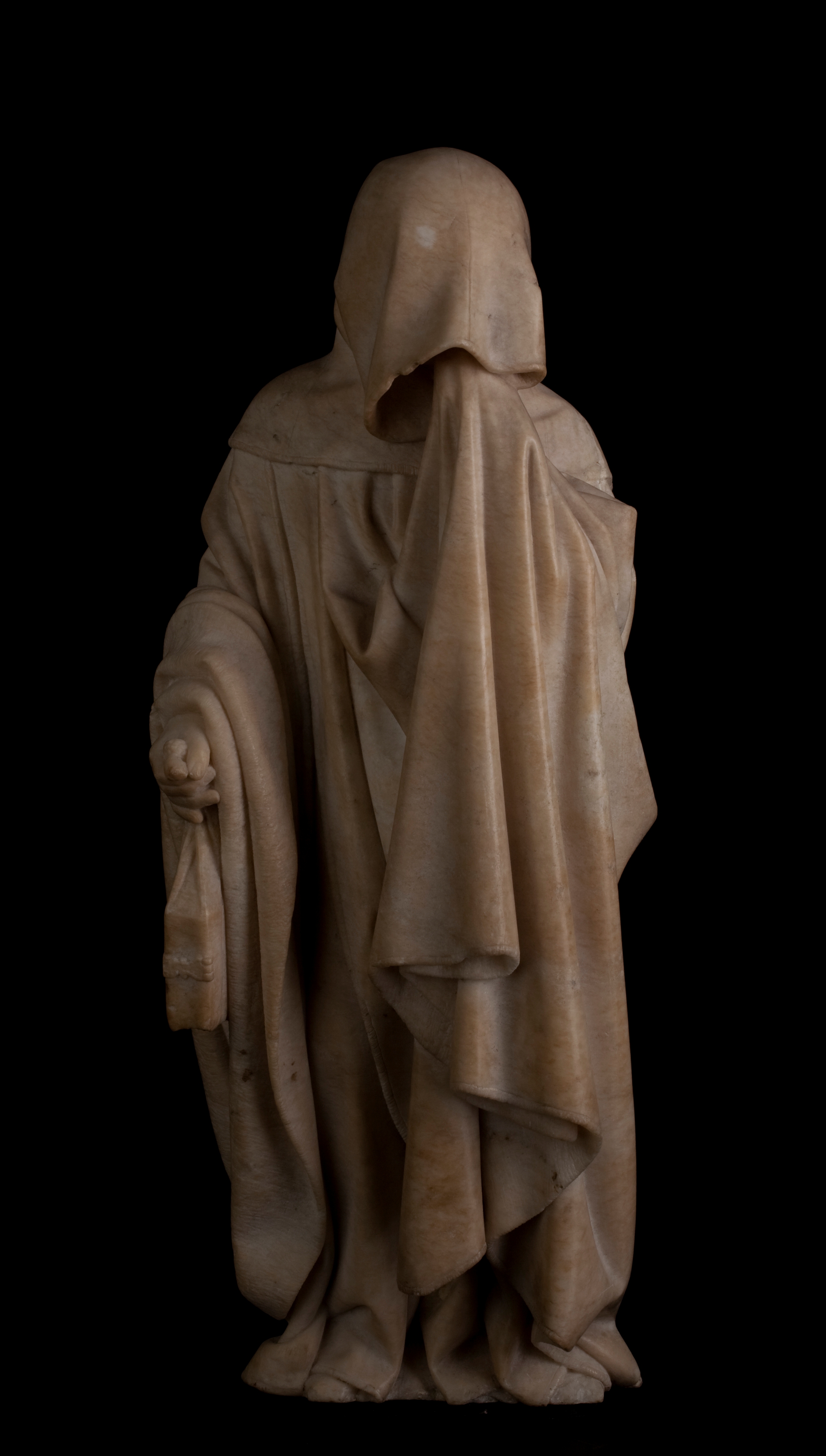
Bonjour!  I would like to invite you to travel to France through works of art at the Dallas Museum of Art on Saturday, December 4 from 9:00 to 12:30pm.    We will explore 18th–19th century French paintings and sculptures, the Reves Collection, and the special exhibition The Mourners: Tomb Sculptures from the Court of Burgundy.  


To register for this teacher workshop or to learn more about other workshops and programs offered in Spring 2011, go to DallasMuseumofArt.org/teachers

À bientôt….

Jenny Marvel
Manager of Programs and Resources for Teachers

Teaching with African Art

Prior to becoming the Coordinator of Museum Visits at the DMA, I served as a McDermott Curatorial Intern working with our curator of African art, Dr. Roslyn A. Walker.  During my year with Roz, I learned not only about the arts of Africa, but I also grew to love the DMA’s collection.  We have a fantastic collection of African art at the Museum, and I enjoy sharing it with our docents, teachers, and especially with students.

A few weeks ago, I led a docent training session entitled Art and Death in Africa.  A majority of African art deals with the cycle of life, so birth, initiation, and death are constantly referenced in our collection.  I felt that death was an especially interesting theme to investigate since it ties in so nicely to one of our current special exhibitions The Mourners: Medieval Tomb Sculptures from the Court of Burgundy.  Check out last Friday’s photo post for some of my favorite works from the collection relating to art and death in Africa.

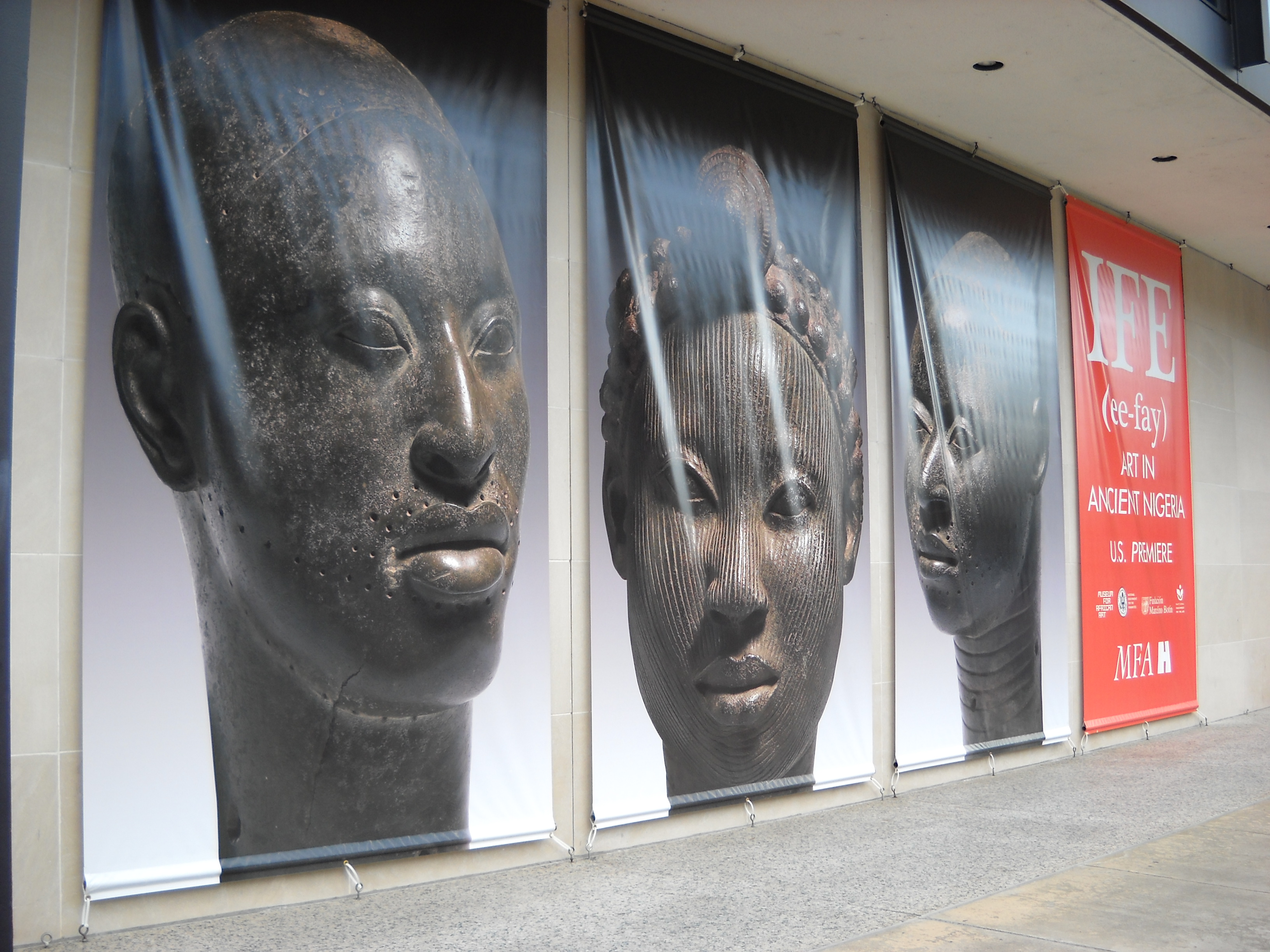
Dynasty and Divinity: Ife Art in Ancient Nigeria at the MFA, Houston

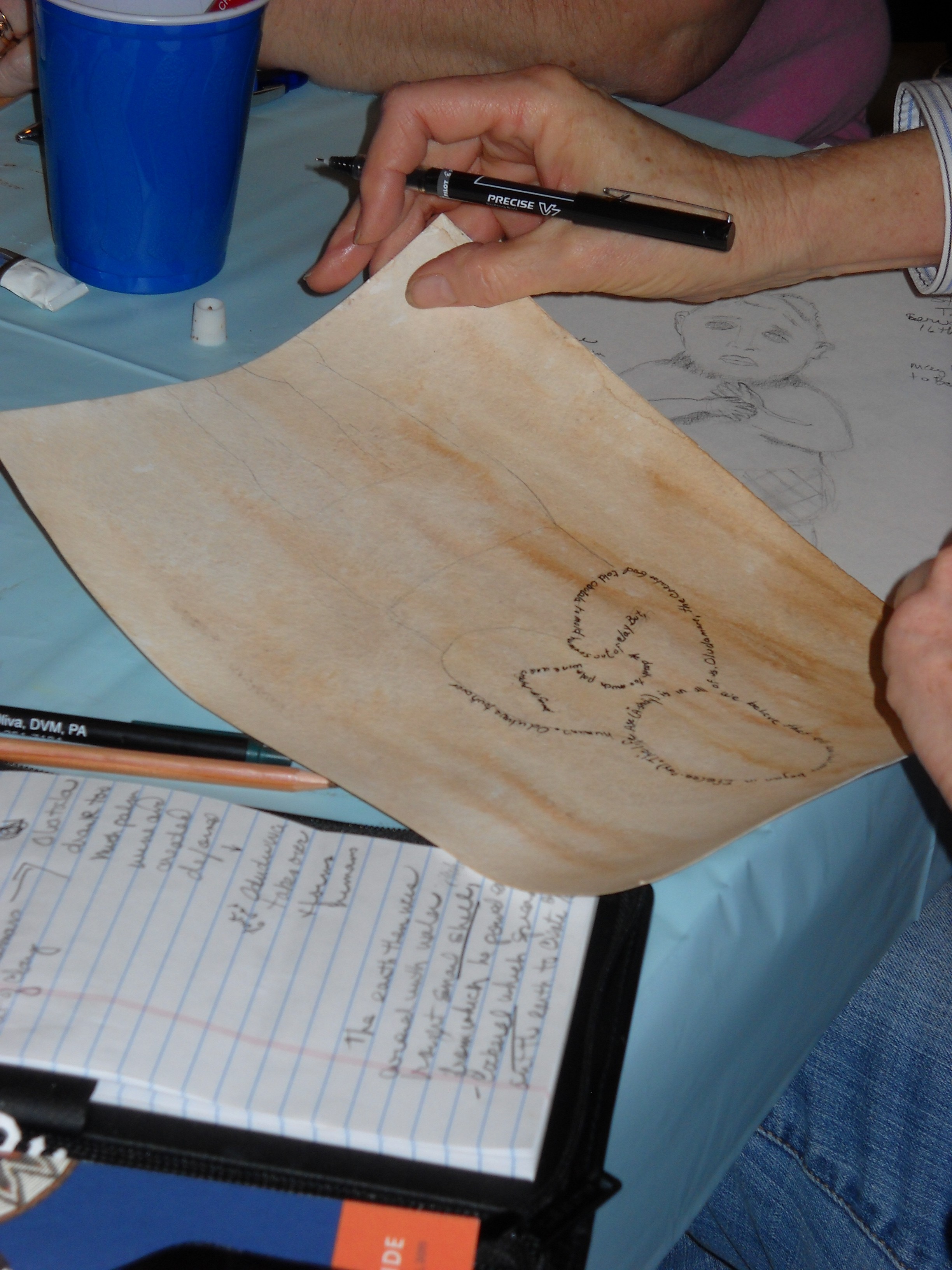
In September, I was invited to lead a Teacher Workshop at the Museum of Fine Arts, Houston related to the exhibition Dynasty and Divinity: Ife Art in Ancient Nigeria.  The works of art in the exhibition date from the 9th to the 15th century, and many of them have never traveled outside of Nigeria.  It was a special treat to see them, let alone to teach with them!  We spent time in the exhibition and also in the MFAH’s African galleries exploring the themes of kingship and belief.  At the end of the day, teachers created concrete poems inspired by a work of art in the Ife exhibition.  I was impressed with the teachers’ finished products, which were created on paper that they had embellished with a watercolor wash. 

A concrete poem created by one of the teachers

Later this month, I will be presenting Themes for Teaching with African Art at the Texas Art Education Association conference in Austin.  Using works of art from the DMA collection, I will share themes, questions, and experiences that can help students make connections between African art and traditions and their lives today.  If you’re attending TAEA this year and want to learn more about teaching with African art in your classroom, plan to attend my session at 6:00 p.m. on Friday, November 12th.  I hope to see you there!

Shannon Karol
Coordinator of Museum Visits


Archives

Categories