Archive Page 45


Longtime Curator “Travels” DMA’s Silk Road

Following her new installation in the third-floor galleries of objects that reflect transport along Eurasia’s  Silk Road, “seasoned” curator Dr. Anne Bromberg sat down with us to discuss her fascinating career. A lifelong Dallasite—except for her years at Harvard getting her B.A. in anthropology and M.A. and Ph.D. in classical art and archaeology—Dr. Bromberg has been on the staff of the Dallas Museum of Art for more than forty years, first as a lecturer and docent trainer beginning in 1962, then as head of the education department, and currently as The Cecil and Ida Green Curator of Ancient and Asian Art. What’s more, she has led an inspired life, traveling extensively to little-known locales, researching and experiencing the cultures within her discipline.

[slideshow]

Q: How would you describe your job at the DMA?

AB: Most curatorial jobs involve trying to acquire art for the museum, organizing exhibitions and/or working on exhibitions that come to us from elsewhere, publishing, lecturing, working with volunteers, [and] cultivating donors. In terms of legwork, it’s going around and seeing dealers and other collections, visiting other museums, going to conferences, and giving lectures outside the museum.

Q: You are in charge of a very diverse area of the Museum’s collections. What is your particular area of expertise?

AB: Classical art, meaning the art of ancient Egypt, Greece, and Rome, and all Asian art, but I’m mainly working with South Asian art.

Q: How did you become interested in Asian art?

AB: One of the really outstanding teachers I had taught evolution in her biology courses, including historical geology, and I was really fascinated with historical geology and that got me into reading about archaeology. And I thought, this is what I want to do. A good teacher makes a difference. I’ve actually been interested in Asia for a long, long time. When I was an undergraduate, I was reading books on Zen Buddhism and haiku, the Ramayana, and things like that. Books stimulate your passion to go see these things in reality.

Q: What are some of your favorite places you’ve traveled to?

AB:  I think both my husband, Alan, and I would say the single favorite place we’ve been is Isfahan in Persia. Italy, of all the European countries, is easily the most seductive, and everybody I know who has been to India is dying to get back. We’ve been there so many times, and you feel like you’ve just scratched the surface.”

Q: What is your favorite object within the ancient and Asian collections at the DMA? Within another collection?

AB: The Shiva Nataraja, because that image is the single most important iconic image in Hinduism generally, and many Hindus would agree with that. It is exceptionally beautiful both aesthetically and because it represents the loving quality of the god Shiva. South Indian Hindu poems describe worship as falling in love with the god, and our Shiva Nataraja is the embodiment of that Chola period poetry.

Brancusi’s Beginning of the World. because of my background, I personally have a strong response to pure geometric forms and classical idealism, and I’m certainly not alone in believing that the ancient Greeks would appreciate that classical, pure, and geometric vision of the beginning of the world.

Q: Do you personally collect art? What types of objects are you most drawn to?

AB: Primarily we’ve collected what I would call third-world contemporary art—things that at the time were being made wherever—New Guinea, India, South America, Mexico, etc.

Q: Why do you think it is important for people to study non-Western art?

AB: If you study non-Western art, you’ll learn what human beings create and why. If you stick only to your own civilization, you are much less likely to think about why these things are being made . . . or about a much more serious question to me, why do we call it art?

Q: Describe your current project, an installation of objects from the DMA’s collections focusing on the Silk Road.

AB: The Silk Road installation is something that has interested me for a long time. We do have a lot of artwork that really displays the meaning of the Silk Road, which tied Eurasia together for millennia. So I was delighted when I got a space where I could show the ties between the Mediterranean world and Asia.

The Silk Road is an ancient transcontinental network of trade routes that spread across Eurasia from the Mediterranean to China and Japan. The phenomenon of the Silk Road is constantly studied and has recently been featured in museum exhibitions around the world. The new installation, organized by Dr. Bromberg, addresses six themes related to the Silk Road, including the development of cities and trade, the importance of animals to early societies, and the spread of religions. The installation presents well-known DMA favorites, such as the Javanese Ganesha and the bust of a man from Palmyra, and new works from several local private collections. Opening this weekend, come see the new installation on Level 3 the next time you visit the DMA.

Ashley Bruckbauer is the McDermott Intern for Programs and Resources for Teachers at the Dallas Museum of Art and Madelyn Strubelt is the McDermott Curatorial Intern of Ancient and Asian Art at the Dallas Museum of Art.

Ask @MoRocca

Last week we asked you to tweet us your questions for Mo Rocca. We picked three at random and below are his answers. Mo Rocca will appear at the Charles W. Eisemann Center tonight at 7:30 p.m. as part of Arts & Letters Live’s 20th season. Purchase Mo Rocca tickets from the Eisemann Center online or call 972-744-4650. Don’t forget that university students, faculty, and staff receive a 40% discount off any price level by entering the code “student” at checkout.


@llkays What is your dream meal where, with whom (from any time or place), and what would you eat?

I’d like to eat Chinese food with Barbra Streisand. She used to work at a Chinese restaurant. Plus she’s Jewish. She could explain to me why Jewish people love Chinese foodin song.

@smallcapsitalic You make me laugh, so what makes YOU crack up?

Gene Wilder and Madeline Kahn in Young Frankenstein. The Marx Brothers and Margaret Dumont. David Sedaris.

@kimbaway What is your favorite type of art?

Modigliani. I like long necks.

Dallas Activities Get a Splash of Color with Late Nights

As you know, our Late Nights are a staple for Dallas activities in the Metroplex. For our second YouTube video, we chose to feature what makes this program so special. If you know anyone who has not experienced Late Nights, share the video with them and plan your visit!

[youtube=http://www.youtube.com/watch?v=XkZK-A0fxFs]

Breaking in Spring

This just in – today’s weather is going to be cloudy with a chance of . . . art?! When we think about visiting an art museum with our families, we may not think about the weather (except  museums often have what feels like arctic air flowing through the galleries to keep the art “comfortable”  – so bring a sweater!). We have some exciting plans for family fun on the horizon, and there is a 100% chance of WFAA’s meteorologist Greg Fields in the forecast!

Don’t miss our free WFAA Family First Day on Saturday, March 12, that will kick off a week-long fiesta of fun family-friendly activities for spring break.

Join us in the galleries as Greg Fields forecasts the weather in works of art. You will even have the chance to search for rough spots, popping storms, and gray skies in paintings to create a weather forecast of your own.

One work of art we think may be on Greg’s radar is Claude-Joseph Vernet’s painting Mountain Landscape with Approaching Storm, on view in the European Galleries. Skirt alert! Definitely umbrella weather – the atmosphere in this landscape is overcast, with strong whipping winds coming in from the west. Place your bets, because it looks like a drencher. Mother Nature is on the war path! The figures in this scene look like they are facing a giant blow dryer! Look closely as they scurry for cover before it begins to rain cats and dogs. Talk about atmospheric indigestion!

Claude-Joseph Vernet, Mountain Landscape with Approaching Storm, 1775

Greg may forecast flash flood warnings, wind advisories, or even a tornado watch! Visitors will be invited to make a sound symphony of the weather in this scene, pose like the people fleeing for cover, and talk about their own scary storm experiences. It will be a rip-roaring good time!

Extend your Museum fun throughout the week of spring break. From March 13 through March 18 at 5:00 p.m., the DMA is offering $5 admission and $5 parking.  Check out the spring break schedule on our website for more information.

Amanda Blake is the Manager of Family Experiences and Access Programs at the Dallas Museum of Art

Thursday Night Live: An Artful Addition to the Nightlife in Dallas

Nightlife in Dallas has a touch of jazz on Thursday nights. Our weekly event, Thursday Night Live, features an exciting vibe with great Dallas jazz bands, exquisite art, and thoughtful conversations. In this video, some of our most loyal fans describe what makes Thursday nights so special in the Dallas Arts District, including live jazz, Artist Encounters, and free student admission.

[youtube=http://www.youtube.com/watch?v=2vgBJBWFJA0]

Every Thursday Night Live runs from 5:00 to 9:00 p.m. (unless otherwise noted).  Please leave a comment and tell us about your Thursday Night Live experiences.

All of the fun. None of the cost.

The program Late Nights at the Dallas Museum of Art is full of activities and experiences for people of all ages. But did you know that there’s a way to enjoy them without having to pay Museum admission?

Volunteering at Late Nights isn’t your average charitable activity. Volunteers can choose from a wide array of programs they wish to help with, and they often get to participate. As a volunteer, you become a part of Late Nights on multiple levels as a facilitator, aide, and participant, and you can also explore the Late Night before or after your volunteering shift. You can get in on the action yourself, helping visitors create their own works of art in the Art Studio or encouraging visitors to think outside the box during a Creativity Challenge.

Many volunteers have said that the rewards that come with volunteering at Late Nights make the event more of a fun activity than actual work. Couples and families will volunteer together to participate in Late Nights in a different way, and more often than not, they come back again and again to volunteer. One volunteer put it this way, “I look forward to the beaming faces of the kids when you’ve applauded them for the project they’ve just completed. It’s really sweet to see the parents and children working so closely together. It’s also amazing to see what people can create with simple materials and their imagination.”

Volunteers receive free admission to Late Nights and also have the opportunity to meet up-and-coming or even nationally known artists who lead workshops or host programs. When you volunteer, you get a glimpse into all of the behind-the-scenes work that is involved in creating a fun and exciting Late Night. You’ll be amazed at how much collaboration and effort goes into each one of these events, and being a part of it can give you a great sense of accomplishment.

Volunteering at the Dallas Museum of Art helps you become an integral part of the Late Night experience. After all, where else can you help little ones wiggle into fun yoga poses and then race against the clock to create a work of art under pressure at the Space Bar? So if you’re looking for a unique way to experience the Museum, consider becoming a volunteer. It will provide you with a new perspective on Late Nights at the DMA.

For more information on volunteering, visit our volunteer page or contact Hadly Clark at 214-922-1311 to volunteer for Late Nights.

The Night Owl and the Pussycats: Adventures in Igniting the Power of Art

From the very beginning in February 2009, this exciting book project inspired by the DMA’s director, Bonnie Pitman, was a collaborative effort. And my responsibility was to serve as the publication’s gatekeeper, charged with trafficking the manuscript, compiling and incorporating the numerous edits and comments, and keeping track of all the details and loose ends. There were “those days” when I imagined masses and masses of rapidly proliferating Hydra heads—and, like a metaphorical Hercules, the faster I lopped them off (i.e., completed a task), the faster they seemed to regenerate.

To keep track of all the edits to the digital manuscript, we used the Microsoft Word feature known as Track Changes, where, like a board game, everyone gets a different color. With five or six people making rainbow-colored edits, the manuscript became a vivid, almost psychedelic, dazzle of clashing colors, from bright pink to pale brown. Since large chunks of text were moved around, Word could only track this by keeping the old, lined-out passages on the page, so I found myself on “fast forward” through whole paragraphs on occasion. Then when comments were added to the screen, a running series of squashed balloons of text crowded in along the right-hand margin. Pretty soon we were laughing about eye strain.

Our quest for a perfect set of images became the next challenge. We pored through hundreds of DMA images—sorting, juxtaposing, weighing, and discarding—for each of the 141 photographs finally chosen. So it was definitely an exciting moment when the book went to the printer in early October 2010. As I write this blog two years later, we have distributed the printed copies. While this project “had its moments,” it’s also been enormously rewarding. I’ve learned a lot about data analysis, the design and packaging of information, and the challenges and pitfalls of fact checking. Even at moments of relatively frazzled morale, our spirits were always kept up by the knowledge that we were presenting something new and important. This book was a labor of love for a large group of people, especially for the two authors.

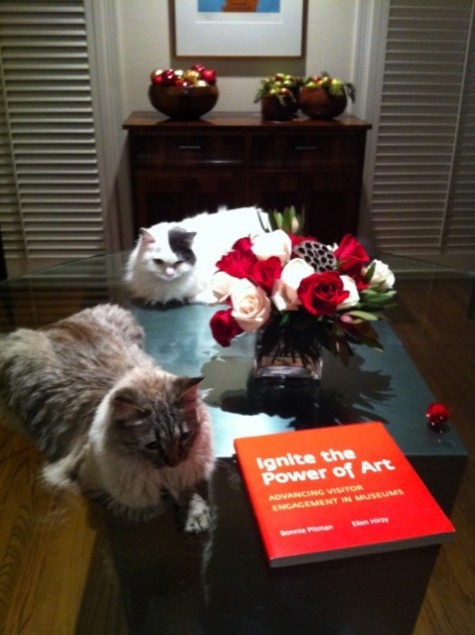
Ending on a light note, Bonnie kept us entertained throughout the editing and production process by sending digital pictures of her two cats, Leda and Perseus. Owing to the late hours she usually keeps, Bonnie was frequently hard at work on this book at one or two o’clock in the morning, seated at her glass work-table, with Leda and Perseus lying on—or playing with—stacks of galleys, photo contact sheets, charts, layouts, and reports—all of which offered the cats an ideal playground. I still have the early photographs showing them stretched out on a hoard of papers and folders. The later pictures depict their puzzlement as the glass tabletop finally resurfaced and the papers receded. And there’s a final shot of the cats sitting wistful, but perhaps also slightly triumphant, on a table cleared of everything but a vase of flowers and a single copy of the printed book. I’m sure Leda and Perseus look forward to a sequel.

Eric Zeidler is Publications Coordinator at the Dallas Museum of Art.

Seldom Scene: Presidents at the DMA

In honor of Presidents’ Day we wanted to share a few images of U.S. Presidents that are in our collection.

George Washington, Rembrandt Peale, c. 1850

George Washington, Jean-Antoine Houdon, c. 1786

Lincoln, Boardman Robinson, 1937

The Washington Family, Edward Savage, c. 1780

Insomniac Tours: A History

Roslyn Walker, DMA curator, leading a Late Night tour.

Have you ever wondered what happens in the Dallas Museum of Art after the sun goes down? Do the paintings look different at night? Does the Museum have a different feel to it? Well, there’s one way to find out.

Late Nights at the Museum feature a variety of programs and activities, including the Insomniac Tour. The Insomniac Tours started informally in 2004, thanks to our Director, Bonnie Pitman, and her night-owl disposition. When the DMA turned 100 we stayed open for 31 hours, and Bonnie led tours into the wee hours of the morning for anyone who wanted a more personalized Museum tour. With the launch of Late Nights, the tours continued, and their name was coined.

Bonnie is not the only one who gives the Insomniac Tour, although she tries to attend as many Late Nights as possible. Other guest tour guides have included artists Krystal Read and Jim Lambie, DMA curators Heather MacDonald, Roslyn Walker, and Jeffrey Grove, and local art critics such as Christina Rees. When Director of Collections Management Gabriela Truly gives the tour, she talks about the art that’s not displayed, and where it is stored. These different speakers give visitors a chance to learn new things about the works of art through multiple perspectives.

The best part about Insomniac Tours is that no two tours are the same. The tour guide will take a poll every Late Night to see how many people have taken an Insomniac Tour before, and will ask for input on what members of the group want to see. If the group is full of newcomers, the tour guide will give a “best of” tour, highlighting some of the most unique parts of the DMA’s collections. Repeat visitors can get a tour of more obscure works, or focus on a certain exhibition or movement.

Since the DMA is such an expansive museum, it can be intimidating for visitors to know where to begin. Joining an Insomniac Tour allows visitors to receive a customized tour with some of the leading art experts. So check it out the next time you’re looking for something to do on a Friday night, and see how art can come alive after dark!

Join Olivier Meslay, Senior Curator of European and American Art and The Barbara Thomas Lemmon Curator of European Art, when he leads his first Insomniac Tour during the February Late Night.

Exit Through the (Stickley) Gift Shop

Take home a bit of Americana inspired by the age of Gustav Stickley in the exhibition store.   


Archives

Categories