Posts Tagged 'Dallas Museum of Art'


Friday Photos: Message Received

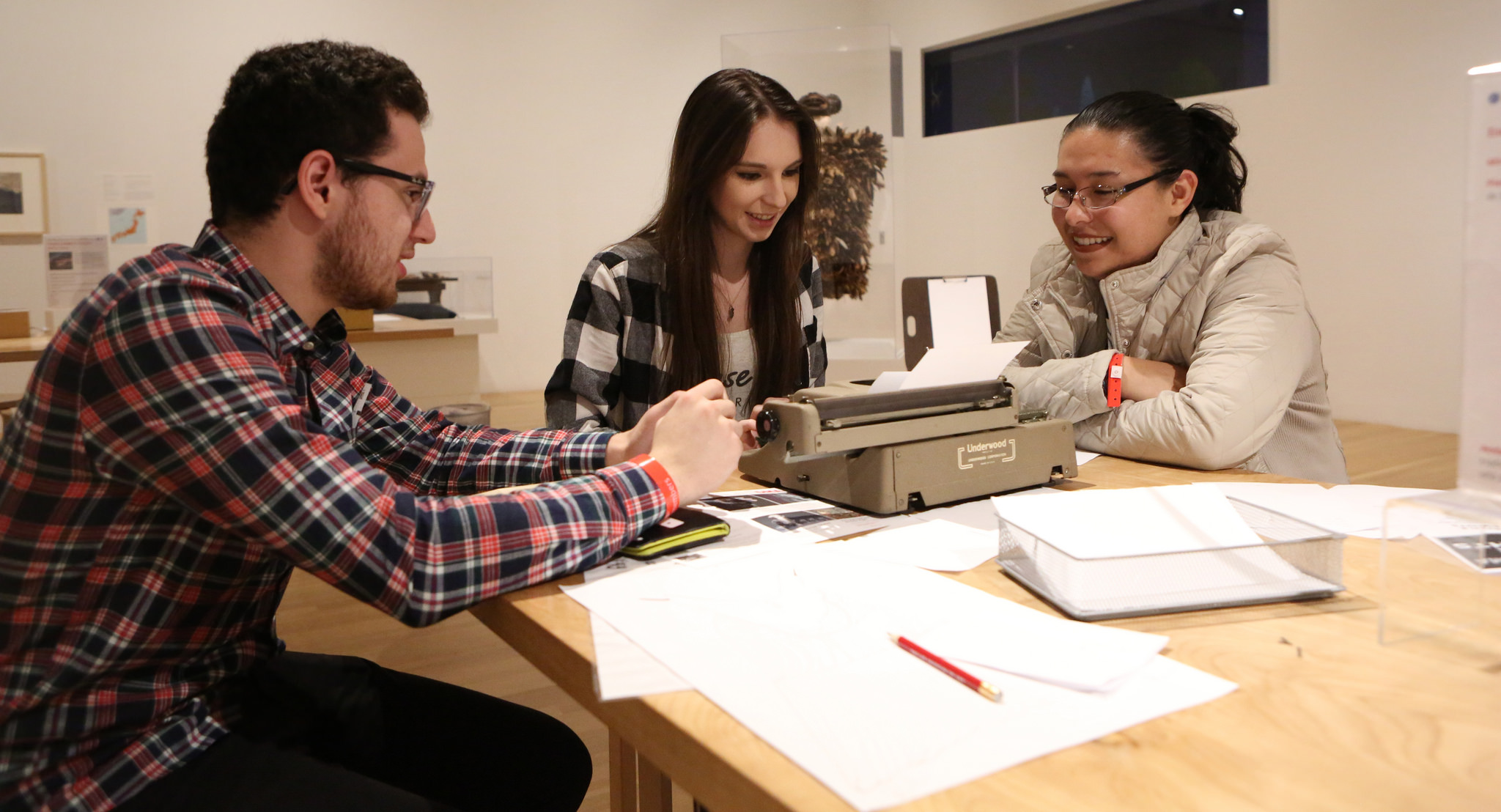
Earlier this fall, the Center for Creative Connections installed various communication devices that span several decades of the 20th century. By displaying these works of art together, we encourage visitors to consider the ways that communication has changed over the years and to notice the design ideas that have remained the same.

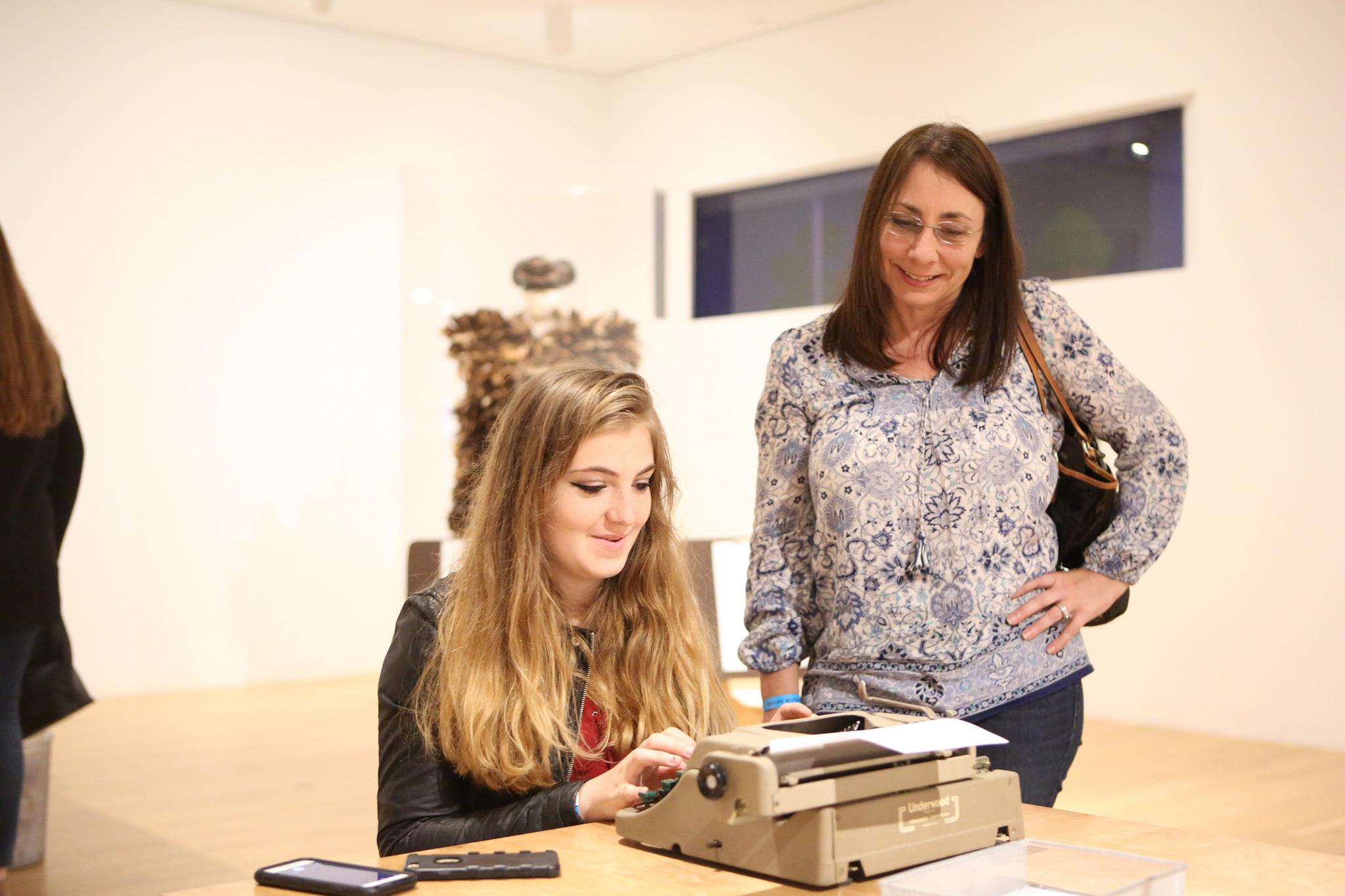
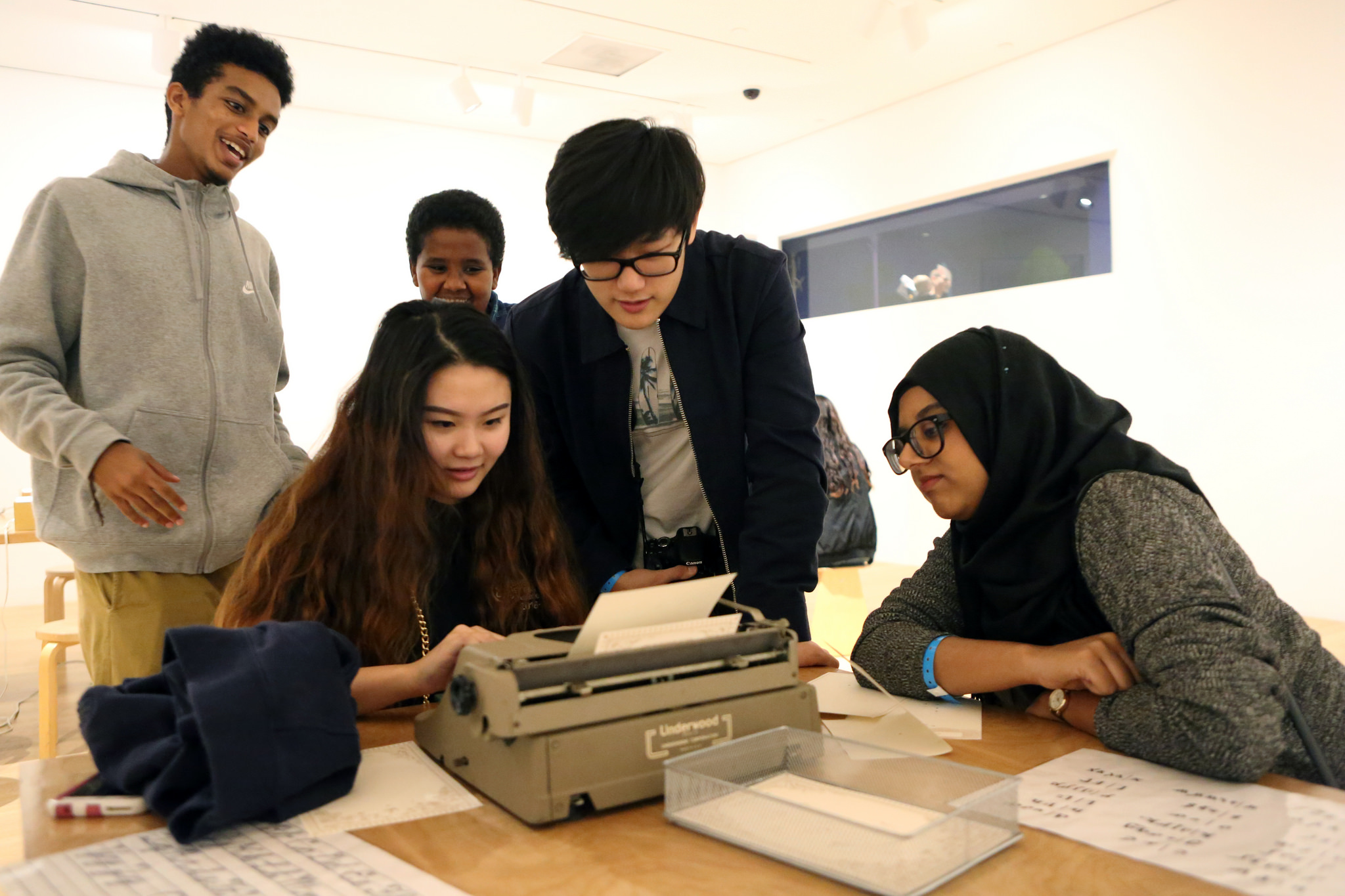
Recently, we added a writing activity at a nearby table so that visitors would have the opportunity to put down their smartphones and take a moment to hand-write or type a letter. Visitors of all ages have been especially taken by the typewriter. It’s been fun to see the look of joy come over faces of visitors who are sitting down to use a typewriter for the first time, or revisiting an old, familiar experience.

The typed responses we’ve received so far are often cryptic and intriguing like these:

Though my favorite response has been this hand-written jewel by a 9-year-old:

hand-written1-contrast

Stop by the Center for Creative Connections during your next visit to the DMA and take a moment to share your thoughts or write a letter to a friend.

Jessica Fuentes
Manager of Gallery Interpretation and the Center for Creative Connections

Prohibition Ends at Last! Bottoms Up!

“What America Needs Now is a Drink” – Franklin D. Roosevelt (supposedly)

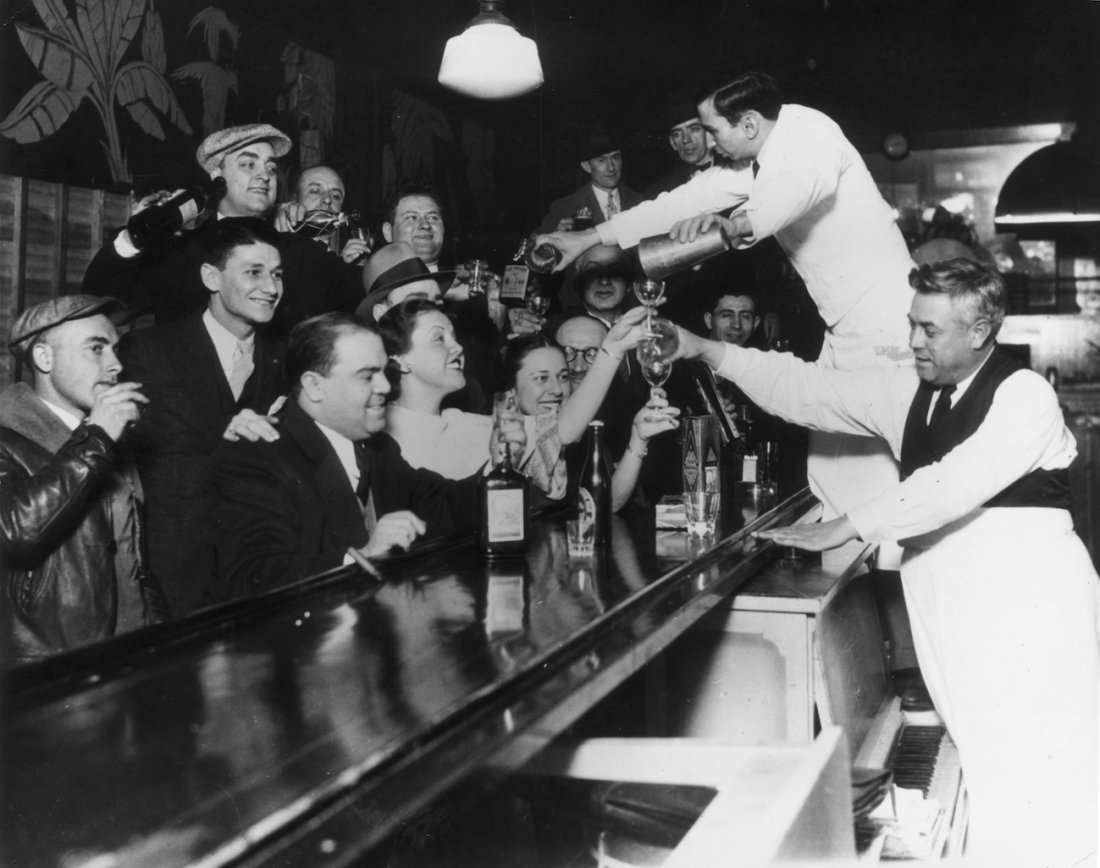
It only took 13 years for the 18th Amendment to be repealed. What was meant to halt drunken disorder, cure mental illness, and simultaneously put an end to crime in America only increased such debauchery. Speakeasies popped up at an unprecedented rate, and corruption ran rampant. It was a dark time for the United States, but there was light at the end of the tunnel. On December 5, 1933, Prohibition was overturned, and still stands as the only constitutional amendment to ever be revoked.

Sloppy Joe's Bar

Sloppy Joe’s in Chicago when the 18th Amendment had been repealed. [American Stock Archive/Getty Images]


Celebrate repeal day by sharing a drink with a loved one, friend, or stranger, and cheers to our constitutional right to enjoy alcohol responsibly. Then stop by the Museum for a special look at cocktail culture in Shaken, Stirred, Styled: The Art of the Cocktail.

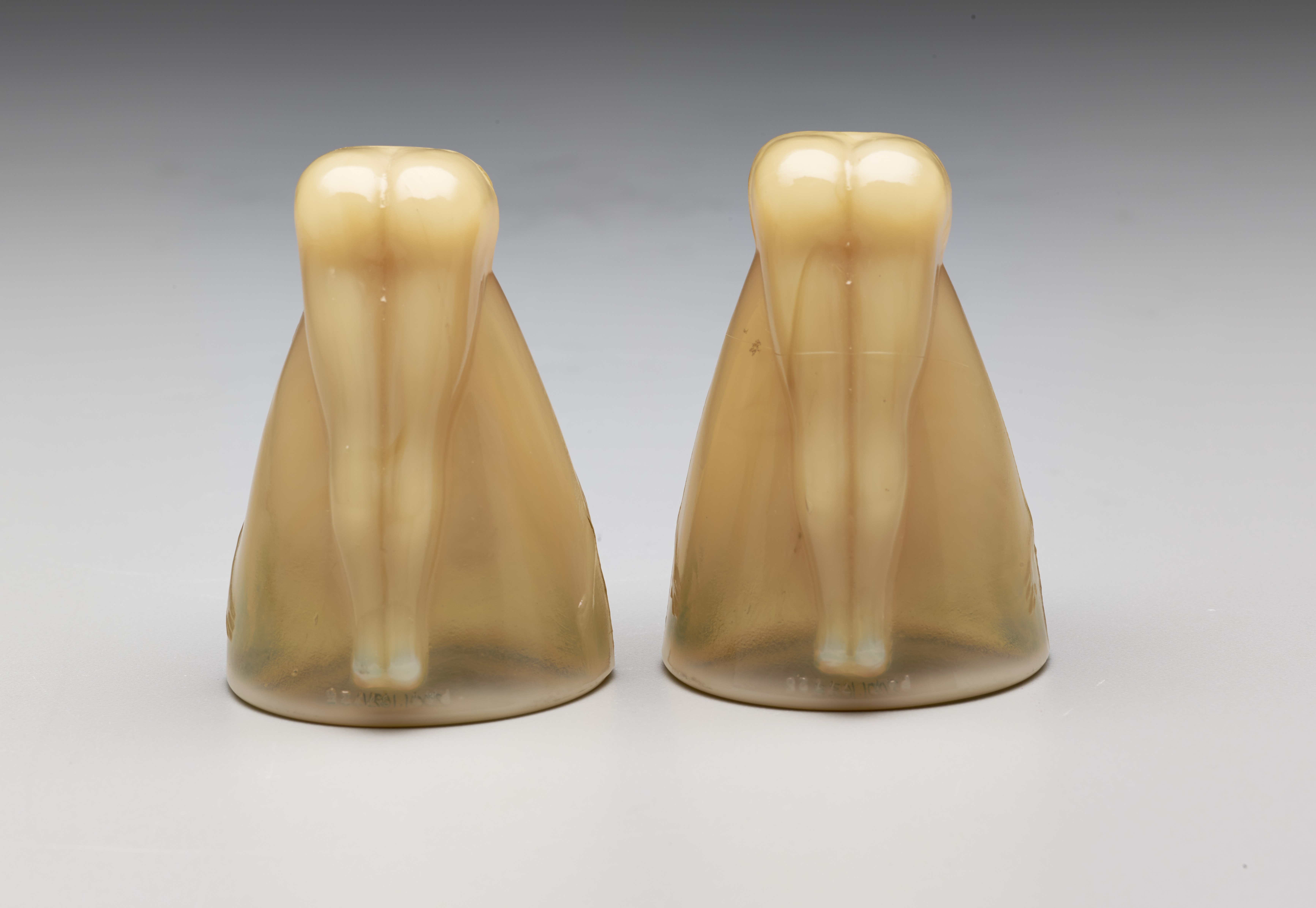
bottoms-up-cocktail-tumbler_2001-163-1

[Image: Bottoms Up cocktail tumbler, 1928, attributed to McKee Glass Company, pressed glass, Dallas Museum of Art, the Patsy Lacy Griffith Collection, bequest of Patsy Lacy Griffith, 2001.163.1–2]


In true rambunctious and Roaring Twenties fashion, the festivities don’t end there. Join us on February 4 when the Museum will turn into a Speakeasy that will rival the Cotton Club itself!

Julie Henley is the Communications and Marketing Coordinator at the DMA. 

A Wondrous Woven Magic

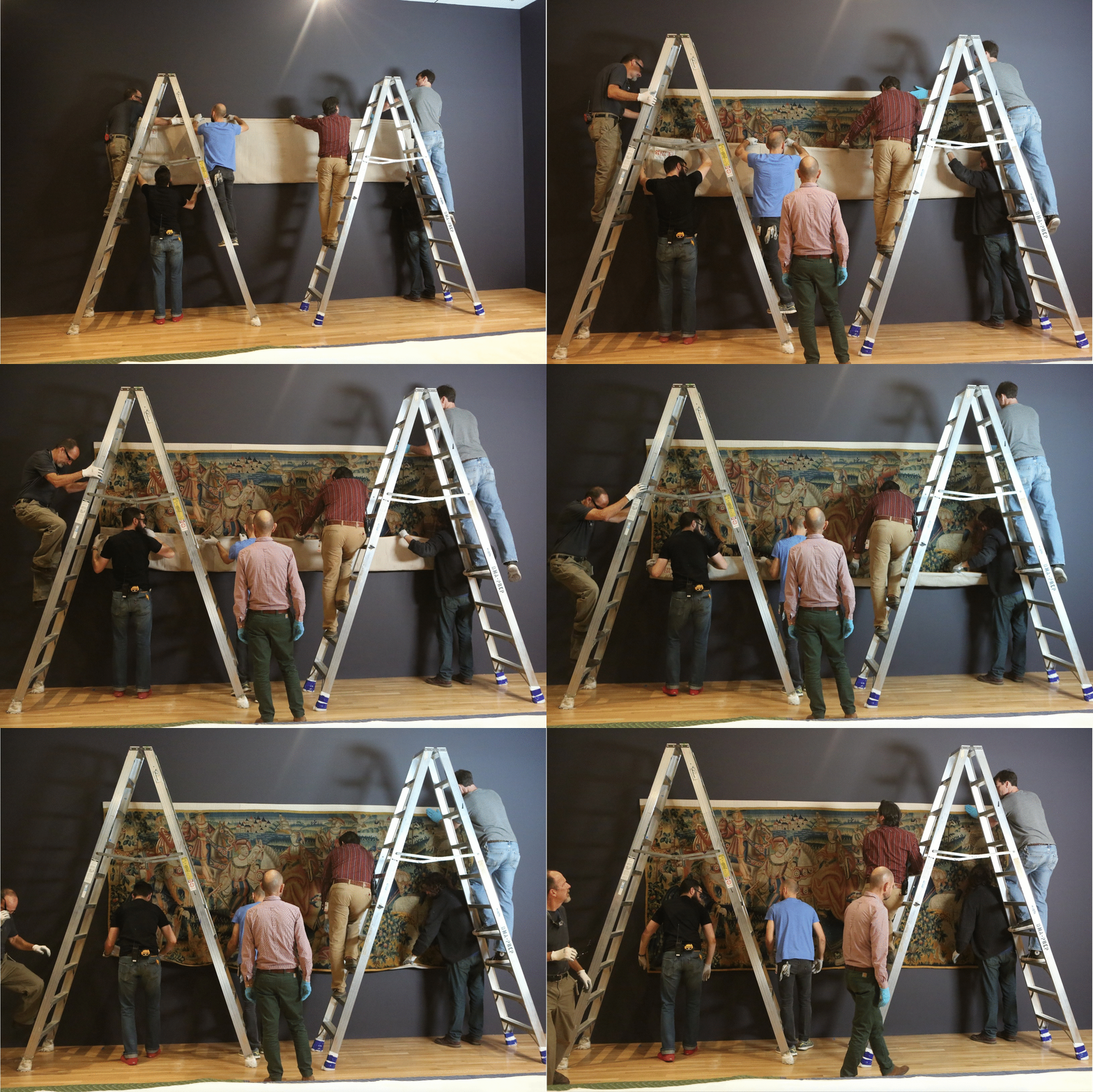
Earlier this week, the DMA exhibitions team wrapped up the installation for Art and Nature in the Middle Ages, which opens Sunday, December 4. Here, our team of skilled preparators carefully unfurl a tapestry from the Middle Ages, overseen by conservators and couriers who traveled with the art from the Musée de Cluny in Paris, France. This exhibition contains a variety of different types of objects: liturgical objects in precious metals, capitals and keystones from building structures, large woven tapestries, unbelievably detailed manuscripts including Books of Hours, and fifteen illuminated stained glass windows. It’s only on view in the US here at the DMA. We hope you’ll come see it, and us, soon.

artnnaturegif

Skye Malish-Olson is the Exhibition Designer at the DMA. 

Cyber Monday

Congratulations! You survived Black Friday 2016! But if you are like us, you might be spending this evening searching Cyber Monday deals to finish off your list.

Black Friday is the ultimate day to go shopping for all of the best deals, steals, and doorbusters, but it’s not for the faint-hearted. If you busted down the doors of all your favorite stores (or even if you didn’t), we would like you to enjoy 10% off a one-year DMA membership. This incredible Cyber Monday deal is only good until MIDNIGHT TONIGHT.

Experience 12 full months of exclusive DMA Member benefits, including:
Free parking in the Museum’s garage
Free admission to all special exhibitions
EXCLUSIVE exhibition Member Preview Days
And so much more!

Most importantly, no doors to bust down.
dma_cybermonday


Shaken AND Stirred

Whether you like your adult beverage shaken or stirred, we think you’ll enjoy this. A celebration of over 100 years of cocktail ware design, Shaken, Stirred, Styled: The Art of the Cocktail opens at the Dallas Museum of Art this Friday, November 18, during the DMA’s Late Night event. Organized chronologically and divided into sections that correspond to major shifts in the consumption of cocktails, the exhibition features nearly 60 works drawn primarily from the Museum’s collection. It explores the relationships between political, social, and economic currents, developments in technology, quotidian practices of consumption, and design styles. An interactive display prompts visitors to explore the history of spirits and cocktails alongside that of the vessels in which they were prepared and served. Below are a few highlights paired with historically accurate cocktails included in the exhibition’s interactive display. Cheers!

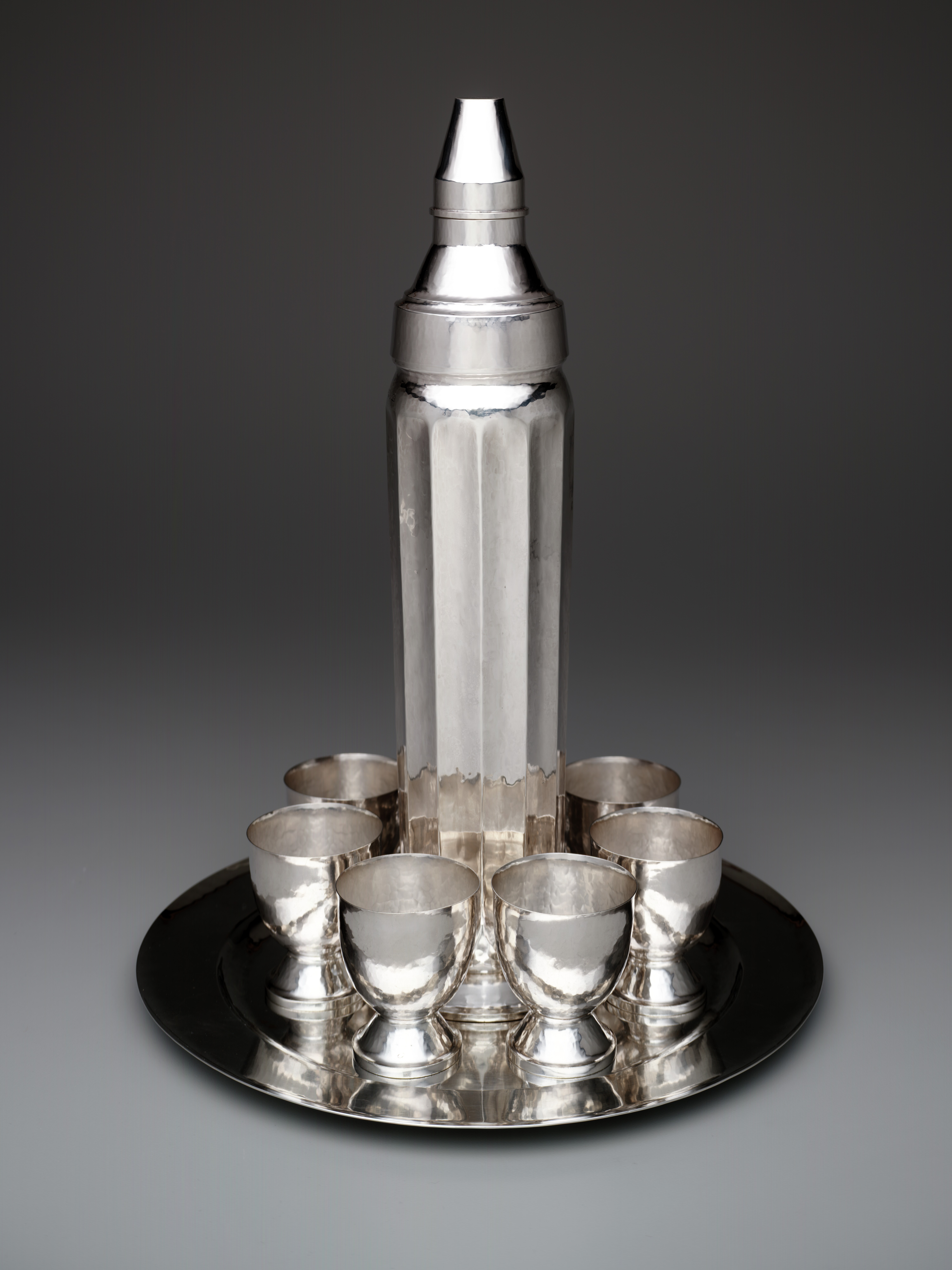
skyscraper-cocktail-shaker_2008-48-1-12

“Skyscraper” cocktail shaker, cups, and tray, William Waldo Dodge, designer, 1928–31, silver, Dallas Museum of Art, The Patsy Lacy Griffith Collection, gift of Patsy Lacy Griffith by exchange, 2008.48.1–12

It would not be surprising if this monumental skyscraper-inspired cocktail shaker once held the ingredients of the Sidecar, one of the most popular cocktails during Prohibition.

The origin of the Sidecar—a shaken mixture of cognac, orange liqueur, and lemon juice, served in a sugar-rimmed cocktail glass—is debated, but commonly believed to be Paris or London at the conclusion of World War I (1914–18). Whatever its origin, the Sidecar quickly crossed the Atlantic and conquered the speakeasies in the newly “dry” United States.

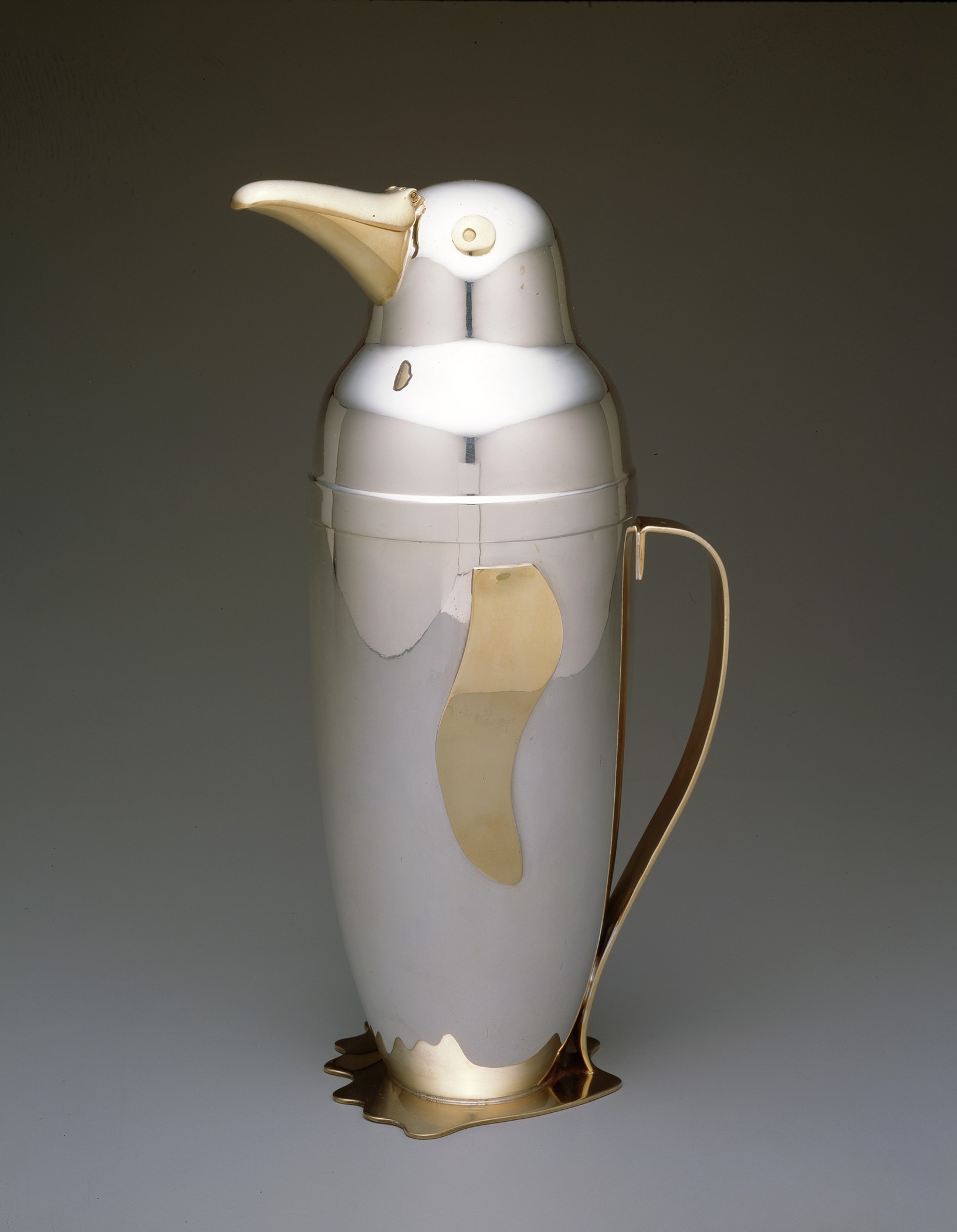
penguin-cocktail-shaker_2002-29-8-a-b

Penguin cocktail shaker, Emile A. Schuelke, designer, Napier Company, manufacturer, Meriden, Connecticut, 1936, gilded silverplate, Dallas Museum of Art, The Jewel Stern American Silver Collection, gift of Jewel Stern, 2002.29.8.a–b

The owner of this gold-accented, silver-plated Penguin cocktail shaker, touted by its manufacturer as the “master of ceremonies at successful parties,” may have utilized it to shake Daiquiris, which peaked in popularity in the 1930s.

Despite possible antecedents native to Cuba, the Daiquiri as it is known today—a shaken mixture of white rum, lime juice, and simple syrup—was first recorded by American mining engineer Jennings Cox in 1902. The Daiquiri shares its moniker with the Taíno (indigenous peoples of the Caribbean) name for a beach near Santiago de Cuba.

circa-70-pitcher_2002-29-68-a-b

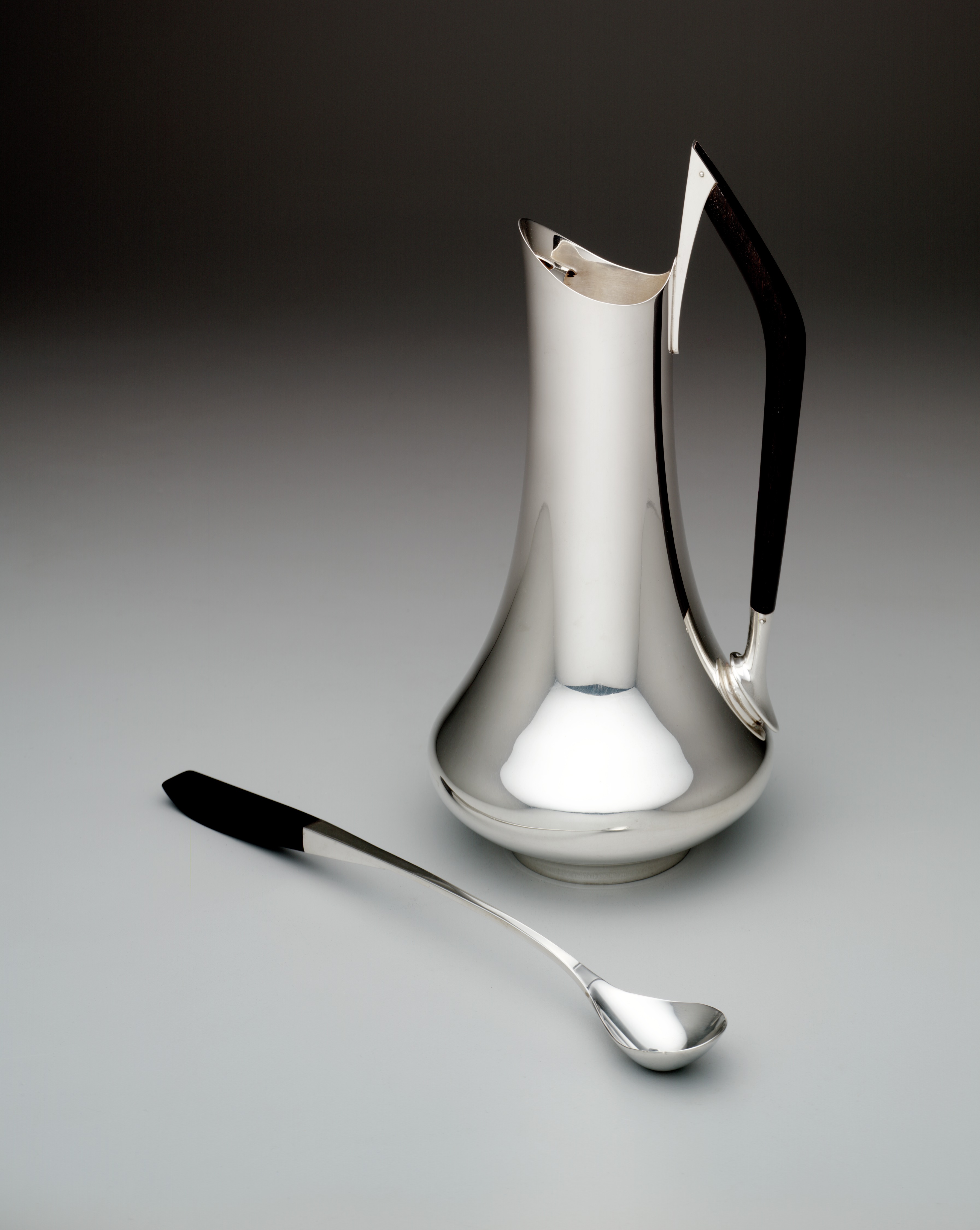
Circa ’70 pitcher-mixer with mixer spoon, Gorham Manufacturing Company, Providence, Rhode Island, designed 1960, silver and ebony, Dallas Museum of Art, The Jewel Stern American Silver Collection, Decorative Arts Fund, 2002.29.68.a–b)

This futuristic Circa ’70 beverage mixer was likely used to stir dry gin Martinis in the 1960s.

Like the Manhattan, the Martini is a spirit-based and vermouth and bitters-laced cocktail that originated in the 19th century. It appeared in print in Jerry Thomas’s How to Mix Drinks, published in 1862. While 19th-century recipes recommend sweet vermouth, by the 1950s dry vermouth was mixed with dry gin and orange bitters and then poured into a classic cocktail glass.

Samantha Robinson is the Interim Assistant Curator of Decorative Arts and Design at the DMA.


Building Blocks

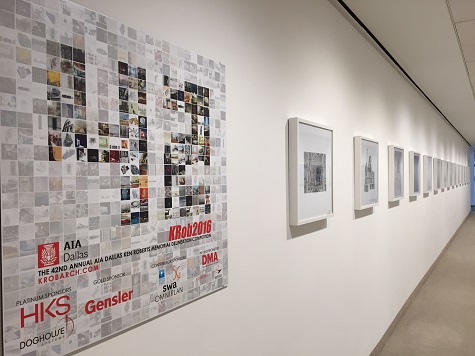
The DMA’s M2 hallway is hosting work by the winners and finalists of the 2016 Ken Roberts Memorial Delineation Competition, which celebrates the best in architectural delineation by professionals and students throughout the world. Averaging more than 400 entries from 25 countries in recent years, KRob is currently the most senior architectural drawing competition anywhere in the world.

Julien Meyrat, a senior designer at Dallas-based architecture firm Gensler, shared some insight into the history of this four-decades-old competition. Be sure to visit the work, on view through December 5 and included in free general admission, on your next visit to the DMA.

img_4272
What is the Ken Roberts Delineation Competition?
The AIA Dallas Ken Roberts Memorial Delineation Competition (or “KRob” for short) is an annual event that recognizes excellence in how architecture is visualized through drawing. Organized by the Dallas chapter of the American Institute of Architects, students and professionals from around the world are invited to submit drawings and renderings done either by hand or by digital means. Most entries are received by the competition’s official website, but people are also encouraged to deliver their submission to the AIA Dallas office. A three-person jury selected by the committee evaluates the entries for technical and expressive qualities and not for the merit of the architectural designs they illustrate. Winners are chosen for various categories: Hand Drawing, Digital/Mixed Media, Travel Sketch, Physical Submissions, and 3D Printing.

How did it get started?
Dallas architect Jack Craycroft noticed an abundance of quality perspective drawings produced by young designers who worked alongside him in the early 1970s. When he was installed as president of AIA Dallas in 1974, he decided to create a competition for Dallas-area architects to showcase their delineations that would have otherwise been given to clients or hidden in flat-file storage cabinets. He enlisted his young up-and-coming colleague Ken Roberts to lead the new committee to organize the event. It was a major success, though Roberts tragically passed away several months later. AIA Dallas resolved to make the new delineation competition an annual event, and renamed it after its first committee chair.

What has changed about the competition over the years?
Going on its 42nd year, the Ken Roberts Memorial Delineation Competition is the longest-running architectural drawing competition anywhere. Thanks to Dallas’s supportive community of architects and faculty from the University of Texas at Arlington, the competition has served as a window into how we continue to find new ways of depicting buildings and environments. One can study how hand drawing was enhanced with a variety of physical media, how the computer enabled exponentially new avenues for visual communication, and how films and video games continue to influence the way individuals tell stories in their delineations. Eight years ago, KRob opened itself to the world, allowing individuals from over 25 countries to participate. Recently the competition added a new category for 3D-printed models, since this new media continues the critical tradition of using drawing as part of the dynamic design process. The annual exhibition that features the winning finalists is intended to convey the tremendous breadth in visual and graphic talent inherent in the art of architectural drawing.

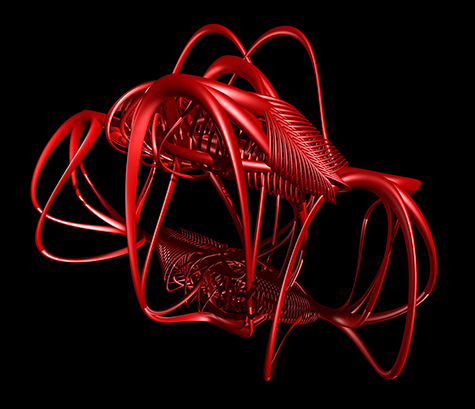
Thomas Rusher, registered architect , Rusher Studio LLC, 3D Print, 2016

Thomas Rusher, registered architect, Rusher Studio LLC, 3D print, 2016.

Julien Meyrat, AIA, is a senior designer at Gensler. He is also a former chair of the AIA Dallas Ken Roberts Committee.

Headed to the Polls

Always vote for principle, though you may vote alone, and you may cherish the sweetest reflection that your vote is never lost. —John Quincy Adams

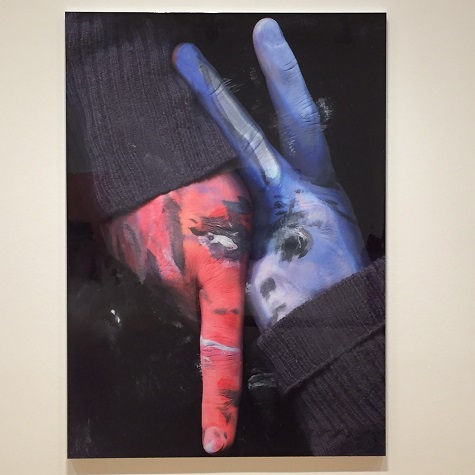
img_4244 fullsizerender


[Images: Lucie Stahl’s Mascot Face-Off (2016) and Defeat (2016) on view in Concentrations 60: Lucie Stahl. Both works © Lucie Stahl.]

The Sum of All Parts

The DMA’s conservation team works on a variety of projects throughout the year. DMA Associate Conservator Laura Hartman shared insights on one fascinating project in the Fall issue of the DMA Member magazine, Artifacts.

Flowers in a Vase with Two Doves (detail), François Lepage, 1816–20, oli on canvas, Dallas Museum of Art, Munger Fund, 2016.23.M

François Lepage, Flowers in a Vase with Two Doves (detail), 1816–20, oil on canvas, Dallas Museum of Art, Munger Fund, 2016.23.M

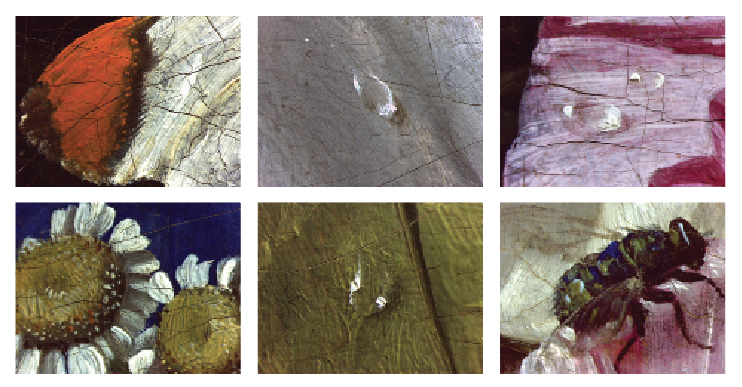
In 1925, Dallas philanthropist Gertrude (Trudie) Terrell Munger endowed a fund for acquisitions to the Museum’s permanent collection. For over ninety years, the Munger Fund has been instrumental in the purchase of some of the DMA’s greatest treasures across its encyclopedic collection. These include Claude Monet’s The Seine at Lavacourt, Camille Pissarro’s Apple Picking at Eragny-sure-Epte, and the important old-master painting Basket of Flowers by Osias Beert the Elder. This spring, the Munger Fund acquired another world-class work: Flowers in a Vase with Two Doves, a beautifully preserved 19th-century painting by the Lyonnais artist François Lepage. The DMA’s conservation team examined it under the microscope to study the artist’s technique a bit closer.

Exquisite in its highly polished finish and attention to detail, Flowers in a Vase with Two Doves is meticulously painted and beautifully preserved, making its examination both enjoyable and an important opportunity to see a work of art as intended by the artist. Lepage has been described as a methodical and slow painter, and it has been suggested that it took him four years to complete this work. At first glance, the surface appears smooth and highly refined, but when observed under magnification each meticulous brushstroke becomes evident, revealing a surprisingly free and painterly technique.

Droplets of water, for example, are expertly applied to petals and leaves to create a convincing optical effect. These droplets, when observed under magnification, reveal a somewhat abbreviated painting approach.

Lepage also used his brush to quite literally add texture, heightening the illusion of tactile effects. Tiny details reveal the use of linear and directive brushstrokes in dialogue with such small highlights as the textured dots found along the butterfly’s wing and at the center of the chamomile flowers.

Microscopic examination of works of art often reveals important and interesting perspectives not immediately visible to the naked eye. This type of study allows conservators to better care for each work of art, giving a fundamental look into an artist’s working techniques.

—Laura Hartman is the Associate Conservator at the DMA.


Pumpkin Perfect

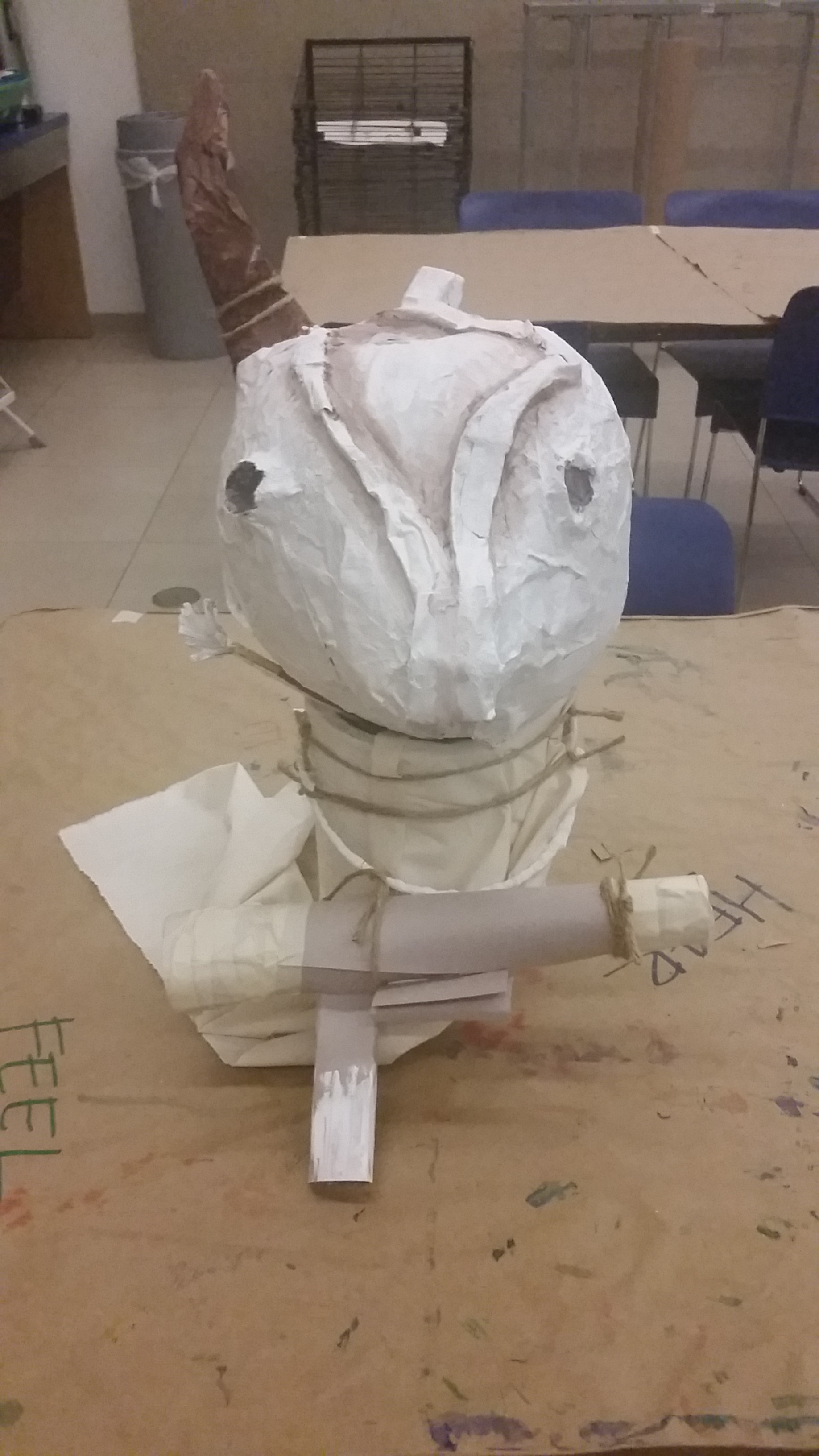
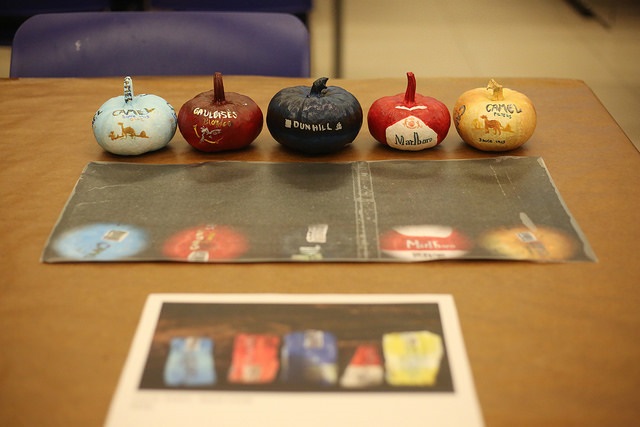
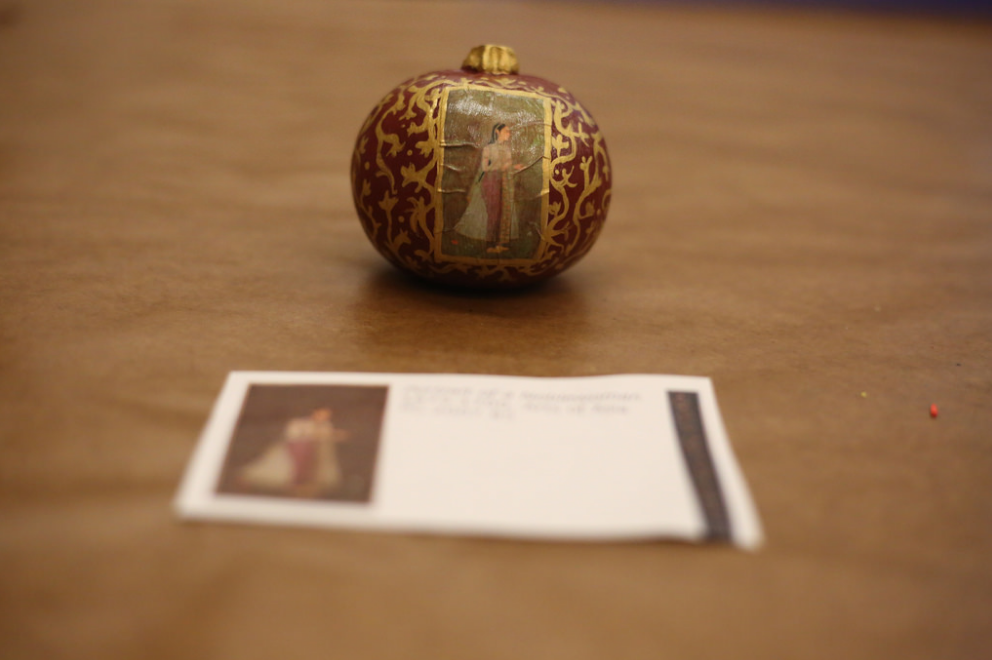
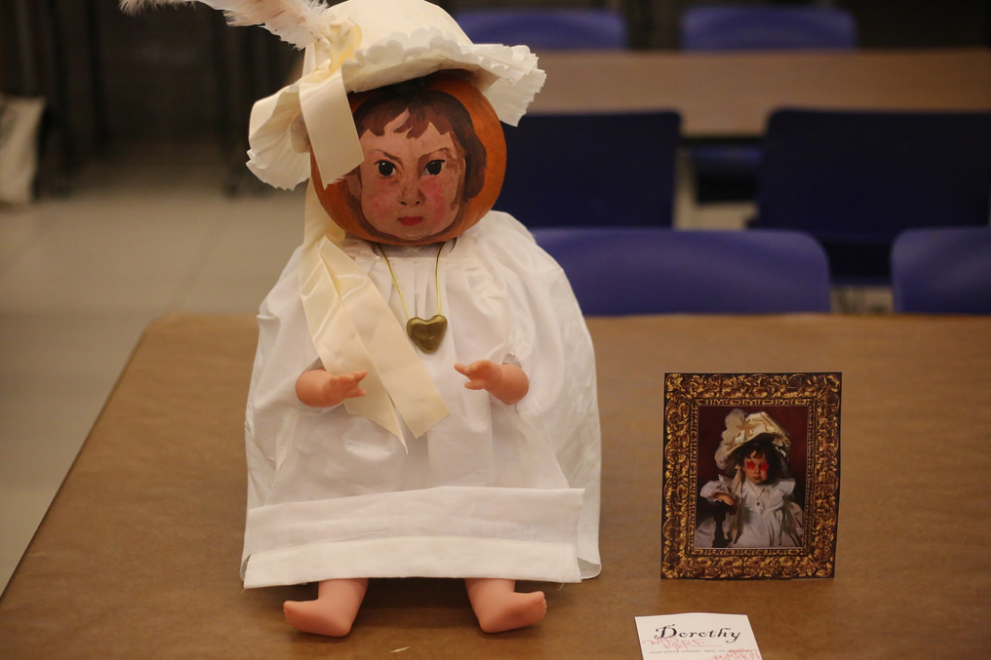
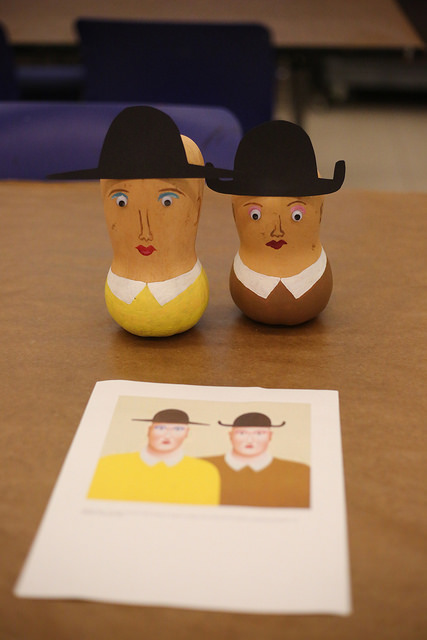
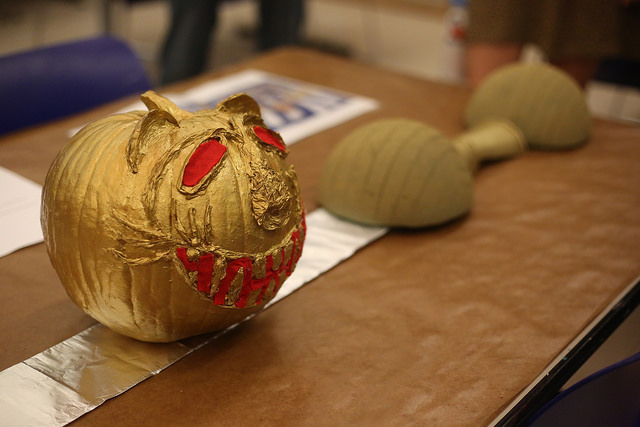
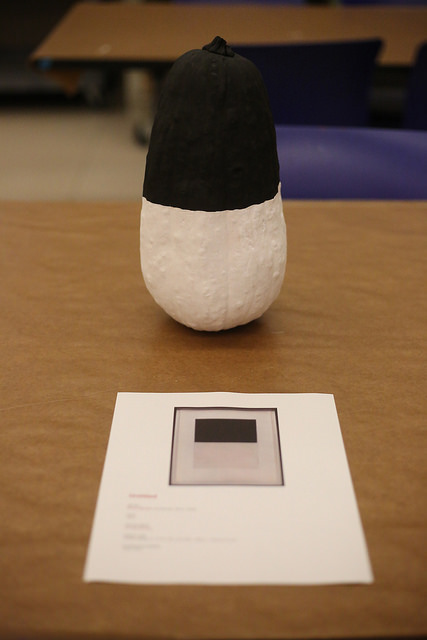
Our Education Department is always up for a creative challenge, so we celebrated today’s holiday by dressing up our pumpkins in their DMA finest for our annual Great Pumpkin Contest. Competition was fierce, but the winning, Linus-approved trophy was awarded to Emily and Jennifer, for their take on everyone’s favorite, somewhat creepy, DMA toddler, Dorothy. Check out all the terrific submissions below. Happy Halloween!

Sarah Coffey is the Education Coordinator at the DMA.

A Fête to Remember

Tomorrow evening the DMA will kick off an Annual Fête celebrating 18th-century French masterpieces from the Michael L. Rosenberg Collection and the release of a new publication, French Art of the Eighteenth Century: The Michael L. Rosenberg Lecture Series at the Dallas Museum of Art. Join us for performances, talks, art making, and a tres magnifique menu.

Before we step back in time and party like it’s 1799, I asked each of the past and present curators of the Rosenberg Collection to share a favorite work of art or a fond memory of working with this group of objects. Catch up with them at the Annual Fête, where they will be available to answer questions about your favorite Rosenberg artworks.

Nicky Myers, The Lillian and James H. Clark Curator of European Painting and Sculpture, DMA

“It is truly a privilege to be able to display and study such an important collection of 18th-century French artwork. Beyond its art historical significance, beyond its extraordinary quality and condition, the Rosenberg Collection is simply stunning. Lush colors, sumptuous costumes, and elegant figures welcome you to the Michael L. Rosenberg Galleries of 18th-Century Art, some of my favorite rooms in the Museum. When we enter these spaces, we are instantly transported back in time to a rare moment when the decorative and fine arts shared the same aesthetic, and when patrons and artists shared similar sensibilities. It is hard for me to choose a favorite work within the Rosenberg Collection, but I’m particularly drawn to the Greuze, Boilly, and Largillière paintings.”
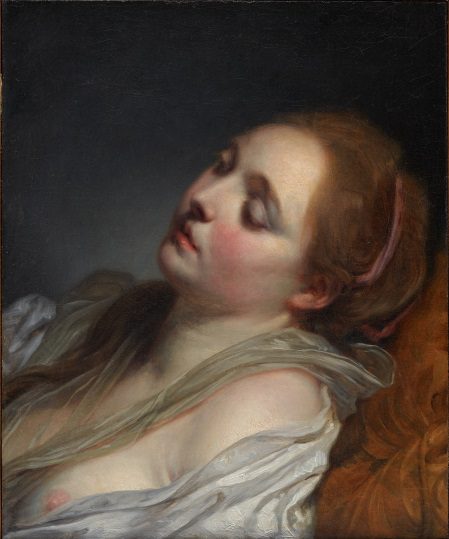
Jean-Baptiste Greuze, The Dreamer, 1765–1769, 29.2004.10, Lent by the Michael L. Rosenberg Foundation

Jean-Baptiste Greuze, The Dreamer, 1765–69, oil on canvas, lent by the Michael L. Rosenberg Foundation, 29.2004.10

Heather MacDonald, Program Officer, Getty Foundation

“What I enjoyed most about working with the Michael L. Rosenberg Collection and its annual lecture series was the opportunity to invite amazing scholars, whose work I’ve admired for years, to come to Dallas and share their research. They’re like historical detectives, piecing together bits of evidence gathered over a lifetime of research and close looking.

I don’t like to choose favorites among works of art in the galleries, but I will confess to an adoration of François-André Vincent’s portrait of the playwright Desforges. It’s such a modern, informal portrait: Desforges is shown in his (beautifully painted) shirtsleeves, with a five-o’clock shadow, looking off in the distance as if caught in a moment of creative inspiration. Vincent painted Desforges on the cusp of the Revolution, which offered new kinds of individual freedoms to French citizens, but this portrait also says so much about how the modern individual had been reimagined by the Enlightenment. There is a whole story about the 18th century contained in this image!”
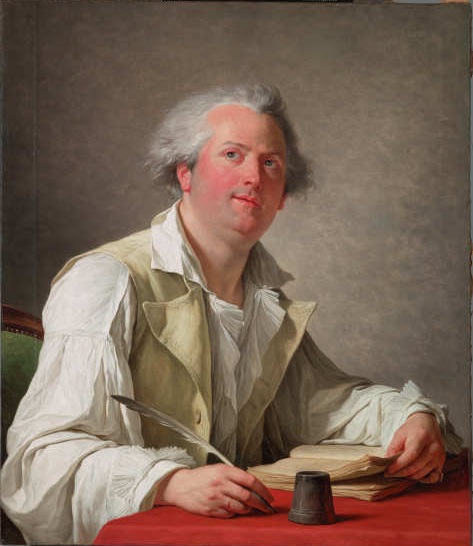
François André Vincent, Portrait of Pierre-Jean-Baptiste Choudard (called Desforges), 1789, 29.2004.1, Lent by the Michael L. Rosenberg Foundation

François André Vincent, Portrait of Pierre-Jean-Baptiste Choudard (called Desforges), 1789, oil on canvas, lent by the Michael L. Rosenberg Foundation, 29.2004.1

Eik Kahng, Assistant Director and Chief Curator, Santa Barbara Museum of Art

“What I remember most fondly about Michael was his sincere love for the works of art that he collected. Before it came to the DMA, the collection was installed at Michael’s house. He very kindly allowed for private tours from time to time, which everyone greatly enjoyed. Michael would routinely ask me to lead the tours, starting in the living room, where the great Lemoyne Bather and the wonderful Oudry animal painting of a water spaniel confronting a heron were on view. However, about five minutes into my talk, Michael would invariably interrupt and start adding his own, detailed commentary. He was so passionate about each and every object and could speak eloquently and informatively about each one. I always teased him that he didn’t need me to be there at all, since he was more than capable of providing his own overview of the collection. It’s always such a pleasure to listen to collectors who really love their art.”

Jean–Baptiste Oudry, Water Spaniel Confronting a Heron, 1722, 29.2004.8, Lent by the Michael L. Rosenberg Foundation

Jean–Baptiste Oudry, Water Spaniel Confronting a Heron, 1722, oil on canvas, lent by the Michael L. Rosenberg Foundation, 29.2004.8


Jessie Frazier is the Manager of Adult Programming at the Dallas Museum of Art.

Archives

Categories